

The myth that “making more pushes you into a higher tax bracket so you lose money” is mathematically wrong. Dangerous, even. For physicians at $250k, $500k, and $1M+, the data shows the real problem is not the top bracket percentage. It is the layered stack of federal, state, payroll, NIIT, and phaseouts that quietly erode your marginal dollar.
Let me walk through what actually happens to your money at those incomes, using real numbers, not cocktail-party folklore.
All examples use 2024 U.S. tax law as baseline, filing status married filing jointly (MFJ) unless otherwise stated. If you are single, the structure is identical but the thresholds are lower; the logic is the same.
1. The Marginal Tax Bracket Myth: What Really Gets Taxed
Start with the basic structure. Federal income tax is marginal and progressive. That means:
- Each slice of income is taxed at the rate of its bracket.
- Moving into a higher bracket does not retroactively raise tax on your earlier dollars.
For MFJ in 2024, here are the core ordinary income brackets:
| Bracket Rate | Taxable Income Range |
|---|---|
| 10% | $0 – $22,000 |
| 12% | $22,001 – $89,450 |
| 22% | $89,451 – $190,750 |
| 24% | $190,751 – $364,200 |
| 32% | $364,201 – $462,500 |
| 35% | $462,501 – $693,750 |
| 37% | $693,751 and above |
Those are taxable income brackets. You hit those only after:
- Pre‑tax retirement contributions (401(k), 403(b), 457(b), etc.)
- Health premiums (if pre‑tax), HSA contributions
- Standard deduction or itemized deductions
In 2024, standard deduction for MFJ is $29,200.
Physicians often confuse “I am in the 35% bracket” with “I pay 35% of my income in tax.” That is false. Your effective tax rate (total tax ÷ gross income) is several points lower.
The real danger zone for physicians is not the posted marginal bracket. It is the effective marginal rate that results once you layer:
- Federal bracket
- Payroll taxes (Social Security + Medicare + Additional Medicare)
- Net Investment Income Tax (NIIT) at higher AGI
- State income tax
- Phaseout-of-benefits cliffs (e.g., certain credits, deductions, or ACA for non‑physicians)
That effective marginal rate is what actually hits your next dollar of income.
2. Anatomy of a Physician Tax Stack
Before we jump to $250k, $500k, and $1M, you need the building blocks.
Federal income tax – ordinary income
This is what you usually think of as “the bracket.” For a W‑2 physician, this hits:
- Salary and bonus
- Moonlighting income (unless run through an S‑corp and partly taken as distributions)
- Most side‑gig income
Long‑term capital gains and qualified dividends sit in a separate 0% / 15% / 20% structure. We will focus on ordinary income, because that is what your clinical work generates.
Payroll taxes
On W‑2 compensation:
- Social Security: 6.2% employee share on wages up to the wage base ($168,600 in 2024). Above that — 0% employee Social Security.
- Medicare: 1.45% employee share on all wages, no cap.
- Additional Medicare tax: 0.9% on wages above $250,000 MFJ / $200,000 single (employee side only).
So for a high‑income physician:
- On your first $168,600 of W‑2 income: 6.2% + 1.45% = 7.65% payroll
- On income from $168,600 up to $250,000 (MFJ): 1.45% only
- Above $250,000 (MFJ): 1.45% + 0.9% = 2.35% payroll
On self‑employment (1099) income, the self‑employment tax (12.4% + 2.9% = 15.3% up to the wage base, then 2.9% above) applies, but half is deductible. The effective marginal rate is similar but not identical. Most employed physicians are W‑2, so I will anchor there.
Net Investment Income Tax (NIIT)
Once modified AGI exceeds:
- $250,000 (MFJ)
- $200,000 (single)
the 3.8% NIIT kicks in on the lesser of:
- Net investment income (interest, dividends, taxable capital gains, passive rental, etc.)
- Excess of MAGI over the threshold
For a physician couple with significant brokerage assets, this 3.8% on investment income is effectively part of the marginal stack once you cross $250k AGI.
State income tax
Large variation here. Let us compare three simple regimes:
- 0%: Texas, Florida, etc.
- ~5% flat/average: Rough proxy for states like CO, NC, etc.
- ~10% top marginal: California, New York City combined can get there.
The real marginal rate for an additional $1 of W‑2 income can easily reach:
- High‑tax state: 37% (federal) + 2.35% (Medicare + Additional) + 10% (state) ≈ 49.4%
- Plus 3.8% NIIT if that incremental income shows up as investment income instead of wages.
Half your marginal dollar gone. That is the actual story.
Now let us walk through the three income tiers.
3. Physicians at $250,000: The NIIT Trigger and the Illusion of Safety
At $250,000 household income, a lot of physicians think they are still “middle class professionals,” especially in HCOL markets. The IRS does not share that opinion. This is where many stealth taxes turn on.
Assume:
- Married physicians, one high‑earning W‑2 spouse
- Gross W‑2 income: $250,000
- Max 401(k) deferral: $23,000 (employee, under 50)
- Pre‑tax health/FSA/HSA etc.: assume $5,000
- State tax: 5% effective
Step 1: Adjusted Gross Income (AGI)
$250,000 − $23,000 − $5,000 = $222,000 AGI
Note: For W‑2, there is no SE tax adjustment here.
Step 2: Taxable income (after standard deduction)
Taxable income = $222,000 − $29,200 = $192,800
Where is that in the bracket table? It lands just into the 24% bracket:
- 10% on first $22,000 → $2,200
- 12% on $67,450 ($22,001–$89,450) → $8,094
- 22% on $101,300 ($89,451–$190,750) → $22,286
- 24% on $2,050 ($190,751–$192,800) → $492
Total federal income tax ≈ $33,072
Effective federal rate ≈ $33,072 ÷ $250,000 ≈ 13.2%
Now add employee payroll tax:
- Social Security: 6.2% of $168,600 ≈ $10,453
- Medicare: 1.45% of $250,000 = $3,625
- Additional Medicare: 0.9% only on wages above $250,000, so at exactly $250k MFJ, this is $0 (practically, the employer starts withholding at $200k, but netted out on your return).
Total employee payroll ≈ $14,078
Add state income tax (5% of $250,000) ≈ $12,500
Total major taxes:
- Federal income: ~$33,072
- Payroll: ~$14,078
- State: ~$12,500
Combined ≈ $59,650, or about 23.9% of gross
Effective tax rate under 25%. Not catastrophic. But the marginal rate story is different.
Marginal dollar at $250k
Take the next $1,000 of W‑2 income (still MFJ, standard deduction unchanged):
- That $1,000 shows up entirely in the 24% federal bracket.
- Payroll: Above the Social Security wage base (assume you already crossed $168,600), so just 1.45% Medicare. But once you step above $250k, Additional 0.9% kicks in.
At $251,000, that last $1,000 gets hit by:
- Federal income: 24%
- Medicare: 1.45%
- Additional Medicare: 0.9% (technically from $250,001 onward)
- State: 5%
Effective marginal ≈ 24 + 1.45 + 0.9 + 5 = 31.35%
If this household also has investment income, crossing $250k MAGI triggers NIIT:
Suppose they have $20,000 in net investment income (dividends + capital gains) and AGI moves from $249k to $251k. The excess over the $250k NIIT threshold is now $1k, so NIIT applies on the lesser of:
- Excess AGI above $250k (now $1k)
- $20k investment income
NIIT = 3.8% of $1,000 = $38 incremental.
So that single extra $1,000 of W‑2 income can face:
- 24% federal
- 1.45% + 0.9% payroll
- 5% state
- 3.8% NIIT on a slice of investment income, in effect
Marginal stack ≈ 35.15% on that $1,000, even though the family’s average federal bracket looks modest.
Key point at $250k: This is the NIIT threshold and the start of Additional Medicare. The posted bracket (24%) massively understates the true marginal cost of more income for capital‑owning physicians.
4. Physicians at $500,000: Climbing into 35% and Compound Friction
At $500,000 household W‑2 income, you are solidly in the 35% bracket. This is where many attendings end up after a few years with productivity bonuses, call pay, and maybe a bit of leadership stipend.
Assume:
- Married, one high‑earning W‑2 physician
- Gross W‑2 income: $500,000
- 401(k) contribution: $23,000
- Pre‑tax benefits: $5,000
- State: compare 0% vs 10% for impact
Step 1: AGI
AGI = $500,000 − $23,000 − $5,000 = $472,000
Step 2: Taxable income
Taxable = $472,000 − $29,200 = $442,800
Now map that into brackets:
- 10% on first $22,000 → $2,200
- 12% on $67,450 → $8,094
- 22% on $101,300 → $22,286
- 24% on $173,450 ($190,751–$364,200) → $41,628
- 32% on $98,300 ($364,201–$462,500 but we stop at $442,800, which is $78,599 above 364,201; I will use the exact number)
Let’s be precise:
$442,800 − $364,200 = $78,600 taxed at 32% → $25,152
Total federal income tax ≈
$2,200 + $8,094 + $22,286 + $41,628 + $25,152 = $99,360
Effective federal rate ≈ $99,360 ÷ $500,000 = 19.9%
Now payroll:
- Social Security: capped at $168,600 → 6.2% * $168,600 ≈ $10,453
- Medicare: 1.45% of $500,000 = $7,250
- Additional Medicare: 0.9% of ($500,000 − $250,000) = 0.9% of $250,000 = $2,250
Total employee payroll ≈ $19,953
Total so far (no state): about $119,313, or 23.9% of gross. Ironically, similar effective rate as the $250k case, which surprises a lot of physicians.
Now state:
- At 0%: done.
- At 10% top marginal (approximate, say California effective near that at this income): State ≈ $50,000 on $500,000.
So:
- No‑tax state: total ≈ $119k → 23.9%
- High‑tax state: $119k + $50k = $169k → 33.8% effective
The state delta alone adds ~10 percentage points to your effective rate.
Marginal dollar at $500k
You are in the 35% bracket for the marginal ordinary dollar once taxable crosses $462,500, but at $442,800 taxable we are still in 32%. However, AGI is $472k, and the brackets reference taxable income, so you cross into 35% at $364,201 of taxable; we already crossed that.
At $500k gross W‑2, taxable is $442,800, which lies fully in the 32% bracket, but you are approaching the 35% bracket threshold of $462,500.
Take an extra $20,000 bonus to move from $500k to $520k gross:
- AGI goes from $472,000 to $492,000
- Taxable goes from $442,800 to $462,800
Now the extra $20,000 sits:
- Partly in the 32% bracket (up to $462,500)
- The last $300 in the 35% bracket
The marginal breakdown on that last slice:
If you are in a no‑tax state:
- Federal: 35% on the top portion
- Payroll: 1.45% + extra 0.9% = 2.35%
- NIIT: If this extra income pushes your MAGI higher, it can increase NIIT on capital gains or dividends at 3.8%, indirectly.
So your top marginal on that sliver is easily north of 37–40% on W‑2 wages alone, and if higher income increases AGI used for NIIT calculations, you are effectively near 41–43%.
In a 10% state:
- Federal 35%
- Payroll 2.35%
- State ≈ 10%
You are now at 47.35% marginal on the top dollar of wages only. If your AGI jump also exposes more investment income to NIIT, it is trivial to be effectively losing half of that marginal bonus.
Visual: Effective Marginal Stack by Income Level
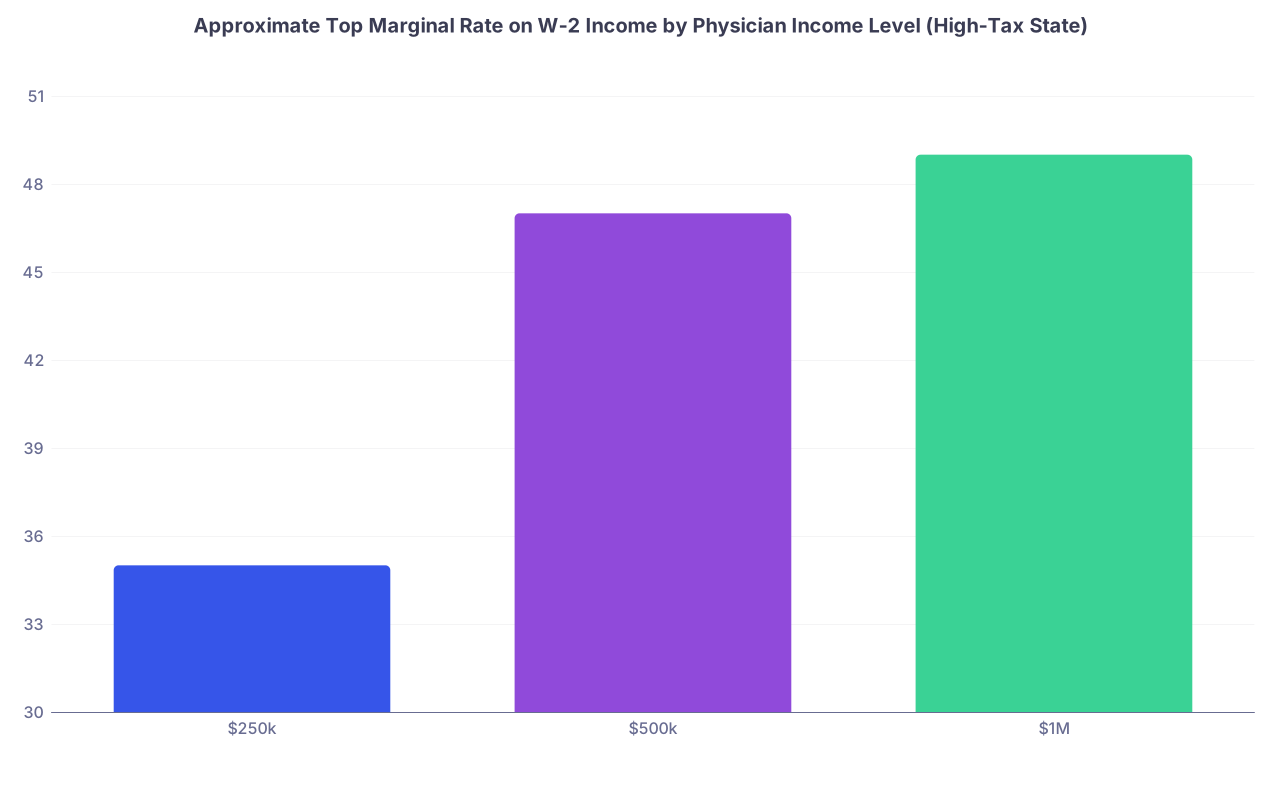
| Category | Value |
|---|---|
| $250k | 35 |
| $500k | 47 |
| $1M | 49 |
That chart is not exact to the decimal. It is directionally correct: marginal tax cost climbs steeply from $250k to $500k, then flattens slightly above $1M, because you are already in the top federal bracket and most phase‑ins are done.
5. Physicians at $1,000,000+: You Are the Target Demographic
Once you cross $1M of income, the tax system stops pretending. You are in the top marginal federal bracket, plus every high‑income add‑on stacked.
Assume:
- Married, one W‑2 physician, $1,000,000 gross
- 401(k) deferral: $23,000 (negligible at this point but we include it)
- Pre‑tax benefits: $5,000
- High‑tax state 10%
- Substantial investment income (not unusual at this level)
Step 1: AGI
AGI ≈ $1,000,000 − $23,000 − $5,000 = $972,000
Step 2: Taxable income
Taxable ≈ $972,000 − $29,200 = $942,800
You are deep into the 37% bracket (starts at $693,751 taxable).
Estimate federal income tax:
You can compute bracket by bracket, but we know:
- Tax owed at the top of 35% bracket (taxable $693,750 MFJ) is about $174,238 (published IRS figure).
- Everything above that to $942,800 is in the 37% bracket.
Excess over 693,750 = $942,800 − $693,750 = $249,050
Tax on that excess at 37% = ≈ $92,148
Total federal income tax ≈ $174,238 + $92,148 = $266,386
Effective federal rate ≈ $266,386 ÷ $1,000,000 ≈ 26.6%
Now payroll (employee side):
- Social Security: capped at $10,453 (same as before).
- Medicare: 1.45% of $1,000,000 = $14,500
- Additional Medicare: 0.9% of ($1,000,000 − $250,000) = 0.9% of $750,000 = $6,750
Total payroll ≈ $31,703
State income tax at 10% effective on $1,000,000 ≈ $100,000
Total major taxes ≈
- Federal income: $266,386
- Payroll: $31,703
- State: $100,000
Total ≈ $398,089
Effective total rate ≈ 39.8%
That is before NIIT on investment income. At $972k AGI, any taxable investment income is fully exposed to the 3.8% NIIT. If you have, say, $100,000 of capital gains / dividends, that is another $3,800 in federal tax. Many physicians in this range also bump into other little add‑ons like phaseouts of itemized deductions where they still apply in their state codes.
Marginal dollar at $1M
At this level, your additional $1 of wage income is hit by:
- Federal income: 37%
- Medicare + Additional: 2.35%
- State: 10%
Baseline marginal ≈ 49.35%.
Frankly, if that extra $1 frees up more room for investment income or triggers NIIT on an incremental slice of gains, you can sit functionally above 50% marginal in certain scenarios.
That is the structure. This is why backend Roth conversions, tax loss harvesting, and entity structure games suddenly matter. You are playing at the level where half of every new clinical dollar is owned by someone else.
6. How the Three Levels Actually Compare
To see the pattern clearly, strip away the noise and compare effective and top‑marginal rates across the three scenarios, for a high‑tax state physician.
| Gross Income | Est. Effective Total Tax Rate | Approx. Top Marginal Rate on W-2 |
|---|---|---|
| $250,000 | ~24–26% | ~31–35% |
| $500,000 | ~33–35% | ~45–48% |
| $1,000,000 | ~40–42% | ~49–52% |
You can argue about a point or two depending on:
- Exact state tax structure
- Itemized vs standard deduction
- Mix of wage vs pass‑through vs investment income
The pattern is stable:
- Effective total rate moves up by roughly 8–10 percentage points from $250k to $500k, then another 7–8 points by $1M.
- Marginal rate goes from low 30s to high 40s, flirting with 50%+ at the top.
The “jump” that people fear — “once I hit the 37% bracket, I lose money” — never happens. What actually happens is quieter: every incremental dollar above about $400–450k in a high‑tax state is almost a coin‑flip between you and the government.
7. What the Data Says You Should Actually Care About
This is where most physician conversations go off the rails. They obsess over the posted “bracket” and ignore the levers that materially change their real tax cost.
Lever 1: Where you live
Moving from a 10% state to a 0% state is like:
- Removing 10 points of marginal rate on your W‑2 income
- And 7–10 points of effective rate across the board
For a $500k physician, that is $50,000 a year. The median family physician does not earn that before tax.
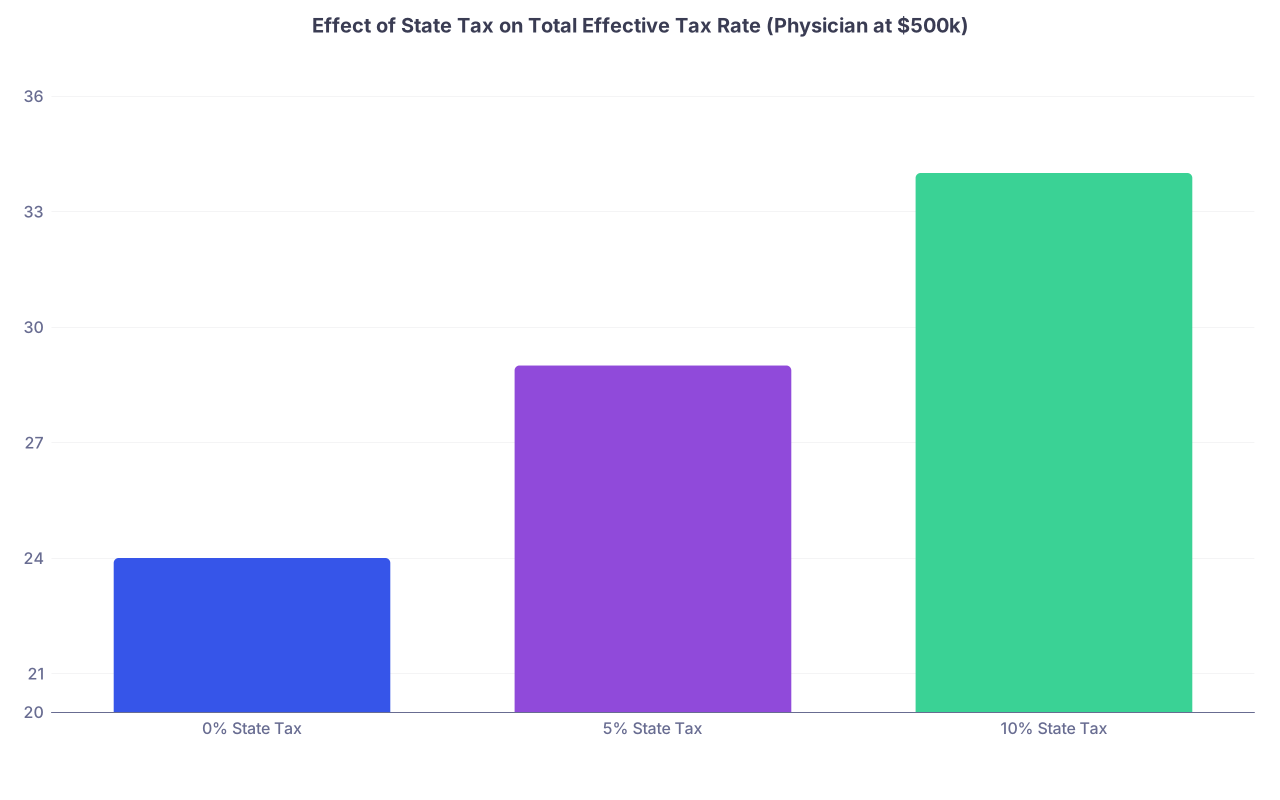
| Category | Value |
|---|---|
| 0% State Tax | 24 |
| 5% State Tax | 29 |
| 10% State Tax | 34 |
The data is blunt: if you plan to earn $500k+ for 20 years, location arbitrage is among the highest‑impact tax moves you can make.
Lever 2: W‑2 vs 1099 vs business income
W‑2 is the worst form of income from a tax‑planning perspective. You are capped on deductions and entity design. A 1099 or practice‑owner model lets you:
- Deduct legitimate business expenses before income ever hits your return.
- Establish defined benefit or cash balance plans that can move $50k–$200k+ pre‑tax per year.
- Potentially access QBI (199A) in carefully structured scenarios (though physicians as specified service businesses have limitations above certain thresholds).
I am not pretending this is trivial. It requires competent legal and tax help and a real business, not a sham entity. But the order‑of‑magnitude difference is obvious in the numbers.
Lever 3: Timing and character of income
A dollar of:
- W‑2 salary for a $1M physician in California → near 50% marginal tax.
- Long‑term capital gain in a year where AGI is purposely kept low → 0–15% federal, maybe lower state treatment.
You can absolutely convert $1 of high‑rate income into lower‑rate income across time by:
- Using pre‑tax retirement accounts while in peak brackets, then Roth conversions in lower‑income years.
- Shifting from current wages to future asset sales where capital gains rules apply.
- Controlling when you realize gains, grant RSUs, or take deferred compensation distributions.
The physicians who “feel” crushed by taxes at $500k and $1M usually have not actually modeled how much of their income must be W‑2 vs what could be re‑titled, deferred, or re‑characterized.
8. The Psychological Trap: Why This Feels Worse Than It Is
From a data standpoint, the U.S. system taxes high‑income physicians heavily but not uniquely. Tech executives at similar incomes pay similar rates. Private equity partners may pay less if they can keep income as carried interest and long‑term gains.
The psychological hit for physicians comes from three things:
- You did 11–15 years of training at low pay, then hit $250k–$500k abruptly. The tax jump is fast, not gradual.
- You often live in high‑cost, high‑tax metros by default (Boston, SF, NYC, LA), amplifying the combined effect.
- Your income is very “W‑2 heavy” with limited flexibility unless you deliberately change your work or ownership structures.
So yes: the marginal tax burden on that extra call shift or administrative role can approach 45–50% in the worst jurisdictions. That is not a moral argument; it is arithmetic.
But no: you are not “losing money by working more” once you pass a bracket. Your extra work is still positive after tax. It is just a much worse deal than you think.

9. What a Rational Physician Does with This Information
You cannot repeal the tax code. But the data points to a few rational responses:
Stop making decisions based on myths about brackets.
Run the math on marginal after‑tax dollars. If an extra 10 hours a month of call yields $3,000 pre‑tax and your marginal rate is 45%, you keep $1,650. Is 10 hours of your life worth $1,650? That is a lifestyle question, not a tax question.Aggressively use tax‑advantaged accounts.
At 37% federal + state, every $1 deferred into a 401(k), 457(b), or cash balance plan saves 40–50 cents today. Even if you later pay 24–28% to withdraw in retirement, the arbitrage is large.Consider location and structure, not just salary.
A $450k job in Texas with partial 1099 or partnership options can easily beat a $550k pure W‑2 job in California once you run effective tax and cost of living numbers. I have watched physicians “trade up” to higher nominal comp and end with less free cash.Model scenarios before lifestyle creep.
Jumping from $250k to $500k gross does not double your after‑tax income. In high‑tax states, it might bump you from ~75% take‑home of each marginal dollar to about half of each new dollar. If your spending scales blindly with gross, you will always feel behind.


Final Summary
Three core points:
Marginal reality beats bracket mythology. At $250k, $500k, and $1M+, your true marginal rate with federal, payroll, state, and NIIT often lands between 35% and 50%, even though your effective rate is lower.
State tax and income structure are not side issues. They are primary drivers. Moving from a 10% to 0% tax state or shifting from pure W‑2 to mixed 1099/ownership can change your lifetime after‑tax wealth by seven figures.
Use your numbers, not slogans. Any decision about extra work, job changes, or practice structure should be run through an after‑tax, after‑expense lens. Once you see the exact marginal cost of each additional dollar, your strategy becomes obvious.


