

The biggest reason physicians screw up Backdoor Roth IRAs is not income limits. It is the pro‑rata rule.
Let me break this down specifically, because half the blog posts on this topic hand‑wave the hard part. You are a high‑income doc. You cannot do a direct Roth IRA contribution. So you use the “Backdoor” Roth process. If you do that while holding pre‑tax money in any traditional, SEP, or SIMPLE IRA on December 31, you can accidentally create a taxable mess that defeats half the benefit.
You need to understand exactly how the pro‑rata rule works, how it is calculated, and what to do with existing IRA balances before you touch a Backdoor Roth.
1. What a Backdoor Roth IRA Actually Is (And Is Not)
A Backdoor Roth IRA is not a special account. It is simply a two‑step process:
- Make a non‑deductible traditional IRA contribution.
- Convert that contribution to a Roth IRA.
That’s it. But the tax mechanics under the hood matter. You need to get three pieces right:
- Your income is too high for a direct Roth IRA contribution (which is true for many attendings).
- Your traditional IRA contribution is non‑deductible (because your income is high and you are covered by a retirement plan at work).
- You do not trigger the pro‑rata rule in a way that makes most of your conversion taxable.
For 2024, the standard limits (ignoring catch‑up) are:
- $7,000 IRA contribution limit (traditional + Roth combined), per person.
- High‑income physicians are often over the Roth direct contribution phase‑out range. So the direct Roth route is closed.
You still can contribute to a traditional IRA. It is just not deductible. That is the backdoor entry point.
2. The Pro‑Rata Rule: The IRS Trap Door
The pro‑rata rule is how the IRS decides what portion of any Roth conversion is taxable versus tax‑free.
Here is the core concept, stated bluntly:
If you have any pre‑tax money in any traditional, SEP, or SIMPLE IRA as of December 31 of that year, the IRS forces you to treat your Roth conversion as coming proportionally from pre‑tax and after‑tax money across all those IRAs combined.
They do not care which account you touched. They only care about the total IRA picture.
The IRS formula (this is the engine)
The calculation is done on IRS Form 8606. The key fraction:
Non‑taxable portion of conversion
= (Total after‑tax IRA basis at year‑end) ÷ (Total value of all IRAs at year‑end + distributions during the year) × Total converted
You do not get to say:
“I only converted the non‑deductible contribution, so this should be tax‑free.”
The IRS does not care which specific dollars you think you moved. It treats every IRA as one big pool.
3. Concrete Numerical Examples: How the Pro‑Rata Rule Bites
Let me walk through real numbers, because this is where physicians finally see why their CPA keeps nagging them about rolling old IRAs into a 401(k).
Example 1: Clean Backdoor Roth, no pre‑tax IRAs
Facts:
- You are an employed cardiologist.
- 2024 income well above Roth limits.
- No money in:
- Traditional IRA
- SEP IRA
- SIMPLE IRA
- You contribute $7,000 to a traditional IRA in 2024, non‑deductible.
- A week later, you convert the full $7,000 to a Roth IRA.
End‑of‑year IRA balances:
- Traditional/SEP/SIMPLE IRAs: $0
- After‑tax basis: $7,000
- Total converted: $7,000
Pro‑rata fraction:
- Basis = $7,000
- Total IRAs at year‑end (plus distributions) = $0 (after conversion) + $7,000 (distribution / conversion) = $7,000
- Non‑taxable portion = 7,000 ÷ 7,000 × 7,000 = 100% non‑taxable
Tax due on conversion: $0
This is the ideal, clean Backdoor Roth scenario.
Example 2: The typical mistake — old rollover IRA sitting there
Facts:
- You did a 401(k) rollover into a traditional IRA years ago. You now have:
- Rollover IRA: $93,000 (all pre‑tax)
- You contribute $7,000 non‑deductible to a new traditional IRA for 2024.
- Shortly after, you convert $7,000 (the new contribution) to Roth.
Here is the problem:
From the IRS point of view, you now have:
- $93,000 pre‑tax IRA money
- $7,000 after‑tax basis
- Total IRA value: $100,000
- You converted $7,000 of that pool
Pro‑rata calculation:
- Basis = $7,000
- Total IRAs = $100,000 (assuming year‑end value close to that, ignoring minor gains)
- Non‑taxable percentage = 7,000 ÷ 100,000 = 7%
- Non‑taxable portion of $7,000 conversion = 7% × 7,000 ≈ $490
- Taxable portion ≈ $7,000 − $490 = $6,510
You just made a “Backdoor Roth” where 93% of the converted amount is taxable. That is not a strategy; that is just a Roth conversion with tax drag.
The more pre‑tax IRA money you have, the worse this gets.
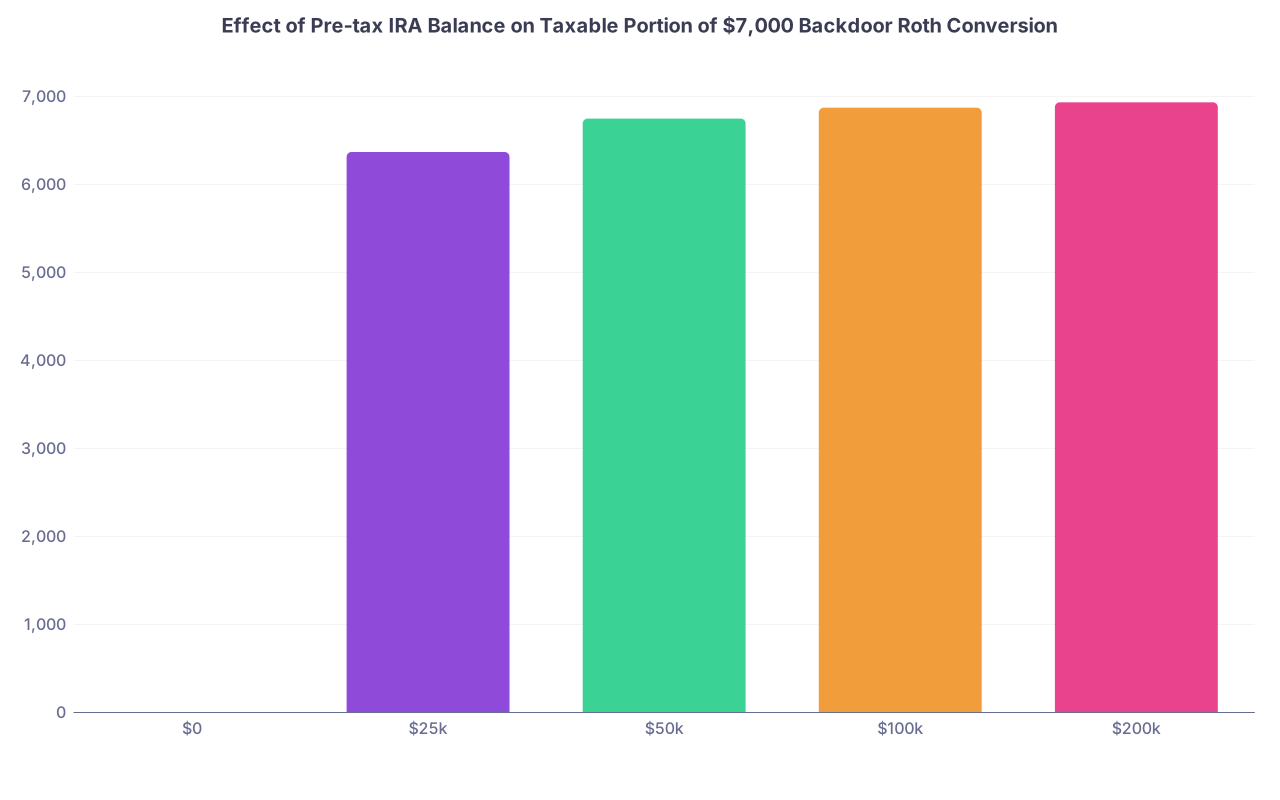
| Category | Value |
|---|---|
| $0 | 0 |
| $25k | 6364 |
| $50k | 6743 |
| $100k | 6867 |
| $200k | 6928 |
(Values approximate taxable amount of a $7,000 conversion at different pre‑tax IRA balances, assuming $7,000 after‑tax basis.)
4. Which Accounts Trigger the Pro‑Rata Rule (and Which Do Not)
This is where physicians often get confused, because the rules are not intuitive.
Accounts that do get included in the pro‑rata pool:
- Traditional IRAs (including rollover IRAs)
- SEP IRAs
- SIMPLE IRAs
Accounts that are not included:
- 401(k), 403(b), 457(b) plans
- Solo 401(k) / individual 401(k)
- Defined benefit/cash balance plans
- Roth IRAs (of course; those are post‑tax)
- HSA accounts
The pro‑rata rule only cares about balances in traditional/SEP/SIMPLE IRAs as of December 31 of that calendar year.
That “December 31” is not a suggestion. It is the cutoff date the IRS literally uses on Form 8606. If, by December 31, you still have pre‑tax money in traditional/SEP/SIMPLE IRAs, it will be factored into the ratio.
5. The December 31 Rule and Timing Backdoor Roths
You can do the contribution and conversion at almost any time during the year. The IRS does not care if you:
- Contribute in April,
- Convert in June,
- Or contribute in December and convert in January of the following year.
The critical point is:
What do your combined IRA balances look like on December 31 of the year of the conversion?
If:
- You convert in 2024, and
- You have any traditional/SEP/SIMPLE IRA money on 12/31/2024,
you trigger the pro‑rata calculation for your 2024 conversion.
So the practical rule for Backdoor Roths:
- Get rid of (or isolate) pre‑tax IRA balances before December 31 of the conversion year.

| Step | Description |
|---|---|
| Step 1 | High income physician |
| Step 2 | Want Roth IRA contribution |
| Step 3 | Contribute nondeductible IRA |
| Step 4 | Convert to Roth IRA |
| Step 5 | Roll pre tax IRA to 401k |
| Step 6 | Consider skipping Backdoor Roth or using spouse |
| Step 7 | Any traditional SEP SIMPLE IRA balance? |
| Step 8 | Can roll to 401k? |
6. “Fixing” Existing IRAs Before Using a Backdoor Roth
Most attendings already have some sort of IRA. Old rollover IRA from residency. SEP IRA from 1099 side income. That is what blows up the Backdoor Roth plan.
You have three main ways to deal with those balances.
Option 1: Roll pre‑tax IRA money into an employer 401(k) or 403(b)
This is usually the best solution if the plan is halfway decent.
Why it works:
- 401(k)/403(b) balances are not included in the pro‑rata rule.
- When you roll pre‑tax IRA money into a 401(k), it is no longer in an IRA. The balance disappears from the pro‑rata equation.
You typically want to:
- Confirm your employer plan accepts roll‑ins from IRAs.
- Roll only the pre‑tax portion into the 401(k).
- Leave any after‑tax IRA basis behind, then convert that to Roth (this is called a “basis isolation” maneuver).
Here is how this looks numerically.
You have:
- Rollover IRA: $93,000 pre‑tax
- Non‑deductible IRA basis from prior years: $7,000
- Total $100,000 in traditional IRA, $7,000 of which is after‑tax basis
If your 401(k) accepts rollovers:
- You instruct custodian to roll $93,000 (the pre‑tax amount) into the 401(k).
- The $7,000 after‑tax basis stays in the IRA.
- Now your IRA is $7,000 after‑tax only.
- Then you convert that $7,000 to Roth.
Pro‑rata at that point:
- Basis = $7,000
- Total IRAs at year‑end = $7,000
- Non‑taxable portion = 7,000 ÷ 7,000 × 7,000 = 100% non‑taxable
That is the clean way to “repair” old IRAs, if your employer plan cooperates.
Option 2: Open a solo 401(k) and roll the IRA into it
If you have any 1099 income (locums, consulting, telemedicine, reading studies on the side), you can often set up a solo 401(k) for that business.
Why this matters:
Most solo 401(k) plans allow IRA rollovers. Solo 401(k) balances also do not count in the pro‑rata rule.
Typical sequence:
- Create a solo 401(k) using a provider that allows incoming IRA rollovers (many brokerages do; you must check).
- Roll your pre‑tax traditional/SEP IRA into the solo 401(k).
- Clean up the IRA structure.
- Then start doing Backdoor Roths.
If you already have a SEP IRA from your 1099 work, this is often a no‑brainer shift: replace future SEP contributions with solo 401(k) contributions and roll the old SEP IRA money into the solo 401(k).
Option 3: Bite the bullet and convert everything to Roth
Less common, but sometimes reasonable early in your career or in a low‑income year.
Scenario:
- You have $80,000 total in traditional/SEP/SIMPLE IRAs, all pre‑tax.
- Your marginal bracket is unusually low this year (sabbatical, fellowship, part‑time, big maternity leave).
- You want everything in Roth long term.
You could:
- Convert the entire $80,000 to Roth in a year when your tax bracket is temporarily low.
- Pay tax on the full amount.
- Now you have $0 in pre‑tax IRAs; going forward, Backdoor Roth conversions are clean.
This is basically a large Roth conversion decision, not just a Backdoor Roth cleanup. You match this with your multi‑year tax planning, not in isolation.
| Strategy | When It Works Best | Main Benefit |
|---|---|---|
| Roll to employer 401(k)/403(b) | Good employer plan that accepts roll-ins | Removes IRA from pro-rata pool |
| Roll to solo 401(k) | You have 1099 income | Keeps tax control, adds flexibility |
| Convert IRA entirely to Roth | Temporary low tax bracket | Long-term Roth growth, clean slate |
7. Spouse IRAs: The Rules Are Individual, Not Household
Here is a common married attending scenario I see:
- You have a huge pre‑tax rollover IRA from residency.
- Your spouse has no IRAs at all and some earned income.
- Both of you are over the Roth income limits.
Question: “Can my spouse still do a clean Backdoor Roth or does my IRA mess everything up?”
Answer: Your spouse’s Backdoor Roth is clean. The pro‑rata rule is individual, based on each taxpayer’s SSN and IRA balances. Your IRA does not contaminate your spouse’s conversion.
Flip side:
- If your spouse has the large pre‑tax IRA and you have none, your Backdoor Roth is clean and your spouse’s is the problem.
I have seen couples delay both Backdoor Roths for years because one partner had an IRA. That is unnecessary. Clean spouse can proceed.
8. Year‑by‑Year Mechanics: How a High‑Income Physician Actually Does This
Let me lay out a typical “good” pattern for an attending starting Backdoor Roths in a clean environment (no pre‑tax IRAs).
Assumptions:
- You are a W‑2 hospitalist, age 38, income $350k.
- Covered by a 401(k)/403(b) at work.
- No traditional IRAs, SEP IRAs, or SIMPLE IRAs.
Annual steps:
- Contribute $7,000 (2024 limit) to a traditional IRA, non‑deductible.
- Do this once per year per spouse if each has earned income.
- Shortly later (days to weeks), convert the full amount in that IRA to a Roth IRA.
- If market moves a bit, small gain/loss, not a big deal.
- File Form 8606 with your tax return to:
- Report the non‑deductible contribution (line 1–3).
- Track your basis.
- Report the conversion and calculate taxable vs. non‑taxable portion.
You repeat this sequence annually. Two key procedural rules:
- Do not forget Form 8606. That form is the entire record of your basis and conversions. Missing it causes headaches later.
- Do not hold pre‑tax IRA money as of December 31 in the year of conversion.
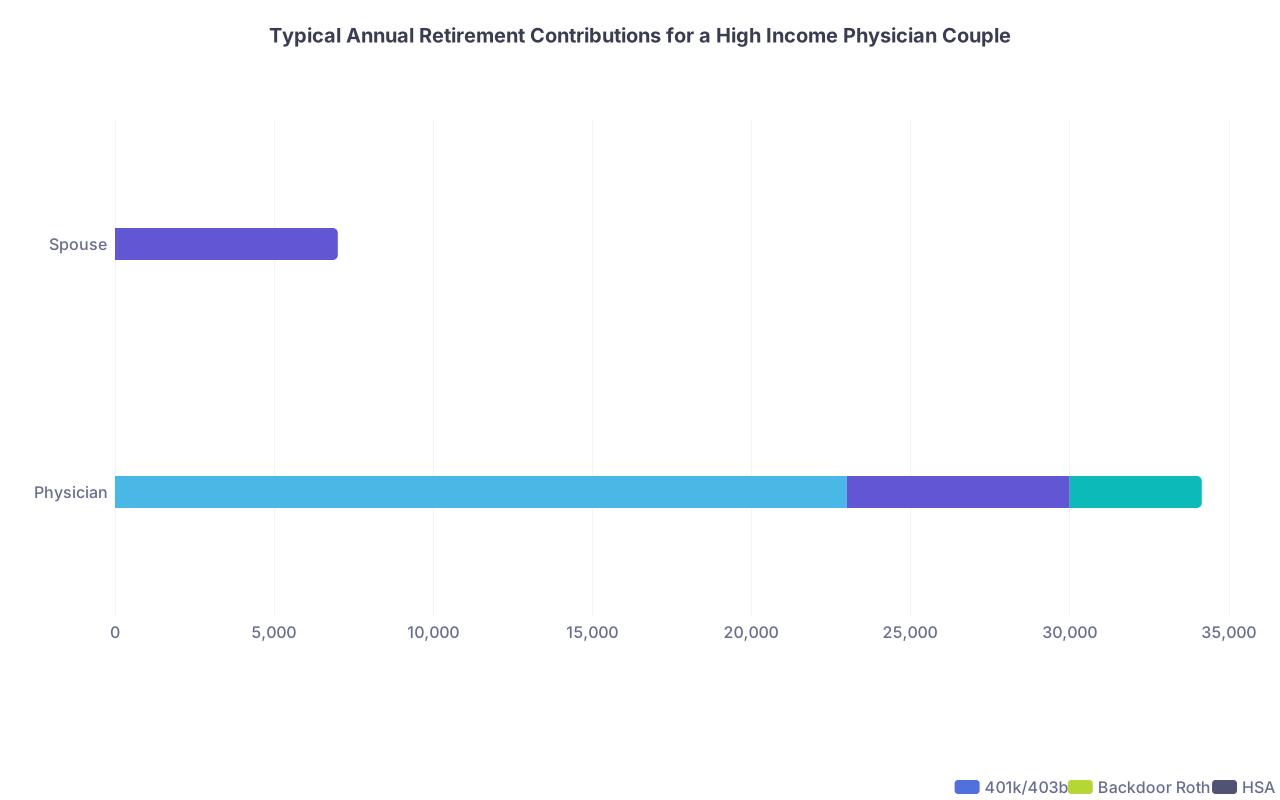
| Category | 401k/403b | Backdoor Roth | HSA |
|---|---|---|---|
| Physician | 23000 | 7000 | 4150 |
| Spouse | 0 | 7000 | 0 |
(2024 example amounts; employer contributions and family HSA coverage not shown for simplicity.)
9. Common Pitfalls and Dumb Mistakes I Keep Seeing
Let us go straight to the mistakes, because they are painfully predictable.
Mistake 1: Doing the conversion with a big rollover IRA still intact
You see this often:
- “I heard about Backdoor Roths on a podcast, so I just opened a traditional IRA, contributed $7,000, and converted it.”
- They completely ignore the $150k SEP IRA from their 1099 work.
Result: 95%+ of the conversion taxable. Not fatal, but you are essentially just doing a Roth conversion of pre‑tax dollars.
If this is you:
Do not panic. The damage is done for that year. The best you can do is:
- Clean things up going forward (roll to 401(k) if possible).
- Make sure Form 8606 has been correctly filed.
- Stop doing additional “backdoor” conversions until the IRA mess is addressed.
Mistake 2: Forgetting that SEP and SIMPLE IRAs count
Some physicians are good about avoiding traditional IRAs but then:
- They start a side gig.
- Their accountant defaults to a SEP IRA because it is “easy.”
Now they have:
- Employer 403(b)
- SEP IRA for side work
And they accidentally ruined future Backdoor Roths because the SEP IRA is in the pro‑rata pool.
If you are still early in your 1099 journey, I strongly prefer solo 401(k) over SEP for physicians who want to do Backdoor Roths. It keeps all tax‑deferred money in 401(k) flavor, outside the pro‑rata problem.
Mistake 3: Not understanding that pro‑rata is calculated each year
You might clean things up one year, do a perfect Backdoor Roth, then:
- A few years later you roll a 401(k) from an old job into a traditional IRA.
- You forget that this re‑creates the pro‑rata issue.
- You keep doing Backdoor Roths, thinking everything is fine.
It is not a one‑time “I fixed it forever” situation. Every December 31, the IRS looks again.
Mistake 4: Ignoring Form 8606 basis
I have seen physicians with 10+ years of non‑deductible contributions, but no Form 8606s. Their preparer just never filed them.
Now you have:
- Unknown basis in IRAs
- No record with the IRS
- Future Roth conversions become a guessing game
You can retroactively fix some of this by:
- Filing late or corrected Forms 8606 for prior years.
- Working with a competent CPA who understands the history.
But this is messy. Much better to get Form 8606 right from year one.

10. Advanced Angle: Multiple Conversions and Market Moves
You will see some people obsess over the timing of contribution vs. conversion.
There are two separate questions:
- Tax side: Does waiting create more taxable growth before conversion?
- Investment side: Do you want the growth happening inside the traditional IRA (pre‑conversion) or inside the Roth?
From a pro‑rata perspective, the timing within a single year does not change the percentage. The fraction is still based on basis ÷ total IRA at year‑end plus distributions.
But for Backdoor Roths specifically, the simple pattern is usually best:
- Contribute, then convert relatively quickly.
- Avoid large gains in the traditional IRA before conversion, because those gains will be taxable when moved to Roth.
This is not about “step doctrine” or IRS suspicion; Backdoor Roths are well known and accepted when done correctly. The quick conversion simply keeps the tax tracking simple.
For most busy physicians, the optimal play is:
- Contribute non‑deductible IRA around the same time annually (early is fine).
- Convert within days to weeks.
- Invest in your long‑term Roth allocation after the conversion lands.
11. Where Backdoor Roths Fit in the Physician Retirement Stack
Backdoor Roths are not the first line of retirement saving. They are a secondary optimization.
For a high‑income physician, the usual order of operations looks something like this:
- Get full employer match in 401(k)/403(b).
- Max out HSA (if you have a high deductible health plan).
- Max out your 401(k)/403(b) employee contribution.
- Backdoor Roth IRA for you.
- Backdoor Roth IRA for spouse (if eligible).
- Extra savings into:
- Taxable brokerage
- Mega Backdoor Roth (if your plan allows after‑tax 401k + in‑plan Roth conversion)
- Cash balance plan if appropriate
Where Backdoor Roths matter:
- $7,000 per person per year does not sound huge. Over a 20+ year attending career with compound growth in a Roth wrapper, it is far from trivial.
- It diversifies your future tax buckets: pre‑tax (401k), Roth, taxable. That matters in retirement when you want flexibility in how you draw income.
But if you are not maxing the employer plan and HSA first, obsessing over Backdoor Roths is backward.

12. Legal / Compliance Edge Cases Physicians Ask About
A few quick clarifications that come up repeatedly in physician circles:
Is the Backdoor Roth “at risk” of being outlawed?
Congress has talked about shutting down the “Backdoor” and “Mega Backdoor” pathways, but as of early 2026, the standard Backdoor Roth via non‑deductible IRA + conversion is still specifically allowed in practice. The IRS has had years to object and has not. If it changes, you will know, because every advisor in your orbit will start yelling.Can I do a Backdoor Roth for last year now?
You can make a prior‑year IRA contribution up to the tax filing deadline (usually April 15, without extension). But the conversion is always dated in the year you actually convert. The pro‑rata rule applies based on the year of conversion, not the contribution year.Do inherited IRAs count in the pro‑rata pool?
No. Inherited IRAs are tracked separately. The pro‑rata rule is applied separately to each person’s IRAs. Your own traditional/SEP/SIMPLE IRAs are one bucket; inherited IRAs do not contaminate that.What if my IRA has both pre‑tax and after‑tax money from old contributions?
You cannot cherry‑pick just the after‑tax dollars to convert, unless you first move the pre‑tax portion into a 401(k) and leave the after‑tax behind, as described earlier. Once you do that properly, you can then convert the isolated after‑tax IRA to Roth with little or no tax.

13. What You Should Do Next (If You Want Backdoor Roths To Actually Work)
If you are a high‑income physician and want to use Backdoor Roth IRAs intelligently, your next steps are not complicated, but they must be precise.
Inventory all IRAs under your name.
Traditional, rollover, SEP, SIMPLE. Pull actual balances. Check December 31 values if you have been converting already.Decide whether to clean them up.
- If you have no IRA balances: you are clear, proceed with annual Backdoor Roths.
- If you have large pre‑tax balances:
- Check if your employer 401(k)/403(b) accepts roll‑ins.
- If you have 1099 income, consider a solo 401(k).
- If you expect a unique low‑income year, model whether a large Roth conversion is worth it.
Coordinate with whoever files your taxes.
- Make sure Form 8606 is filed and correct.
- Make sure they understand Backdoor Roth mechanics; not all CPAs do this well.
- Get them to walk through, on paper, how the pro‑rata fraction would look if you did a conversion this year with current balances.
Once your IRA landscape is clean and your tax reporting is correct, the ongoing execution is fairly routine.
Key Takeaways
The pro‑rata rule is the core risk in Backdoor Roth IRAs for high‑income physicians; if you hold any pre‑tax traditional/SEP/SIMPLE IRA money on December 31 of the conversion year, the IRS forces you to treat your Roth conversion as partly taxable based on the ratio of after‑tax basis to total IRA value.
The clean Backdoor Roth playbook is simple but strict: eliminate or isolate pre‑tax IRA balances by rolling them into a 401(k)/403(b)/solo 401(k) or, in some cases, converting them in a low‑tax year, then contribute non‑deductible IRA and convert to Roth annually while tracking everything on Form 8606.
Pro‑rata is applied per person, per year. Your spouse’s IRAs do not affect your pro‑rata ratio, and every December 31 the IRS recalculates using your current IRA balances, so any new traditional/SEP/SIMPLE IRA you create later can re‑contaminate future Backdoor Roths if you are not paying attention.


