

The worst financial mistake many physicians make is treating W‑2 vs 1099 as a “rate of pay” question instead of a “total structure” question.
You are not just picking a box on a tax form. You are choosing a legal and financial ecosystem that controls liability, benefits, deductions, audit risk, and long‑term wealth building. And yes, sometimes that “higher hourly rate” 1099 offer is a raw deal once you actually run the numbers.
Let me break it down specifically.
1. Core Difference: What W‑2 vs 1099 Really Means
First, strip away the recruiter noise.
W‑2 physician
You are an employee. The hospital/group:
- Controls your schedule, workflow, tools.
- Withholds taxes (federal, state, Social Security, Medicare).
- Often provides benefits: health, retirement match, malpractice, CME, disability, etc.
- Reports wages on a W‑2.
1099 physician
You are an independent contractor. The hospital/group:
- Pays you gross, with no tax withholding.
- Often does not provide benefits or malpractice (sometimes they do malpractice or occurrence policies, but assume not unless contract says so).
- Expects you to handle your own taxes, insurance, retirement.
- Reports payments on a 1099-NEC (or 1099-K via platforms).
In practice, the IRS cares about control and independence. Many “1099” locums arrangements are, in substance, employees misclassified as contractors, but that is a separate fight. From your standpoint, assume you are truly independent if you are 1099.
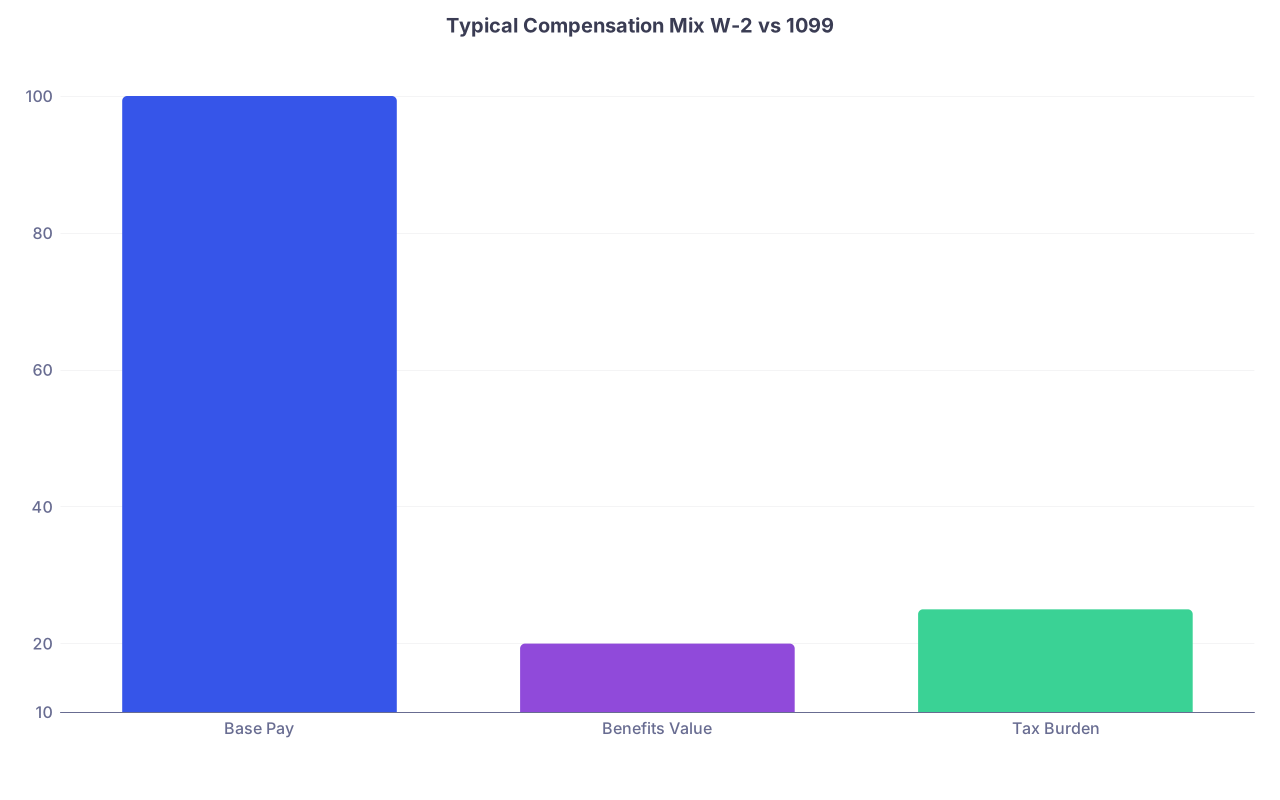
| Category | Value |
|---|---|
| Base Pay | 100 |
| Benefits Value | 20 |
| Tax Burden | 25 |
The dangerous myth:
“1099 = more money, W‑2 = less money.”
Wrong. The truth is:
- 1099 = more control and more responsibility.
- W‑2 = more simplicity and more built‑in benefits.
You need to quantify both.
2. The Self‑Employment Tax Reality Check
This is where a lot of physicians get blindsided.
As a W‑2 employee:
- You pay 6.2% Social Security on wages up to the wage base (for 2024, $168,600).
- You pay 1.45% Medicare on all wages, plus 0.9% additional Medicare over certain thresholds.
- Your employer matches the other 6.2% + 1.45%.
As a 1099 contractor:
- You pay both halves via self‑employment (SE) tax:
- 12.4% Social Security on net earnings up to the wage base
- 2.9% Medicare + 0.9% additional over thresholds
- You get to deduct half the SE tax above‑the‑line, but the cash still left your pocket.
On $300,000 of net 1099 income (single, ignoring state and federal income tax for a moment):
- Social Security portion (capped at wage base): 12.4% × 168,600 ≈ $20,906
- Medicare 2.9% × 300,000 = $8,700
- Additional 0.9% Medicare on 300k – 200k = 0.9% × 100,000 = $900
- Total SE tax ≈ $30,506
Compare that with W‑2:
- You would only be paying your half:
- Social Security: 6.2% × 168,600 ≈ $10,453
- Medicare: 1.45% × 300,000 = $4,350
- Additional Medicare: 0.9% × 100,000 = $900
- Total ≈ $15,703
So rough incremental cost of being 1099 vs W‑2 on that income: ~$14,800 more SE tax.
Can you reduce some of that with an S‑Corp structure? Yes. But not all. And that requires discipline, structure, and good accounting.
3. S‑Corp vs Sole Proprietor for 1099 Physicians
Most physicians who are 1099 end up in one of three setups:
- Sole proprietor (maybe with a single‑member LLC, taxed as sole prop)
- S‑Corporation (physician PC/PLLC electing S‑status)
- Multi‑member entity (rare for a single doc contracting alone; usually group practice)
Let’s focus on the two most common: sole prop vs S‑Corp.
Sole Proprietor (Schedule C)
You receive 1099‑NEC income, report it on Schedule C.
- Pay SE tax on all net profit (after ordinary and necessary business expenses).
- Very simple to set up. Often no separate business return.
- Easy to commingle funds if you are sloppy (and you will be tempted to be).
- No “reasonable salary” games. What you make is what you tax.
S‑Corporation
You form an entity (PC, PLLC, or LLC depending on state rules for professionals) and elect S‑Corp.
- The S‑Corp pays you:
- A “reasonable salary” (W‑2 from your own corporation), subject to payroll taxes.
- Distributions (dividends) that are not subject to SE tax.
- You file a corporate return (Form 1120‑S) plus your individual return.
- You handle payroll (via a service like Gusto, ADP, etc.).
- Increased accounting complexity and costs.
The core play:
Reduce SE taxes by characterizing part of the profit as distributions instead of salary.
Example: $300,000 net income via S‑Corp.
- You set “reasonable salary” at $180,000 (this number is critical and must be defensible – specialty, market pay data, hours, etc.).
- The remaining $120,000 is a distribution.
SE/payroll taxes apply only to $180,000 salary portion (employer + employee side combined, but you control both via your S‑Corp). The $120,000 distribution escapes the 15.3% SE tax, saving roughly:
- 15.3% × 120,000 ≈ $18,360
But subtract:
- Extra corporate tax prep: maybe $1,500–$3,000 per year
- Payroll processing: $500–$1,200 per year
- Reasonable salary scrutiny: if you get aggressive, the IRS can reclassify distributions as wages.
Net savings can still easily be $10k–15k+ per year for a high‑earning physician, if you do it correctly.
| Feature | Sole Proprietor | S-Corp |
|---|---|---|
| SE tax on all profit | Yes | Only on salary |
| Payroll required | No | Yes |
| Separate business return | No | Yes (1120-S) |
| Admin complexity | Low | Moderate/High |
| Typical savings at $300k net | Minimal | ~$10k–$18k after costs |
If your 1099 income is small (say, $30k of moonlighting), the compliance overhead of an S‑Corp often is not worth it. Once you are consistently above ~$150k–$200k 1099 income, S‑Corp starts to make sense in most situations.
4. Deductible Expenses: What 1099 Unlocks That W‑2 Often Does Not
This is the real strength of independent contractor status. You can convert a meaningful slice of your life into legitimate business expenses. The key word: legitimate.
Common physician 1099 deductions:
- Malpractice premiums (if you pay directly)
- Tail coverage you buy yourself
- CME: conferences, online courses, board review subscriptions
- Professional subscriptions: UpToDate, specialty journals, society dues
- Licensing: state licenses, DEA, board certification fees
- Equipment: stethoscope, loupes, otoscope, reference books
- Portion of cell phone and internet
- Travel related to work (mileage, flights, hotels, meals subject to rules)
- Home office (for admin work; must meet IRS exclusivity and regular use tests)
- Legal and accounting fees
- Payroll costs (if S‑Corp)
- Retirement plan contributions (employer side)
As a pure W‑2 employee, after the Tax Cuts and Jobs Act (TCJA), most “unreimbursed employee expenses” are not deductible for many physicians because the 2% AGI miscellaneous itemized deduction bucket was effectively nuked for this area. That means:
- Your CME, license fees, etc., are not deductible personally if your employer does not reimburse them, unless you have special circumstances or business on the side.
- Some states allow deductions that the federal return does not, but do not rely on that to move the needle.
So a 1099 structure with serious, legitimate expenses might shave $20k–$50k+ off your taxable income every year.
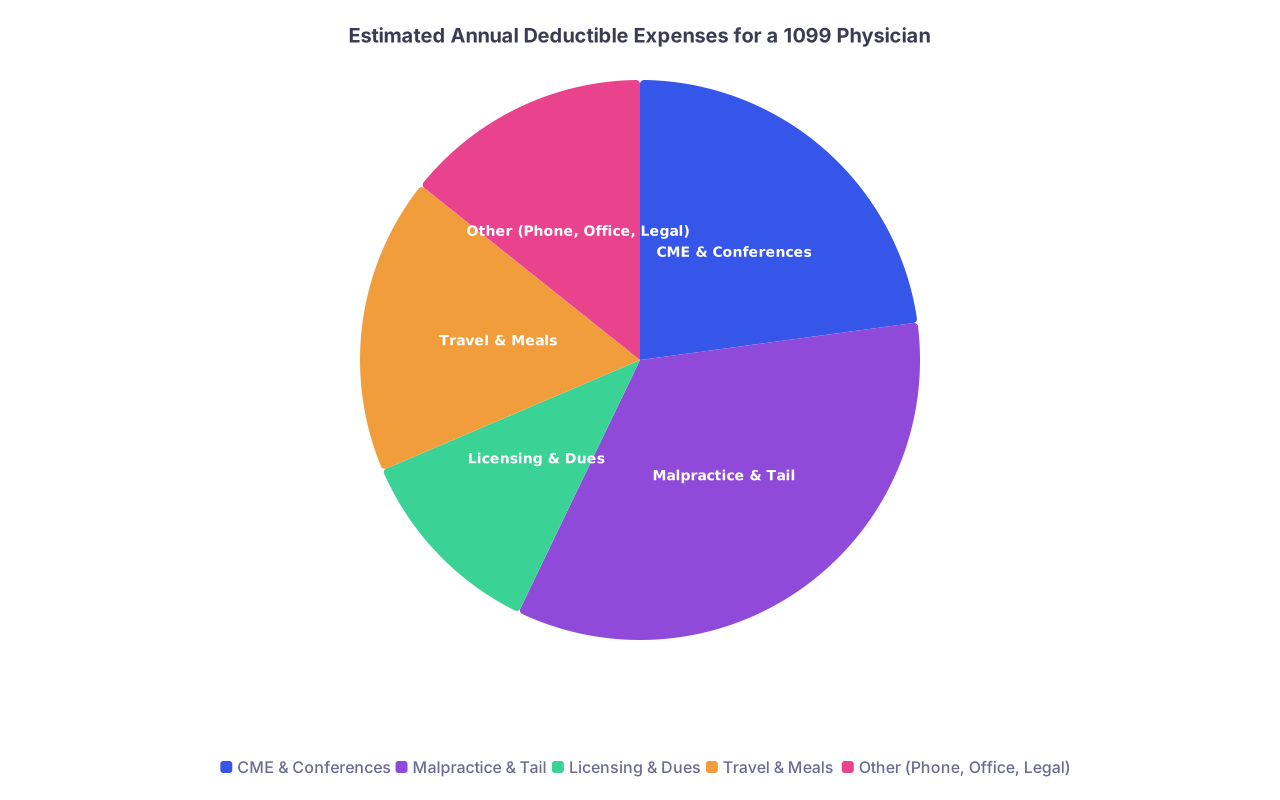
| Category | Value |
|---|---|
| CME & Conferences | 8000 |
| Malpractice & Tail | 12000 |
| Licensing & Dues | 4000 |
| Travel & Meals | 6000 |
| Other (Phone, Office, Legal) | 5000 |
But do not get cute. The fastest way to a painful audit is:
- Deducting obviously personal vacations as “CME trips” with minimal business content.
- Claiming an absurd home office deduction when you do 99% of your admin work at the hospital.
- Running your personal car at 90% business use with no mileage log.
Be aggressive but defensible. Backed by documentation.
5. Retirement Accounts: W‑2 vs 1099 Firepower
Here is where things get interesting.
As a W‑2 Employee
You are typically limited to:
- 401(k) or 403(b):
- Employee elective deferral limit (2024): $23,000 (plus $7,500 catch‑up over age 50).
- Employer match and possibly profit sharing, total combined limit: $69,000 (2024, if plan is designed that way). Most hospitals do not go that high.
- 457(b) if available (often in academic or large systems).
- Backdoor Roth IRA (assuming income limits and no major pre‑tax IRA issues).
You cannot create your own separate 401(k) on top of that for the same W‑2 job.
As a 1099 Physician
You can design your own plan for that 1099 income:
- Solo 401(k)
- SEP IRA (simpler, but less flexible than solo 401(k))
- Cash balance plan (for very high incomes and targeted defined benefit planning)
Solo 401(k) gives you:
- Employee deferral (shared across all 401(k)/403(b)s you participate in)
- Employer contribution (up to 20% of net 1099 earnings if sole prop; 25% of W‑2 from your S‑Corp, subject to overall limits)
If you have a W‑2 job with a 401(k) and 1099 moonlighting/locums income, the key nuance:
- The employee deferral limit (the $23k) is aggregate across all plans.
- The employer contribution limit is separate per unrelated employer.
So if you max your W‑2 employee deferral at the hospital (say, $23k), you cannot defer more as an employee into the solo 401(k), but you can still make employer contributions on the self‑employment income. That can add tens of thousands of additional pre‑tax savings.
Example:
- W‑2 job: $350k, you put $23k into 403(b) + get match.
- Side 1099: $200k net.
You open a solo 401(k) for the 1099:
- No more employee deferral (already used at W‑2 job).
- But employer contribution: roughly 20% of net self‑employment earnings (after some SE tax adjustments), maybe ~$37k–$40k+ additional tax‑deferred space).
This is exactly where a lot of academic physicians with locums work quietly build serious tax‑advantaged balances.

6. Benefits, Malpractice, and Insurance: Where W‑2 Often Wins
The most underestimated value of a W‑2 setup is the benefits package. Especially for physicians with families.
Typical W‑2 employer benefits:
- Health insurance subsidy (sometimes extremely generous)
- Employer HSA contributions (if high‑deductible plan)
- Retirement match or fixed contribution
- Group disability insurance premiums (sometimes partially or fully paid)
- Group life insurance
- CME allowance
- Paid vacation/PTO
- Employer‑provided malpractice with tail (critical in certain specialties)
Those are not “nice extras.” For a typical attending, the true value of benefits is easily $30k–$80k+ per year.
On the 1099 side, you must:
- Buy your own individual health insurance (ACA marketplace or private, often more expensive, sometimes worse networks).
- Pay 100% of your disability and life insurance.
- Cover your own malpractice (claims‑made vs occurrence, tail risk if you leave).
- Self‑fund your CME and license fees.
Run rough numbers:
- Family health insurance on the individual market: $12k–$25k/year depending on state and plan.
- Strong individual long‑term disability policy: $3k–$7k/year.
- Malpractice: wildly variable; a low‑risk outpatient PM&R doc vs OB/GYN in a litigious state are not even on the same planet.
Any time a recruiter offers you “$50/hour more on a 1099 contract,” you need to stack that against:
- Additional SE tax (maybe $10k–$15k+).
- Cost of missing employer benefits (maybe $30k–$80k+).
- Your new admin time burden (self‑payroll, tax planning, etc.).
A lot of seemingly “higher pay” 1099 offers collapse to roughly even—or worse—once you include all of this.
7. The Qualified Business Income (QBI) Deduction (Section 199A)
This is the part most physicians either overestimate or ignore.
Section 199A allows up to a 20% deduction on qualified business income from pass‑throughs (sole prop, S‑Corp, partnerships). But health services are a specified service trade or business (SSTB), which brings income limits.
For an SSTB (which includes physicians):
- Above certain taxable income thresholds, the QBI deduction phases out and then disappears.
- For 2024 (ballpark; check exact figures for your filing year), the phase‑out range is roughly:
- Single: around $191k–$241k taxable income
- Married filing jointly: around $383k–$483k taxable income
Most full‑time attendings are well above these thresholds. That means:
- Many 1099 physicians do not get much, if any, QBI deduction.
- Some can still capture QBI by:
- Filing married filing separately in some scenarios (complicated, not always helpful).
- Intentionally driving down taxable income via retirement contributions, HSA, and other deductions to stay inside the phase‑out window.
- Creating non‑SSTB related business lines (e.g., non‑clinical consulting through a separate entity) that may qualify.
Do not build your 1099 business case on QBI unless your CPA can show you the math with your actual income and deductions. For many high‑earning specialists, QBI is somewhere between minor and nonexistent.
8. Legal and Liability Angle: Asset Protection and Risk
Physicians obsess over malpractice but forget about business liability.
W‑2:
- Your employer generally covers malpractice and related liability for your clinical acts within scope, though plaintiffs will name you personally anyway.
- Business creditors and vendor disputes are not your direct issue.
- Asset protection is more about personal planning (homestead laws, retirement accounts, umbrella policies, state‑specific protections).
1099:
- You are running a business.
- You sign contracts. Lease offices. Hire staff. Enter vendor agreements.
- You need:
- A properly structured entity (PC, PLLC, or LLC depending on your state) to separate business debts from personal assets (to the extent your state law allows for professional liability).
- Malpractice coverage under your entity, and possibly separate general liability.
- A real operating agreement/bylaws if there are multiple owners.
There is a subtle but real difference:
- Malpractice suits will generally follow you regardless of entity (professional liability is personal in many states).
- Contract disputes, unpaid vendor claims, or employment lawsuits from your staff are usually against the entity. If you are just a sole proprietor, they go straight at you.
Is that catastrophic often? No. But I have seen physicians personally liable for things like:
- Office lease guarantees they did not really read.
- Employment law issues (wrongful termination, wage/hour problems) in tiny practices they ran casually.
You want clean separation of personal and business finances. That means a separate business bank account, clear books, and no paying your kid’s private school directly from the practice checking account.
9. Practical Scenario Comparisons
Let us make this concrete.
Scenario A: Hospitalist W‑2 vs Locums 1099
Hospital offers:
- $300k W‑2 salary
- 401(k) with 4% match (on base salary)
- Health insurance worth $18k/year
- Employer‑paid malpractice
- CME fund: $4k/year
- 5 weeks PTO
Locums agency offers:
- $220/hour, 14 shifts/month (~168 hours/month → 2,016 hours/year)
- Annual gross ≈ $220 × 2,016 ≈ $443,520, 1099
- No benefits, no malpractice included
Looks like the locums gig is way better. On paper.
Now subtract:
- Malpractice: say $15k/year (varies)
- Health insurance: $18k
- CME/licensing: $6k
- SE tax vs employee FICA: maybe +$15k–$20k incremental
- No 401(k) match (but you can solo 401(k) your own, which is a plus)
- Unpaid time off: if you actually take 4 weeks off, your income drops by
8% ($35k)
Net difference does not vanish, but that flashy ~$140k headline gap compresses very quickly after:
- True cost of benefits lost
- Tax structure
- Realistic vacation time
- Higher admin burden, variability, and risk
Is locums still better? Possibly, especially if:
- You leverage an S‑Corp structure correctly.
- You fully load a solo 401(k) or defined benefit plan.
- You are willing to work more shifts and like the flexibility.
But it is no longer a slam dunk “obvious” win. You need the spreadsheet.

| Step | Description |
|---|---|
| Step 1 | Offer Received |
| Step 2 | Value salary plus benefits |
| Step 3 | Estimate gross income |
| Step 4 | Subtract SE tax and insurance |
| Step 5 | Add retirement and deduction advantages |
| Step 6 | Compare net after tax and benefits |
| Step 7 | Consider contract |
| Step 8 | Renegotiate or decline |
| Step 9 | W-2 or 1099? |
| Step 10 | Net and risk acceptable? |
Scenario B: Full‑time W‑2 + 1099 Moonlighting
This is where hybrid gets powerful.
- Primary job: $350k W‑2, strong benefits.
- Moonlighting: $80k 1099 at an urgent care.
Plan:
- Max 403(b) employee deferral at main job.
- Get match and maybe 457(b).
- Set up a solo 401(k) for the 1099 work and contribute ~20% employer side (maybe $15k–$18k).
- Deduct CME and travel related to the moonlighting.
- Potentially use S‑Corp if moonlighting grows above $150k+ and justify salary vs distribution.
This is often the sweet spot:
- You keep the W‑2 safety net (benefits, malpractice, simpler taxes).
- You use the 1099 income to supercharge retirement savings and deductions.
10. Decision Framework: How to Choose What Fits You
You are not choosing “W‑2 vs 1099 in the abstract.” You are choosing which fits your real life.
Key questions:
How comfortable are you running a small business?
If the idea of payroll, quarterly estimates, and a separate tax return makes you want to scream, pure 1099 may not be worth the extra complexity unless the pay is truly superior.Do you have (or want) a strong tax and accounting team?
If you are going 1099 at high income, a DIY TurboTax approach is reckless. Budget for a CPA who specifically works with physicians and small professional practices.Are you actually going to maximize the 1099 advantages?
S‑Corp structure, aggressive but legitimate deductions, solo 401(k), HSA optimization. If you are going to be lazy and treat 1099 income like oversimplified cash, you will bleed money to the IRS.How valuable are the W‑2 benefits to you right now?
Young family. Chronic medical conditions. Near‑term fertility treatments. In those cases, the stability and subsidy of a robust W‑2 benefit package might be worth more than the theoretical tax arbitrage.Do you value flexibility over stability?
1099 work often gives you more control over when and how you work but less job security. Some thrive on that. Others hate the constant hustle.
11. Common Mistakes Physicians Make in W‑2 vs 1099 Decisions
I have seen the same errors repeat across specialties:
- Ignoring SE tax: Thinking “I get to deduct everything now” and then being stunned by a $70k April tax bill.
- Overestimating QBI: Assuming they will get the 20% pass‑through deduction when their income level and SSTB status wipe it out.
- Running everything through a sole prop with no structure: Mixing personal and business funds, no entity, no clear books. Perfect setup for stress in an audit or lawsuit.
- Undervaluing employer benefits: Walking away from $30k–$80k/year of benefits for a modest hourly bump.
- Setting unreasonably low S‑Corp salary: Trying to call $50k “reasonable compensation” on $500k net income. That is how you invite IRS attention.
- No estimated tax payments: Spending 1099 income as if it were net, then scrambling to borrow for taxes later.

| Category | Value |
|---|---|
| No estimated taxes | 80 |
| No entity structure | 65 |
| Ignoring SE tax | 70 |
| Weak recordkeeping | 75 |
| Overaggressive deductions | 60 |
12. How to Structure This Intelligently
If you are leaning 1099, here is what a sound structure usually looks like for a high‑earning physician:
- Form a professional entity (PC, PLLC, or LLC) as allowed by your state.
- Elect S‑Corp when your income justifies it (often >$150k consistent net).
- Open a separate business checking account; all 1099 payments go there.
- Set a defensible salary based on specialty, hours, regional data. Pay it via payroll.
- Maintain clean books (QuickBooks or similar).
- Hire a CPA who actually understands physicians and S‑Corps. Not your cousin who “does taxes on the side.”
- Build a retirement plan appropriate for your income level (solo 401(k), potentially a defined benefit plan if you are consistently very high income and older).
- Keep receipts and logs for major deductions (mileage, travel, home office).
If you are W‑2 only, your main levers are:
- Maximizing retirement accounts
- Backdoor Roth where appropriate
- HSA optimization
- Smart state‑specific planning (529s, etc.)
- Negotiating compensation and benefits on the front end instead of trying to out‑deduct things on the back end.
Key Takeaways
- W‑2 vs 1099 is not just about the hourly rate; it is about total after‑tax, after‑benefit compensation and risk.
- 1099 can be more lucrative, but only if you intentionally use entity structure, retirement accounts, and legitimate deductions while managing SE tax and benefits gaps.
- For many physicians, a hybrid model (strong W‑2 anchor job plus 1099 side work with a smart structure) gives the best mix of stability, flexibility, and tax efficiency.


