

It is January 2nd. Hospital just cut your hours, your wRVUs are flat, but your 1099 income from moonlighting and telemedicine exploded last year. Your CPA sent a one-line email: “We should talk about an S‑corp election.” Your colleague down the hall swears by his “disregarded LLC” and says S‑corps are a pain. You open Google, and every article sounds like it was written for a freelance graphic designer, not someone with malpractice risk, Stark, and a partnership track to think about.
Let’s fix that. This is how physicians should think about S‑Corp vs LLC. Not generic small business fluff. Real numbers, real compliance issues, and how this plays with call coverage, malpractice, and hospital contracts.
1. The Baseline: What You Are Actually Choosing
First thing: you are not really choosing “S‑Corp vs LLC” as much as you are choosing:
- Legal entity form (LLC vs corporation vs PLLC/PC), and
- Tax treatment (disregarded entity, partnership, S‑corp, or C‑corp).
For physicians, the legal side and tax side are annoyingly intertwined because of professional entity rules in your state and your medical board.
Legal entity vs tax election
Here is the basic mapping:
Single‑owner LLC (or PLLC)
– Default tax: Disregarded entity (reports on Schedule C of your 1040)
– Optional: Elect S‑corp (Form 2553)Multi‑owner LLC (or multi-physician PLLC)
– Default tax: Partnership (Form 1065)
– Optional: Elect S‑corp (Form 2553 + sometimes 8832 first)Professional Corporation (PC, PA, or similar)
– Default tax: C‑corporation (Form 1120) in many cases
– Optional: Elect S‑corp (Form 2553)
So when people say “I have an S‑corp,” they often really have:
- A PLLC or PC under state law; and
- An S‑corp tax election with the IRS.
For this discussion, I will assume you are allowed to form an LLC/PLLC or PC in your state as a physician, and that your state allows professional practices to elect S‑corp status. If you are in one of the more restrictive states (e.g., California with professional corp rules), the patterns are the same, but the entity names may shift.
2. The Core Tax Difference: Self‑Employment vs W‑2 Payroll
Everything you have heard about “S‑corps saving tax” boils down to one technical distinction:
LLC taxed as a sole prop/partnership:
– All active income is subject to self‑employment (SE) tax (Social Security + Medicare), up to the Social Security wage base and then 2.9% Medicare (+ 0.9% NIIT for high earners).S‑Corp:
– You pay yourself a W‑2 salary (subject to FICA).
– Remaining profit distributions are not subject to SE tax or FICA.
Same top‑line income. Different split between “wage” and “distribution.”
Let me put some numbers on this.

| Category | Value |
|---|---|
| LLC - SE Tax Only | 68000 |
| S-Corp with Salary | 52000 |
| S-Corp Aggressive Split | 44000 |
Assume:
- Net 1099 income from your practice: $400,000
- Married, above the Social Security wage base already (because you also have W‑2 from a hospital job, or your S‑corp salary hits it)
Scenario 1: Single‑member LLC taxed as sole prop
- Entire $400,000 is subject to 2.9% Medicare + 0.9% additional Medicare above threshold.
- Rough SE tax on this slice (ignoring that half is deductible) ≈ 3.8% × 400,000 = $15,200
- Plus income tax, but that part is the same regardless of entity.
Scenario 2: S‑corp; you pay yourself $260,000 W‑2, $140,000 as distributions
- Medicare + additional Medicare apply only to salary.
- Additional Medicare (0.9%) hits above threshold, but again, just on wages.
- The $140,000 distribution avoids 3.8% ≈ $5,320 in FICA/SE tax.
Scenario 3: S‑corp; you push it and pay $210,000 W‑2, $190,000 distribution
- Now 3.8% × 190,000 ≈ $7,220 SE/FICA savings.
- But you are flirting with “unreasonably low” compensation.
This is the real game: how much of your income can be reasonably classified as distribution instead of wages.
If your 1099 income is $120,000 and your reasonable salary is $110,000, your theoretical S‑corp savings are maybe a few hundred dollars per year. Not worth the additional complexity for most physicians.
If your 1099 income is $350,000+ and you can defend a $200–250k salary, now you are looking at several thousand dollars per year after entity costs. Over ten years, that is serious money.
3. “Reasonable Compensation” for Physicians: Where the IRS Actually Cares
The weak link in every S‑corp pitch is this: the IRS does not let you arbitrarily designate 90% of your income as distributions. For physicians, reasonable compensation is often high because your income is skill‑based, not capital‑based.
Reasonable compensation is an evidence problem. If audited, you or your CPA must defend the salary using:
- MGMA, AMGA, or similar physician compensation benchmarks
- Your specialty (radiology vs family med vs derm vs anesthesia)
- Your payor mix (Medicare, commercial, cash pay)
- Hours worked, call burden, administrative duties
I have seen auditors push very hard on physicians trying to pay themselves $120,000 W‑2 with $300,000 distributions. They do not buy it. And they have data.
For a typical situation:
- Hospitalist with $350k 1099 income:
– Reasonable salary often in the $230–260k range. - Dermatologist with $600k net income via private practice:
– Salary in the $300–350k+ range is usually defensible, sometimes higher. - Outpatient IM with $250k of 1099 telemed income on the side:
– Salary maybe $160–200k, depending on how much of that is personally performed work vs leverage.
If you are trying to run an S‑corp at $400k income and a $90k salary, that is not tax planning. That is a problem waiting to happen.
4. Legal and Regulatory Overlay: What Physicians Cannot Ignore
Tax people love to ignore the fact that you are not a software consultant. You practice medicine. That means:
- Malpractice and asset protection
- Corporate practice of medicine rules
- Stark, AKS, and billing relationships
- State medical board ownership rules
LLC vs PC/PLLC for physicians
In many states:
- Licensed professionals (MD/DO) must form a Professional Corporation (PC), Professional Association (PA), or Professional Limited Liability Company (PLLC).
- Only licensed professionals can own voting shares or membership interests.
- Ownership by non‑physician spouses, investors, or management companies may be restricted or prohibited.
An LLC (or PLLC) is often the cleanest starting point because:
- Default entity is flexible (disregarded/partnership)
- It can later elect S‑corp status if and when it makes financial sense
- Operating agreement can be drafted to handle partner arrivals/departures, call, overhead, buy‑sell, etc.
A PC with S‑corp election is common in states like California or Texas where professional entities are tightly regulated. The S‑corp tax result is similar; the main difference is on the corporate law side.
Malpractice and asset protection
Let me be blunt: neither an LLC nor an S‑corp protects you personally from malpractice claims based on your own professional negligence. The plaintiff will name:
- You (Dr. Smith) personally, and
- Your entity (Smith Internal Medicine PLLC, or Smith Medical Group, Inc.).
The entity is more about:
- Contracting with payors and hospitals
- Housing equipment and receivables
- Employment and payroll
- Segregating business risk (leases, employees) from personal assets
You still absolutely need adequate malpractice coverage (occurrence or claims‑made with tail). The entity does not replace that.
Where entity choice matters more is:
- Separation of clinical entity from real estate LLC that owns your building
- Segregating ownership if you have imaging, lab, or ASC interests
- Protecting business assets from non‑malpractice creditors (leases, employees, vendors)
On that front, LLC vs corporation is more state‑law‑driven than S‑corp vs disregarded. Check your state’s charging order and professional entity rules.
5. Practical Thresholds: When Does S‑Corp Make Sense for a Physician?
There is a threshold where the tax savings clearly justify the hassle, and a range where it is marginal. I will give you aggressive but realistic breakpoints.
| Net 1099 Income | S-Corp Recommendation | Rationale |
|---|---|---|
| <$150,000 | Generally no | Limited SE savings after reasonable salary |
| $150k–$250k | Maybe | Case by case; modest savings vs complexity |
| $250k–$400k | Often yes | Savings likely $4k–$8k/year if salary set well |
| >$400,000 | Strong yes | Savings often $8k–$15k+/year, worth structure |
This assumes:
- You already max Social Security via other W‑2 or via S‑corp salary.
- You are an actively practicing physician, not a passive investor.
- You are not playing games with absurdly low “reasonable compensation.”
If you are a hospitalist doing $220k 1099 plus $180k W‑2, or a radiologist doing $600k 1099 through a group, this is where S‑corp starts making technical sense. If you are a part‑time urgent care doc with $90k 1099, probably not.
6. Structural Options for Common Physician Situations
Let me walk through a few archetypes and how the LLC vs S‑corp decision plays out.
Scenario A: Solo 1099 contractor / telemedicine / locums
You are an anesthesiologist contracting with a group as 1099. You also do some telemed. Your net income (after minimal expenses) is $380,000.
Baseline options:
- Single‑member PLLC taxed as disregarded entity (Schedule C)
- Same PLLC elects S‑corp; you pay yourself W‑2 + distributions
If you stay disregarded:
- Simple bookkeeping: income and expenses on Schedule C
- All $380k subject to Medicare/SE tax (roughly 3.8% above thresholds)
- No payroll, no separate corporate tax filing
If you elect S‑corp:
- You set salary at, say, $240k via payroll.
- $140k distributions avoid SE tax → ≈ $5,320 savings.
- You must run payroll, file Form 1120‑S, pay state entity fees, keep books clean.
Here I would usually say: yes, S‑corp is rational, because:
- You are above the income threshold where FICA savings are material.
- Your “reasonable salary” has a clear benchmark in MGMA data.
- You can outsource payroll cheaply and tax prep is not huge.
Scenario B: Small private practice, 3–5 physician owners
You and three partners run a cardiology practice. You own 25% each. The practice nets $2,400,000 after expenses before owner compensation ($600k per owner). All owners are working physicians.
Common structures:
- PLLC taxed as partnership with guaranteed payments and distributions
- PLLC or PC taxed as S‑corp, with W‑2 salary plus K‑1 distributions
Partnership tax default:
- Each partner may receive a “guaranteed payment” (similar to salary) and share of profits.
- Entire compensation for services is generally subject to SE tax. IRS has historically treated guaranteed payments and active partner income as SE taxable.
- Flexibility in allocations, but less FICA planning.
S‑corp structure:
- Each physician gets W‑2 salary (say $350k) from S‑corp.
- Remaining $250k as S‑corp distributions.
- 3.8% SE tax saved on $250k ≈ $9,500 per physician, per year.
- The practice must implement consistent payroll, entity formalities, etc.
Here, the margin is big. For 4 partners, that is ≈ $38,000 per year combined FICA savings. It easily justifies S‑corp complexity, as long as you document compensation and keep distribution formulas clean.
You do have to watch:
- Owner‑employee benefit rules (S‑corp owners >2% have quirky health insurance and fringe rules)
- Profit sharing and defined benefit plans, as S‑corp structures interact slightly differently than partnerships
But this is precisely the kind of group where a properly structured S‑corp can make a meaningful difference.
7. How Retirement Plans, QBI, and Payroll Taxes Interact
Physicians often get bad advice here, usually from advisors who do not understand how physician compensation is structured.
Retirement contributions
S‑corp vs LLC mainly changes how the contribution is calculated, not whether you can have a plan.
- Solo 401(k) or group 401(k):
– Employee deferral (up to $23,000 or so, indexed) comes from W‑2 wages.
– Employer profit‑sharing is typically a percentage of wages or earned income.
If you aggressively lower your S‑corp salary to chase FICA savings, you may:
- Reduce the base on which employer contributions can be made.
- Limit how much you can stuff into defined benefit or cash balance plans.
Example:
You earn $350k. With S‑corp you set salary at $180k, distributions at $170k.
- Employee 401(k) deferral limited to wages → no problem; $180k supports max deferral.
- Employer contribution (say 20–25% of comp) is now on $180k, not $350k.
- Your max employer piece drops materially.
If your priority is aggressive retirement savings (e.g., big cash balance plan), you may intentionally not chase the maximum S‑corp tax arbitrage. You keep salary higher to feed the retirement formula.
For many high‑earning physicians, total tax savings from larger retirement contributions can exceed the SE tax savings from an overly low S‑corp salary. This is why generic “pay yourself as little as possible” advice is bad.
QBI (Qualified Business Income) deduction
Many physicians get blocked from the 20% QBI deduction due to:
- Being a “specified service trade or business” (SSTB), including health.
- Having taxable income above phase‑out thresholds.
For a high‑earning attending (married filing jointly, taxable income > the SSTB upper threshold), QBI often phases out entirely. Whether you are LLC or S‑corp may not change your QBI reality. The S‑corp decision for physicians is usually about FICA, not QBI.
If your total taxable income is in the mid ranges (lower for single, moderate for married), then entity structure and wage levels can affect QBI math. But most full‑time attendings with strong clinical income are not getting a full 20% on physician income anyway.
8. Administrative Reality: What S‑Corp Actually Adds To Your Life
Let me be very clear: if you elect S‑corp, you are signing up for more moving parts. Not insane, but real.
With an LLC taxed as disregarded (solo) or partnership (group):
- Income and expenses run through one entity bank account.
- You book receipts and pay expenses.
- At year end, you or your CPA reports on Schedule C or 1065.
- No payroll unless you have non‑owner employees (and even then, simpler).
With an S‑corp:
- You must run formal payroll for owners.
- You must file quarterly payroll tax returns (Form 941, state equivalents).
- File annual W‑2s and W‑3.
- File corporate return Form 1120‑S + K‑1s to owners.
- Track basis in the S‑corp if there are debt or loss issues.
- Maintain basic corporate formalities (minutes, separate accounts, etc.) to keep the IRS and your state comfortable that this is a real corporation.
For a solo doc, this usually means:
- A payroll service (Gusto, ADP, etc.) doing W‑2, 941s, state forms.
- A CPA doing your 1120‑S and personal return.
- Slightly higher professional fees (maybe $1,500–$3,000 more per year).
If your expected FICA savings are $1,800/year, this is pointless. If they are $8,000/year, the math is obvious.
9. State‑Level Gotchas That Physicians Forget
Federal tax rules are only half the picture. State law can quietly kill your S‑corp advantage or add complexity.
Common state issues:
- S‑corp franchise or margin taxes
– Some states impose minimum franchise taxes or gross receipts margins on corporations, including S‑corps.
– Example: California’s $800 minimum tax on corporations and LLCs, plus S‑corp income tax of 1.5% at the entity level. - Professional entity requirements
– Some states do not recognize PLLCs or limit S‑corp elections for professional entities.
– States may require a PC for medical practices. - State unemployment and workers comp
– As an S‑corp, your owner W‑2 wages can be subject to state unemployment and workers comp rules, making classification and premiums slightly more complex.
If you are in a high‑tax state like CA, NY, or NJ, you must make sure the state S‑corp treatment does not erode the FICA savings or add huge admin burden. Often it still works, but the margins shrink.
10. How to Actually Decide: A Clean Framework
Stop thinking of this as a philosophical question. It is just a model: numbers + constraints + preference.
Here is the actual flow I use when I am walking a physician through this decision.

| Step | Description |
|---|---|
| Step 1 | Estimate Net 1099 Income |
| Step 2 | Stay LLC Default |
| Step 3 | Check State Rules |
| Step 4 | Use PC or PLLC Default Tax |
| Step 5 | Calculate Reasonable Salary |
| Step 6 | Model FICA Savings vs Added Costs |
| Step 7 | Stay LLC/Partnership |
| Step 8 | Elect S-corp and Implement Payroll |
| Step 9 | Above 250k? |
| Step 10 | Professional Entity Allowed as S-corp? |
| Step 11 | Savings > 3x Costs? |
You need three concrete numbers:
- Projected net practice income from 1099 / entity (not top line, after expenses).
- Defensible reasonable compensation range from MGMA/AMGA and actual workload.
- All‑in costs of S‑corp: extra accounting, payroll, state fees, and your own tolerance for complexity.
I am fairly strict: if FICA savings are not at least 3× your added annual recurring costs and hassle, skip S‑corp. You have too many other things to worry about as a physician.
11. A Short Comparative Snapshot
To bring it together, here is the technical contrast in a way that maps to what you actually live day to day.
| Feature / Issue | LLC (Default Tax) | S-Corp (LLC/PC with Election) |
|---|---|---|
| Tax on earnings | All subject to SE tax (if active) | W-2 salary subject to FICA, distributions not |
| Owner pay form | Draws / guaranteed payments | W-2 salary + K-1 distributions |
| Admin complexity | Lower | Higher (payroll, 1120-S, W-2) |
| Reasonable comp requirement | Not formalized | Critical; main audit focus |
| Retirement plan flexibility | High; pay = earned income | High but limited by W-2 salary level |
| Best for | Lower 1099, simplicity priority | Higher 1099, FICA savings justify cost |
And visually, how your income splits:
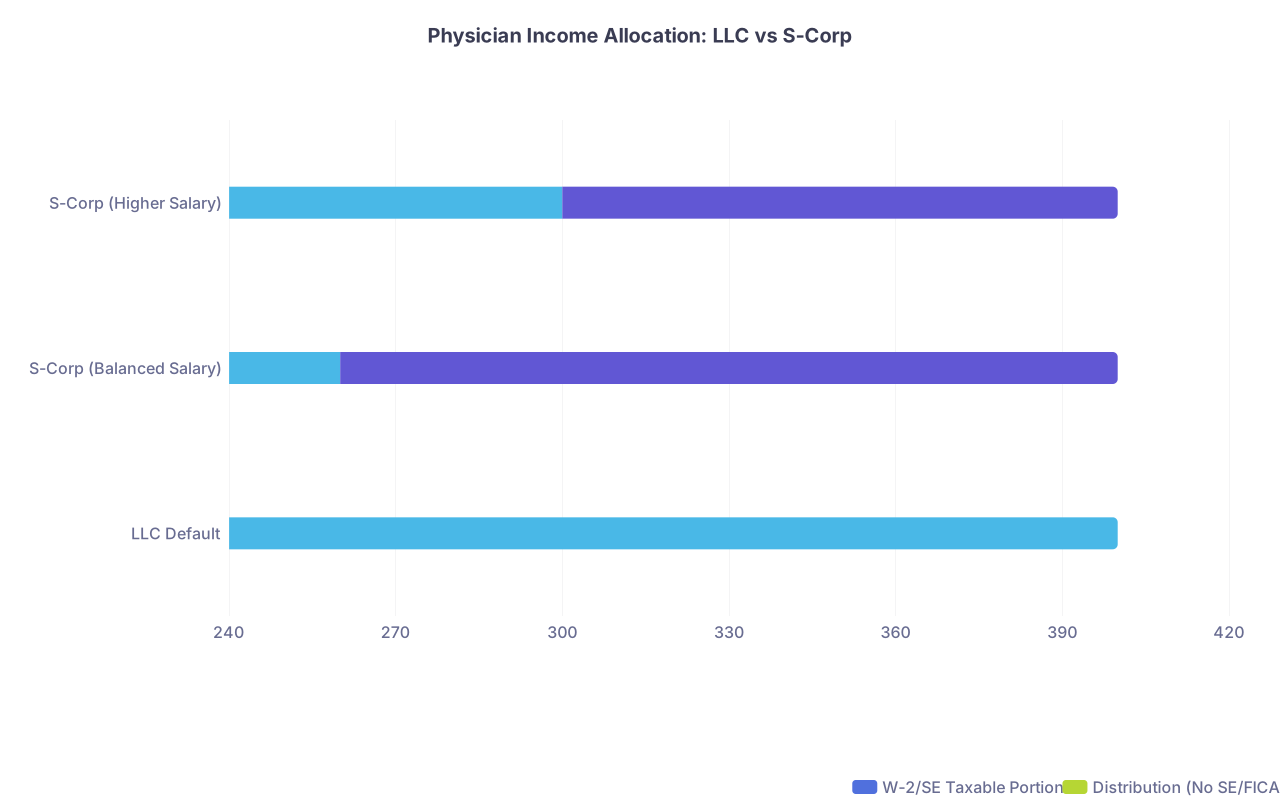
| Category | W-2/SE Taxable Portion | Distribution (No SE/FICA) |
|---|---|---|
| LLC Default | 400 | 0 |
| S-Corp (Balanced Salary) | 260 | 140 |
| S-Corp (Higher Salary) | 300 | 100 |
(All numbers in thousands; illustrative only.)
12. Execution: If You Decide to Move Forward with S‑Corp
Let me outline the technical steps, because half the mess I see in audits comes from sloppy implementation.
Confirm state law
– Check that your state permits a professional entity (PLLC/PC) to elect S‑corp.
– Confirm ownership restrictions (all physician owners, no non‑physician shares).Choose entity type
– If starting from scratch: form PLLC or PC with proper professional designation, EIN, bank account.
– If you already have an LLC/PLLC: review operating agreement to ensure it fits S‑corp rules (single class of stock, etc.).Elect S‑corp on time
– File Form 2553 within 2.5 months of the start of the tax year, or use late election relief if applicable.
– Make sure every eligible owner signs as required.Set “reasonable compensation” annually
– Document with MGMA or similar bench data.
– Put your calculation and rationale in writing each year.
– Update when your duties, hours, or income materially change.Implement payroll properly
– Use a payroll service that handles federal and state withholding, FICA, unemployment, and W‑2s.
– Pay salary regularly (not one random check in December).Keep distributions clean
– Owners take distributions proportional to ownership (only one class of stock/income).
– Avoid shareholder loans, disguised wages, or strange allocation games unless your CPA tells you it is intentional.Reevaluate annually
– Income goes down? S‑corp savings may evaporate.
– Income goes up substantially? May justify adjusting salary and distributions.
– State tax changes or new federal rules? Re‑run the math.
13. Where Physicians Specifically Go Wrong
I see the same mistakes repeatedly:
- Setting laughably low salaries (“I pay myself $80k W‑2 on $500k income”).
- No documentation of compensation rationale.
- Running personal expenses through the practice recklessly, then trying to convince an auditor that wages are “reasonable.”
- Ignoring retirement plan interactions, then discovering they capped themselves at low employer contributions.
- Forming entities inconsistent with state professional rules, risking medical board issues or voiding contracts.
The IRS today is much more data‑driven. They have large samples of physician pay by specialty, geography, and practice type. If you choose S‑corp, assume they can see whether your wage/distribution split looks absurd compared with your peers.
14. Final Takeaways
You have a demanding clinical job. You do not need a fragile, over‑engineered tax structure that only works if no one looks too closely.
Here is the short version:
- S‑corps for physicians are about FICA savings on distributions, nothing magical. At higher incomes ($250k+ 1099), the savings can justify the admin. Below that, often not.
- “Reasonable compensation” for doctors is high. Use real comp data, document your logic, and do not chase unicorn savings by paying yourself obviously low wages.
- Entity choice lives inside state professional rules, retirement plan design, and your real income pattern. Run your numbers with someone who actually understands physician compensation, not generic small business boilerplate.
If you treat this like a technical problem, not a trend, you will make the right call.


