

Most physician partners are leaving tens of thousands of dollars on the table every year because they do not understand how K‑1 income and guaranteed payments actually get taxed.
Let me break this down specifically, the way I do with practice partners who show up in March clutching their K‑1 and wondering why their tax bill just jumped by $80,000.
You are not a W‑2 employee. The game is different. The rules are different. And the IRS does not care that your “salary” is called a “draw” or that your group “withholds” 25% for taxes. The Code cares about one thing: how the partnership allocates profit and what ends up on your Schedule K‑1.
This is a deep dive into tax planning for physician partners with:
- Schedule K‑1 income from a partnership or LLC taxed as a partnership
- Guaranteed payments (your “base comp,” “draw,” or “stipend”)
- Possibly distributions, buy‑in payments, or ancillary business income
If that is you, keep reading. If you think your accountant “takes care of it,” you are exactly the person who needs to understand this.
1. The Core Problem: You Think Like a W‑2, But You Are a Partner
W‑2 employment is simple: the hospital withholds taxes, you file a 1040, maybe itemize a few deductions, call it a day.
Partnership K‑1 life is not simple:
- You are taxed on allocated profit, not what you physically take home.
- Guaranteed payments are taxed like wages for income tax and self‑employment tax, but reported completely differently.
- Distributions are usually not taxable, but they are absolutely not “tax free money.” They just represent profit you are already being taxed on.
Let’s put some rough numbers to this.
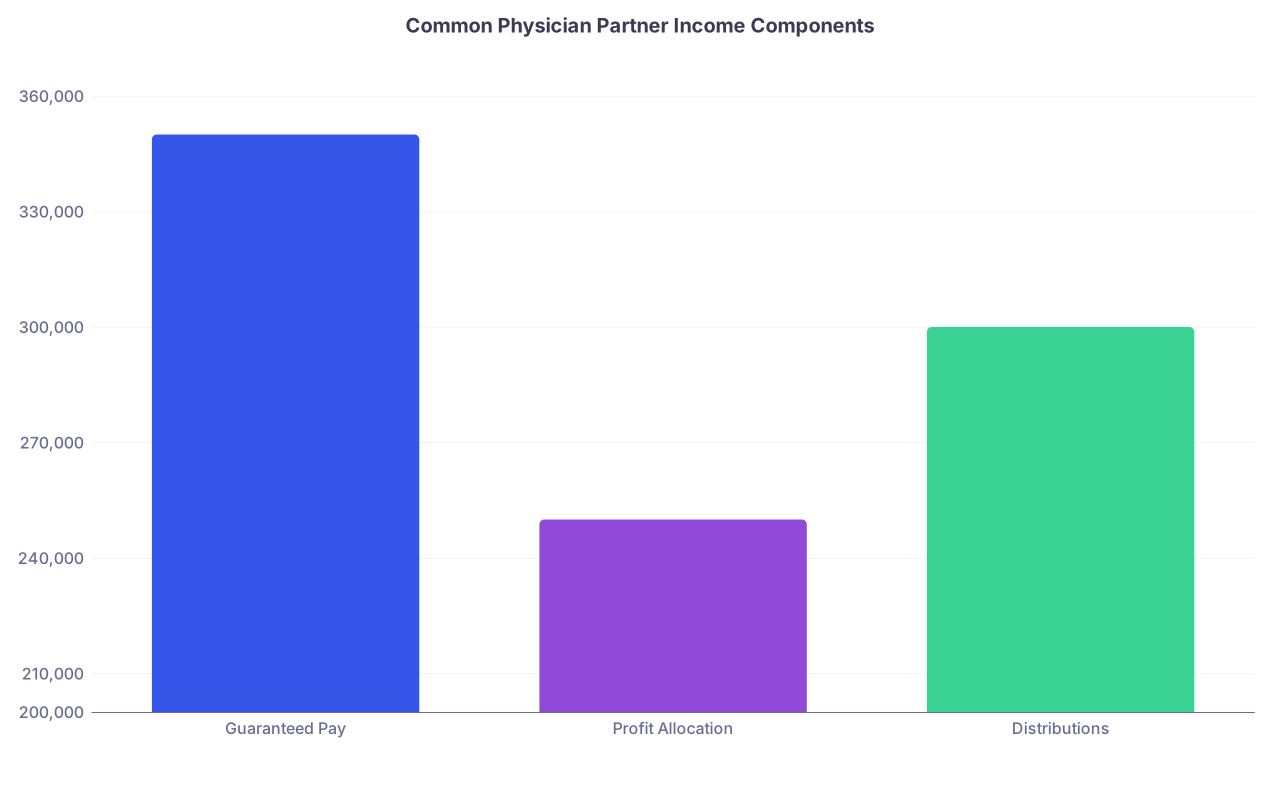
| Category | Value |
|---|---|
| Guaranteed Pay | 350000 |
| Profit Allocation | 250000 |
| Distributions | 300000 |
A very typical setup for a mid‑career physician partner:
- Guaranteed payment: $350,000
- K‑1 ordinary business income (your share of profit): $250,000
- Cash distributions during the year: $300,000
Tax reality:
- You owe income tax and self‑employment (SE) tax on $350,000 guaranteed payments.
- You also owe income tax and usually SE tax on $250,000 of allocated profit.
- The $300,000 cash distribution is usually not separately taxable; it is just pulling cash out of your capital account.
You see $650,000 as “what I earned this year.”
The IRS sees $600,000 of taxable partnership income.
Your checking account sees $650,000 of cash.
Your tax bill feels like a gut punch.
2. What K‑1 Income and Guaranteed Payments Actually Are
Let me get precise with the terms, because the wording in your partnership agreement matters.
Guaranteed Payments – Your “Salary,” But Not Really
Guaranteed payments under §707(c) are amounts paid to a partner for services (or capital) that are determined without regard to partnership income.
In plain English: The group pays you $X no matter what the practice’s profit is.
Tax treatment:
- Reported to you on Schedule K‑1, not on a W‑2.
- Goes on your 1040 as “ordinary income” (usually Schedule E, with a notation).
- Subject to income tax and self‑employment tax (Social Security up to the cap, plus Medicare, plus the 0.9% additional Medicare if you are high income).
- Deductible to the partnership as an expense before computing residual profit.
If your “base comp” is structured as a guaranteed payment, it behaves like self‑employment income, not W‑2 wages.
K‑1 Ordinary Business Income – Your Share of the Pie
After the partnership deducts all expenses, including guaranteed payments, what is left is partnership profit. That profit is allocated among partners based on whatever sharing ratios are in your partnership (or operating) agreement.
Your share of that profit shows up on:
- Schedule K‑1, Box 1: Ordinary business income (loss)
- Possibly Box 2 (rental), Box 3 (interest), or Box 4 (dividends), etc., for other items
Tax treatment:
- Included in your 1040 as pass‑through income.
- Usually subject to income tax and self‑employment tax if you are an active physician partner.
- You owe tax even if the group leaves the cash inside the practice and does not distribute it to you.
That last point is the one that burns people: “Phantom income.” The partnership allocates you $250,000 of profit on your K‑1 but only distributes $150,000 in cash. You still owe tax on $250,000.
Why This Structure Matters For You
The breakdown between guaranteed payments and K‑1 income drives:
- Self‑employment tax exposure
- Ability to qualify for the Qualified Business Income (QBI) deduction
- Your capacity for retirement plan deferrals (especially if you have a plan tied to “earned income”)
- Estimated tax planning and cash reserve needs
3. The Tax Buckets: How Your K‑1 Income Gets Hit
You do not have “one” tax. You have several. Understanding which income hits which bucket is half the game.
3.1 Income Tax vs Self‑Employment Tax
You face:
- Federal income tax
- State income tax (unless you are lucky enough to be in TX, FL, TN, etc.)
- Self‑employment tax on partnership earnings (12.4% Social Security up to the annual wage base, plus 2.9% Medicare, plus 0.9% Additional Medicare above thresholds)
Here is a clean view.
| Income Type | Subject to Income Tax | Subject to SE Tax | Common For Partners |
|---|---|---|---|
| Guaranteed Payments | Yes | Yes | Very common |
| K‑1 Box 1 (active) | Yes | Yes | Very common |
| K‑1 Investment Income | Yes | No | If group owns RE |
| Qualified Dividends | Yes, at pref. rates | No | Less common |
| Capital Gains | Yes, at cap. rates | No | Asset sales |
3.2 The QBI Deduction (Section 199A) – Often Overestimated
You are in a “specified service trade or business” (SSTB) as a physician. That is tax jargon for: Congress does not like giving you the full QBI deduction when you earn a lot.
Mechanics in brief:
- QBI is basically your share of qualified business income from the partnership (K‑1 Box 1 and similar) excluding guaranteed payments.
- Potential 20% deduction on this QBI.
- Phased out as taxable income rises above set thresholds for SSTBs. For 2024, for married filing jointly, the full deduction is allowed below $383,900 of taxable income and completely phased out above $483,900. (Single filing thresholds are lower.)
If your combined household income is high—which for most successful physician partners it is—your QBI deduction is often sharply reduced or eliminated. Yet I still see people projecting “20% off my K‑1 income” in rough back‑of‑envelope math. Wrong.
But QBI still matters at the margin. Maximizing retirement contributions, timing income/expenses, and entity planning can sometimes bring you back into an effective QBI window.
4. Cash Flow Planning: Estimated Taxes So You Do Not Get Crushed in April
This is where physician partners get hurt the most. I see it every year.
You earn:
- $350,000 in guaranteed payments
- $250,000 in K‑1 profit
Total partnership income: $600,000.
The group “withholds” 25% of your gross and sends you the rest as draws/distributions. You feel safe. Until your CPA shows you that your combined federal + state + SE tax rate on that income is closer to 40–45%.
You are short by six figures.
4.1 How To Set Your Own “Withholding”
You must think like a 1099, not a W‑2. Self‑funded tax planning:
Estimate your total tax rate on partnership income:
- Federal: often 24–37%
- State: 0–10%
- SE tax effective rate on income above the Social Security cap: roughly 3.8% (Medicare + Additional Medicare) once you are past the Social Security base
Many physician partners in high‑tax states land around 38–45% combined.
Set an automatic tax sweep:
- Every time your group does a distribution or draw, peel off a fixed percentage (often 35–45%, depending on your state and situation) into a separate “tax” savings account.
- Do not commingle this with emergency fund or investments.
Make quarterly estimated payments:
- Use IRS Form 1040‑ES for federal.
- Use analogous estimated payment vouchers for your state.
- Many high‑earners fund federal estimates via big one‑time payments synced to distributions (for example, a large Q1 distribution after year‑end true‑up).
Here is how the mismatch typically looks.
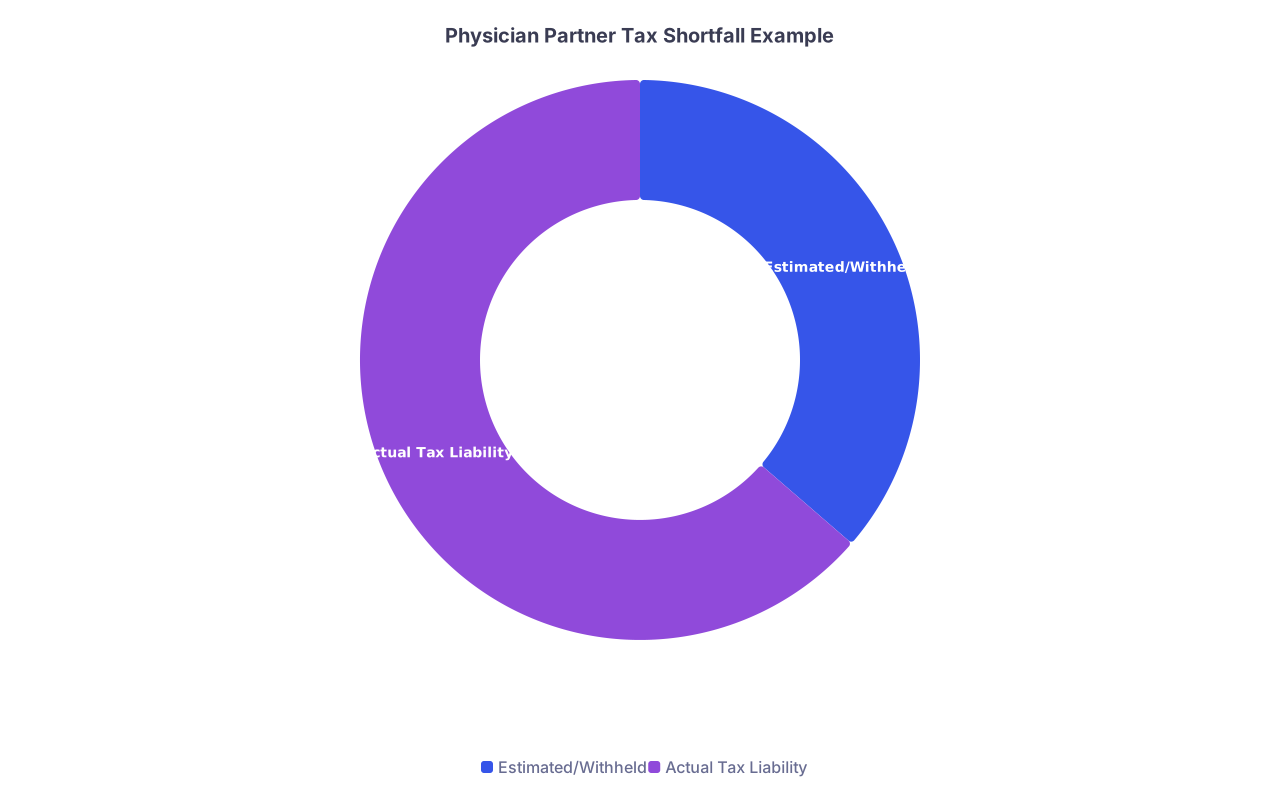
| Category | Value |
|---|---|
| Estimated/Withheld | 120000 |
| Actual Tax Liability | 210000 |
If you only treat 20–25% as “for taxes,” you will consistently under‑fund your eventual liability.
4.2 Safe Harbor Rules – How Not To Get Penalized
You can avoid underpayment penalties if you:
- Pay at least 90% of the current year’s tax liability through withholding and estimates; or
- Pay at least 100% (110% for higher incomes) of your prior year’s tax via withholding and estimates.
Physician partners often use the 110% prior‑year safe harbor as a baseline, then true up when they file the return. This smooths out variable income years, especially if your collections swing.
5. Big‑Impact Planning Areas for Physician Partners
Now the part you actually care about: how to reduce the tax hit without committing fraud or playing games the IRS hates.
5.1 Maximize Retirement Contributions – But Know What Is Possible
You do not control your partnership’s retirement plan design (usually), but you absolutely should understand it and push intelligently.
Common structures:
- 401(k)/profit‑sharing plan
- Cash balance pension plan layered on top
- 457(b) (if part of a hospital or academic structure) – this is not from the partnership entity, but often sits alongside your K‑1 world
Your contributions plus the partnership’s contributions reduce the partnership’s taxable profit, which reduces what flows to your K‑1. For you personally, pre‑tax deferrals reduce your current year tax while building assets in a tax‑deferred environment.
Targets:
- 401(k): Employee deferral up to the annual limit (e.g., $23,000 + catch‑up if age 50+, amounts change yearly).
- Profit sharing: Employer contribution generally up to total annual additions limit (for example, $69,000 or $76,500 with catch‑up for 2024; both your deferral and employer contributions count toward that).
- Cash balance: Can allow six‑figure annual contributions for older physicians.
The high‑leverage move: Work with a practice‑wide TPA/actuary to model how increasing employer contribution or adding a cash balance plan affects partner vs staff contributions. Well‑designed plans heavily favor physician partners without violating nondiscrimination rules.
5.2 Health Savings Accounts (HSA) – Often Ignored, Quietly Powerful
If your group’s health insurance arrangement allows a high‑deductible health plan (HDHP), you might be eligible for an HSA.
- Triple tax benefit: deductible going in, tax‑free growth, tax‑free withdrawals for qualified medical expenses.
- Can effectively serve as a stealth retirement account if you pay current medical expenses out‑of‑pocket and let the HSA grow.
Not a giant dollar amount compared to your K‑1, but at high marginal rates every shielded dollar matters.
5.3 Choosing Between Guaranteed Payments and Profit Share
This is the subtle one, and it depends heavily on your partnership agreement and tax advisor’s comfort.
Guaranteed payments:
- Always subject to SE tax.
- Reduce partnership profit (so can impact QBI negatively, if applicable).
- Provide predictability to you.
K‑1 profit allocation:
- Also subject to SE tax if you are an active partner.
- Drives QBI.
- Can better tie your income to collections and practice performance.
For physicians, unlike some investors, you usually do not escape SE tax simply by changing labels. You are actively performing services. The IRS is not amused by aggressive attempts to recast compensation as “distributive share” only to avoid SE tax.
But there are still planning levers—timing of income, bonus structures around year‑end, and how aggressively the practice retains vs distributes profits.
6. Entity and State‑Level Strategies: Where the Bigger Moves Live
This is where things get just technical enough that you must involve a competent CPA and usually a tax attorney. But you should know the landscape.
6.1 Pass‑Through Entity (PTE) Tax Elections – SALT Workarounds
If you are in a high‑tax state (CA, NY, NJ, IL, etc.), you have a state and local tax (SALT) deduction cap of $10,000 on your federal return. You cannot deduct your full state income tax as an itemized deduction.
Many states now offer a Pass‑Through Entity (PTE) tax election:
- The partnership itself pays state income tax on its income.
- The partnership deducts that state tax on its federal return as a business expense.
- Partners receive a corresponding state credit or adjustment.
For a physician partnership with several million in net income, using the PTE election can create a meaningful federal tax benefit for partners by functionally bypassing the $10,000 SALT cap.
This is not optional “nice to have.” In high‑tax states, if your group is not analyzing PTE election annually, you are leaving serious money on the table.
6.2 Side Entities – Real Estate and Ancillary Services
Many physician groups:
- Own their clinic building through a separate LLC.
- Hold imaging, labs, or ASC interests through separate entities.
Those K‑1s behave differently:
- Rental income might not be subject to SE tax.
- Depreciation and interest expense can shelter some of that income.
- Eventually, sale of the building or ancillary business can trigger capital gains, taxed at lower rates.
This is why you might have three or four K‑1s in your tax packet:
- Core practice partnership – your main professional income.
- Real estate LLC – rent from the building.
- ASC or imaging center partnership – facility fees or technical revenue.
- Management company, sometimes.
Tax planning here is about:
- Ensuring inter‑company leases are set at reasonable fair market rates.
- Proper depreciation schedules.
- If you materially participate, whether the income is passive or non‑passive for loss limitation purposes.
7. Practical Year‑Round Tax Planning Checklist
I am not a fan of generic “checklists,” but for physician partners this sequence works.

| Step | Description |
|---|---|
| Step 1 | Start of Year |
| Step 2 | Review Prior Year K-1s |
| Step 3 | Set Quarterly Tax Estimates |
| Step 4 | Maximize Retirement Plan Elections |
| Step 5 | Midyear Income Check |
| Step 6 | Adjust Distributions or Estimates |
| Step 7 | Year End Planning Meeting |
| Step 8 | Finalize Contributions and Bonuses |
| Step 9 | Gather Docs for CPA |
| Step 10 | File Return and Reset |
What to do, specifically:
Q1 (Jan–Mar):
- Review last year’s K‑1s and tax return.
- Calculate effective tax rates.
- Set estimated payment targets and auto‑transfer percentage to your “tax” account.
- Confirm retirement plan limits for the year.
Q2–Q3:
- Get year‑to‑date financials from your practice (production, collections, YTD draws, and expected profit).
- Mid‑year 1‑hour call with your CPA: Are we over‑ or under‑withholding? Any expected swings in income?
- Confirm whether the practice will use the state PTE election again.
Q4 (critical):
- Finalize retirement plan contributions (401(k) deferrals, profit sharing, cash balance).
- Consider pre‑paying certain practice expenses if income is unusually high (only at the entity level, and only with your CPA’s blessing).
- Re‑evaluate QBI eligibility – any levers to pull before year end?
Tax Filing Season (Feb–Apr):
- Get K‑1s as early as possible from the practice. Push for internal deadlines.
- Review K‑1 for accuracy: capital account movements, guaranteed payments, profit share percentages.
- Post‑mortem with CPA: what worked, what did not, what to change in the partnership agreement or your withholding approach.
8. Common Mistakes I See Physician Partners Make
These are not theoretical. These are the actual train wrecks that land in my inbox.
Treating partnership “withholding” as if it were W‑2 withholding.
Result: Massive April balances due and underpayment penalties.Ignoring the K‑1 until March.
By then it is too late to adjust prior‑year retirement contributions (especially for some plans) or restructure compensation.Assuming someone else is looking at PTE election or SALT strategies.
Many smaller groups outsource to bookkeepers who do not even raise the issue.Over‑estimating QBI.
Planning based on a 20% deduction that disappears once taxable income crosses a threshold.Failing to coordinate household income.
Your spouse’s W‑2, 1099 gigs, backdoor Roths, and RSUs all affect marginal tax brackets and timing decisions.No mental separation between “distributions” and “income.”
Spending every dollar distributed as if it is pure, after‑tax take‑home, rather than partly future tax liability.
9. When You Actually Need to Pay For Help (And What Kind)
There is a point where DIY with TurboTax plus a friendly neighborhood CPA is not enough. Physician partners with K‑1 income and guaranteed payments usually cross that line.
You want:
- A CPA who prepares many physician and professional service partnership returns, not just generic small business returns.
- Someone fluent with:
- K‑1 allocations
- PTE elections and state‑specific rules
- Cash balance and defined benefit plan designs
- Basic planning for ancillary entities and real estate
And you want them engaged by Q2, not March 10.
You do not need:
- A “wealth manager” whose primary value is charging 1% AUM to put you in target‑date funds while giving superficial tax commentary.
- Aggressive scheme‑salespeople pitching dubious captive insurance arrangements, questionable conservation easements, or “we can make your income passive” nonsense just to dodge SE tax.
If someone’s pitch sounds like a magic trick—big tax savings with no underlying economic substance—walk away.
FAQ (Exactly 5 Questions)
1. My group pays me a “salary” on a W‑2 and also gives me a K‑1. Am I still a partner for tax purposes?
Yes. Many hospital‑affiliated or large multi‑specialty groups use hybrid structures where physicians receive W‑2 wages from one entity and a K‑1 from another (often for ancillary distributions, shared ownership, or bonuses). Your K‑1 income is still pass‑through partnership income on top of your W‑2. The planning becomes more complex, because SE tax may or may not apply depending on the structure, and you need to coordinate retirement limits, QBI treatment, and estimated taxes across both income streams.
2. Are guaranteed payments always bad because they are fully subject to self‑employment tax?
No. Guaranteed payments are not “bad”; they are a tool. They create predictable income regardless of practice profit, which is useful for both the group and junior partners. They are also fully deductible to the partnership, which can simplify allocations. The issue is not that they are taxed; your K‑1 profit is usually also subject to SE tax as an active partner. The real planning questions are: how much should be guaranteed versus variable, how it affects partner economics, and whether the structure undermines or supports long‑term QBI and retirement planning.
3. Do distributions from the partnership create additional taxable income for me?
Usually not. For an ongoing, healthy practice, distributions are generally just the mechanism to get already‑taxed profits out of the entity and into your personal account. Tax is triggered by the income allocated on the K‑1, not by the cash distribution itself. There are exceptions—liquidations, sales of partnership interest, or distributions exceeding your basis—but for a typical physician partner, the key is to remember: income is from the K‑1, cash from distributions is how you access it.
4. Can I avoid self‑employment tax on my K‑1 income by restructuring as an S‑corporation?
In most physician partnership settings, simply slapping an S‑corp label on top does not give you the clean SE tax reduction some business owners enjoy. Complexities include hospital or payer contracting rules, professional corporation laws, malpractice and credentialing requirements, and how the core partnership is legally organized. Where “S‑corp wrappers” are used (for example, your ownership interest held through a professional corporation that elects S‑status), the IRS still expects reasonable compensation subject to payroll taxes. Any SE tax planning has to be done very carefully with competent counsel; aggressive attempts to convert nearly all income to distributions are a red flag.
5. What is the single highest‑value move for a new physician partner in year one?
Two things, done together. First, set a conservative automatic tax reserve: sweep 35–45% of every draw/distribution into a separate high‑yield savings account for taxes and commit to quarterly estimates. That prevents the predictable first‑year tax disaster. Second, sit down early with a CPA who understands physician partnerships and walk through your partnership agreement, K‑1 structure, retirement plan options, and state rules (including any PTE election). That combination—aggressive cash reserving plus informed planning—usually saves more money and stress than any exotic strategy.
Key points, no fluff:
- You are taxed on your K‑1 allocations and guaranteed payments, not on what hits your checking account. Distributions are not “extra income”; they are just moving already‑taxed profit.
- High‑leverage moves for physician partners are boring but powerful: over‑fund retirement plans, set aggressive quarterly tax reserves, and use state PTE elections where available.
- If your CPA is not proactively talking about K‑1 structure, SE tax exposure, QBI limits, and PTE strategy, you do not have a physician‑grade tax advisor yet.


