

You are standing in a hotel room in Denver on a Sunday night, suitcase still half-zipped, logging into credentialing for a hospital in Wyoming… while your W‑2 from a Texas locums assignment sits unread in your email, and you still officially “live” in California where your family is.
Three states. One physician. And all of them want tax money.
This is where multistate taxation stops being theoretical and starts being a real problem. If you do locums tenens, telemedicine across state lines, multi-state call coverage, or split employment between systems in different states, you are in multistate tax territory whether you like it or not.
Let me break this down specifically: we will focus on three pillars that drive everything for traveling physicians:
- Nexus – when you are “doing business” in a state
- Residency – which state gets to treat you as “theirs”
- Credits – how to keep from being taxed twice on the same dollar
Ignore any of those three, and you will either overpay or get letters from state Departments of Revenue that ruin your week.
1. Start with your “home base”: tax residency
Everything hangs on which state can claim you as a resident. Not “where your license is.” Not “where the group is based.” Where you are a tax resident.
Domicile vs statutory residency
There are two overlapping concepts, and physicians constantly mix them up:
- Domicile: your true, permanent home. Where you intend to return when you travel.
- Statutory residency: a state-created category if you are physically present enough and have a “permanent place of abode,” even if you claim domicile somewhere else.
Example you will actually see:
- You grew up and still own a house in New York (high-tax).
- You take a “tax-friendly” job in Florida, rent an apartment, start working locums all over the Southeast.
- You still spend summers with family in New York, easily breaking 183 days there some years.
New York can — and often will — say: you are domiciled in New York or at least a statutory resident. That means worldwide income is taxable by New York. Florida does not have an income tax, so New York wins by default.
If you are trying to move from a high-tax to a no-tax state (CA → TX, NY → FL, NJ → NV, etc.), you need an intentional, documented residency change. Waving your hands and saying “But I’m a traveler” does not hold up in audit.
| Category | Value |
|---|---|
| TX | 0 |
| FL | 0 |
| NV | 0 |
| WA | 0 |
| TN | 0 |
| WY | 0 |
| SD | 0 |
| AK | 0 |
| NH | 0 |
(Those “0” values simply highlight the group: states without an individual wage/earned income tax. NH taxes interest/dividends only.)
What actually proves residency
States do not care what you tell HR. They look at facts. The patterns I see auditors use repeatedly:
- Where your spouse and minor children live
- Where you own or lease your main home
- Driver’s license and vehicle registration
- Voter registration and where you actually vote
- Where your mail and Amazon packages are going
- Address on your federal return, bank accounts, medical license renewals
- Where your “stuff” really is: furniture, pets, cars
If you want Texas to be your tax home while you are working half the year in CA/NY, you need:
- A real Texas residence (own or long-term lease, not just a PO box or your cousin’s couch)
- TX driver’s license and car registration
- Voter registration and at least one election voted from that address
- Update all key documents to that address: bank, DEA, NPI, malpractice, licensing profiles
- Minimize overnight stays and physical presence in the high-tax state, especially early in the move
I have seen audits lost over things as small as “your kids are still in private school in Manhattan” while someone swore they had moved to Florida.
2. Nexus: when your work creates tax exposure in another state
Now shift from “where you belong” (residency) to “where you are working” (nexus).
Nexus is the threshold where a state can say: you are conducting business here, and we get to tax the related income.
There are two flavors relevant to physicians:
- Employee wage nexus – when your W‑2 income is taxable in a state
- Business/independent contractor nexus – when your 1099 or practice income is tied to that state
Employee wage nexus – the hospital shift problem
As an employed physician, nexus is brutally simple: physically working in a state = that state can tax the wages earned there.
- 7 night shifts in Colorado at a hospital on a W‑2 → Colorado gets to tax those wages.
- 10 clinic days physically in Oregon while employed by a Washington group → Oregon gets tax.
- Commuting across state lines (live in NJ, work in NY) → both care, but the work state (NY) gets first dibs.
Yes, even if:
- You are there only a few days a year.
- You are “just moonlighting.”
- The hospital never withholds that state’s tax on your paycheck.
States differ on enforcement, but the rule is clear: source of wage income is where the work is physically performed.
1099 and telemedicine: the silent nexus killer
For independent contractors or S‑corp/PC owners doing telemedicine or remote coverage, nexus gets more complicated.
Think through two separate questions:
- Where are you sitting when you provide services?
- Where is the patient located and where is the facility licensed?
Both can create nexus.
Common real scenarios:
- You live in Texas and do tele-ICU for a California system. You sit in Dallas, patients and hospitals are in CA.
- You live in Florida and take tele-psych consults from your home for hospitals in NY and MA.
- You are licensed in 10+ states via the IMLC and do mixed telehealth / in-person locums.
Some states source service income to where the work is performed (your location). Others source to where the benefit or patient is located. It depends on the statute and whether it is wage vs business income.
Bottom line: multistate telemedicine can easily give you:
- Filing requirement in your home state (resident on worldwide income)
- Nonresident filings in multiple “patient” states that treat the income as sourced there
You will not get a friendly email saying “by the way, you created nexus.” You find out when a CP2000-type state notice arrives, or worse, when a big state like California matches licensing or hospital reporting data to your federal return.
3. Nonresident returns vs resident return: who gets what
So now you have:
- One resident state (domicile) that taxes worldwide income
- Several nonresident states that want to tax income you sourced there (wage or business)
The order of operations matters.
The correct filing sequence
You do not just throw numbers randomly onto each return. The clean way:
- Prepare the federal return first. This is your master income and deduction picture.
- For each nonresident state, calculate the portion of income sourced to that state. File a nonresident return there.
- Then prepare your resident state return, reporting all income, and claim credits for taxes paid to other states where allowed.
Do not reverse that order. If you start with your resident state and hack numbers to “fit,” your credits will not reconcile to the nonresident filings, and matching programs will flag you.
How income is partitioned
Common approach for a W‑2 physician with multiple states:
- Allocate W‑2 wages among states based on actual days worked or shifts logged in each state.
- Use physician schedules, locums contracts, or pay stubs with state-specific earnings where available.
- Keep a simple spreadsheet tracking date, location, and type of work.
For 1099/S‑corp:
- Allocate professional fees or collections based on:
- Where services were physically performed, and / or
- Where patients/hospitals are located, depending on state rules
- Use work logs, billing reports, and telehealth dashboards to support allocation.
When a state accepts apportionment by workdays, I often see 3 buckets:
- State A: 120 days
- State B: 60 days
- Other states: 40 days
- Total: 220 workdays → allocate proportionally to A, B, and “everywhere else.”
4. Credits for taxes paid to other states: the double-tax shield
Here’s the good news: in most cases, you are not supposed to pay full tax twice on the same income.
Your resident state usually gives a credit for taxes paid to other states on the same income, but only up to the amount of its own tax on that income.
You need to understand how this works, or you will:
- Overpay by not claiming the credit, or
- Trigger notices by claiming credits that do not match what other states report.
| State | Role | Tax Rate on Income | Tax Due on $100k | Credit Mechanics |
|---|---|---|---|---|
| NY | Resident state | 9% | $9,000 | Credits tax paid to other states |
| CA | Nonresident source | 10% | $10,000 | Taxes CA-sourced portion; no outbound credit |
| TX | None | 0% | $0 | No state income tax |
If that same $100k is sourced to CA and you are a NY resident:
- CA taxes the $100k at 10% → $10,000
- NY computes tax on all your income. For this $100k, NY’s share would be $9,000.
- NY gives you a credit up to its own tax on that income → $9,000 credit.
- You still end up with $10,000 total tax (CA wins, NY effectively backs off on that income).
There is no “refund” of the extra $1,000. You are just capped at single level of state tax at the higher state’s rate.
Common physician-specific credit mistakes
I see the same patterns over and over in multistate physician returns:
- Claiming a credit in the wrong direction (trying to take a credit on the nonresident return instead of the resident return).
- Forgetting that some states do not give a credit for taxes paid to certain other states, or only for wage income, not business income.
- Assuming a no-tax or low-tax state gives a credit (it does not – there’s nothing to credit against).
- Double-counting – taking credit in two different resident states in a transition year.
If you changed residency mid-year (for example, moved from CA to TX in July while still doing CA locums afterward), the credit calculus gets messier. You may need to:
- File part‑year resident in old state
- Nonresident in old state for the post-move source income
- Resident in new state on worldwide income from the move date
- Coordinate credits across all of them
That is when DIY software starts to fall apart.
5. Special complications for physicians: multi-entity, multi-role lives
You are not a simple W‑2 employee. Most traveling physicians who ask about multistate taxation have 3–5 income sources:
- W‑2 hospital employment in one or more states
- 1099 locums or telehealth through a staffing company
- An S‑corporation / professional corporation
- Partnership K‑1 from a group practice or ASC
- Various 1099s from speaking, expert witness work, CME teaching, etc.
Let me walk through how this actually interacts with multistate rules.
W‑2 multi-state work
If you are on payroll in multiple states, you should see:
- Follow-up W‑2s showing state wages and withholding per state, often with box 15–17 details for two or three states.
Problems I see:
- Employer incorrectly sources all wages to one state, ignoring travel shifts elsewhere.
- Employer withholds in a state based on your “residence” paperwork, not where you physically work.
- No withholding done for states where you clearly have wage nexus.
You are still responsible for filing in those states even if withholding is wrong or zero. The fix:
- File accurate nonresident returns anyway.
- Potentially adjust future withholding (new W‑4 state equivalents) if the income is recurring.
S‑corporation or PC income
If you set up an S‑corp (or are a shareholder in a group PC taxed as S‑corp), you do not get to magically escape multistate sourcing. Two layers to think about:
- At the entity level: the S‑corp must file in each state where it has nexus (offices, telehealth footprint, significant services).
- At the shareholder level: your K‑1 income is allocated among states based on apportionment factors (often sales or service revenue by state).
So if your professional corporation in Texas is providing tele-neurology consults to hospitals in California and New York, that PC may have to:
- Register in CA and NY
- File multi-state S‑corp returns
- Apportion income among TX, CA, NY
- Push that multi-state breakdown onto your K‑1
Then your personal returns in your resident state + the nonresident states all have to line up with that K‑1 breakdown.
Partnerships, ASCs, and side LLCs
Same concept: partnership nexus = your nexus through the K‑1. If you own 2% of an ASC in Arizona that sees patients pulled from four neighboring states, you might suddenly find an AZ nonresident K‑1 triggering an AZ filing requirement.
6. Multi-state physician case study (realistic pattern)
Let me give you a composite scenario I have seen versions of dozens of times.
Dr. A:
- Domiciled in California through 6/30 (owns a home, family there).
- Moves to Nevada on 7/1, buys a condo, gets NV license and registration, kids move schools.
- W‑2 job in CA Jan–June.
- Locums W‑2 in Oregon for 40 shifts spread across the year.
- 1099 tele-ICU from home in NV covering hospitals in CA and WA from August–December.
How this plays out:
Federal return: W‑2 CA wages, W‑2 OR wages, 1099 NEC or S‑corp K‑1 for tele-ICU, all Schedule C or K‑1 details.
California return:
- Part‑year resident 1/1–6/30: worldwide income in that period (including OR shifts during that window if any, plus any tele work done while still living in CA).
- Nonresident 7/1–12/31 for CA-sourced income only:
- Any CA in-person shifts post-move
- Portion of tele-ICU income that CA treats as sourced to CA (often patient/hospital location based).
Oregon return:
- Nonresident return with OR-sourced wages based on the locums W‑2 (ideally the W‑2 shows OR state wages).
Nevada:
- No individual income tax. No return. Good.
Residency-credit interaction:
- For the first half of the year, CA may give credits for taxes paid to OR on overlapping income, depending on timing.
- For the second half, there is no resident state credit because Nevada has no income tax.
Multiply that by two or three years of partial moves and recurring locums assignments, and you see why “just use TurboTax” is often not enough.
7. Minimizing headaches: structuring your multistate work
You will not get this perfect, but you can make your life much easier with some basic structuring decisions.
Concentrate your nonresident work
Instead of sprinkling 2–3 shifts in five different states, you are far better off:
- Working mostly in your home state plus 1–2 “target” states,
- Or batching locums such that you spend a block of time in a single other state.
Each additional state with meaningful income usually means:
- Another nonresident return
- More apportionment complexity
- More notice potential
If an opportunity adds only marginal income but forces a brand-new, high-complexity state filing (California, New York, New Jersey, Massachusetts), I often tell physicians: that “one week of locums” is not worth the multiyear tail.
Pay attention to high-friction states
Some states are simply harder:
- California
- New York
- New Jersey
- Massachusetts
- Pennsylvania
- Some city-level taxes: New York City, Philadelphia, etc.
They have:
- Aggressive residency audits
- Tight sourcing rules on telemedicine and service income
- Complex credits and apportionment forms
If you are going to work in these states while claiming residency somewhere else, do it with your eyes open. Keep:
- Detailed logs of days and locations worked
- Documented timeline of any residency changes
- Clean separation of business entities if you use them
Track your workdays. Like a grown-up.
Physicians hate time-tracking. But for multistate tax, your calendar is gold.
Minimal viable system:
- A master calendar (Google Calendar, Outlook, even a spreadsheet) with:
- Date
- Location (state, facility)
- Type (in-person, tele, home call, etc.)
- At year-end, export and tally workdays by state.
When a state questions your apportionment or wage sourcing, a clean, contemporaneous calendar shuts down a lot of arguments. “I think I worked about 20 days in Oregon” doesn’t.

| Step | Description |
|---|---|
| Step 1 | Plan Assignments |
| Step 2 | Track Workdays by State |
| Step 3 | Determine Residency and Domicile |
| Step 4 | Identify States with Nexus |
| Step 5 | Prepare Federal Return |
| Step 6 | File Nonresident State Returns |
| Step 7 | File Resident State Return with Credits |
| Step 8 | Review Notices and Adjust Future Withholding |
8. Practical documentation checklist
If you are a traveling physician or telemedicine-heavy doc, here is what you should have ready every year:
- Work calendar with location for each clinical day
- All W‑2s, checking that state codes and wages look sane
- All 1099s, plus breakdowns by client/hospital and state if possible
- Contracts for locums and telehealth assignments (states, facilities, expected locations of service)
- Evidence of residency: lease or deed, driver’s license, voter registration, school records for kids
- If changing residence: moving date, closing/lease dates, updated IDs, address change confirmations
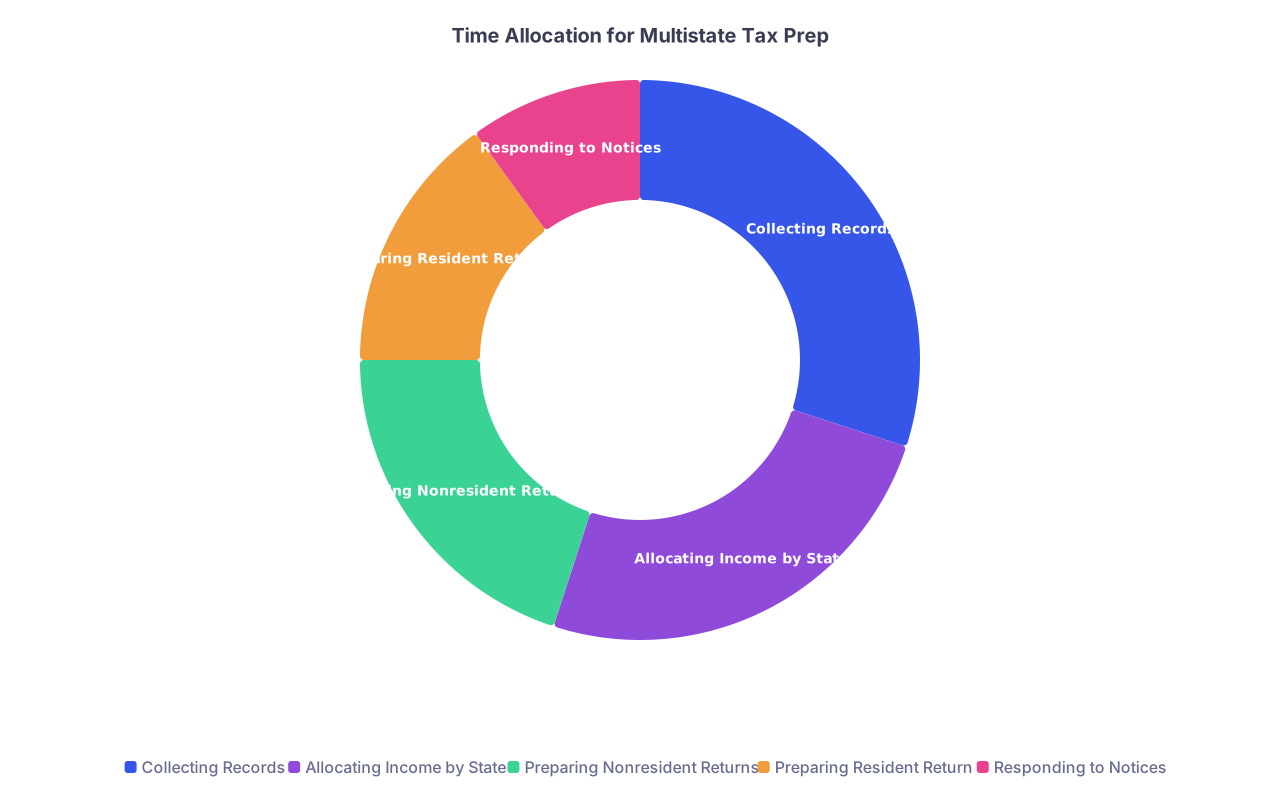
| Category | Value |
|---|---|
| Collecting Records | 30 |
| Allocating Income by State | 25 |
| Preparing Nonresident Returns | 20 |
| Preparing Resident Return | 15 |
| Responding to Notices | 10 |
Spend time once setting this up properly, and the downstream compliance is much less painful.
9. When you absolutely should not DIY
I am not going to pretend everyone needs a tax specialist every year. But there are red-flag situations where you should not be the one piecing this together in April at 11 p.m.
Here’s where I draw the line:
- You have meaningful income in 3+ states (not just $2k from a one-off weekend).
- You changed residency between a high-tax and a no-tax state in the last 2–3 years.
- You own an S‑corp, PC, or partnership that has revenue or operations in multiple states.
- You are doing telemedicine across many states and nobody has ever walked you through sourcing rules.
- You have already received a “nonfiler” or nexus letter from a state.
A good CPA or EA with real multistate experience will:
- Build a clean year‑by‑year residency narrative
- Standardize apportionment methods for your work
- Align your entity and personal filings so K‑1s and returns match
- Tell you when to walk away from assignments that are complexity bombs
And frankly, probably save you more in properly claimed credits and avoided penalties than the fee costs.

10. Key takeaways
I will keep this brief:
- Residency drives everything. You have one primary tax home (domicile), and high-tax states will fight hard not to lose you. If you claim to have moved, prove it on paper and in your lifestyle.
- Nexus is triggered by where you work and where your patients are. Locums, telemedicine, and multi-entity setups create filing obligations in states you barely think about.
- Credits are the guardrail against double taxation, but only if you file in the right sequence and claim them correctly. Get that wrong, and you either overpay or invite state scrutiny.
Handle those three pillars properly, and multistate taxation becomes annoying but manageable instead of career-level painful.
FAQ (exactly 4 questions)
1. If I live in a no-tax state (TX, FL, NV) and do telemedicine for patients in high-tax states, do I still owe those states tax?
Often yes. Many high-tax states source service income based on where the patient or hospital is located, not just where you sit. That means your telehealth or remote coverage can create nonresident filing obligations and taxable income in those states, even though your home state has no income tax. The exact answer is state-specific and depends on whether you are W‑2 or 1099 and how the contract is structured.
2. How many days can I work in another state before I have to file there?
There is no universal “safe” day count. Some states technically require a return if you earn even a few hundred dollars there. Enforcement varies, but once you have meaningful income or repeated assignments, you are solidly within filing territory. The more aggressive states (NY, CA, NJ, MA) have very low thresholds and sophisticated matching systems, so assuming “a few shifts don’t matter” is risky.
3. Can I avoid multi-state filings by running all my locums through an S‑corp in my home state?
No. An S‑corp does not block nexus. If the corporation has revenue sourced to other states (because services are performed there or patients are there), the entity itself may have to file in those states, and the K‑1 income will be apportioned among them. You still end up with multiple state filings, just with an extra entity layer that needs its own returns.
4. If my employer only withholds tax for my resident state, do I still owe taxes to the states where I moonlight?
Yes. Withholding is not what creates liability; earning income in the state does. If you work shifts in another state and your employer or locums group does not withhold there, you are still responsible for filing a nonresident return and paying any tax due. In those cases, your resident state may give you a credit, but only if you actually filed and paid the other state first.


