

It is 8:30 p.m. You just finished clinic, you are half‑scrolling through your email, and your recruiter drops a “final” contract PDF into your inbox. The base salary looks fine. But then your eyes hit the other lines: call stipends, quarterly quality bonus, relocation package, “medical directorship” stipend, and a mysterious “signing bonus.”
You know all of that is “income,” but how it is taxed? What gets hit with payroll taxes? What can be deferred into a 401(k)? What will trigger a nasty surprise next April?
This is where most physicians make preventable tax mistakes. Not on the base salary. On the extras.
Let me break this down specifically.
1. Big Picture: How the IRS Sees Your Contract
From a tax perspective, your compensation falls into three broad buckets:
- W‑2 employee income
- 1099 independent contractor income
- Reimbursements / fringe benefits (some taxable, some not)
Almost every nuance of call pay, stipends, and bonuses turns on one question:
Are you an employee (W‑2) or an independent contractor (1099)?
- Hospital-employed, large system, or academic physicians → usually W‑2
- Many locums, some telemedicine, some small groups → often 1099
- Private practice owners → often S‑corp/partnership with K‑1 income plus W‑2 from their own entity
Why this matters:
- W‑2: Income is subject to income tax + FICA (Social Security up to the annual wage cap + Medicare, plus possible additional 0.9% Medicare surcharge at high incomes). You cannot “expense” your own work costs on Schedule C anymore; unreimbursed employee expenses are basically dead for most people.
- 1099: Income hits Schedule C (or your entity). You pay both sides of Social Security and Medicare as self-employment tax. But you also get bona fide business deductions and more flexible retirement plan options.
Every line in your contract—call pay, “stipend,” bonus—has to be classified into one of those buckets. There is nothing magical about the label. The IRS does not care if the hospital calls it a “stipend,” “bonus,” or “distribution.” It cares how you actually work and how the payment is structured.
2. Call Pay: W‑2 vs 1099 and Payroll Tax Traps
Call pay is one of the most common places I see physicians misunderstand their tax position.
There are three main call structures:
- Embedded call – “Call included in your base salary”
- Separate call stipend as a W‑2 employee
- Separate call coverage as a 1099 contractor
Each one has slightly different tax consequences.
2.1 Embedded Call in Base Salary
“Base salary $350,000, call included, 1:4 rotation.”
Tax treatment: simple. Every dollar of that $350k is W‑2 wages.
You pay:
- Federal and state income tax (based on brackets)
- Employee payroll taxes:
- Social Security (6.2% up to the annual wage base)
- Medicare (1.45% on all wages + 0.9% Additional Medicare above thresholds)
No special deductions just because you took more call. The only leverage is through employer retirement plans (401(k), 403(b), 457(b), etc.) and benefits.
Financially, the problem is not tax. The problem is undervaluing call when it is baked into base.
2.2 W‑2 Call Stipend / Call Pay
Example:
“Additional call stipend: $1,000 per 24‑hour in‑house call, payable quarterly.”
If you are an employee, this is still W‑2 compensation. It is usually treated exactly like your base salary:
- Subject to income tax
- Subject to FICA (Social Security and Medicare)
- Counted in your “compensation” for 401(k)/403(b) limits and employer match (if the plan document defines it that way, which many do)
Implications:
- You cannot “shelter” call pay from FICA. There is no legal trick to recast it as something else if you are an employee.
- You could, however, increase your deferrals (401(k), HSA, etc.) during heavy-call years to offset the higher income.
- If call pay pushes you higher into brackets or drives you into the Additional Medicare Tax zone, your effective rate on those marginal dollars is higher than your blended rate.
Where this bites people:
You are used to $300k salary. New hospital offers $300k plus “$100k expected call pay.” You think, “Perfect, that covers my student loans.” Reality: marginal tax on that extra $100k is brutal—federal, state, plus additional Medicare. Your net on that call pay might be 45–55 cents on the dollar depending on your state.
2.3 1099 Call Coverage
Separate scenario. A hospital pays your group or pays you directly as a 1099 for “unassigned call” or ED coverage.
Now we are in self-employment territory.
If you personally receive a 1099‑NEC for call:
- Income goes on Schedule C (or through your S‑corp/LLC filing as a business).
- You pay:
- Income tax on the net profit
- Self-employment tax (both employee and employer side of Social Security and Medicare) on the first chunk of net earnings until you hit the Social Security cap.
But you get something powerful: deductions.
You can legitimately deduct:
- CME directly tied to that work
- Licensing and DEA fees needed for that call work
- Pro‑rated home office (if you meet rules), EHR subscription, medical software you pay for
- Pro‑rated cell phone, internet
- Certain professional services (CPA, legal) tied to the business
- Retirement plan contributions (solo 401(k), SEP‑IRA) on that net income
- Health insurance (self-employed health insurance deduction) in some structures
Here is where negotiations matter:
| Structure | Tax Form | Payroll Taxes | Deductions Possible |
|---|---|---|---|
| Embedded in base (employee) | W-2 | Yes | Very limited |
| Separate W-2 call stipend | W-2 | Yes | Very limited |
| 1099 call coverage (you direct) | 1099-NEC | Yes (SE tax) | Broad business |
| 1099 to your group/entity | K-1/1099 | Depends | Through entity |
The IRS does not like fake 1099s for what is really W‑2 work. But sometimes the call arrangement genuinely qualifies as separate contractor work (different agreement, your control of schedule, your malpractice coverage, etc.). If that is the case, structuring it properly can create room for more aggressive retirement savings and deductions.
3. Stipends: Education, Medical Directorships, and “Administrative” Money
Now let us talk stipends. The word “stipend” is abused in physician contracts. From a tax lens, there are three broad buckets:
- True tax‑free educational/reimbursement stipends
- Taxable W‑2 stipends (most “medical directorship” or admin stipends)
- 1099 stipends (consulting, committee work, advisory roles)
3.1 Education Stipends, CME, and Reimbursements
Example clauses you see:
- “Annual CME stipend of $3,000.”
- “Licensing and board fees reimbursed up to $5,000 per year.”
- “Education stipend of $10,000 during fellowship.”
Tax treatment depends on structure.
If you are an employee and the employer has an accountable plan and reimburses actual business expenses (CME, board fees, license renewal, required conferences), those reimbursements are usually not taxable to you. They do not show up in your W‑2 if done correctly.
The key pieces of an accountable plan:
- You substantiate the expense (receipt, date, business purpose).
- Excess reimbursements are returned or not given.
- Payments align reasonably with business purposes.
If instead they say “CME stipend of $3,000 paid to you in cash, no receipts required,” that is usually taxable W‑2 income. I see this mis‑implemented all the time.
Fellowship “stipends” are another mess. Many training stipends are simply W‑2 wages with a nicer word. Unless it is a properly structured scholarship/grant without service obligation, assume it is taxable.
3.2 Medical Directorship and Administrative Stipends (W‑2)
Classic example:
“You will serve as Medical Director of the ICU and receive a $30,000 annual stipend, paid monthly.”
If you are an employee with a single contract that includes these duties, that “stipend” is almost always just W‑2 wages. Fully taxable. Subject to FICA. No special deductions.
What you can do:
- Clarify whether this stipend counts as “plan compensation” for retirement. If your 401(k)/403(b) match formula is based on “eligible compensation,” make sure the stipend is included, not excluded, in that definition.
- Confirm whether the duties and the time expectations are realistic relative to the pay. Tax is one issue; being paid $10k for what turns out to be a 10‑hour‑per‑week admin job is a different kind of problem.
3.3 1099 Stipends: Advisory, Committee, Speaking
Separate stream: You get a side agreement with the hospital, a pharma company, or a device manufacturer:
- “Advisory board stipend: $1,500 per meeting”
- “Quality oversight committee stipend: $12,000 per year”
- “Speaking honoraria: $5,000 per engagement”
These are classic 1099‑MISC or 1099‑NEC items.
Tax implications:
- They go on Schedule C (or through your entity) as business income.
- You owe income tax + self‑employment tax on net profits.
- But you can deduct legitimate business expenses: travel, lodging, conference fees, professional liability tied to that activity, etc.
This is where many doctors get sloppy. They collect a handful of these payments and do nothing:
- No estimated tax payments
- No tracking of expenses
- No entity planning or retirement plan use
Then they get hit with a $10k+ tax bill plus penalties. All avoidable with some basic planning.
4. Bonuses: Sign‑On, Relocation, Productivity, and Quality
Bonuses are where contracts hide some of the nastiest tax and clawback landmines.
You will commonly see:
- Sign‑on bonus
- Relocation assistance (sometimes labeled “bonus”)
- Productivity bonus (RVU‑based)
- Quality / value‑based bonus
- Retention bonus
Each has slightly different tax and cash flow consequences.
4.1 Sign‑On Bonuses: Taxed Upfront, Clawed Back Later
“Sign‑on bonus: $50,000 payable within 30 days of start, subject to 3‑year forgiveness schedule.”
Nine physicians out of ten mentally spend that $50k like it is free money. It is not.
Tax reality:
- In the year you receive it, the entire $50k is taxable W‑2 income.
- The employer will withhold federal tax (often at “supplemental wage” flat rates), state tax, and FICA.
- You might only see $30k–$35k hit your bank account.
Now imagine you leave after 18 months and owe back $25k under the clawback clause:
- You do not get your taxes back from the employer.
- You have to write a check for the “gross” or “net” amount depending on language. Many contracts require repayment of the “gross” amount (full $50k), which is brutal.
There is a weird, partially helpful tax rule here: claim of right. In plain English, if you included income in a prior year and later had to repay it, you can either:
- Take a deduction for the repayment in the year you pay it back; or
- In some cases, claim a credit under section 1341 to reduce your current year taxes.
But this is messy. And it does not make you whole on FICA. It also does nothing for you if you blew the cash and now you are borrowing to repay.
The real move: do not treat the sign‑on bonus as spendable income. Treat it like a high‑risk loan that may be forgiven each year you stay. Park it in cash or conservative investments until the clawback period is over.
4.2 Relocation Bonuses and Reimbursements
Since 2018, most moving expense reimbursements are taxable. The old deduction for moving expenses is gone for almost everyone except active‑duty military under certain conditions.
Two typical structures:
- “Relocation allowance of up to $15,000, reimbursed against actual moving expenses with receipts.”
- “Relocation bonus of $20,000, paid with your first paycheck, subject to 2‑year clawback.”
In practice, both are usually treated as W‑2 income:
- Included in Box 1 wages
- Subject to income tax and FICA
- Withheld at supplemental wage rates
Sometimes hospitals will “gross up” your relocation to try to make you whole after tax. Example: they give $25k so that after taxes you net about $18k of real moving money. Check if your offer includes a gross‑up. Most do not.
Also: relocation often has its own clawback separate from the sign‑on bonus. Check both clocks.
4.3 Productivity and Quality Bonuses: Withholding and Timing
Productivity bonuses (often RVU‑based) and quality bonuses are usually:
- Paid as W‑2 wages
- Subject to the same payroll taxes and withholding rules as salary
- Paid quarterly or annually, often with minimal tax planning by payroll
Here is where physicians get surprised:
- The hospital may use a flat withholding rate for “supplemental wages” (for example, 22% federal) for bonuses, even though your true marginal rate is higher (35%+).
- You will feel flush in April when your big RVU check hits, then shocked the following April when your CPA tells you you owe an extra $20k because of under‑withholding.
Solution is not complicated: you or your CPA estimate your total income and adjust:
- Increase W‑4 withholdings on base salary
- Request higher percentage withholding on bonuses
- Or make quarterly estimated tax payments yourself
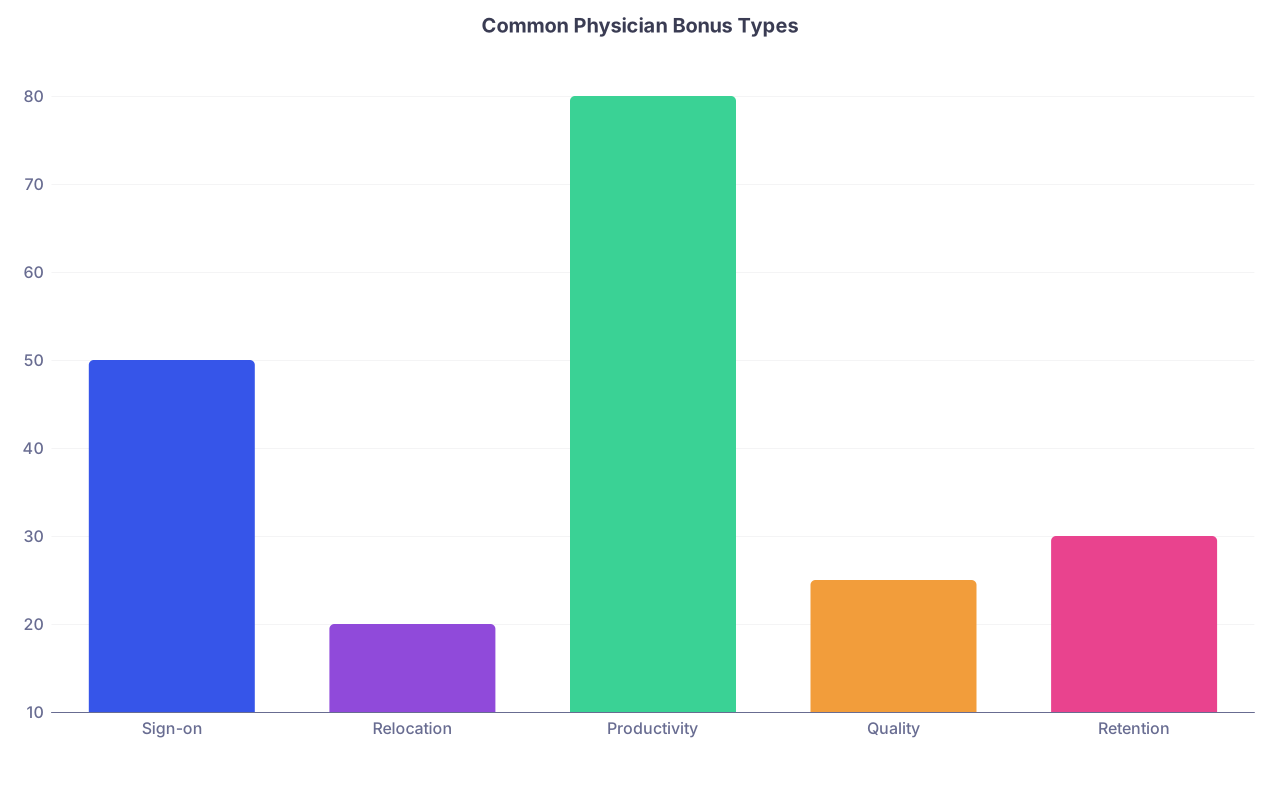
| Category | Value |
|---|---|
| Sign-on | 50 |
| Relocation | 20 |
| Productivity | 80 |
| Quality | 25 |
| Retention | 30 |
(Values just illustrative in thousands.)
Retention bonuses are the same story as sign‑on: taxed when paid, often tied to a service period with clawback if you leave early.
5. Payroll Taxes, Retirement Plans, and What You Can Actually Control
At high physician incomes, subtle differences in how money is classified have real tax impact.
Let’s slice two main pain points:
- Payroll taxes (Social Security and Medicare)
- Retirement plan space and what counts as “compensation”
5.1 Payroll Taxes: When They Really Matter
Social Security:
- For W‑2 employees, you pay 6.2% up to the annual wage base (which changes yearly; think roughly the first $160k–$180k zone).
- Your employer pays another 6.2% on their side. You do not see it, but it is real cost.
Medicare:
- You pay 1.45% on all wages, no cap.
- Employer pays another 1.45%.
- Above certain thresholds, you pay an extra 0.9% Additional Medicare Tax on wages.
If your base salary alone already exceeds the Social Security wage base, then extra W‑2 call pay and bonuses do not increase your Social Security tax, just Medicare. But if your base is lower and call/bonuses push you over the cap, that extra chunk gets hammered by full FICA.
For 1099 income, you are paying both sides (self‑employment tax). But remember: you also get to deduct half of the self-employment tax above the line, and you can manage entity structure (S‑corp, etc.) if large enough.
Rule of thumb: Structuring extra work as 1099 only makes sense when it is legitimate business activity and when you are willing to run it like an actual business—tracking expenses, doing proper accounting, funding retirement plans.
5.2 Retirement Plans: Does This Dollar Count?
One of the most under‑leveraged points in contract review is how each type of pay is defined under the retirement plan.
You want to know:
- Is call pay included in “compensation” for the 401(k)/403(b) plan?
- Are bonuses included?
- Are stipends included or excluded?
- Is there a separate non‑qualified plan (457(b), deferred comp) and what pay counts there?
Why this matters:
- Higher “plan compensation” means larger employer match and sometimes larger employer contributions.
- For 403(b)/401(k), your own deferrals are capped by the IRS dollar limit, but employer contributions are often a percentage of your eligible compensation.
If your contract structure is “low base, big RVU bonus” but the retirement plan only counts base salary as “eligible compensation,” you are losing free money.
You want language like: “All W‑2 wages, including bonuses and call stipends, are considered eligible compensation under the Qualified Retirement Plan.”
6. Practical Contract Moves: Where You Actually Have Leverage
You cannot negotiate the tax code. But you can negotiate structure.
There are a handful of places where I have seen physicians meaningfully improve their position:
6.1 Separate and Clarify Reimbursements vs Taxable Stipends
Bad: “CME stipend of $5,000 paid annually in your paycheck.”
Better: “Employer will reimburse up to $5,000 annually for CME, board exam fees, licensing, and related educational expenses under an accountable plan.”
That one line cleans up taxation on those dollars. Done correctly, the reimbursements never hit your taxable income at all.
Same with technology, cell phones, and professional dues where the employer is willing.
6.2 Make Sign‑On and Relocation Clawbacks Less Dangerous
You may not get rid of clawbacks, but you can often improve them:
- Shift from “repay full gross amount” to “repay net amount received.”
- Change a 3‑year cliff to annual forgiveness (1/3 forgiven per year).
- Narrow the triggers for clawback (e.g., not triggered if terminated without cause).
- Ask for partial forgiveness if you leave for specific reasons (family relocation, spouse job).
Tax does not change, but your risk of having to repay heavily taxed dollars drops.
6.3 Push for Call/Bonus to Count in Retirement Formula
This is straightforward:
- Ask HR for the summary plan description (SPD) and check the definition of “eligible compensation.”
- If bonuses/call are excluded, push to include them. Larger systems may say no. Smaller groups sometimes say yes.
If you are maxing retirement every year, this is thousands of extra pre‑tax dollars annually.
6.4 Legitimize and Optimize 1099 Streams
If you have or can negotiate genuine 1099 work (telemedicine, committee work, consulting, independent call coverage), stop treating it like “extra cash” and treat it as a mini‑practice:
- Set up an LLC or S‑corp when your CPA says the dollar amount justifies it.
- Open a solo 401(k) and use part of that income for additional tax‑deferred savings.
- Track and deduct genuine business expenses.
- Pay quarterly estimates so you are not ambushed on April 15.
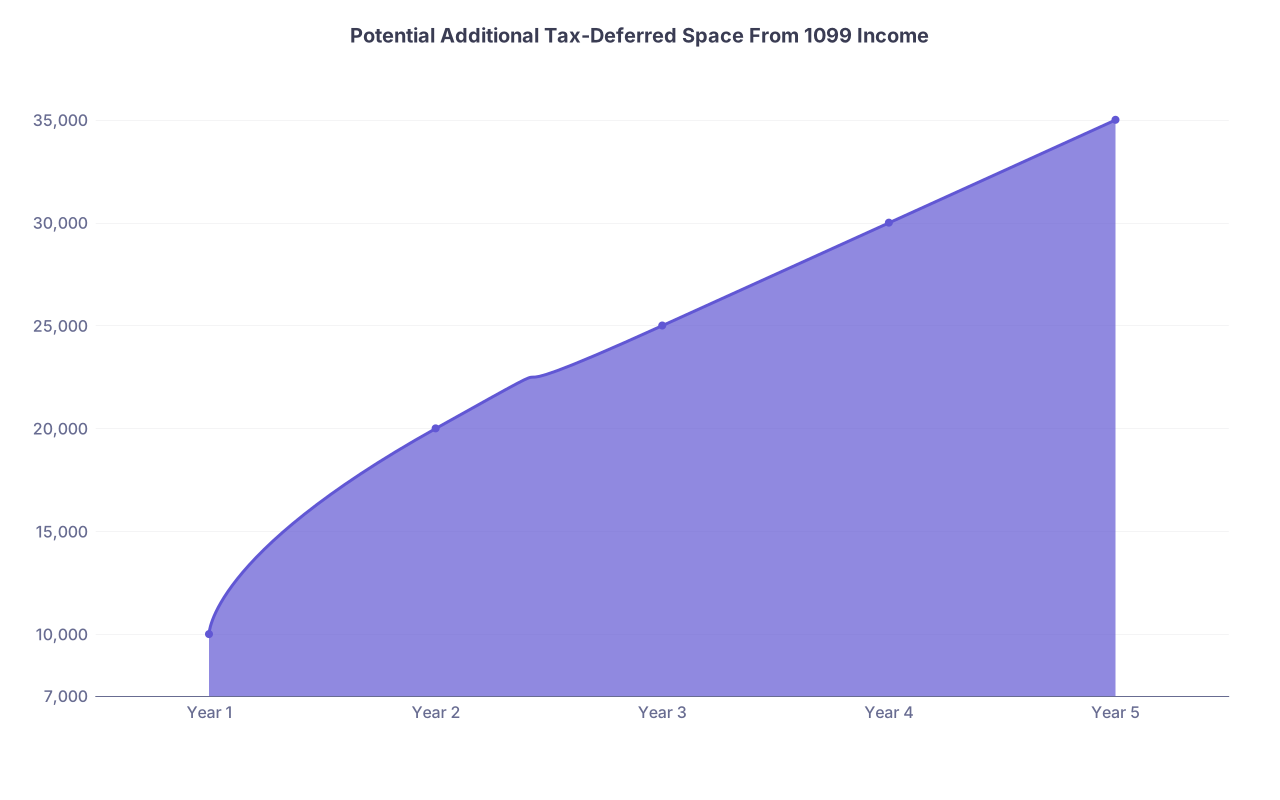
| Category | Value |
|---|---|
| Year 1 | 10000 |
| Year 2 | 20000 |
| Year 3 | 25000 |
| Year 4 | 30000 |
| Year 5 | 35000 |
Again, numbers are illustrative, but the trend is real. A modest 1099 stream, handled correctly, can significantly expand your retirement savings space.
7. Timing, Withholding, and Not Getting Crushed in April
The last nuance is boring but lethal: timing.
When all these checks hit—sign‑on, relocation, RVU bonuses, quality checks—matters for how painful your tax bill feels.
Common failure modes I have seen:
- Sign‑on bonus hits in January. You are in a lower effective bracket based on partial‑year income projections. You increase lifestyle. By December of that same year, your actual income is much higher than you modeled, pushing you into higher brackets and under‑withholding.
- Massive year‑end RVU bonus in December with low withholding. CPA prepares your return in March. You owe $40k. No cash.
Straightforward mitigations:
- As soon as you sign, have your CPA or a competent planner model year‑one income including sign‑on, relocation, expected call, and bonuses.
- Adjust W‑4 aggressively. Tell payroll you want a fixed extra amount withheld from each paycheck.
- Or schedule quarterly estimated tax payments for the “lumpy” income streams.
You are not trying to “optimize every dollar of arbitrage.” You are trying to avoid the “what do you mean I owe $50,000?” conversation.

| Step | Description |
|---|---|
| Step 1 | Contract Signed |
| Step 2 | Base Salary W-2 |
| Step 3 | Call Pay |
| Step 4 | Stipends |
| Step 5 | Bonuses |
| Step 6 | Sign-on, Relocation, Productivity |
| Step 7 | Payroll Taxes + Limited Deductions |
| Step 8 | SE Tax + Business Deductions |
| Step 9 | Not Taxable with Accountable Plan |
| Step 10 | Retirement Plan via Employer |
| Step 11 | Solo 401k / SEP Options |
| Step 12 | Annual Tax Return |
| Step 13 | W-2 or 1099 |
| Step 14 | Reimburse or Taxable |
8. Quick Reality Check Before You Sign
Let me give you a concrete mental checklist. When you read the compensation section of your contract, ask:
- For each dollar—call, stipend, bonus—is this W‑2, 1099, or a non‑taxable reimbursement?
- Does this type of pay count toward my retirement plan “compensation”?
- Is any of this subject to clawback, and if so, over what time frame and on what terms?
- Do I have any genuine 1099 streams where I should be operating like a business?
- Based on the projected total, do I need to increase withholdings or make estimated payments?
If you cannot answer those five questions clearly, you do not understand your contract from a tax perspective yet.
Key Takeaways
- Labels like “stipend,” “bonus,” or “call pay” are cosmetic. What matters is whether the money is W‑2 wages, 1099 business income, or a true reimbursement under an accountable plan.
- Sign‑on and relocation bonuses are almost always fully taxable when paid and often subject to clawbacks. Treat them like conditional loans, not free money.
- You can’t change the tax code, but you can often negotiate structure: make reimbursements non‑taxable, ensure call/bonuses count toward retirement plan compensation, and legitimize 1099 work to unlock deductions and additional retirement space.


