

Most physicians are doing real estate wrong—because they misunderstand “passive,” “active,” and material participation.
Let me be blunt. If you are a high‑income W‑2 physician buying rentals and thinking, “These losses will save me a ton on taxes,” without understanding material participation rules, you are almost certainly wrong. And the IRS is very happy to let you stay confused.
You asked about passive vs active real estate for doctors, with a focus on material participation and taxes. So I am going to walk through exactly how this works in the real world for physicians: call schedules, W‑2 vs 1099 status, spouses, syndications, STR loopholes, and what actually moves the tax needle.
1. The Core Problem: Passive vs Active Income for Doctors
The tax code divides income into buckets. How you earn the money matters as much as how much you earn.
For almost all practicing physicians, the profile looks like this:
- Very high W‑2 or 1099 clinical income
- Limited free time
- Moderate to high interest in real estate
- Fuzzy understanding of “real estate professional,” “material participation,” and “passive losses”
The key buckets under §469 (the passive activity rules):
- Active / non‑passive income:
W‑2 wages, 1099 clinical income, partnership K‑1 from your group practice, etc. - Portfolio income:
Dividends, interest, capital gains from stocks. Not active, not passive. Its own animal. - Passive income:
Income from “passive activities”—where you do not materially participate. Typically real estate rentals.
Why this matters:
Passive losses can only offset passive income. They do not offset W‑2 wages or 1099 clinical income unless you qualify for a specific exception (real estate professional status, or certain short‑term rentals). That’s the wall most physicians run into.
2. What “Passive” Really Means for Real Estate
“Passive” is a tax classification, not a description of how lazy the investment feels. Buying an apartment building via a syndication feels passive. Running your own small duplex feels active at 2 a.m. But the tax code does not care about your stress level. It cares about material participation.
By default, all rental real estate activities are passive, even if you work hard on them—unless:
- You qualify as a Real Estate Professional (REP) under §469(c)(7), and
- You materially participate in the specific activity.
or
- The property is not a “rental activity” under the IRS definition (often the case with short‑term rentals with very short average stays) and you materially participate.
For most physicians, step 1 is the blocker. They fail REP, so all their rentals stay in the passive box.
3. Material Participation: The Actual Tests
Material participation is where most people get lost. There are seven tests in the regs (Treas. Reg. §1.469‑5T). You only need to meet one.
The most commonly used:
- You participate in the activity for more than 500 hours during the year.
- Your participation is substantially all the participation in the activity (nobody else is doing much).
- You participate more than 100 hours and no one else participates more than you.
- You participated in the activity on a regular, continuous, and substantial basis during the year.
For physicians, the 500‑hour and 100‑hour/no‑one‑more‑than‑you tests are the real ones in play.
Let us quantify this.
- 500 hours per year = ~10 hours per week, every week
- 100 hours per year = ~2 hours per week
And you need those hours per activity, unless you make a grouping election (more on that later). If you own five rentals and do not group them, you are talking 500 hours per rental. That is fantasy for someone working full‑time in medicine.
4. Real Estate Professional Status (REP): Why Most Physicians Fail It
To convert rental real estate from passive to potentially non‑passive, you need REP. The tests are brutal for a typical full‑time doctor.
Two requirements, both annual:
- More than 750 hours of services in real property trades or businesses in which you materially participate.
- More than half of your personal service hours must be in those real property trades or businesses.
Read that again. If you work 2,000 hours a year as a hospitalist, you would need >2,000 hours in real estate to meet the “more than half” test. That is not a typo. It is mathematically impossible for full‑time clinicians unless they are lying or miscounting.
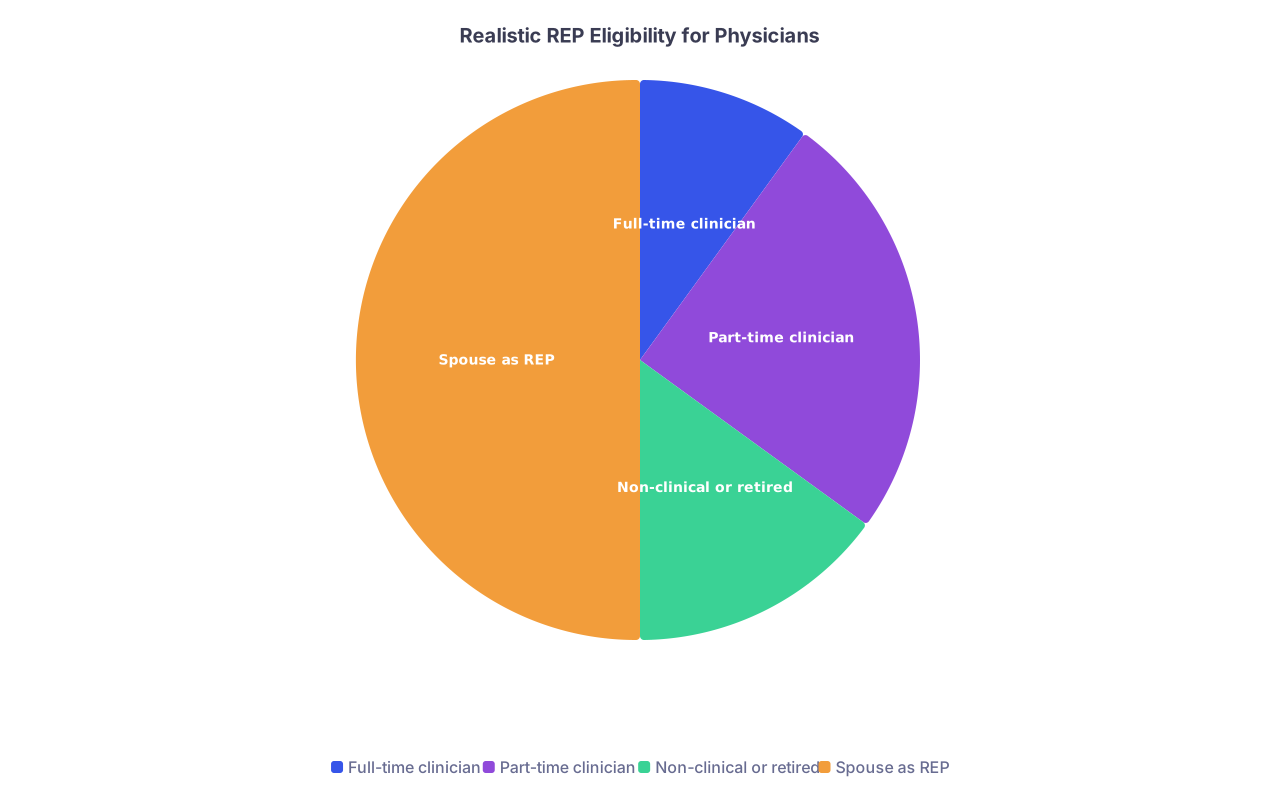
Who can realistically hit REP?
- Physicians who have substantially reduced or left clinical work (0.5 FTE or less and ramped‑up RE)
- Physicians whose spouse qualifies as REP (very common structure)
- Physicians who have shifted into admin/business roles where they count hours differently (but that gets messy fast)
| Category | Value |
|---|---|
| Full-time clinician | 10 |
| Part-time clinician | 25 |
| Non-clinical or retired | 15 |
| Spouse as REP | 50 |
Those proportions are not IRS statistics. They are what I see in real practices: REP for an actively practicing full‑time physician is the rare exception.
5. Passive Real Estate for Doctors: What It Actually Does
Let me make this crystal clear:
If you are a high‑income W‑2 physician with typical long‑term rentals and no REP, your rental losses are:
- Passive losses
- They do not offset your W‑2 wages or 1099 clinical income
- They carry forward to future years and can offset:
- Passive income from other rentals or investments, or
- Gains when you sell a rental (or are freed up in a fully taxable disposition)
Are the losses useless? No. But they are deferred, not current, tax savings.
This is where depreciation and cost segregation get misunderstood.
Cost Segregation and Bonus Depreciation
A lot of syndications and turnkey rental promoters pitch: “We’ll wipe out your taxes with depreciation.” For a W‑2 doctor with no REP, that is half‑true at best.
Here is what actually happens when you buy a property for $500,000:
- Allocate, say, $400,000 to building, $100,000 to land (no depreciation on land).
- Regular straight‑line depreciation on $400,000 over 27.5 years: ~ $14,500 per year.
- If you do a cost segregation study, you might accelerate $100,000–150,000 of that into year one via bonus depreciation.
Great. That creates a paper loss. But if you are not REP / not non‑passive, that paper loss is passive. And it will sit there until you have passive income or sell.
For many physicians, the play is:
- Accumulate passive losses while working
- Use them years later when:
- You have other passive income (real estate cash flow, syndication distributions, etc.), or
- You sell a large appreciated property and want to offset the gain, or
- You retire, lower your W‑2/1099 income, and possibly qualify for REP later
Nothing wrong with that. But it is not the “zero tax” fantasy Instagram sells.
6. Active Participation vs Material Participation: The $25,000 Exception
There is a common, confusing phrase: “active participation.” It is less strict than material participation.
Here is how it works:
- If you actively participate in rental real estate (approve tenants, decide on repairs, etc.), and
- Your modified AGI is under $100,000 (phased out between $100,000–$150,000),
You may be able to deduct up to $25,000 of rental real estate losses against non‑passive income.
For most attending physicians, this is completely gone due to income. You blow through the $150,000 AGI phaseout in residency or shortly thereafter.
So:
- Active participation ≠ material participation
- That $25,000 exception ≈ irrelevant for most full attendings
I still mention it because you will see it in CPA guides and blogs and it misleads a lot of doctors.
7. When Real Estate Losses Can Offset Physician Income
There are essentially three realistic paths to using real estate losses against W‑2/1099 clinical income for doctors:
- Your spouse qualifies as a Real Estate Professional and you file jointly.
- You personally qualify as REP (usually later in your career, part‑time, or retired).
- Short‑term rental exception where the property is not treated as “rental real estate” and you materially participate.
Let’s take them one by one.
7.1 Spouse as Real Estate Professional
This is the most common legitimate structure in high‑income physician households.
Requirements:
- You file Married Filing Jointly.
- Your spouse:
- Spends >750 hours in real property trades or businesses, and
- More than half of their personal service time in those trades, and
- Materially participates in the rentals in question (often via grouping election).
Your spouse could be:
- A full‑time agent, broker, property manager, or flipper.
- A stay‑at‑home parent who builds a real estate business and hits the hours.
- Someone who left their prior career and now does RE full‑time.
Then, if you:
- Buy a few high‑quality properties (or a large one)
- Do a cost segregation
- Generate, say, $200,000 of paper losses
Those losses can offset your W‑2 attending salary, if the REP and material participation tests are truly met and well‑documented.
I have seen this work beautifully. I have also seen the IRS challenge sloppy hour logs and crush people who tried to “backfill” the story.

7.2 You as Real Estate Professional
For most full‑time attendings, this does not happen while working 50–60 hours a week clinically. The math just does not work.
Where it becomes plausible:
- Late‑career physician cutting back to 0.4–0.5 FTE.
- Physician who shifts into a non‑clinical or low‑hours role and builds a real estate business.
- Early retiree from medicine who leans into real estate.
If that is your plan, you can be intentional:
- Buy properties during high‑income years, let passive losses accumulate.
- Later, intentionally build to REP status and then use current losses to offset new types of income.
- Use prior suspended losses once you dispose of properties.
But do not kid yourself that you can do a full‑time surgical residency and simultaneously document 1,200+ real estate hours. That is exactly the type of thing the IRS picks up in exam.
7.3 Short‑Term Rental (STR) Exception
This is the “STR loophole” you have probably heard about.
A property is generally not treated as rental real estate (and thus not automatically passive) if the average period of customer use is 7 days or less, or 30 days or less with substantial personal services.
For many Airbnb/VRBO style properties with average stays under 7 days, the IRS does not default them into passive rental. Now, you apply the general material participation tests, not the REP rules.
Translation: you do not need REP to make STR losses non‑passive. You only need to materially participate.
Typical pathway for a busy physician:
- You or your spouse own a short‑term rental (often in a drive‑to vacation area).
- Average stay is 3–4 nights.
- You handle:
- Pricing strategy
- Listing management
- Messaging with guests
- Coordination with cleaners
- Major decisions
- You log >100 hours and no one else exceeds your hours. Or you log >500 hours.
If that activity is non‑passive, then large first‑year depreciation from furnishing, improvements, and potentially cost segregation can offset your W‑2 physician income.
But this works only if:
- You actually do the work (Airbnb “co‑hosts” doing everything for you will kill your hours).
- You track time in detail.
- The average stay test is clearly met.

| Step | Description |
|---|---|
| Step 1 | Buy STR property |
| Step 2 | Average stay under 7 days |
| Step 3 | Track hours in detail |
| Step 4 | Non passive STR |
| Step 5 | Passive STR |
| Step 6 | Losses can offset W2 income |
| Step 7 | Losses limited to passive bucket |
| Step 8 | Hours > 100 and more than anyone else |
8. Active vs Passive Real Estate Structures for Doctors
Let me contrast some common setups physicians use.
| Scenario | Passive or Non-Passive | Can Offset W-2/1099 Clinical Income? |
|---|---|---|
| Long-term rentals, no REP | Passive | No (losses stay passive) |
| Long-term rentals, spouse REP | Non-passive (if material participation) | Yes |
| Syndication investment | Passive | No (unless other passive income) |
| STR with material participation, no REP | Non-passive | Yes |
| Triple-net commercial lease | Usually passive | Rarely, generally no |
Passive Real Estate (Typical for Doctors)
Examples:
- Buying turnkey single‑family rentals with property managers.
- Investing in apartment syndications or REITs.
- Owning a property on a long‑term lease (especially NNN).
Characteristics:
- Low time commitment.
- Truly passive or semi‑passive in effort.
- Tax status: passive under §469 unless you clear REP and material participation hurdles.
These are solid tools for building net worth, hedging inflation, and diversifying away from the hospital paycheck. They are not normally tax shelters for W‑2 wages.
Active / Non‑Passive Real Estate for Physicians
Examples:
- You or spouse qualify as REP and directly manage a portfolio of rentals.
- You run one or more STRs and clearly materially participate.
- You are personally involved in flips or development and meet material participation.
Characteristics:
- Significant time commitment.
- Documentation burden (hour logs, emails, calendars).
- Real potential to offset clinical income with legitimate losses.
This is where the meaningful near‑term tax arbitrage lives. But it is not casual. If you think you can just sign a piece of paper at tax time and call yourself “active,” you are lining up for an audit problem.
9. Grouping Elections: One of the Few Nuanced Levers that Matter
Real estate professional households often end up with multiple properties and not enough hours per property to clearly meet material participation. This is where the grouping election under Reg. §1.469‑9 comes in.
Concept:
- You elect to treat all rental real estate activities as a single activity.
- Then, your hours across all properties can be aggregated to determine material participation.
This can be a powerful move for a spouse REP who:
- Manages 6–10 doors.
- Has, say, 600–800 hours spread across them.
- Could not claim 500 hours in any one property, but clearly spends significant time overall.
Key cautions:
- Grouping is a binding election; ungrouping later is difficult.
- Grouped activities are treated as one for purposes of dispositions and freeing suspended losses.
- You want a CPA who actually understands this—not one who is guessing.
10. Practical Tax Planning for Physicians: What I Actually Recommend
Let me strip the theory and give you concrete directions.
If You Are an Early‑Career / Full‑Time Physician
- Assume your rentals will be passive.
- Use them for:
- Long‑term wealth building
- Inflation hedge
- Optional future flexibility with REP or STR strategies
- Do not buy real estate solely because of promised tax losses against your W‑2 job. That is the wrong reason and usually wrong math.
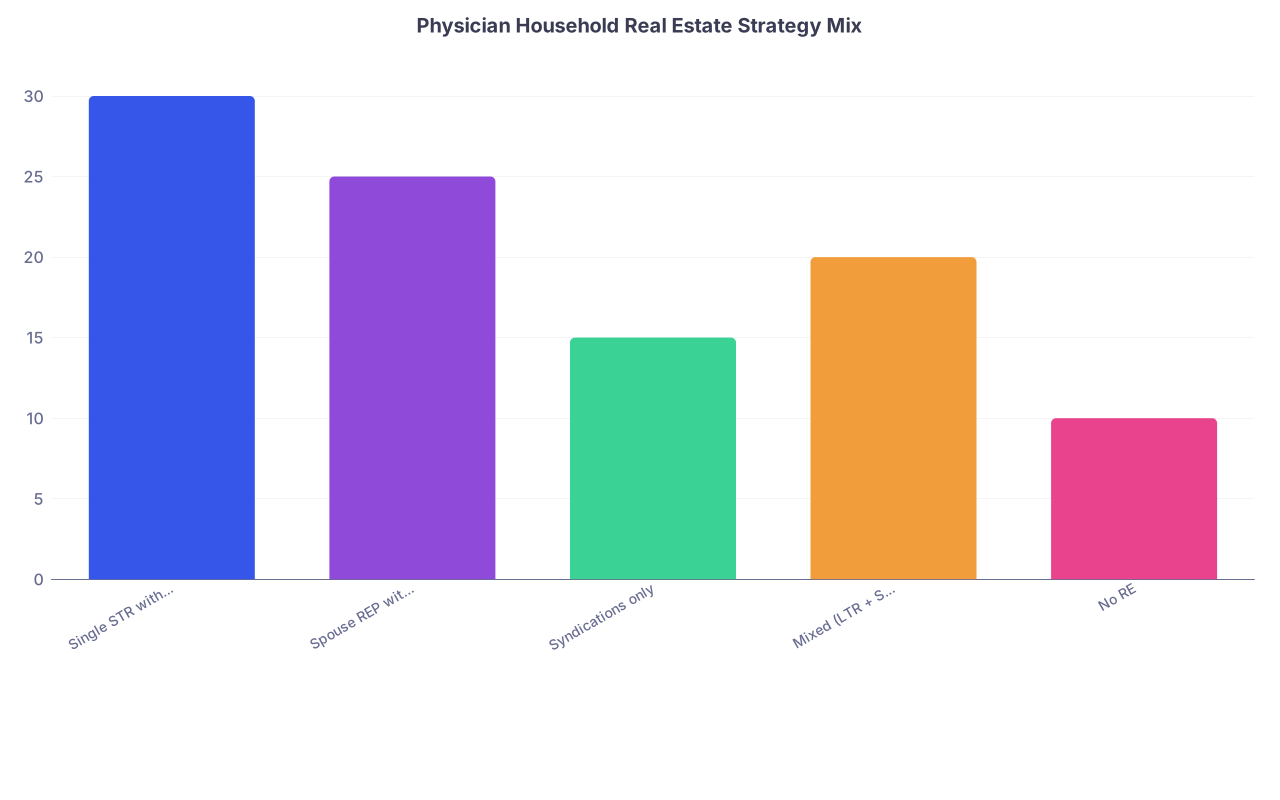
- If you want some tax advantage now, consider one well‑run STR where you or your spouse can realistically meet material participation tests. One. Not five.
If Your Spouse Is Interested in Real Estate
- This is the highest‑leverage pathway for many high‑earning physicians.
- Have your spouse genuinely build a real estate business:
- Agent or broker
- Property manager
- Active investor / operator
- Aim for:
- Clear >750 real estate hours
- More than half of their working time
- Detailed logs
- Coordinate with a real‑estate‑savvy CPA to:
- Structure grouping
- Plan cost seg studies and acquisition timing
- Decide when to accelerate vs hold depreciation
| Category | Value |
|---|---|
| Single STR with MTM | 30 |
| Spouse REP with LTRs | 25 |
| Syndications only | 15 |
| Mixed (LTR + STR) | 20 |
| No RE | 10 |
If You Are Approaching Part‑Time or Retirement
- Now REP might actually be personally attainable.
- You can:
- Gradually shift clinical hours down.
- Ramp up ownership and management of rentals.
- Plan a year (or several) where large cost seg‑driven losses offset high‑bracket income from final big clinical years, business sale, or other events.
- But do this intentionally. The IRS looks back at busy years with skepticism when you suddenly claim 1,000+ RE hours.
11. Documentation: The Boring Part That Decides Who Wins in Audit
I have seen physicians lose audits not because their facts were bad, but because their records were.
If you are going to:
- Claim REP
- Claim material participation in STRs to offset W‑2 income
- Group multiple rentals and treat them as non‑passive
Then you must be obsessive about documentation:
- Contemporaneous time logs: spreadsheets, apps, calendars
- Emails and messages showing decisions, tenant screening, vendor management
- Clear breakdown:
- Acquisition / investor activities (which often do not count toward hours)
- Operational management (which does)
- Written policies for your role vs property manager role
The IRS does not accept “I kind of remember spending 15 hours a week.” They will destroy that. They want specifics. Date, activity, hours, and proof.
12. Where Doctors Get This Wrong (And How to Avoid It)
Three common mistakes I see repeatedly:
Calling passive syndication losses “offsets” to W‑2.
They are passive. They offset passive income, not your hospital job. Unless you already have significant passive income, those losses are just being banked for later.Claiming REP while still in full‑time clinical practice.
If your schedule is 12 hospitalist shifts a month plus charting, CME, and call, do not sign a return claiming you had more real estate hours than physician hours unless you want an audit story to tell later.Doing STR material participation on autopilot.
Having a “co‑host” run everything and then logging “management” hours after the fact is nonsense. If someone else is clearly doing more than you, you fail the 100‑hour/no‑one‑more‑than‑you test.
If you are serious about this, the sequence is simple:
- Decide whether you want mostly wealth‑building passive real estate or tax‑leveraged active real estate.
- Align your strategy: LTR/syndications vs REP/STR.
- Hire a CPA who works with real estate investors and understands physician income patterns.

FAQ (Exactly 5 Questions)
1. Can my W‑2 attending income be “sheltered” by buying rental properties in an LLC?
No. The LLC does not change passive vs non‑passive status. It is a legal and asset protection wrapper, not a tax magic trick. Unless you or your spouse qualify for REP and materially participate (or qualify under the STR rules), rental losses will be passive and cannot offset your W‑2 income.
2. Do hours spent educating myself on real estate (podcasts, courses, books) count toward REP or material participation?
Generally no. The IRS is explicit that investor‑type activities and education do not count toward material participation. Under audit, “I listened to BiggerPockets for 300 hours” is a punch line, not evidence. Focus on operational tasks: tenant screening, repair oversight, pricing, bookkeeping, and coordination.
3. If I invest in a real estate syndication that does a big cost seg and passes me a $100k loss, can that reduce my taxes this year?
Only if you already have passive income to offset, or you or your spouse are valid REP and materially participate in the syndication’s trade or business (rare; most LPs do not materially participate). For a typical W‑2 physician with no REP, that $100k is a passive loss carryforward. It will help in the future, not right now.
4. How many short‑term rentals do I need to make a dent in my tax bill as a high‑income physician?
Often, just one well‑chosen STR, purchased early in the year, furnished and improved with a cost seg, can generate six‑figure paper losses that offset clinical income—if you truly materially participate. More STRs are not always better; they just create more operational headache and more chances to fail the participation tests.
5. Do I need a “real estate CPA,” or can any CPA handle this?
Any licensed CPA can file a return. That is not the question. For REP, grouping elections, STR exceptions, and aggressive but defensible depreciation strategies, you want someone who handles these issues routinely. Ask them directly: “How many clients do you have with REP or STR material participation? How many IRS exams on these issues have you managed?” Their answers will tell you what you need to know.
Key takeaways, no fluff:
- For most full‑time physicians, typical rentals and syndications are passive. Their losses do not offset W‑2 income; they build a bank of passive losses for later.
- To convert losses into real tax savings against physician income, you need either a REP spouse or genuine material participation in STRs under the non‑rental rules, backed by serious documentation.
- Decide if you want real estate primarily for wealth building or for tax leverage. Then build a strategy—and a team—that actually matches that goal, instead of chasing marketing slogans.


