

It is late March. You just finished a brutal week of call, your accountant sent over a draft return, and you are staring at an eye‑watering six‑figure tax bill. Again.
A colleague mentions at sign‑out, almost offhand: “Yeah, but my syndication K‑1 wiped out most of my clinical income. Cost seg plus bonus depreciation. You should look into it.”
You nod like you understand. You do not. But you also know you are tired of being the IRS’s favorite donor.
This is where depreciation and cost segregation become very real for you as a physician investor. Not as abstract tax jargon. As the difference between writing a $220,000 check to the government or keeping $100,000+ in your own pocket to build your balance sheet.
Let me break this down specifically.
1. The Core Concept: Why Real Estate Is a Tax Shelter (If You Use It Correctly)
Start with the basic friction: your clinical income is “ordinary income.” It is hit by:
- Federal income tax
- State income tax (in many states)
- Payroll taxes (Medicare; Social Security up to the cap if you are not already maxed via W‑2/partnership)
Real estate income sits in a different box. The tax code treats ownership of rental property like a business with:
- Operating income and expenses (rents – repairs – property management – interest – taxes, etc.)
- Non‑cash expenses like depreciation
- Potential for capital gains and 1031 exchanges when you sell
Depreciation is the lever. It lets you:
- Reduce taxable rental income (often turning it into a paper loss)
- Potentially use those losses against other income, depending on your status (this is the big fork in the road we will get to)
Without understanding depreciation and the rules around passive vs non‑passive income, you are just buying real estate and hoping. You want to be extracting specific, intentional tax benefit.
2. Depreciation 101: The Boring Thing That Quietly Saves You Hundreds of Thousands
Depreciation is the IRS saying, “Buildings wear out. We will let you expense that slowly over time.”
Key points you must lock in:
- You depreciate the building and improvements, not the land.
- For residential rental property, the default MACRS recovery period is 27.5 years.
- For nonresidential (commercial) property, it is 39 years.
So if you buy a small apartment building for $1,000,000 and allocate 80% to building, 20% to land, then:
- Depreciable basis = $800,000
- Straight‑line residential depreciation = $800,000 / 27.5 ≈ $29,091 per year
That $29k shows up as an expense on Schedule E, even though no cash left your pocket. It is a paper loss.
Multiply that by scale (multiple properties, syndications, larger deals) and you can see how people start showing six‑figure “losses” on paper while collecting positive cash flow.
The problem (or opportunity) is that 27.5 or 39 years is slow. The tax code gives you a way to accelerate this.
3. Cost Segregation: Turning 27.5 Years into 1–15 Years
Cost segregation is not magic or a “loophole.” It is an engineering + tax exercise that says:
“Instead of treating the entire building as one 27.5‑ or 39‑year asset, let us break it into components that the IRS already agrees have shorter lives.”
A cost segregation study reclassifies parts of the property into:
- 5‑year property: carpets, appliances, some cabinetry, certain fixtures
- 7‑year property: some office furniture, specialty equipment
- 15‑year property: land improvements (parking lots, landscaping, exterior lighting, some site utilities)
- Remaining 27.5/39‑year property: the true structural components
Why does that matter?
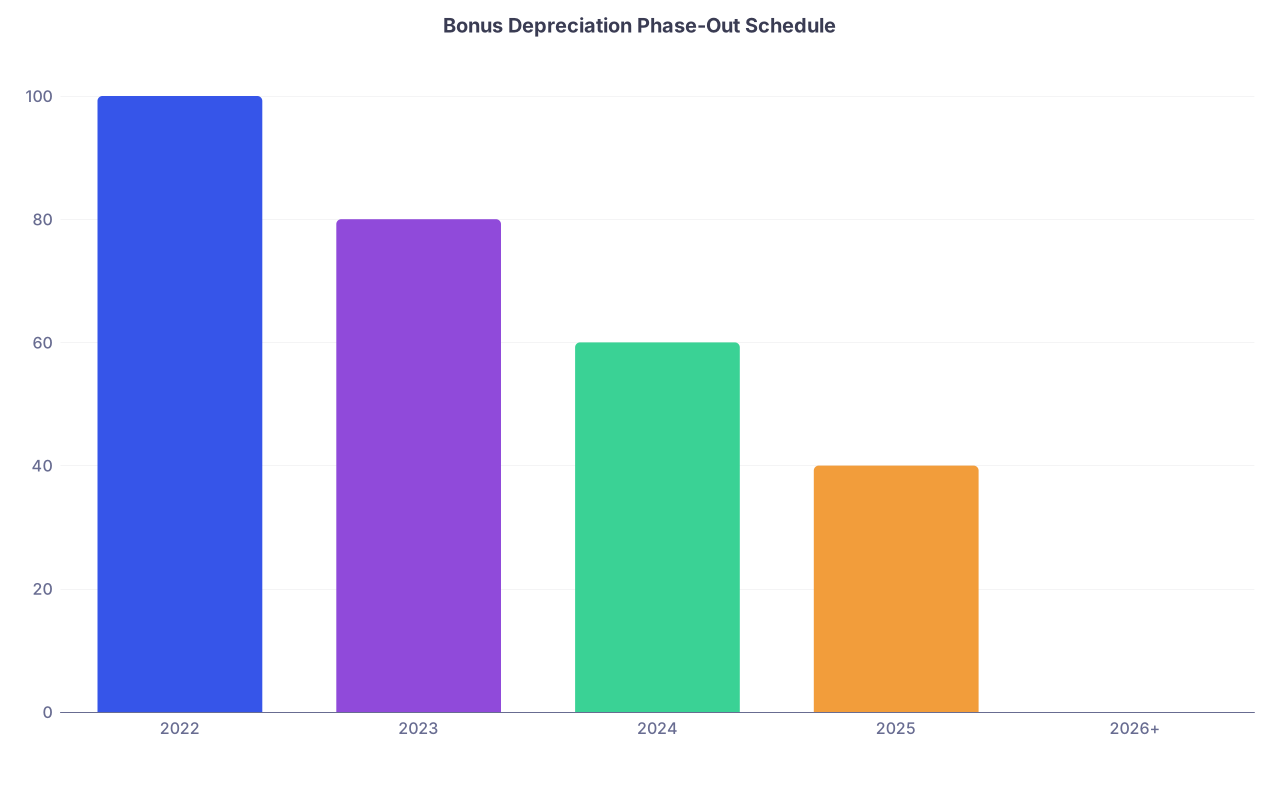
Because then you can pair those shorter‑life assets with bonus depreciation (which has been incredibly powerful the last few years).
Current bonus depreciation landscape
This is time‑sensitive, and a lot of physicians are behind on this timeline.
| Category | Value |
|---|---|
| 2022 | 100 |
| 2023 | 80 |
| 2024 | 60 |
| 2025 | 40 |
| 2026+ | 0 |
- 2022: 100% bonus depreciation on qualifying assets
- 2023: 80%
- 2024: 60%
- 2025: 40%
- 2026 and beyond (under current law): 0% bonus (still have Section 179 in some contexts, but for most passive physician investors, bonus was the hammer)
What does this look like in real numbers?
Say you buy a $2,000,000 small multifamily property in 2024. Rough, simplified numbers:
- Allocate 80% to building → $1,600,000 depreciable
- Cost seg study finds:
- 20% as 5/7/15‑year property → $320,000
- 80% as 27.5‑year → $1,280,000
In 2024 with 60% bonus depreciation:
- You can immediately expense 60% of that $320,000 = $192,000
- The remainder of the 5/7/15‑year property (~$128,000) is depreciated over its normal shorter life
- Plus you still get regular straight‑line depreciation on the 27.5‑year chunk (~$46,545 in year 1)
So maybe you have $240–260k of depreciation in year 1, instead of ~$58k without cost seg and bonus.
That is a radically different K‑1.
4. Passive vs Non‑Passive: The Fork That Dictates Whether This Helps Your Clinical Income
Here is where a lot of physicians misunderstand and get burned.
The passive activity rules (Internal Revenue Code §469) basically say:
- Income and loss are either passive or non‑passive.
- Your W‑2/1099 clinical income is non‑passive active income.
- Most rental real estate is passive by default.
- Passive losses can only offset passive income, unless you qualify for special rules (real estate professional status, short‑term rental carve‑outs, or some limited $25k exception that phases out for high earners).
So if you do nothing else and just invest passively in a syndication as a typical physician:
- Those big depreciation losses from cost seg offset your passive rental income from that property (and maybe from other passive real estate if grouped).
- If the loss is bigger than the passive income, the extra becomes a suspended passive loss. It carries forward to future years or unlocks when that property is sold.
That still helps. It shields current and future passive income. But it does not reduce your W‑2 salary from your hospital job. That is the critical misconception.
To use those losses against clinical income, you have to cross one of the specific thresholds the code allows.
5. The Three Paths Physicians Actually Use To Unlock Losses
You will hear a lot of confusing chatter. Strip it down. For physicians, there are three real paths.
Path 1: Real Estate Professional Status (REPS) + Material Participation
This is the “I am serious about real estate as a second career” route.
To claim REPS under §469(c)(7), you (not your spouse unless filing jointly and using their time):
- Perform more than 750 hours of services during the year in real property trades or businesses in which you materially participate, and
- Those hours are more than half of your total personal service hours for the year.
Then, for the actual rental activities:
- You must materially participate (one of the tests, such as 500 hours, or being involved in substantially all participation, etc.), or
- You make a grouping election to treat all rentals as one activity, and materially participate in that grouped activity.
For a full‑time clinical physician working 2,000+ hours a year, this is usually impossible without:
- Cutting clinical time down massively, or
- Having the spouse qualify as the real estate professional while you continue clinical work.
That “spouse REPS” strategy is extremely common and legit when done right.
If REPS is established and you materially participate in the rental activity (or group), then:
- Your rental activities are no longer “per se passive”
- Losses from those rentals become non‑passive, and they can offset your clinical income.
I have seen couples where the physician makes $650k W‑2, the spouse qualifies for REPS, they do a $5M syndication with a large cost seg, and they generate a $400k loss that wipes out most of the MD’s taxable income for that year. That is not hype. It is math.
But the documentation burden is real. Hour logs. Real work. Not “I read BiggerPockets on the treadmill” hours.
Path 2: Short‑Term Rental Carve‑Out
Short‑term rentals can be treated very differently if structured properly.
If:
- The average period of customer use is 7 days or less, or
- The average is 30 days or less and significant services are provided,
then the activity is not considered a rental activity under §469, and the standard passive rental rules do not automatically apply.
Then, if you materially participate in that short‑term rental activity, its losses can be non‑passive without REPS.
This is the “STR loophole” your younger colleagues love talking about.
For a busy physician, this can be practically easier than REPS because:
- You only need to meet material participation tests for that single property (e.g., 100 hours and more than any other person).
- You do not need more than 750 hours or to beat your clinical hours.
But you have to be careful:
- You cannot outsource everything to a full‑service property manager. That kills your material participation argument.
- You must track hours and genuinely be managing the property: pricing, guest communication, bookings, contractor coordination.
- You need to make sure the average stay truly meets the short‑term criteria.
Pair an STR with a cost seg and bonus depreciation, and you can generate a six‑figure loss that offsets your W‑2 in year one. This is exactly why so many high‑income professionals are suddenly “into Airbnbs.”
Path 3: Accept It Is Passive, Use It Strategically Anyway
If:
- You do not qualify for REPS,
- You do not want an STR,
- You are mostly a passive investor in syndications or funds,
then you accept the passive treatment and still use depreciation to your advantage by:
- Offsetting passive income from multiple deals (grouping where appropriate)
- Building a bank of passive losses that will:
- Shield future passive income, and
- Unlock against any gain when that property is sold (including depreciation recapture components)
Is it as dramatic as eliminating your clinical tax bill in year 1? No.
Is it still smart and powerful over a 10–20 year horizon? Absolutely.
6. A Simple Comparison: No Cost Seg vs Cost Seg for a Typical Deal
Let us make this concrete with a basic physician‑owned rental example.
Assume:
- You and your spouse buy a small 10‑unit residential building for $1,500,000 in 2024
- 80% building = $1,200,000 depreciable
- Net operating income (NOI) after all cash expenses = $90,000 per year
- You qualify for REPS via your spouse, and you materially participate
- 60% bonus depreciation applies (2024)
Scenario A: No Cost Seg
- Straight‑line depreciation: $1,200,000 / 27.5 ≈ $43,636 per year
- Taxable income from the property: $90,000 – $43,636 ≈ $46,364
If your marginal combined (federal + state) tax rate is ~40%:
- Tax on the rental income ~ $18,500
Scenario B: With Cost Seg + Bonus Depreciation
Engineer‑supported study breaks out:
- 25% as 5/7/15‑year = $300,000
- 75% as 27.5‑year = $900,000
Year 1 depreciation:
- Bonus depreciation: 60% of $300,000 = $180,000
- Remaining short‑life depreciation (simplified assumption year 1): maybe ~$20,000
- Straight‑line on 27.5‑year portion: $900,000 / 27.5 ≈ $32,727
Total year 1 depreciation ≈ $232,727
Taxable income from the property:
- $90,000 NOI – $232,727 depreciation = ($142,727) loss
That is a non‑passive loss if REPS + material participation are satisfied.
At a 40% marginal rate, that loss could reduce your overall tax liability by roughly $57,000 in year 1.
Even if the cost seg study cost you $6,000–$10,000, it is not subtle which outcome you prefer.
| Scenario | Taxable Income from Property | Approximate Tax Impact (40% rate) |
|---|---|---|
| No Cost Segregation | +$46,364 | ~$18,500 tax owed |
| With Cost Seg + Bonus Dep | -$142,727 | ~$57,000 tax saved |
7. What About Depreciation Recapture? The “Gotcha” That Is Overstated
Every time depreciation comes up at a physician dinner, someone says, “Yeah but you pay it all back when you sell.”
No. That is too simplistic.
There are two main buckets when you sell:
Depreciation recapture
- The portion of gain attributable to prior depreciation is generally taxed at up to 25% (unrecaptured §1250 gain)
- If you sell for more than original purchase price, you may also have true capital gain on top of recapture
Long‑term capital gain
- The appreciation above your original basis (adjusted for improvements, selling costs, etc.), taxed at long‑term capital gains rates (plus NIIT for high earners)
Three key realities:
A dollar of tax saved early is more valuable than a dollar paid later, because of time value and compounding.
You may never pay full recapture if:
- You 1031 exchange into another property, or
- You die owning the property and your heirs receive a step‑up in basis (current law)
Even if you do pay recapture, that is usually at 25%, not your 37%+ ordinary income rate.
So yes, there is recapture. No, it does not “erase” the benefit of using cost segregation. It just changes the long‑term math and reinforces that you must plan your exit strategy.
8. How Physicians Actually Implement This (And Where They Screw It Up)
Let me walk through typical patterns I see among physicians.

Pattern 1: The High‑Earning W‑2 Couple, Spouse Does REPS
- Physician: full‑time hospitalist, cardiologist, anesthesiologist, etc., making $500k–$900k W‑2
- Spouse: not working clinically, or in a flexible/part‑time role
- They deliberately:
- Acquire 2–5 rentals or a small portfolio over 2–3 years
- Have the spouse manage contractors, coordinate turnovers, oversee property management, handle bookkeeping, attend inspections, etc.
- Track hours carefully to meet >750 hours and “more than half of total work hours” for the spouse
They then:
- Execute cost seg studies on the larger properties in early years
- Take large non‑passive losses that wipe out a large chunk of the physician’s W‑2 income for a few years
- Use the extra after‑tax cash to either pay down debt faster or acquire more assets
This works very well when done meticulously. The screw‑ups are:
- No hour logs. Then in an audit, everything is “reconstructed” from memory. IRS hates that.
- Using a full third‑party property manager and the spouse does not actually make the decisions. The IRS digs and finds they are largely passive.
- Sloppy grouping elections or no elections when they should have grouped.
Pattern 2: The “One Big STR” Play
- Busy attending or senior fellow, decent cash reserves, high marginal tax rate
- Buys one well‑located short‑term rental (often in a drivable vacation area)
- Self‑manages (or uses a la carte services but keeps control over pricing, communication, etc.)
- Meets material participation tests for that STR alone (often 100–200 honest hours in year 1)
They then:
- Do a cost seg + bonus depreciation in the first year of operation
- Generate a six‑figure loss against W‑2 income
- Possibly rinse and repeat with one more STR the next year
Mistakes I see:
- Letting a full‑service manager handle everything and assuming it still counts as participation.
- Average stay length creeping above 7 days and not realizing they just fell back into “rental activity” territory.
- No contemporaneous logs when the IRS examiner asks, “Show me specific dates, tasks, and hours.”
Pattern 3: The Passive LP in Syndications Who Expects Too Much
- Physician invests $100k–$300k as a limited partner in a multifamily or self‑storage syndication
- Sponsor does a cost seg and passes through K‑1 losses (maybe $60k–$180k on a $300k check in first year)
As a plain passive investor:
- Those are passive losses. They will not offset your W‑2 or 1099 income.
- They will offset that property’s passive income and potentially other passive activities if you group correctly.
- Suspended losses accumulate until:
- The property sells, or
- You have enough passive income in later years to absorb them
This is still excellent. You are still compounding tax‑advantaged. But it is not the same as REPS/STR. The big mistake is when the sponsor’s marketing materials “strongly imply” these losses can wipe out your clinical income, without clarifying the passive rules.
9. Practical Checklist Before You Chase Cost Seg as a Physician
Before you start ordering cost segregation studies because some podcast made it sound sexy, slow down.

| Step | Description |
|---|---|
| Step 1 | Decide to Use Real Estate for Tax Planning |
| Step 2 | Accept passive treatment and invest passively |
| Step 3 | Design REPS strategy and track hours |
| Step 4 | Buy short term rental and materially participate |
| Step 5 | Acquire properties where cost seg makes sense |
| Step 6 | Use depreciation to shelter passive income |
| Step 7 | Coordinate with CPA on cost seg, elections, and documentation |
| Step 8 | Do you want losses to offset W2 income? |
| Step 9 | Can you or spouse meet REPS or STR rules? |
Ask yourself, very concretely:
- Do you need these losses to offset W‑2 income, or are you content with them just sheltering passive income?
- Is REPS realistically attainable for you or your spouse? Not aspirationally. Realistically.
- Are you willing to keep detailed logs and actually do the work required for material participation?
- Is the property large enough for a cost seg study to be worthwhile? (On a $200k duplex, probably not. On a $1M+ property, usually yes.)
- Is your CPA actually comfortable with REPS, cost seg, and physician‑level fact patterns? Many are not. Some just say “no” to anything complex because they do not want the audit risk.
| Category | Value |
|---|---|
| $750k Property | 4000 |
| $1.5M Property | 8000 |
| $5M Property | 20000 |
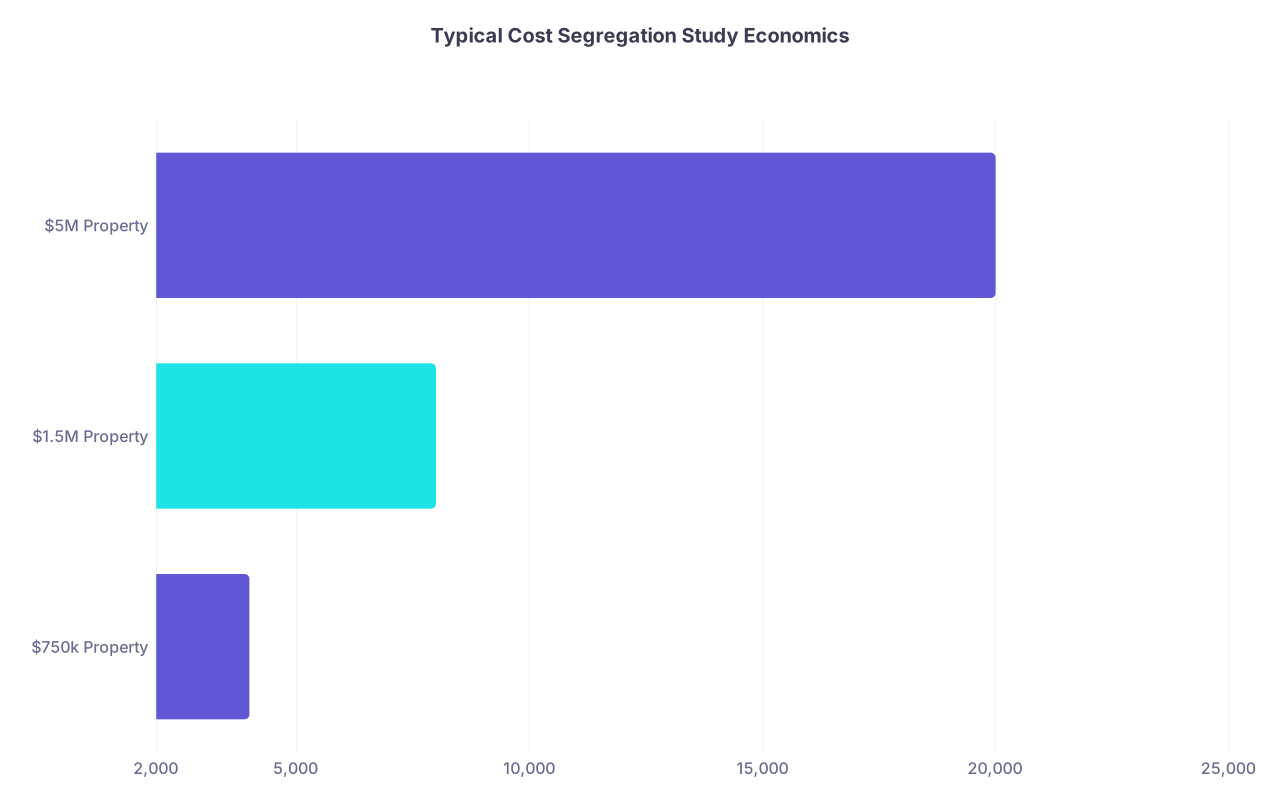
The chart above is not gospel, but it reflects ballpark study costs (in dollars) I tend to see:
- Sub‑$500k: often not worth the cost unless you have very high conviction and special circumstances
- $750k–$2M: sweet spot for many physician‑owned properties
- $5M+ or syndications: a no‑brainer if you are doing any serious tax planning
10. Documentation: The Boring Shield That Saves You in an Audit
If you are going to play at this level, you must behave like someone the IRS takes seriously.
You need, at minimum:
- A reputable cost segregation firm’s full report (not a two‑page “summary” someone on the internet whipped up)
- Clear depreciation schedules tied to that report and your tax return
- Contemporaneous logs for:
- REPS hours (if applicable)
- Material participation on rentals or STRs
- Written elections (grouping elections, 469 elections, etc.) in your return when required
- A CPA who understands:
- §469 passive activity rules
- Grouping rules and elections
- How to defend cost seg and REPS in an exam
Rough heuristic: if your CPA dismisses REPS as “that’s a scam” or “only for people with hundreds of properties,” they are not the right partner for what you are trying to do.
11. How This Fits Into a Larger Physician Wealth Plan
All of this only makes sense inside a bigger frame.
Depreciation and cost segregation are not the goal. They are tools. The real goals:
- Build enough after‑tax cash flow and equity that clinical work becomes optional.
- Protect your family from one‑sided dependence on a hospital or private equity group.
- Use the tax code as written to compound faster than your colleagues who just hand over 45% of their marginal dollar and hope their 401(k) bails them out.

Real estate with intelligent use of depreciation can:
- Provide relatively stable, inflation‑hedged income
- Allow you to “manufacture” paper losses early in ownership
- Be repositioned, refinanced, or exchanged to keep deferring tax
- Ultimately give you assets that your heirs inherit with a stepped‑up basis (under current rules), wiping out decades of built‑in gain and recapture
But you do not chase tax losses for their own sake. A terrible deal with great depreciation is still a terrible deal. The property must stand on its own underwriting:
- Location, tenant base, rent growth potential
- Debt terms, DSCR, downside scenarios
- Operator quality (if you are investing passively)
12. Putting It All Together: A Sample Roadmap for a Mid‑Career Physician
Let me sketch a realistic path I have seen variants of many times.
You are 42, making $650k as a proceduralist in a high‑tax state. You are married with two kids. Your spouse left their prior career and is open to something flexible. You have $400k in taxable investments plus retirement accounts.
Over the next 5 years, you:
Decide your spouse will pursue REPS seriously, not as a checkbox.
Year 1–2:
- Buy a $1.2M small multifamily and a $900k small office or mixed‑use building.
- Your spouse handles tenant screening, renovations oversight, contractor management, rent collection oversight with a light‑touch property manager.
- You engage a strong CPA and cost seg firm.
- Conduct cost seg on the $1.2M property in year 1 and the $900k property in year 2.
- Generate combined 2‑year non‑passive losses of, say, $400k–$500k.
- This slashes your total tax bill across those two years by low‑ to mid‑six figures.
Year 3–5:
- Use excess after‑tax cash to pay down high‑rate debt and fund an additional acquisition or two.
- Build a bank of passive losses from newer deals and/or syndications.
- Refinance one property to pull out equity for further investments.
- Track everything cleanly because you know an audit is possible.
At year 5, maybe you scale back clinical time by 0.2 FTE without a lifestyle hit because your real estate income and past tax savings support the gap.
Did depreciation and cost segregation alone do that? No. But they accelerated your compounding and allowed you to keep hundreds of thousands you would otherwise have handed over, giving your plan more oxygen.
13. Where You Go From Here
You are not going to become a real estate tax expert overnight. You also do not need to.
Your next steps are simpler:
- Decide whether you actually want to use real estate as a tax strategy, or just as one part of a broader investment mix.
- Have a blunt conversation with your spouse about whether REPS or an STR play is viable for your household. Be honest about time and interest.
- Interview CPAs who can talk comfortably, without hand‑waving, about §469, cost segregation, and physician fact patterns.
- Run specific numbers on your last year’s return: what would a $150k paper loss have done to your actual tax bill?
From there, you start small but intentional. Maybe it is one well‑bought short‑term rental. Maybe it is a $1M small multifamily with a serious REPS plan. Maybe you accept that you are going to be a passive LP and use the losses to build a long runway of sheltered passive income.
You are transitioning from “I pay whatever the return says” to “I design my tax outcome within the rules.”
With depreciation, cost segregation, and real estate now demystified, you are in a better position to make that shift. The next phase is choosing the actual deals, operators, and structures that align with your clinical career and family life.
That is where this stops being theory and becomes your real portfolio. And that is the step you take next.


