

The biggest mistake physicians make with side-gig income is assuming their CPA is “handling it.” They’re not. At least not the way you think.
Most CPAs treat your side work like a rounding error on your W‑2 life. They plug 1099s into software, take a standard set of deductions, and move on. Meanwhile, thousands of dollars you could have kept are leaking out every single year because no one is actually planning. They’re just reporting.
Let me walk you through what really happens behind the scenes—and what your CPA probably will not tell you unless you ask the right questions and push harder than you’re used to.
Why Most CPAs Quietly Hate Your Side Gig
Your side gig is complicated. And unprofitable—for them.
A practice tax return for a doctor making $600K W‑2? Easy. Familiar. High-fee.
Your random mix of 1099 telemedicine, chart review, expert witness work, and course content? That’s work. They now have to track expenses, maybe a solo 401(k), home office rules, mileage, entity questions, QBI, state tax mess—the list is long. But you’re expecting the same tax prep fee.
So here’s what happens in real life:
They’ll do the minimum necessary to file a clean return and avoid obvious red flags. They will not:
- Proactively tell you when you’ve crossed the line where an S‑corp actually makes sense
- Design your side gig around better tax treatment before you sign contracts
- Push you to document aggressive but completely legal deductions
- Coordinate your business structure with retirement, asset protection, and long-term planning
Why? Because that requires thinking in October and November, not April. It’s tax planning, not tax prep. And unless you’re paying them explicitly for planning, you’re getting tax prep.
You think you have “a CPA.”
What you actually have is “someone who files your tax return.”
Those are not the same thing.
The First Big Secret: Your 1099 Money Is Not “Extra Income”
Every attending I’ve worked with says a version of the same thing the first year they do serious side work:
“Wait… how do I owe THIS much?”
Because you’re mentally treating side income as bonus money, but the IRS treats it as a business. And a nasty one, if you don’t structure it correctly.
Imagine this: You pick up $100,000 in telemedicine and consulting as a 1099. You spend almost none of it during the year because you “know taxes will be bad.” You’re right. On an unstructured sole prop, here’s roughly what happens:
- 37% federal bracket (for many high earners)
- 2.9% Medicare, plus 0.9% additional Medicare over the threshold
- 12.4% Social Security on the first chunk
- State income tax (say 5–10% in many physician-heavy states)
You can easily watch 45–50% of that $100K disappear if you just let it hit Schedule C with no planning. Half gone. For work you did nights and weekends.
Your CPA will not sit you down in July and say:
“At your current pace, your side gig is going to add $100K of income. If we don’t restructure this and get you a proper retirement plan, we’re going to donate close to $50K of your effort to the government. Let’s fix that.”
Most will shrug in April and say, “Yeah, side gigs are heavily taxed.” Then show you the bill.
You can’t afford that kind of passivity.
Entity Choice: The Conversation Most CPAs Postpone Until It’s Too Late
This is the part everyone wants a simple answer to:
“Should I be an LLC? S‑corp? Just a sole prop? What’s best for physician side gigs?”
Your CPA’s answer is often, “You don’t really need an entity yet.” Translation:
“I don’t want to deal with that now.”
Let me give you the backstage version.
Phase 1: The “Don’t Overcomplicate It” Stage
If you’re making $5K–$20K a year on the side, fine. You probably don’t need an S‑corp. A simple Schedule C sole proprietorship (with or without a single-member LLC for legal reasons) is fine. The administrative cost and payroll hassle of an S‑corp eats a lot of the tax benefit at low income levels.
But the moment your side income is consistently in the $40K–$60K+ range, the math changes.
Here’s why.
As a sole prop, every dollar of net profit is subject to self-employment tax (both sides of Social Security and Medicare), plus ordinary income tax. With an S‑corp, you split income into:
- Reasonable salary (subject to payroll taxes)
- Distributions (not subject to self-employment tax)
Done right, you’re still paying plenty of tax, but you’re no longer lighting thousands on fire for no reason.
Where most CPAs drop the ball is timing. They wait for you to have several strong 1099 years and only then suggest an S‑corp. By then you’ve overpaid for 2–3 years.
The Part No One Explains Clearly
You don’t form an S‑corp “because I heard they save taxes.” You form it when these three boxes are checked:
- You have reasonably predictable side income
- Net profit after legitimate expenses is high enough to justify payroll and admin
- You’re willing to run it as a real business with payroll, bookkeeping, and separate accounts
If your CPA hasn’t walked you line-by-line through how much self-employment tax you’re paying right now and what your savings would be under an S‑corp at different salary levels, they’re not really advising you. They’re just avoiding a conversation they think you’ll find “too complicated.”
| Annual Net 1099 Profit | Entity Type Usually Fine | S-Corp Worth Modeling? |
|---|---|---|
| $10,000 | Sole prop/LLC | No |
| $30,000 | Sole prop/LLC | Maybe |
| $60,000 | Sole prop or S-corp | Yes |
| $100,000 | S-corp often beneficial | Strongly yes |
| $200,000+ | S-corp or multi-entity | Critical to model |
These aren’t religious rules. They’re reality-based starting points. And they should be explicit, not a mystery.
Deductions: What Your CPA Won’t Proactively Push You To Take
Most physicians are wildly conservative about deductions. Not because they love paying tax. Because they’re scared of “the audit.”
Most CPAs are scared of audits too, but for a different reason: audits are time-consuming and rarely billable at full rate. So they quietly encourage under-deducting. Fewer questions. Cleaner-looking returns. Less work.
Here are the categories where you’re probably leaving money on the table with your side gig.
1. Home office – the “I’m a doctor, I can’t do that” myth
I’ve lost track of how many times I’ve heard: “My CPA said home office is a red flag.”
That was 20 years ago. The world has changed. Telemedicine, chart review, expert witness work, online courses—you’re literally generating all of that from your laptop at home.
If you have a regularly and exclusively used space in your home for your side business, you qualify. It does not have to be a separate room with a mahogany door. It has to be a defined space, used consistently, not shared with personal life.
Your CPA, worried about documentation and explanations, might just skip it to keep things “simple.”
Simple is expensive.
2. Mixed-use tech
Your laptop, phone, iPad—these are not personal toys in your context. They’re business assets. Do you use them for personal stuff too? Of course. The IRS knows that. That’s why partial deduction exists.
I’ve literally seen physicians paying for a separate “work” laptop just to feel comfortable deducting it 100%. That’s backwards. You can legitimately allocate business use and deduct that proportion.
Again, your CPA often won’t push hard here. They ask, “Any expenses?” You shrug, “Just my laptop I use for everything.” They move on. Faster prep. Less grey area.
Meanwhile your tax bill goes up.
3. Travel, conferences, and CME that actually feed your side gig
If your side gig is speaking, consulting, expert testimony, online content, or anything with a business development angle, a huge amount of your “CME” and travel might be properly business-related.
But unless you label it that way and document it, your CPA will default to treating it as “work stuff” with limited or no business deduction impact. They’re not in the room when you’re negotiating a contract at a conference bar at 10:30 pm.
You are. But you never tell them. Or they never ask.
The real pros ask intrusive questions:
Why were you in Vegas?
Was that talk paid or unpaid?
Who did you meet with?
Was there a business purpose behind that dinner?
Most CPAs don’t bother. Too much time. Not enough fee.

The Retirement Play: The Move That Changes The Math Completely
Here’s a line I’ve heard at least a dozen times:
“No one told me I could put THAT much into retirement from side income.”
This is where the gap between “tax prep” and “tax planning” becomes painful.
Most CPAs are decent at IRAs and maybe your W‑2 401(k). But the real leverage with side gigs for physicians is advanced retirement stuff:
- Solo 401(k)
- SEP-IRA (less flexible but still used)
- Defined benefit / cash balance plans for bigger consistent 1099 income
If you’re maxing your W‑2 401(k) and think you’re “done,” you’re leaving serious money on the table if you also have significant 1099 income.
A well-designed solo 401(k) on top of your main job can move tens of thousands of dollars a year into tax-deferred or Roth buckets, directly reducing your current tax bill in the process (for traditional contributions).
The unspoken truth: a lot of CPAs don’t fully understand how these interact with high-earner physicians who already have employee plans. So they avoid the topic or give one-line answers like “You already have a 401(k), so you’re limited.”
That’s not always true. It’s nuanced. It depends on who sponsors which plan and in what capacity you’re participating.
The right tax planner will say:
“You’re making about $150K in 1099. We can structure a solo 401(k), coordinate with your hospital plan, and likely shelter an extra $30–$60K a year. Here’s exactly what that looks like.”
The wrong one will say:
“Just do an IRA. You probably make too much for a deduction anyway.”
Same credential. Very different level of competence.
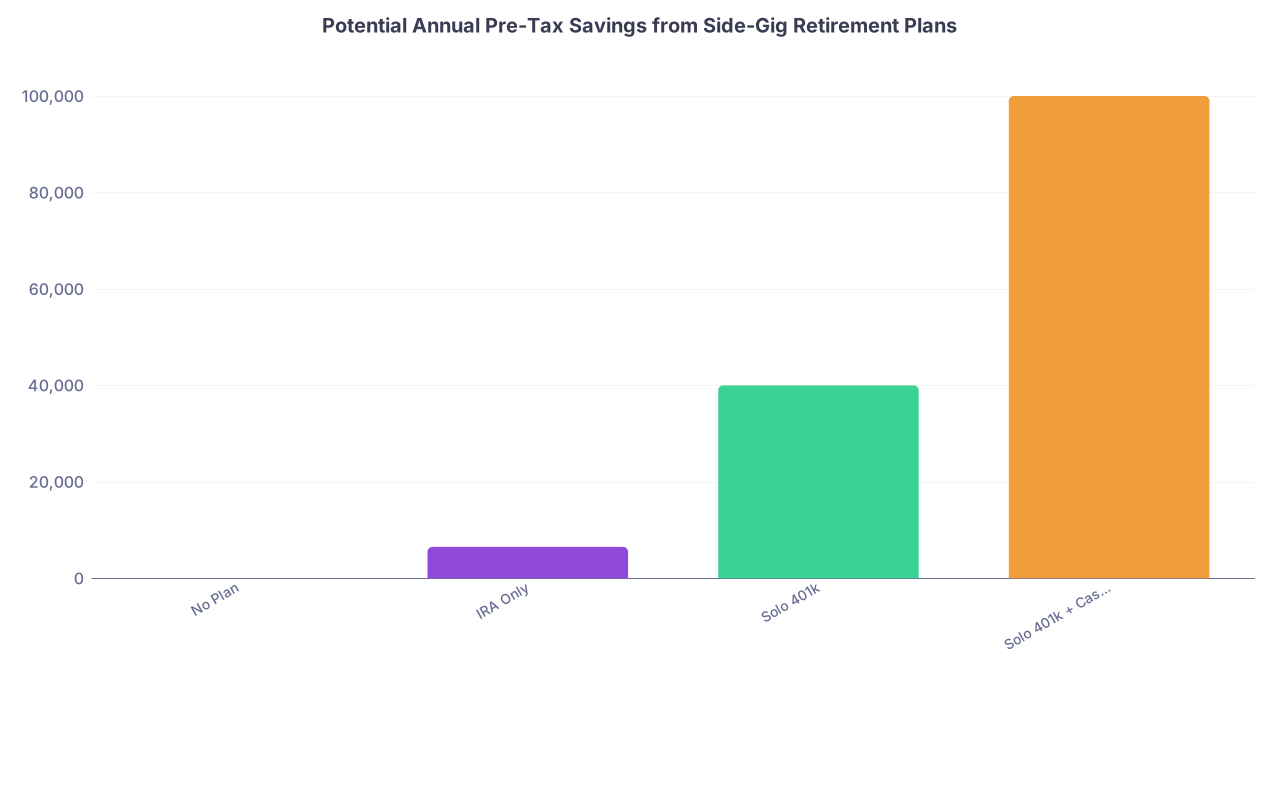
| Category | Value |
|---|---|
| No Plan | 0 |
| IRA Only | 6500 |
| Solo 401k | 40000 |
| Solo 401k + Cash Balance | 100000 |
QBI and “Pass-Through” Games: The Quiet 20% You Might Be Missing
The Qualified Business Income (QBI) deduction is one of those things many physicians have heard of, but almost no one really understands. Including some CPAs, if we’re being honest.
Here’s the rough idea:
If you have qualified business income from a pass-through entity (sole prop, partnership, S‑corp, etc.), you may get up to a 20% deduction on that income. But there are income limits, and “specified service trades or businesses” (SSTB) have stricter rules. Medicine is usually an SSTB.
Where does your side gig sit? That’s where things get interesting.
- Straight clinical moonlighting? Likely SSTB. QBI may phase out at higher incomes.
- Expert witness work, consulting, education, content creation? That might be arguable as non-SSTB depending on how it’s structured and what’s actually provided.
I’ve sat in rooms where tax attorneys and CPAs dissected a physician’s consulting business and legitimately repositioned it to qualify for more QBI. Not shady. Just accurate categorization with better documentation and separation from pure clinical care.
That conversation never happens if your CPA sees you as “another doctor with a couple 1099s.” They throw it all into one bucket and call it a day.
You want someone who’s thinking:
Can part of this be treated as non-SSTB?
Do we have documentation to back that narrative?
What’s the aggregate impact on QBI over 5–10 years?
If no one is asking those questions, you’re leaving a 5-figure sum on the table over your career. Quietly. Every April.
State, Legal, and Asset Protection – The Things You Assume Someone Else Is Watching
Here’s another thing CPAs usually won’t bring up unless forced:
Your side gig changes your liability picture.
Separate from malpractice. Separate from your W‑2 job.
You start doing expert witnessing, chart review, consulting, telehealth across state lines: you’re now running an actual business with contract risk, regulatory risk, data/privacy risk.
Your CPA’s default move: ignore it. They file Schedule C or S‑corp returns and leave the legal structure, licensing, and asset protection to… no one, really.
You were probably assuming “someone” would mention if there was a problem. That someone does not exist unless you hire them.
A well-aligned team (CPA + attorney who understands doctors) will coordinate:
- Where your entity is formed vs where you’re actually working
- How your contracts name you (personally vs entity)
- How your business assets and personal assets are separated
- Whether your malpractice covers side work—or doesn’t
Your CPA will often say, “That’s a legal question.” And stop there.
Fair enough from a liability standpoint. But from your perspective, the absence of a red flag from a financial professional feels like a green light. It’s not.
Silence is not safety. It’s ignorance.

| Step | Description |
|---|---|
| Step 1 | Start Side Gig |
| Step 2 | Use Sole Prop or LLC |
| Step 3 | Model S Corp |
| Step 4 | Form S Corp + Payroll |
| Step 5 | Track Expenses and Home Office |
| Step 6 | Set Up Solo 401k or SEP |
| Step 7 | Review QBI and State Issues |
| Step 8 | Annual Tax Planning Meeting |
| Step 9 | 1099 Income Over 40k? |
| Step 10 | Tax Savings Justify Admin? |
What You Should Actually Expect from a Real Tax Partner
Let me be blunt. If your only interaction with your CPA is dropping off a tax packet in March and signing returns in April, you don’t have tax planning. You have data entry with credentials.
For a physician with meaningful side income, you should expect:
- A dedicated planning conversation during the year, when changes can still be made
- A clear explanation of how your 1099 income is taxed compared to your W‑2
- An opinionated recommendation on entity choice with actual numbers
- Coordination around retirement accounts tied to your side business
- A willingness to help structure contracts and income streams in tax-efficient ways (within legal bounds)
And just as important: you should feel them pushing you a little. Asking about expenses. Probing how and where you work. Challenging your assumptions about what “counts.”
If your CPA never says, “We’re being too conservative here, you’re leaving money on the table,” they’re probably protecting themselves more than they’re protecting you.
How to Start Fixing This – Without Burning Everything Down
You don’t have to blow up your entire CPA relationship tomorrow. But you do need to shift from passive to active.
Here’s how you start:
Schedule a non-tax-season meeting explicitly for side-gig planning. Tell them that’s the agenda.
Send them a one-page summary: approximate 1099 income, what you actually do, where you work, and any major expenses.
Ask very direct questions:
- “At my current 1099 level, do you think an S‑corp would lower my total tax bill after admin costs? Show me the math.”
- “How much am I paying each year in self-employment tax from my side gigs?”
- “What’s the maximum I could be putting into retirement accounts specifically from this side income?”
- “Which of my expenses could or should be business-related that I’m not currently tracking?”
If the answers are vague, rushed, or dismissive, you have your answer: they’re not interested in being your strategist. Just your filer.
Then you either:
- Upgrade the relationship (pay for planning, get more of their time), or
- Upgrade the CPA (find someone who actually likes working with entrepreneurial physicians)

The Quiet Reality: No One Cares About Your Side Income As Much As You Do
Hospitals don’t care how your 1099 work is taxed.
Recruiters don’t care.
Most CPAs only care up to the point their prep fee is justified.
You’re the only one with the real incentive to squeeze inefficiency out of your side-gig structure. That means you have to:
- Stop assuming “it’s taken care of”
- Stop being intimidated by the language
- Start demanding actual explanations, not shrugged one-liners
Over the years, I’ve watched physicians wake up to this and restructure things:
- A hospitalist turning $80K of scattershot moonlighting into an organized S‑corp with a solo 401(k), saving five figures a year.
- An expert witness who stopped treating her work as “just doctor stuff” and reclassified correctly, unlocking QBI on a chunk of income.
- A telemed doc who moved from under-deducting everything “to be safe” into properly documented, aggressive-but-defensible deductions and cut their April shock bill in half.
They didn’t become accountants. They just stopped being passengers.
Years from now, you won’t remember the specific tax forms or the exact deduction percentages. You’ll remember whether you treated your side gigs like a real business—or like loose change. One of those paths quietly builds wealth and freedom. The other just builds resentment every April.
Choose early which story you want to tell.


