
It is late February. Your group’s K‑1s just dropped into your inbox, your CPA sent a 14‑page organizer, and buried in the email is a line: “We will evaluate whether your income qualifies for the 20% Qualified Business Income (QBI) deduction.”
You remember hearing “doctors do not qualify.” Your partner swears his buddy in anesthesia is “getting the full 20%.” Someone on the board wants to spin off imaging into a separate LLC “to get QBI.”
This is exactly where practices start leaving real money on the table—or walking straight into an IRS problem.
Let me break this down specifically for physicians and group practices: when you actually qualify, when you definitely do not, and where there is real planning versus pure fantasy.
1. The brutal truth first: physicians are a “specified service trade or business”
Start with the core problem.
Under Internal Revenue Code §199A, most business owners can deduct up to 20% of “qualified business income.” But Congress carved out a subset called “specified service trades or businesses” (SSTBs). These are basically high‑income professionals whose main “asset” is their reputation/skill: law, accounting, consulting, financial services, performing arts, pro sports, and—yes—health.
Physicians are squarely in the SSTB bucket. The statute and regulations are explicit: the performance of services in the field of health is an SSTB.
That means:
- A solo cardiologist? SSTB.
- A 200‑physician multi‑specialty clinic? SSTB.
- A hospitalist LLC contracting with a hospital system? SSTB.
So why do you ever hear about a 20% QBI deduction for doctors?
Because SSTBs are not automatically disqualified. They are phased out once taxable income crosses certain thresholds. Below those levels, you can absolutely get QBI, even as a physician.
And there is another twist: some entities that orbit your practice can be non‑SSTB even though you are a doctor. That is where real planning lives.
2. The income thresholds: where QBI lives or dies for physicians
For physicians, the QBI deduction is not about your entity type. It is about your taxable income at the individual level.
There are three zones for SSTBs (physician practices included):
- Below threshold → full QBI deduction possible
- Within phase‑out range → partial QBI deduction, subject to complex wage/property limits
- Above top of phase‑out → SSTB QBI is gone. Zero. No 20% deduction from that practice income.
Let’s anchor to current numbers. These adjust annually, but the structure stays the same. I will use 2024 filing season for 2023 income as a reference point:
| Filing Status | Threshold (Full QBI Possible) | Phase-out Range | Above This = No SSTB QBI |
|---|---|---|---|
| Single | $182,100 | $182,100–$232,100 | > $232,100 |
| MFJ | $364,200 | $364,200–$464,200 | > $464,200 |
| MFS | $182,100 | $182,100–$232,100 | > $232,100 |
(If you are reading this in a later year, the exact dollar amounts will be higher, but the logic is the same.)
Zone 1: Below the threshold
Example: Married, taxable income $320,000, both spouses physicians in a group practice.
Your taxable income is below $364,200. Even though the practice is an SSTB, you are not in the phase‑out at all.
What happens:
- QBI = your share of ordinary business income from the practice (ignoring wages you get as a W‑2, ignoring guaranteed payments).
- Proposed deduction = 20% of that QBI.
- Subject to an overall cap: 20% of your taxable income (before the QBI deduction) minus capital gains.
So if your K‑1 shows $250,000 of qualified business income, your theoretical QBI deduction is $50,000. Then you cap it at 20% of taxable income if that is lower.
This is the zone where lower‑earning physicians, dual‑physician couples with aggressive retirement contributions, or part‑time physicians actually qualify fully.
Zone 2: In the phase‑out
Example: Married, taxable income $410,000, you are a partner in a cardiology group.
You are inside the $364,200–$464,200 band. Now the math gets unpleasant. Two things happen:
- Because you are an SSTB, your QBI starts being reduced ratably until it hits zero at the top of the range.
- The wage and property limitations (the W‑2/UBIA tests) start to apply proportionally as you climb through that range.
Translation:
- At the bottom of the phase‑out, you are almost like a non‑SSTB.
- At the top, you are treated like a fully disqualified SSTB.
- In the middle, you get a shrinking piece of a shrinking pie.
A lot of physicians in this band can still salvage a partial deduction by hitting two levers:
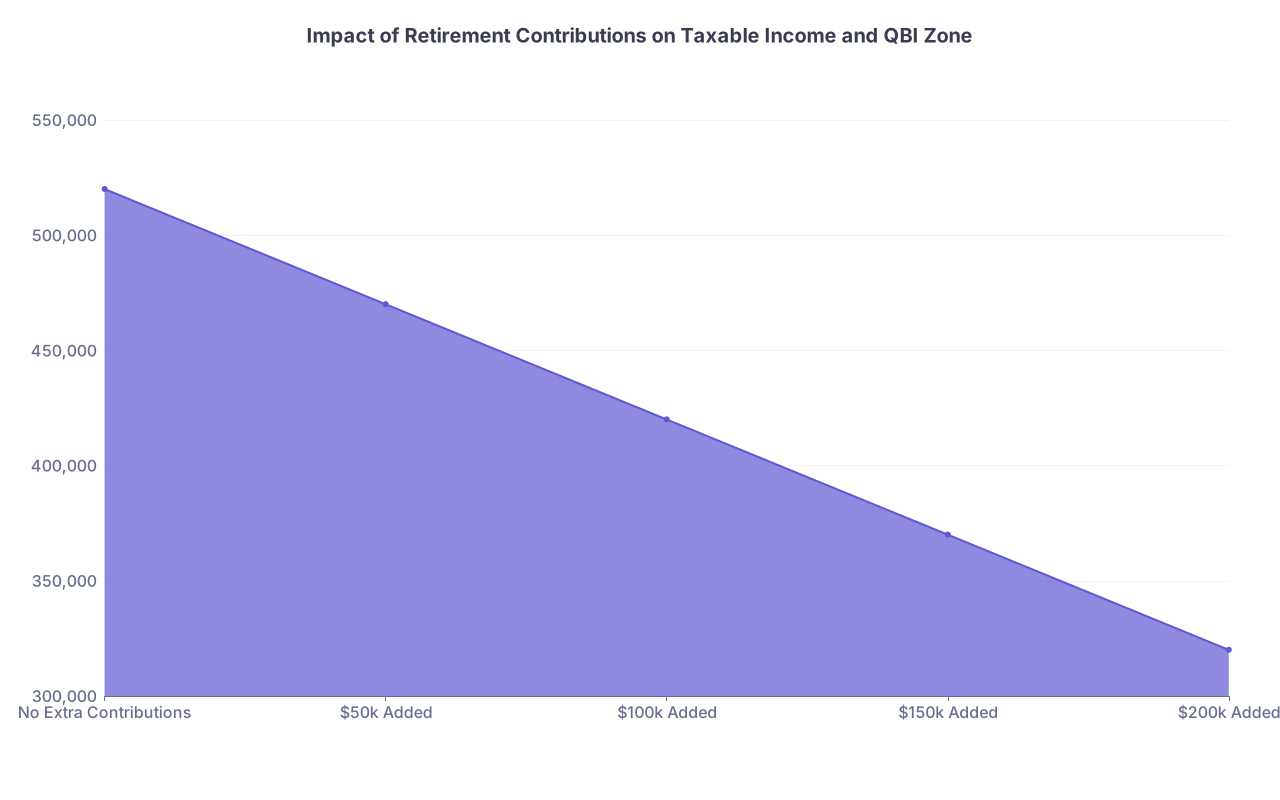
- Reducing taxable income (maxing retirement, HSA, defined benefit, strategic charitable planning).
- Making sure the practice actually pays enough W‑2 wages or has sufficient qualified property to support the wage/property limitation.
We will come back to that.
Zone 3: Above the top of the phase‑out
Example: Single, taxable income $550,000 from your ortho group.
You are well above $232,100. Your practice is an SSTB.
Outcome: your QBI from that medical practice is zeroed out for §199A purposes. No 20% deduction on that business income. Period.
This is where a lot of academic speakers, high‑earning subspecialists, and large‑market proceduralists land. They cannot salvage QBI on their clinical practice income once taxable income is that high.
They can, however, still get QBI on qualifying non‑SSTB income streams if those exist and are structured correctly.
3. What actually counts as “qualified business income” for a physician?
This part is where I routinely see practices and even some CPAs get sloppy.
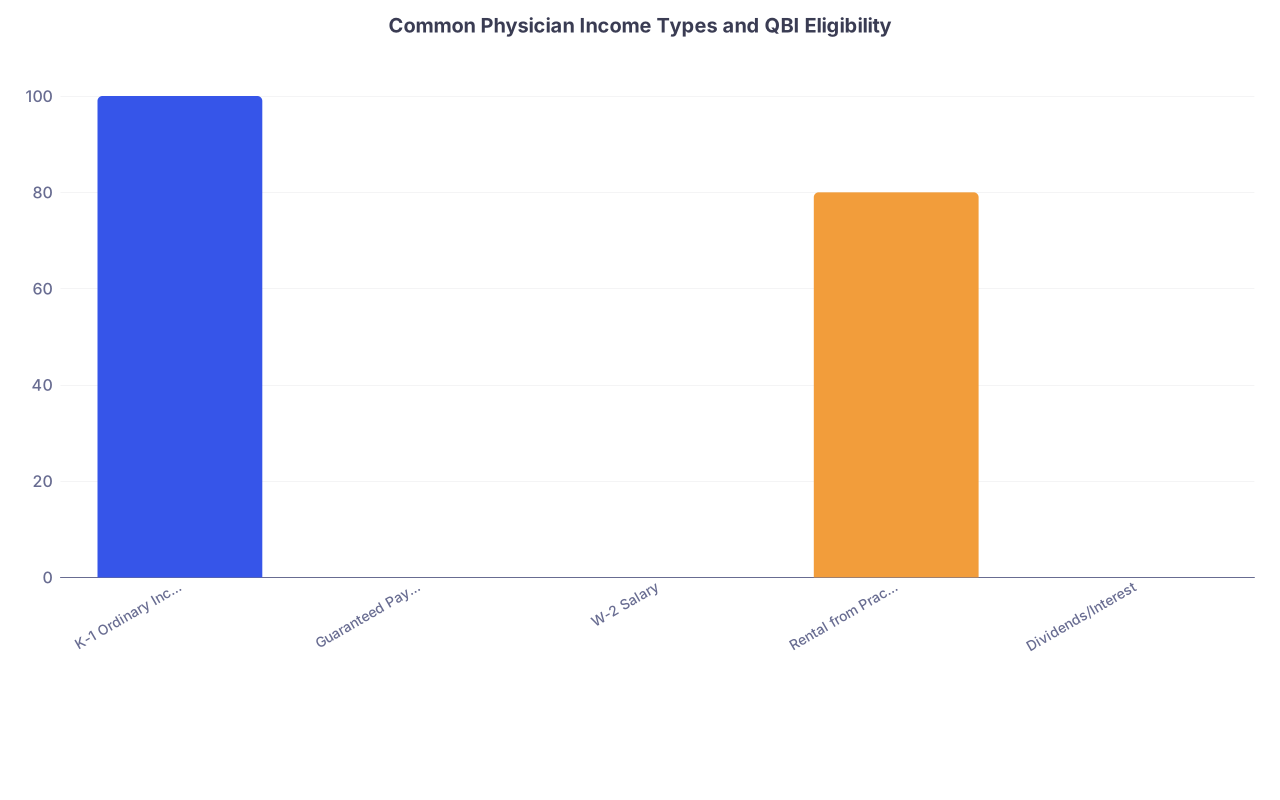
For §199A, “qualified business income” is ordinary business income from a U.S. trade or business, excluding certain items. In physician land, that means:
Included as candidate QBI (from a pass‑through):
- Your share of ordinary business income on a K‑1 (partnership or S corp) from the practice.
- Your share of ordinary RE income from a separate practice‑owned real estate LLC (if it qualifies as a trade or business and is not tainted as SSTB via aggregation rules).
- Income from distinct non‑medical lines of business (ASC management entity, imaging company leasing to third parties, etc.) that actually stand on their own.
Generally excluded:
- W‑2 wages from your hospital or practice. Zero QBI.
- Guaranteed payments to partners (often used in physician comp formulas). These do not qualify as QBI.
- Capital gains, dividends, interest that is investment‑type (not trade‑or‑business interest).
- Reasonable compensation to S‑Corp owner‑physicians via W‑2. The S‑Corp profit after wages may qualify, but the wages themselves do not.
| Category | Value |
|---|---|
| K-1 Ordinary Income | 100 |
| Guaranteed Payments | 0 |
| W-2 Salary | 0 |
| Rental from Practice Real Estate LLC | 80 |
| Dividends/Interest | 0 |
Do not gloss over the guaranteed payment issue. I have seen groups with 80–90% of partner comp structured as guaranteed payments “for services rendered.” That is basically taking a sledgehammer to your potential QBI base. If you are below or in the phase‑out band, the drafting of the operating agreement and comp model matters a lot.
4. Entity structure myths: what helps and what absolutely does not
You have probably heard some of this in the lounge:
- “Just make yourself an S‑Corp and you will get QBI.”
- “Split into two LLCs—one clinical, one admin—and the admin company will get QBI.”
- “Put the building in a separate LLC and you get the full 20% on that rent.”
Some of this is wishful thinking. Some of it is strategic but must be done with discipline.
Myth: “S‑Corp magically creates QBI”
If your practice is an SSTB and your taxable income is above the SSTB phase‑out ceiling, changing your PC/PLLC to an S‑Corp does not restore QBI on that income. The SSTB rule is not about entity type. It is about field of activity and your taxable income.
What S‑Corps can do is:
- Change the mix between W‑2 wages (non‑QBI) and distributive profits (potential QBI) for owners.
- Help in non‑SSTB contexts, where you need a certain ratio of wages to QBI to beat the wage limitation.
For high‑income clinicians squarely above the SSTB cap, though: no entity gymnastics will resurrect QBI on that clinical revenue.
Sometimes-legit: separating non‑SSTB lines of business
Now we are in more interesting territory.
A physician group may operate multiple distinct businesses under its umbrella:
- The clinical practice (SSTB).
- A management company performing admin/IT/billing services for third‑party clients (not just your own practice), which can be non‑SSTB.
- A stand‑alone imaging center or lab that markets to outside providers and has real business infrastructure.
- A real estate LLC that owns the office building and leases space to unrelated tenants.
The key questions:
- Is the non‑clinical activity a real business in its own right, with employees, systems, risk, and revenue from outside parties?
- Does it pass the IRS smell test that it is not just a paper shell to recharacterize clinical income as “management” or “facility fee”?
The regulations have an “anti‑crack‑and‑pack” rule specifically to shut down games where an SSTB strips out pieces of itself into a second entity solely to qualify for QBI. For physicians, that means:
- If an entity provides 80% or more of its property or services to a commonly owned SSTB, it can itself be treated as an SSTB.
- “Commonly owned” is broadly defined (same owners, related parties, etc.).
So the famous trick of setting up “Dr. Smith Management LLC” that only serves “Dr. Smith Medical LLC” with no external clients? That is exactly what the IRS targeted. In most cases, that management company will be reclassified as part of the SSTB.
If, on the other hand, you own an imaging center that has meaningful external business and a different economic profile, that can legitimately be a separate QBI‑producing, non‑SSTB business (subject to its own limitations and thresholds).
Real estate LLCs: sometimes gold, sometimes useless
Many physician groups own their building in a separate pass‑through entity and pay rent. On a K‑1, you see:
- K‑1 from practice (SSTB).
- K‑1 from real estate LLC (rental income).
Can that rental income qualify as QBI?
- If the real estate LLC is a bona fide trade or business (regular, continuous, profit‑motivated activity) AND
- It is not sucked into the SSTB world via aggregation rules (i.e., it has more going on than just renting solely to your own practice and meets certain thresholds),
then yes, the rental income can be QBI. And it is not automatically an SSTB just because a physician owns it.
But:
- If the rent is just a thin wrapper around the clinical operation, with no other tenants and no real business activity beyond collecting rent from your own SSTB, the IRS may treat it as part of the SSTB for §199A.
- If your taxable income is well above the SSTB limit, your clinical practice QBI is gone, but your real estate QBI might still survive if it is non‑SSTB.
This is one of the few clean planning wins for high‑earning doctors who cannot get QBI on their clinical income but have meaningful practice‑related real estate.
5. Where physician groups actually win QBI
Let’s go through realistic scenarios I see.
Scenario A: Young partners, solid but not crazy income
Married couple, both hospitalists in a private group taxed as a partnership. Combined taxable income after maxing 401(k)s and HSA is around $320,000.
Result:
- Below the SSTB threshold.
- Their ordinary business income on the K‑1 is QBI.
- Guaranteed payments hurt them; they should restructure comp so that more is partnership profit and less is guaranteed payment, consistent with real risk/ownership.
- They can get a full 20% QBI deduction, subject to the 20% of taxable income cap.
This is the sweet spot where careful agreement drafting and regular review of K‑1 categories put real cash back in their pocket, year after year.
Scenario B: High earners, but strong planning to stay in phase‑out band
Married orthopedic surgeon partner, spouse is a lower‑earning NP with some 1099 income. Their raw earnings would put taxable income around $500,000. They implement:
- Max 401(k)/profit‑sharing at the practice level.
- Add a Cash Balance plan.
- Use aggressive pre‑tax health benefits, FSA, HSA.
- Stack charitable contributions using a donor‑advised fund in high‑income years.
They systematically drive taxable income down into the $380,000–$420,000 range.
Now they float inside the SSTB phase‑out, not above it.
Result:
- They may still get a partial QBI deduction on the practice K‑1.
- The group needs to ensure sufficient W‑2 wages are paid overall to prevent the wage limitation from killing the benefit.
This is where a strong practice CFO or outside advisor can actually model the trade‑offs: extra retirement contributions versus current cash, versus incremental QBI deduction.
Scenario C: Clinical income too high, but side business wins
Single interventional cardiologist, taxable income $700,000 from practice (SSTB). Separately, he and a partner own an ASC operating company that:
- Pays facility fees and collects from multiple independent groups.
- Has distinct staff, contracts, marketing.
- Is taxed as an S‑Corp; he receives a K‑1 with $200,000 of ordinary business income and W‑2 wages of $120,000.
Result:
- Clinical practice ASTB QBI = zero (taxable income way above ceiling).
- ASC business likely non‑SSTB, QBI eligible, subject to W‑2 wage limitation.
- He can still get a QBI deduction on that $200,000 ASC profit, if structured correctly.
This is a realistic path for entrepreneurial physicians who build genuine non‑clinical or hybrid business lines.
6. The wage and property limitation: where groups routinely blow it
Once you are above the basic threshold (even for non‑SSTBs), the W‑2 wage / qualified property limitation kicks in. For SSTBs in the phase‑out band, this limitation phases in as the SSTB benefit phases out.
The basic rule for the maximum QBI deduction from a given business (before SSTB disqualification) is:
- Lesser of
- 20% of QBI, or
- The greater of
- 50% of W‑2 wages paid by that business, or
- 25% of W‑2 wages + 2.5% of unadjusted basis (UBIA) of qualified property.
In physician practices:
- W‑2 wages = staff + employed physicians’ W‑2s + maybe owner‑physician W‑2 if S‑Corp.
- Qualified property = typically significant only if the practice owns buildings, expensive equipment, etc.
Common failure patterns:
- Too little W‑2 wage relative to owner profit in an S‑Corp holding a non‑SSTB business (like imaging/ASC). Owner wants to minimize payroll tax, so they pay themselves tiny salary and big distributions. Then they wonder why the QBI deduction is capped.
- UBIA not maintained properly. Nobody tracks tax basis of property at acquisition, so the 2.5% factor cannot be used correctly.
- Aggregation not used when it should be. Two related non‑SSTB entities that share staff and property might benefit from being treated as one for the wage/property test, but the CPA files separately without aggregation election.
For pure clinical SSTBs above the SSTB income ceiling, the wage/property test does not even matter. QBI is already zero. The test becomes critical in phase‑out ranges and for non‑SSTB side businesses.
7. Planning levers that are actually worth your time
Let’s be blunt: you are not going to out‑scheme §199A with shell entities. The IRS has already seen that movie.
Here is what does move the needle for physician QBI:
Drive taxable income into the favorable zone, when realistic
- Maximize qualified retirement plans (401(k), profit‑sharing, defined benefit/cash balance).
- Use HSA, FSA, and other pre‑tax benefits.
- Bunch charitable deductions in high‑income years.
- Utilize timing of income/expense recognition where you have control (year‑end bonuses, elective procedures, etc.).
Fix your comp model and K‑1 structure
- Reduce unnecessary “guaranteed payments” if they are just disguised profit.
- Ensure partner distributions are properly reflected as QBI‑eligible income.
- Revisit operating agreements so tax allocations mirror economic reality but maximize QBI base.
Treat real non‑clinical businesses as real businesses
- If you have an imaging center, ASC, diagnostic lab, or management company with meaningful third‑party revenue, structure it as a separate trade or business with clean books and true business substance.
- Pay reasonable W‑2 wages. Do not starve the business purely to chase payroll tax savings and then sabotage QBI.
Real estate done right
- Own practice real estate in a separate entity that acts like a real landlord.
- Consider additional tenants, market‑rate leases, and clear documentation that it is more than an appendage of the SSTB.
- Track UBIA carefully at acquisition.
Avoid dumb “crack‑and‑pack”
- If the only purpose of a new LLC is to reclassify clinical income as “admin” to chase QBI, abandon the idea. You are painting a red target on the practice.
- Remember the 80% common‑ownership rule for SSTBs. If you are primarily serving your own practice, you are probably still an SSTB.

| Step | Description |
|---|---|
| Step 1 | Physician Entity Income |
| Step 2 | Health SSTB |
| Step 3 | QBI possible |
| Step 4 | Partial QBI with wage limits |
| Step 5 | No QBI on clinical income |
| Step 6 | Likely non QBI |
| Step 7 | High audit risk, likely SSTB |
| Step 8 | Non SSTB QBI possible |
| Step 9 | Is it clinical care? |
| Step 10 | Separate trade or business? |
| Step 11 | Taxable income below SSTB threshold? |
| Step 12 | Within phase out band? |
| Step 13 | Substance and third party revenue? |
8. How this plays out in practice governance and partner politics
You cannot separate §199A from physician group politics. I have sat in partner meetings where:
- Older partners opposed a cash balance plan because “we are not giving more to junior docs”—even though the QBI and tax savings made it mathematically attractive for everyone.
- One subspecialty with higher income was furious that QBI planning was tuned around the mid‑income partners to keep them in the phase‑out.
- The group’s “tax guy” had pushed almost all comp into guaranteed payments for years, killing QBI for everyone under the threshold.
Here is how to avoid that mess:
Model the impact at the group level and by partner tier
- Have your CPA or advisor run QBI projections on multiple comp structures and retirement plan designs.
- Show: pre‑tax cash, after‑tax cash, QBI deduction impact, and long‑term retirement savings. Numbers shut down a lot of hypothetical arguments.
Align comp policy with tax policy
- If staying in the QBI zone requires large pre‑tax contributions, you need buy‑in that your group values tax‑efficient savings over pure current cash.
- Decide explicitly if the practice is going to chase QBI for the mid‑income doctors or accept that high producers will be above the limit and focus planning elsewhere.
Keep documentation meticulous
- Operating agreement, employment agreements, and lease agreements should all line up.
- If you claim separate trades or businesses for non‑clinical operations, be ready to prove it: org charts, client lists, independent marketing, separate financials.

9. Common red flags that will get unwanted IRS attention
If your group is doing any of the following, you are on thin ice:
- Newly formed “management” LLC that only invoices your own practice for administrative services, with the same owners in the same proportions, no outside clients, and no staff.
- Sudden shift of physician comp from W‑2 to “independent contractor through an LLC” with no change in actual control or risk, solely to chase QBI.
- Lease arrangements where your practice pays above‑market rent to a building LLC owned by the same partners, clearly just to move income from an SSTB to non‑SSTB real estate.
- K‑1s where 90% of physician partner income is labeled as guaranteed payments without a compelling business justification.
I am not saying you will be audited tomorrow. I am saying these patterns are well known, and if §199A stays important on Capitol Hill’s radar, these are the first places IRS agents will look.
10. Practical checklist for your next tax season
Here is how I would have you prepare before the next K‑1 season hits:
Pull your last two years’ returns. Identify:
- Your taxable income each year.
- Whether you claimed a QBI deduction, and on which K‑1s.
- How much of your practice K‑1 was QBI versus guaranteed payments or W‑2.
With your CPA, answer:
- Am I below the SSTB threshold, within the phase‑out, or above the ceiling?
- If I am close to a threshold, what specific moves would push me under?
- Do I have any non‑SSTB businesses (ASC, imaging, real estate, consulting) that are not being treated as QBI but should be?
For the group practice:
- Review the operating agreement and compensation model with a tax lens.
- Identify opportunities to convert excessive guaranteed payments into distributive profits (if economically reasonable).
- Evaluate retirement plans and whether expanded contributions could unlock or enlarge QBI for significant numbers of partners.
For real estate or side entities:
- Verify they are operated as genuine separate trades or businesses.
- Clean up leases, service agreements, and governance.
- Ensure W‑2 wages and UBIA are properly tracked.
| Category | Value |
|---|---|
| No Extra Contributions | 520000 |
| $50k Added | 470000 |
| $100k Added | 420000 |
| $150k Added | 370000 |
| $200k Added | 320000 |
You do not need to become a §199A savant. You do need to understand where you sit in the thresholds, and whether your practice structure is working with or against you.

The bottom line
Three key points and then you can close this tab:
Physician practices are SSTBs, but that does not mean no QBI. It means QBI depends heavily on your taxable income relative to the SSTB thresholds. Below the line, you can get the full 20% deduction. Above the ceiling, your clinical practice QBI is gone.
Real planning lives in structure and substance. Cleaning up guaranteed payments, designing retirement plans, and respecting the difference between clinical and non‑clinical businesses can turn §199A from a rumor into a tangible, annually recurring benefit.
Entity games without economic reality are asking for trouble. If an arrangement only exists on paper to reclassify physician clinical income as something else, assume the IRS has seen it before and will treat it as SSTB anyway.
If you walk into your next meeting with your CPA or practice board clear on those three points, you are already ahead of most physician groups.