

Most doctors are dead wrong about medical equipment “write‑offs.”
You do not “get it for free.” You are not “sticking it to the IRS.” And that shiny $300,000 laser is not a “no‑brainer because you can write it off.”
If you remember nothing else, remember this: a tax deduction is a discount, not a refund. You’re still spending real, after‑tax money. The tax code just decides how fast you get to recognize that pain.
Let’s tear apart the myths that vendors, colleagues, and frankly some lazy accountants let circulate in private practice medicine.
Myth #1: “If I Can Write It Off, It’s Basically Free”
This is the most common and the most dangerous.
Here’s what actually happens when you “write off” equipment:
You reduce your taxable income by the cost of the asset (either all at once or spread over years). That’s it. You save your marginal tax rate on that amount. You do not get the whole purchase price back.
Say you’re in a combined marginal rate of 40% (federal + state + payroll effects).
You buy a $100,000 ultrasound for your practice.
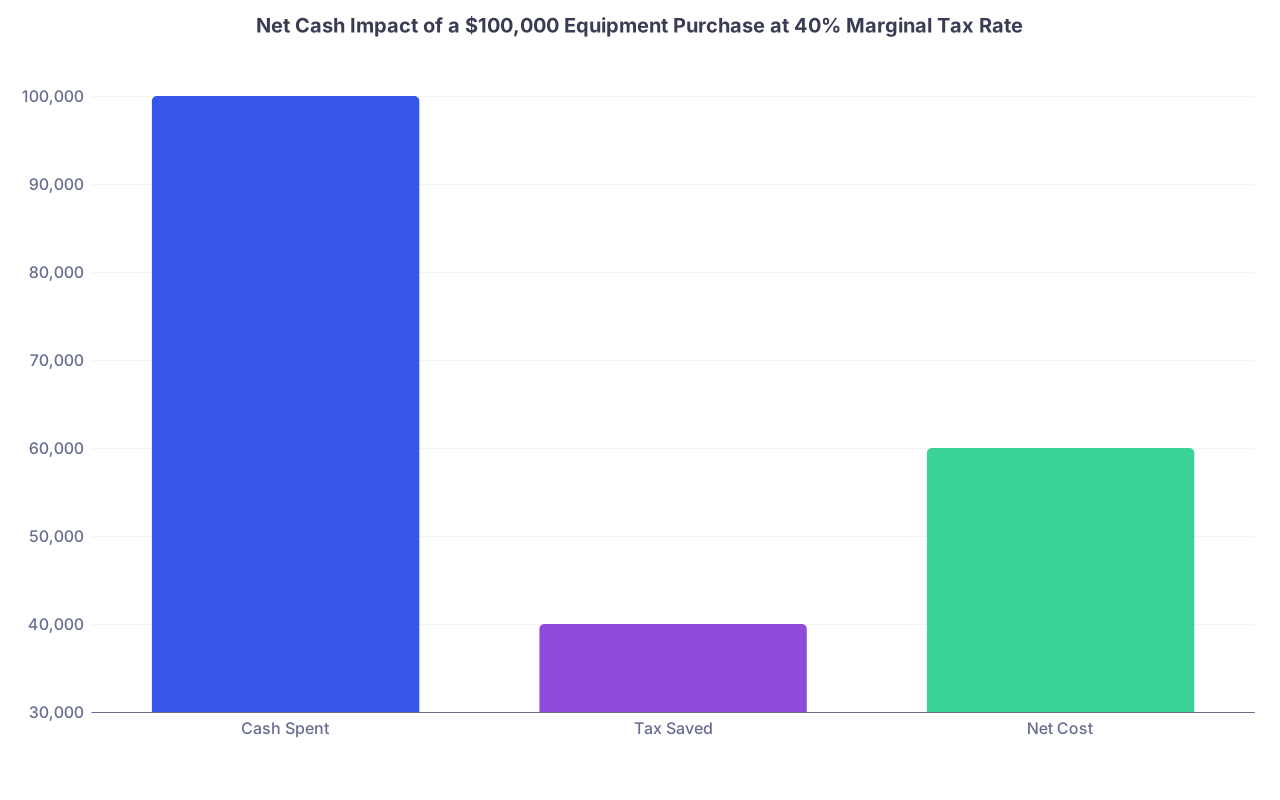
If you can deduct the full $100,000 in year one:
- You reduce your taxable income by $100,000
- You save $40,000 in taxes
- You are still out $60,000 in real, permanent, gone-forever cash
That’s the math. Every single time.
Here’s how that looks compared to no purchase:
| Category | Value |
|---|---|
| Cash Spent | 100000 |
| Tax Saved | 40000 |
| Net Cost | 60000 |
Every time a rep tells you, “But you can write it off,” translate it into plain English:
“You can overpay for this, but the government will chip in your marginal tax rate.”
That’s all.
If the machine doesn’t pay for itself in after‑tax cash flow, the deduction just helps you lose money slightly slower.
Myth #2: “Section 179 Means I Can Deduct Anything I Want”
I hear this constantly:
“My CPA said I can use Section 179 and write off the whole thing this year, so worst case, I’m fine.”
No. Section 179 has rules. Limits. And traps if you’re not paying attention.
The broad strokes, without the legalese:
- Section 179 lets you elect to expense (deduct immediately) certain business property instead of depreciating it over years.
- There’s an annual dollar limit (over a million dollars, indexed, but it phases out if you place too much equipment in service).
- The deduction is limited to your taxable business income. You can’t use Section 179 to create or increase a loss beyond certain boundaries. Excess gets carried forward.
- The equipment has to be used more than 50% for business.
And no, your personal Peloton “for patient demos” doesn’t magically qualify.
Let’s compare how Section 179 and regular depreciation actually differ for a typical piece of medical gear in a simple, realistic way.
| Scenario | Year 1 Tax Savings | Total Tax Savings Over Life | Cash Outlay Pattern |
|---|---|---|---|
| Section 179 (full expensing) | $40,000 | $40,000 | Big tax benefit in year 1, none later |
| 5-year Depreciation | ~$8,000/year x 5 | $40,000 | Smaller annual savings, same total |
Notice the key word: timing.
Section 179 does not increase the total deduction. It just moves it forward.
So if your rep sells the laser as “a big write‑off at the end of the year,” they’re technically right about timing but conveniently silent about everything else:
- They’re not asking if you even have enough taxable income to use the deduction.
- They’re not discussing what happens when your income drops later and you wish you had those deductions in future years.
- They’re definitely not telling you that you may be prepaying for revenue you never actually see.
Myth #3: “Bonus Depreciation Makes Equipment a No‑Risk Move”
You’ve probably heard some flavor of this in the last few years:
“Between bonus depreciation and Section 179, you’d be crazy not to buy now. The government’s basically paying for a big chunk of it.”
Bonus depreciation has been generous, yes. After the 2017 tax law, it briefly allowed 100% immediate expensing for many types of equipment. That led to a lot of dumb decisions dressed up as “tax planning.”
The reality:
- Bonus depreciation is phasing down. It’s not permanent, and the percentages are shrinking unless Congress changes the rules again.
- It still doesn’t change the math that a deduction is just a partial refund of money you already spent.
- If you finance the equipment, you might be taking a giant deduction up front… and then paying interest and principal for years with no future depreciation left to offset that income.
Let me paint a scenario I’ve seen in real practices:
A dermatologist finances a $250,000 laser at the end of a good income year. Takes 100% bonus depreciation. Saves about $100,000 in taxes at a 40% rate.
They’re thrilled. Feel like a genius.
Next year, two things happen:
- Volume drops because a large referral source changes insurance relationships.
- The laser doesn’t generate as much revenue as promised—patients aren’t paying the out-of-pocket costs like the rep boasted.
Result:
They’ve locked in five years of payments on an asset that isn’t pulling its weight. The tax break already happened. And now, when income is lower, there’s no more depreciation to cushion the blow.
That’s not “free money.” That’s front-loading your future relief into a year when you might not even have needed it that badly.
Myth #4: “My CPA Will Figure Out the Best Way to Write It Off”
I’m going to be blunt: a lot of doctors overestimate how proactive their accountants really are.
Most CPAs working with small medical practices:
- Record what you already did
- Make sure it complies
- Minimize taxes given the facts you hand them
They do not usually:
- Model the ROI of that $400k robot versus leasing or outsourcing
- Compare Section 179 vs bonus vs straight-line in the context of your actual business plan
- Walk through what happens if reimbursements drop 20% in three years
That’s not malice. It’s just not what most are paid or staffed to do.
So when a doctor tells me, “My accountant said it’s fine because I can write it off,” what I actually hear is:
“No one has seriously modeled the cash flows, the risk, or the opportunity cost of this thing.”
If your CPA is exceptionally strategic and actually builds year‑over‑year projections around major capital purchases, great. Most do not. You should assume they’re optimizing form-filling, not capital allocation.
This is a business decision first, tax decision second.
Myth #5: “Any Equipment That Produces Revenue Is Worth Buying if It’s Deductible”
Here’s the quiet part vendors never say out loud: revenue isn’t enough. You need after‑tax profit, after overhead, after financing, after maintenance, and after your time.
Let’s do a stripped‑down comparison of two physicians considering a machine:
| Factor | Dr. A (Busy Suburban Practice) | Dr. B (Small Rural Practice) |
|---|---|---|
| Machine Cost | $150,000 | $150,000 |
| Financing | 5-year loan | 5-year loan |
| Estimated Procedures/Year | 500 | 120 |
| Net Profit per Procedure (after staff/supplies) | $200 | $150 |
| Annual Net Profit Before Loan | $100,000 | $18,000 |
| Annual Loan Payments (approx) | $34,000 | $34,000 |
| Net Before Tax and Depreciation | $66,000 | -$16,000 |
Same machine. Same deduction rules. Totally different reality.
For Dr. A, the deduction is a bonus on top of a profitable service line. Great.
For Dr. B, the deduction subsidizes a money‑losing decision. The tax code is not going to rescue that.
This is the core principle:
If the business case is bad before tax, the tax benefits just make a bad decision slightly less painful.
You should be able to justify the purchase on pre‑tax numbers. The writing‑off is the dessert, not the main course.
Myth #6: “Buying at Year-End Is Always Smart for the Write‑Off”
Year‑end is the Superbowl of bad equipment decisions. Reps know it. Banks know it. A lot of doctors don’t.
The script is predictable:
“You had a great year. You’re going to get killed on taxes. If you buy now and place it in service before December 31, you can write off the whole amount. Don’t leave money on the table.”
Here’s what they’re not admitting:
- If you buy in January instead of December, over the life of the equipment your total tax deductions will be almost identical. You’re just shifting them by one year.
- The December decision is usually rushed, under‑analyzed, and emotionally driven by tax anxiety.
- You might be committing to a major capital purchase with zero actual patient demand data, no marketing plan, and no realistic capacity analysis.
Worse, if your income is unusually high this year but will likely normalize or drop next year (new partner joining, payer mix changing, going part time), there are times where not front‑loading a deduction actually gives you more flexibility.
You don’t get extra special bonus deductions for year‑end panic buying. You get the same size pie, just sliced differently on the calendar.
Myth #7: “Leasing vs Buying Is Mainly a Tax Question”
No. Leasing vs buying is a control and risk question with tax as a secondary factor.
The vendor pitch usually sounds like this:
- “Lease payments are deductible as an expense.”
- “You preserve capital and get flexibility.”
- “Plus, you still get the write‑off each year.”
What they skip over:
- If you lease, the lessor usually gets the depreciation benefits. You get to deduct the lease payments as operating expenses. Still a deduction, just structured differently.
- The real lever is risk and obsolescence. If the tech changes quickly (aesthetic devices, imaging), buying might leave you owning an expensive dinosaur in five years.
- For stable, long‑life workhorse equipment (autoclaves, standard ultrasound, exam tables), owning can make more economic sense long term.
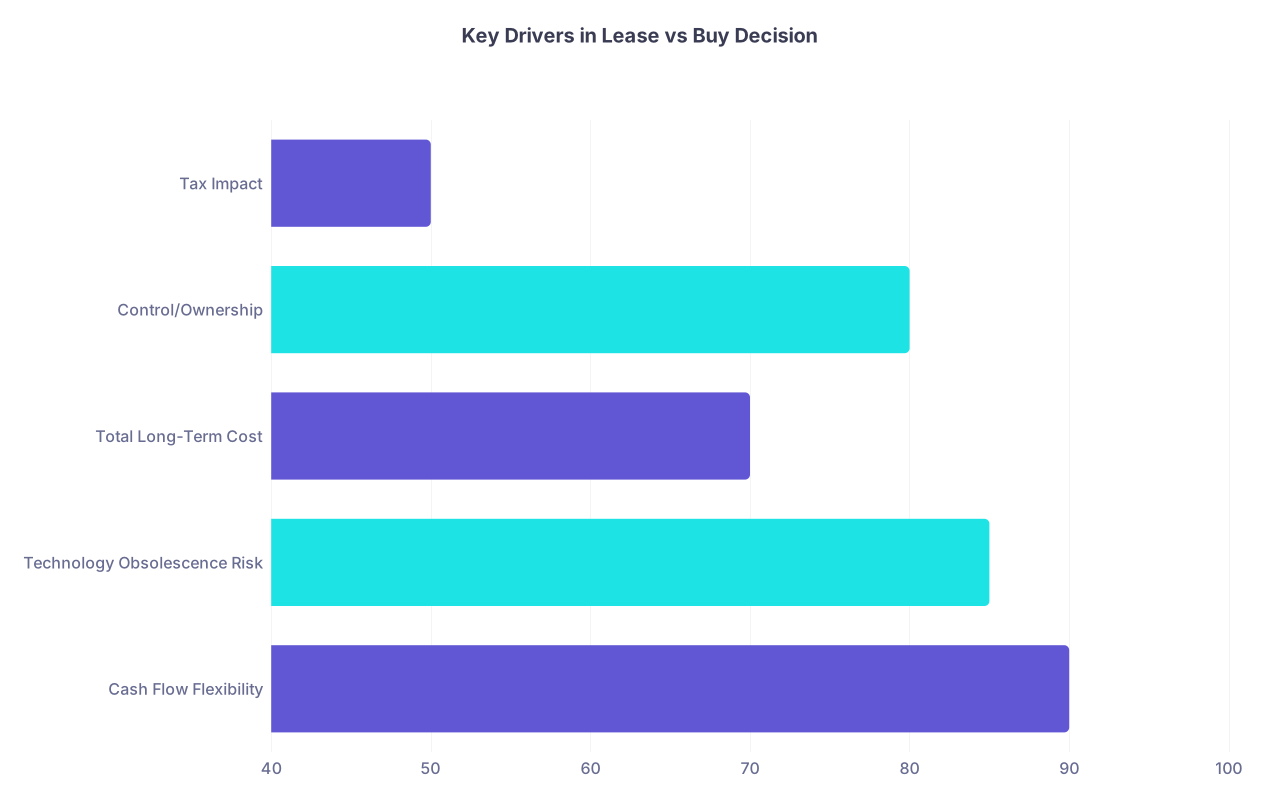
Here’s a clean way to frame it:
| Category | Value |
|---|---|
| Cash Flow Flexibility | 90 |
| Technology Obsolescence Risk | 85 |
| Total Long-Term Cost | 70 |
| Control/Ownership | 80 |
| Tax Impact | 50 |
The tax impact is just one piece, and it’s often the least important one. The IRS doesn’t care if you go bankrupt owning a beautiful MRI. It just cares how you report it on Schedule C, 1065, or 1120.
Myth #8: “Personal Use and Mixed Use Aren’t a Big Deal If It’s ‘Mostly’ for the Practice”
This is where doctors quietly get themselves in trouble.
You can’t just slap “medical device” on something and deduct 100% if you’re also using it personally or it’s not genuinely necessary for the business.
- Equipment that’s used both personally and professionally has to be allocated.
- If business use drops below 50% for certain property, you can trigger recapture of previously taken deductions, including Section 179.
- “It’s in my home but I sometimes use it for telehealth or patient education” is not a magic shield.
I’ve seen physicians run expensive computers, big-screen TVs, fitness equipment, even camera gear through the practice and wave it off as “for the office.” Sometimes they skate by. Sometimes they don’t.
The IRS is not stupid. Auditors know what a typical medical office looks like. That 85‑inch OLED in your den, “for reviewing imaging,” does not pass the smell test.
If you wouldn’t be comfortable walking an auditor physically through the use case, and showing logs or documentation, don’t pretend it’s a clean equipment write‑off.
How to Think Like an Adult About Equipment “Write‑Offs”
Let me strip away the noise and give you a simple framework. When you’re considering a big piece of equipment:
Ask these first, before you even say the word “deduction”:
Pre‑tax business case:
Does this generate reliable, realistic incremental profit, not just gross revenue, based on your actual patient base and payer mix?Capacity and demand:
Do you have the schedule room, staffing, and real patient demand to use this regularly?Financing and risk:
If revenue underperforms by 30–40%, can the practice still comfortably service the debt and keep you sleeping at night?
Then, and only then, ask the tax questions:
- Does immediate expensing (Section 179/bonus) in the current year help given your income trajectory and projected changes?
- Is there a benefit to stretching deductions into later, higher‑income years?
- How does the equipment interplay with other planned purchases? Are you stacking too much into one year?
For large purchases, you want your CPA and, ideally, a real financial planner who understands medical practices to run the numbers. On paper. With assumptions you actually recognize as your reality, not some vendor’s fantasy spreadsheet.
The Bottom Line: The Tax Code Is Not Your Business Partner
The painful truth is this:
The IRS is not “helping you buy equipment.” It’s merely deciding how and when you recognize a cost you’ve already taken on.
If you would not buy that MRI, that laser, that fancy ultrasound without the deduction, you probably should not buy it with the deduction. Because the tax benefit just lowers the effective price by your tax rate. That’s it.
Years from now, you won’t remember the Section 179 form your accountant filed. You’ll remember the machines that quietly earned their keep day after day—and the ones that sat in the corner, a $200,000 monument to a bad assumption about “write‑offs.”


