

The IRS does not care that you are busy seeing patients. If you have untaxed income, they expect their cut four times a year—on their schedule, not yours.
This is the part most physicians learn the hard way: your tax life changes the moment you step outside pure W‑2 employment. Moonlighting, telehealth 1099s, partnership K‑1s, locums, private practice draws—once that starts, you’re on the hook for quarterly estimated tax. Miss the rhythm, and you get penalties even if you “catch up” in April.
Let’s build you a working, chronological payment calendar you can actually follow—quarter by quarter, then month by month in each quarter, and right down to “here’s what you do this week” as deadlines approach.
Big Picture: Your Quarterly Tax Year at a Glance
First, the core truth: “quarterly” in IRS-land is not four equal chunks of three months.
Here’s the real schedule you live by:
| Tax Period Covered | Due Date (Most Years) |
|---|---|
| Q1: Jan 1 – Mar 31 | April 15 |
| Q2: Apr 1 – May 31 | June 15 |
| Q3: Jun 1 – Aug 31 | September 15 |
| Q4: Sep 1 – Dec 31 | January 15 (next yr) |
Now layer physician reality on top:
- Q1: You’re still catching up from holidays, maybe adjusting to new contracts.
- Q2: Academic folks are ending the year; many start summer moonlighting.
- Q3: Call-heavy summers, big swings in 1099 for some specialties.
- Q4: Year-end bonuses, practice distributions, and tax planning chaos.
We’ll walk each quarter chronologically. At each point I’ll tell you: what to track, what to calculate, what to pay, and where physicians usually screw this up.
Before the Year Starts: Baseline Setup (December – Early January)
At this point you should lock in your system so you’re not guessing each quarter.
Late December – First Week of January
Do this once, then maintain:
- Figure out if quarterly estimates even apply to you this year
You generally need to pay estimated taxes if both are true:
- You expect to owe at least $1,000 in tax after subtracting withholding and credits.
- Your withholding + refundable credits will be less than:
- 90% of your current year tax, or
- 100% of your prior year tax (110% if your AGI was > $150,000).
As a physician, if you have:
- Moonlighting
- 1099 telemedicine
- Locums
- Partnership or S‑corp income from a group or side practice
…assume you need to plan for estimates unless your W‑2 withholding is aggressively dialed up.
- Pull last year’s numbers
You need:
- Prior year Form 1040, especially:
- Line with “Total tax”
- AGI line
- Prior year state return (same idea: total tax)
- How much was withheld from:
- W‑2 jobs
- Any 1099 with backup withholding (rare, but check).
- Choose your strategy: safe harbor or “true-up”
Here’s the honest advice: most attendings should aim for safe harbor to avoid penalties, not perfection.
You can avoid federal underpayment penalties by paying the lower of:
- 90% of what you actually owe this year
- 100% of last year’s tax (110% if AGI > $150k)
That’s the “safe harbor” rule. It gives you a target to automate even if income jumps.
- Set your quarterly target
Example:
- Last year total federal tax: $80,000
- AGI: $320,000 → need 110% of last year’s tax = $88,000
- You expect this year to be $350,000 income, but who knows
Your federal safe harbor target: $88,000 for the year.
Divide by 4 → $22,000 per quarter (combined withholding + estimates).
Do a similar back-of-the-envelope for state.
- Decide: More withholding vs actual estimates
Physicians with W‑2 income can often avoid quarterly payments by:
- Increasing W‑2 withholding via an updated W‑4 early in the year.
The IRS treats all withholding as evenly spread throughout the year, even if most happens late. That can rescue you from penalties if you realize you underpaid and crank up withholding in the fall.
If you’re heavy 1099 or practice income, you’ll likely need true estimated payments.
Quarter 1: January – March (Payment Due Mid-April)
This is the setup quarter. At this point you’re building the machine.
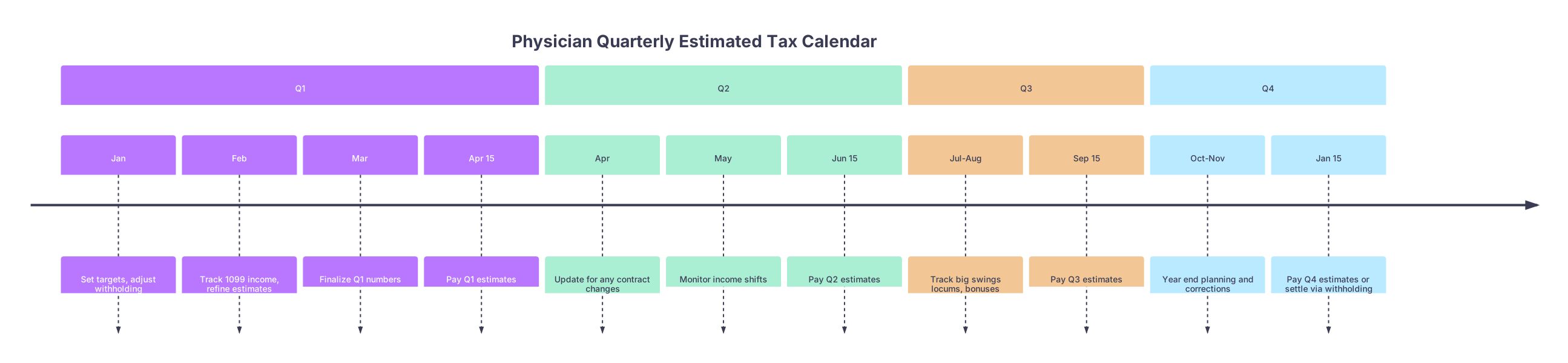
| Period | Event |
|---|---|
| Q1 - Jan | Set targets, adjust withholding |
| Q1 - Feb | Track 1099 income, refine estimates |
| Q1 - Mar | Finalize Q1 numbers |
| Q1 - Apr 15 | Pay Q1 estimates |
| Q2 - Apr | Update for any contract changes |
| Q2 - May | Monitor income shifts |
| Q2 - Jun 15 | Pay Q2 estimates |
| Q3 - Jul-Aug | Track big swings locums, bonuses |
| Q3 - Sep 15 | Pay Q3 estimates |
| Q4 - Oct-Nov | Year end planning and corrections |
| Q4 - Jan 15 | Pay Q4 estimates or settle via withholding |
January: Baseline + Withholding Adjustments
At this point you should:
- Collect:
- Final December pay stubs
- Any 1099s or late checks from last year (for awareness)
- Adjust your W‑4 at your main W‑2 job if you plan to use withholding strategy:
- Use the IRS withholding estimator (or your CPA’s spreadsheet).
- Aim for your paycheck withholding + planned estimates ≈ quarterly target.
For 1099/locums income:
- Open or confirm a separate business/tax savings account.
- Decide a fixed savings percentage (example: 30–35% of gross 1099) that automatically moves into that account every time you’re paid.
This is how you avoid “surprise, you owe $40k” next spring.
February: Dial In Your Actual Q1 Income Run Rate
By mid‑February, you should have a feel for how this year compares to last.
Tasks:
- Tally January 1099/side income.
- Multiply by 12 for a rough annualized number.
- Ask: “Is this year looking higher, lower, or similar to last year?”
If your income is clearly trending much higher than last year, safe harbor based on last year might still be okay penalty-wise, but you’ll have a big balance due in April next year. Decide if you want:
- Pure safe harbor (minimal penalties, maybe big balance later), or
- Closer to real-time payments (smaller April shock).
March: Finalize Q1 Estimate
At this point you should be preparing for the April 15 Q1 deadline.
Run a quick estimate of year‑to‑date (YTD) numbers:
- W‑2 gross and withholding YTD (from latest pay stub)
- 1099/locums/partnership income YTD
Compare withholding so far to safe harbor target pace.
- Example: Safe harbor annual target = $88,000
- By March 31, 1 quarter of the year → goal ≈ $22,000 total paid
- If withholding so far is $15,000 → make a Q1 estimate of about $7,000.
Decide payment method:
- Go to IRS Direct Pay (using bank account)
- Or EFTPS if you’ve set that up
- Or schedule through tax software if already using it
Remember state: many high-tax states have their own estimated payment schedule. Add that to your calendar right now.
Quarter 2: April – May (Payment Due June 15)
This is the quarter most physicians ignore because they just “did taxes.”
April 1 – April 10: Checkpoint Before Q1 Payment
At this point you should:
- Confirm all Q1 data through March 31.
- Re‑run the “do I owe at least $1,000?” logic if your situation changed mid‑quarter (new 1099 contract, joined a partnership, etc.).
- If your CPA prepared your return by now, ask them to:
- Explicitly tell you each quarterly estimate number for both federal and state, and
- Whether those are based on prior year safe harbor or current year projection.
By April 15: Execute Q1 Payment
Your checklist for April 15:
- Federal Q1 estimate paid (IRS Direct Pay → “Estimated Tax” → correct tax year).
- State Q1 estimate (if required) paid.
- Payment amounts recorded in a simple tracking file:
- Date
- Amount
- Confirmation number
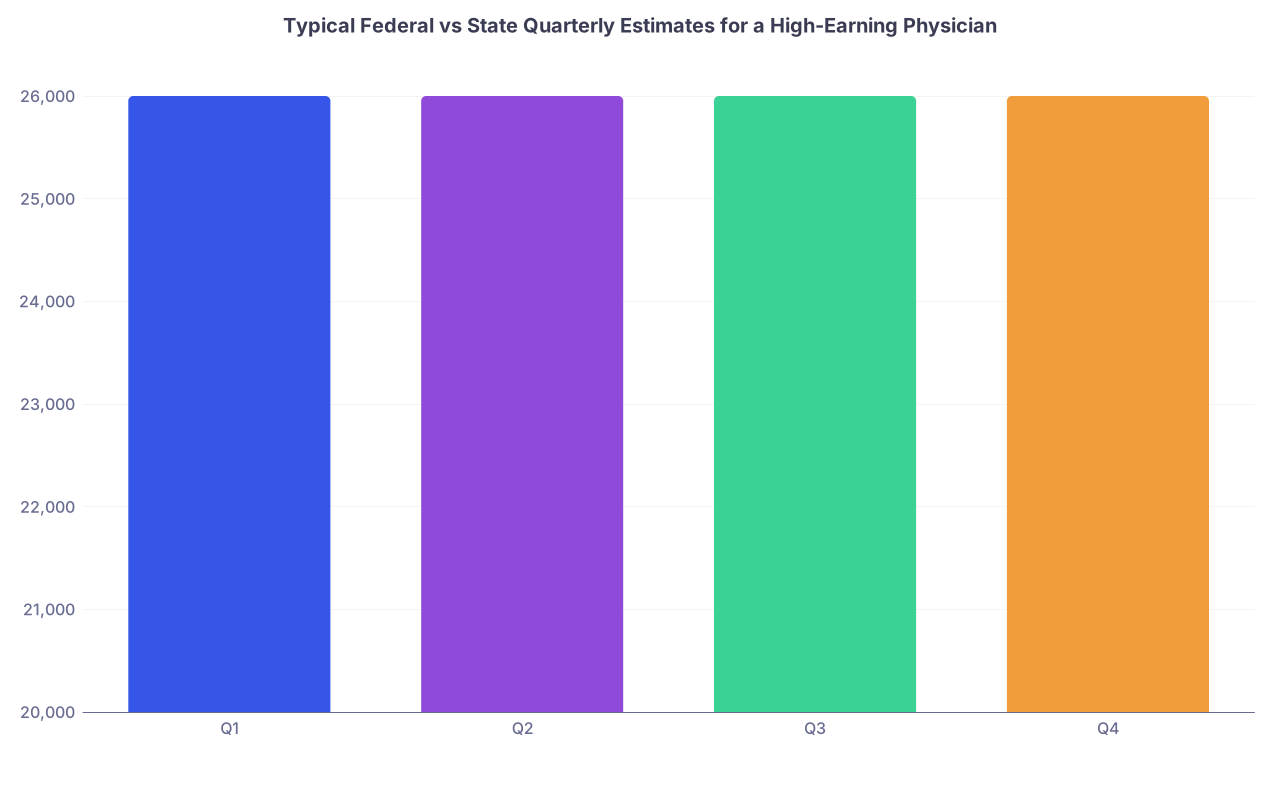
| Category | Value |
|---|---|
| Q1 | 26000 |
| Q2 | 26000 |
| Q3 | 26000 |
| Q4 | 26000 |
(Example: a high-earning physician in a high-tax state might be around this range combined federal + state. Adjust numbers for your actual situation.)
Late April – May: Adjust for Reality
At this point you should adjust for any big changes that hit in Q1:
- New 1099 telehealth contract started?
- Locums ramped up?
- Left employment and joined a partnership with K‑1 income?
- Bought into a surgery center with distributions?
In May:
- Re‑annualize your 1099/side income with Q1 numbers:
- If Q1 1099 income was $30,000 → projected annual $120,000.
- Use a simple rule of thumb:
- Set aside 30–35% of 1099 income for combined federal/state in high-tax areas.
- 25–30% might work in lower-tax states with lower marginal brackets.
You’re not aiming for perfect. You’re aiming for: no surprise, no penalty.
Quarter 3: June – August (Payment Due September 15)
Summer is where physicians accidentally blow this.
Early June: Q2 Payment Prep (Due June 15)
At this point:
- Update YTD income through May 31.
- Recalculate your “pace”:
- Are you on track to safe harbor?
- Or already beyond it and better off approximating 90% of current year tax?
If your income jumped massively (common when:
- graduating residency
- becoming partner
- adding major moonlighting)
…you might want to increase Q2 and Q3 payments so Q4 and next April are less brutal.
By June 15:
- Pay Q2 federal estimate.
- Pay Q2 state estimate.
July – August: Watch for Big Mid-Year Shifts
Here’s where I see physicians get blindsided:
- Start heavy locums over the summer “just for a few months”
- Take large practice distributions
- Extra call coverage or RVU bonuses hit
At this point you should:
- Treat any new major income source as if it will continue, until proven otherwise.
- Immediately start siphoning a percentage into your tax savings account with every check, not “once a month” when you remember.
If you’re getting K‑1s with uneven quarterly distributions:
- Ask the practice accountant for a projection of full-year K‑1 income.
- Build that into your own tax projection instead of just counting distributions.
Quarter 4: September – December (Payment Due Next January 15)
This is the clean-up and course-correction quarter. Done right, you walk into April with little drama.
Early September: Q3 Payment (Due September 15)
By September 10, you should:
- Update all YTD income:
- W‑2 YTD gross and withholding
- 1099/YTD deposits
- Any K‑1 expectation updates
- Compare total tax already paid (withholding + Q1/Q2 estimates + any Q3 withholding spikes) against:
- Your safe harbor threshold, and
- A fresh projection of current year total tax (if you or your CPA can run it).
If you’re already over safe harbor but under 90% of current year tax, decide:
- Do you want to pay more now (Q3), or
- Live with a larger April payment?
By September 15:
- Pay Q3 federal and state estimated payments.
- Log them immediately.
October – November: Year-End Tax Planning Window
This is where you have the most leverage.
At this point you should:
Run a near-final projection
- Ask your CPA for a year-end tax projection using 9–10 months of data.
- Or use last year’s return in software and plug in current YTD numbers.
Review levers you can still pull before Dec 31 For physicians with side practices / 1099:
- Max out solo 401(k) or SEP-IRA contributions.
- Buy needed business equipment this year instead of next (if it makes sense operationally).
- Time big expenses or CME if you’re Schedule C.
For W‑2:
- Max 401(k)/403(b)/457 contributions.
- Check if you’re eligible for HSA contributions.
Decide whether to fix underpayment via:
- Bigger Q4 estimated payment in January, or
- Increased W‑2 withholding in Nov/Dec.
Remember: withholding is treated as if it was paid evenly all year. Q4 estimates are not. That can reduce penalties.
The January 15 Finale: Q4 Payment and Clean-Up
Q4 covers income from September 1 – December 31. Payment is due January 15 of the following year.
First Week of January (Following Year)
At this point you should:
- Gather final December pay stubs.
- Tally Q4 1099 income and any late-year bonuses or distributions.
- Compare total tax paid YTD (withholding + Q1–Q3 estimates + any extra paying) against:
- Safe harbor target, and
- Your most recent projection of actual tax liability.
If you’ve already hit:
- 100% (or 110%) of last year’s tax → you’ve met safe harbor.
- And are reasonably close to 90% of current year tax → penalties will be minimal or zero.
By January 15
Decide one of three paths:
- Pay a Q4 estimate as your CPA calculated.
- Skip Q4 estimate and plan to “catch up” via increased withholding before Dec 31 next year
(this only works prospectively; for the past year your levers are limited). - Pay a deliberately larger Q4 estimate if you want a refund cushion instead of balance due in April.
Then:
- Pay Q4 federal and state estimates (if using them).
- Save confirmations.
- Note that if you file and pay your entire previous year’s tax by January 31, in some cases you may skip the January 15 estimate—but talk to your CPA before playing games with that.
Weekly Rhythm Around Each Deadline
If you want this to be truly plug-and-play, here’s the week-by-week pattern around each quarterly cut-off (April 15, June 15, Sept 15, Jan 15):
Three weeks before deadline:
- Update all YTD numbers.
- Draft projected annual income.
- Recheck safe harbor vs current-year projection.
Two weeks before:
- Decide exact payment amounts.
- Confirm bank accounts and logins (IRS Direct Pay, state portals).
One week before:
- Submit payments (do not wait until the actual due date; online portals glitch).
- Screenshot confirmations and save to a “Tax YYYY” folder.
Week of deadline:
- Double-check your log:
- Federal? ✔
- State? ✔
- Any local/city estimates (NYC, Philly, etc.)? ✔
That’s the operational rhythm that keeps penalties away.
Simple Quarterly Checklist for Busy Physicians
Last piece: your bare-minimum quarterly action list.

Each quarter, by the 10th of the payment month (April, June, September, January):
Pull:
- Latest W‑2 pay stub
- All 1099 income totals YTD
- Any practice/K‑1 projection updates
Confirm:
- Safe harbor target based on last year’s tax
- Your best guess at current year tax if income changed dramatically
Decide:
- How much in withholding vs estimate this quarter.
- Whether to adjust W‑4 for the next quarter.
Pay:
- Federal estimate by IRS Direct Pay or EFTPS.
- State/local estimates as required.
Log:
- Date, amount, confirmation of each payment.
- Quick running total for the year.
The Short Version: What Actually Matters
To close this out, here are the only three things you truly need to lock in:
Know your safe harbor number and live by it.
Use last year’s tax (100% or 110%) as your baseline target. Hit that between withholding and estimates, and you’ve avoided the worst penalties.Automate the savings and calendar the dates.
Skim 25–35% off every 1099/side dollar into a separate tax account, and lock the four IRS dates (Apr 15, Jun 15, Sep 15, Jan 15) into your calendar with reminders 3, 2, and 1 weeks ahead.Adjust quarterly, not yearly.
Every quarter, redo the math with real YTD numbers. Income changes fast for physicians—your tax plan needs to move just as fast, on a predictable schedule.


