

The worst tax mistakes physicians make in their first two years after fellowship are not about what they do. They are about when they do it.
You can make the right moves in the wrong order and light six figures on fire.
This timeline will keep you from doing that.
Big Picture: Your First 24 Months As An Attending
Your first two years after fellowship are not “normal” years. They are distorted:
- Income jumps hard mid-year
- Withholding is usually wrong
- You sign bad contracts before you have good advisors
- Everyone suddenly wants to sell you something (whole life, private placements, dodgy tax shelters)
So we are going to structure your decisions by time:
- Final 3–6 months of fellowship – Set the foundation, not the entities
- Months 0–3 of attending life – Stabilize cash flow and avoid early traps
- Months 3–12 (end of Year 1) – Optimize taxes on high income and one-off events
- Year 2 – Only now do you layer in structures, advanced planning, and bigger shifts
At each point: what you must do now, what you can safely defer, and what you should absolutely not touch yet.
Final 3–6 Months of Fellowship: Foundation, Not Fancy
You are still cheap (tax-wise). That is your advantage. Use it to make low-cost, high-leverage moves.
At this point you should:
- Clarify your first attending role(s)
- Employed W‑2? (hospital, large group)
- Independent contractor 1099? (locums, ED, anesthesia, telemed)
- Mix of both?
This dictates almost everything that follows. Guessing is dumb. Ask for it in writing.
- Get basic tax infrastructure, not advanced structures
At this stage you should:
Hire a CPA or EA who actually works with physicians
- Ask: “How many docs with >$400k income do you work with? What entities do they typically use?”
- If they sell insurance or investments, walk.
Set up basic accounts, not entities:
- High-yield savings for emergency fund
- Separate checking for “future 1099 income” if you expect moonlighting
- A password manager, because you are about to have 20 logins tied to money
Skip the S‑corp/LLC/partnership rabbit hole for now. You do not yet know your true income pattern.
- Understand your marginal bracket reality
Sit down with your CPA for a projected Year 1 and Year 2 tax picture:
- Expected salary or 1099 income
- State you are moving to
- Existing student loan plan (IBR, PAYE, REPAYE/SAVE, PSLF, or private)
- Spouse’s income and filing status
Have them show you the marginal rate on your next $10,000 of income including:
- Federal income tax
- State income tax
- Payroll taxes (SS/Medicare) if 1099
Why? Because this will later dictate:
- How aggressively you fund pre-tax retirement vs Roth
- Whether backdoor Roth is a no-brainer (for most attendings, it is)
- Whether you should bunch deductions (like charity or elective procedures) into certain years
- Do NOT:
- Create a random S‑corp for future moonlighting “because everyone says so”
- Buy any tax shelter you do not fully understand
- Refinance federal loans without a deliberate review of PSLF and repayment options
Months 0–3 of Attending Life: Stabilize and Protect
You start the job. You feel rich. This is prime “Bad Decision Season.”
At this point you should freeze big structural tax moves and focus on three things:
- Get withholding and estimated taxes roughly right
Your first pay stub as an attending tells a story. Read it:
- Verify:
- Filing status is correct (single vs married)
- State taxes are being withheld correctly after your move
- Retirement contributions (401k/403b/457b) are set how you want
For W‑2 employment:
- Use the IRS Tax Withholding Estimator with:
- Prior year income (fellowship)
- Projected new salary
- Spouse’s income
- Then adjust your W‑4 to avoid a huge under-withholding surprise.
For 1099 income (moonlighting, locums):
- Immediately start quarterly tax estimates. Rule-of-thumb for high-income physicians in many states:
- 30–35% for federal
- Add your state rate on top
- Have a separate “tax” savings account. Every time 1099 money hits, move that % out.
- Lock in risk protections, not tax gimmicks
This is where people mis-sequence badly. At this point you should:
- Finalize:
- Own-occupation disability insurance (individual policy)
- Term life insurance if anyone depends on your income
These are not tax decisions directly, but they affect:
- Whether you can tolerate higher-risk investments later
- How much you need to self-insure via savings and entity-based asset protection
Say no to:
- Whole life or fancy permanent policies pitched as “tax-free retirement”
- “You can borrow against this, it’s like your own bank” nonsense
Those products are brutally ill-timed early in attending life.
- Start the simple long-term tax moves
Without overfitting:
Enroll in employer retirement plans:
- Aim to at least contribute enough to capture full employer match in 401k/403b
- If you can swing it, target max annual contribution by year end (your CPA can show you why this matters at your marginal bracket)
Clean up your existing IRAs:
- Roll any pre-tax traditional IRAs, SIMPLE IRAs, SEP IRAs into your new employer 401k/403b if allowed
- Objective: Get your traditional IRA balance to $0 by the end of the calendar year
- This sets you up for clean backdoor Roth IRA contributions starting this year or next
At this point you should not:
- Rush into backdoor Roth before you understand the pro-rata rule
- Open HSAs or solo 401ks without knowing if you are actually eligible
Months 3–12 of Year 1: First Tax Optimization Layer
Now you have 3–6 months of real income data. You know:
- Actual monthly net pay
- Actual moonlighting/1099 income
- Realistic savings rate
- How brutal your tax withholding looks
Now you sequence the first wave of tax decisions.
Step 1: Lock in your retirement account strategy for Year 1
Sit down with pay stubs and do the math with your CPA or a spreadsheet.
At this point you should decide for Year 1:
- Pre-tax vs Roth in employer plans
As a new attending, your income is often:
$350k single or combined household
- Top federal tax bracket or close
In that range, pre-tax deferrals almost always beat Roth, unless:
- You are temporarily in a lower bracket due to part-year work
- You are committed to early retirement with very low future taxable income
- You are planning heavy Roth conversions in early retirement years
So for most new attendings:
- Max pre-tax 401k/403b in Year 1
- Use Roth only in:
- Roth IRA via backdoor
- Mega backdoor Roth if your plan is unusually generous and your advisor understands it
- Start (or schedule) backdoor Roth IRA
Timeline:
- If your traditional IRA balance is now $0:
- Make nondeductible contribution to traditional IRA
- Convert to Roth IRA shortly after
- If not zero yet:
- Finish rolling pre-tax IRAs into employer plans by December 31
- Then fire the conversion this year or lock it in for January of Year 2
| Account Type | Target Use Year 1 | Tax Treatment |
|---|---|---|
| 401k/403b | Max, pre-tax | Defers income tax |
| 457b (gov) | Max if safe | Defers income tax |
| Backdoor Roth IRA | Start if eligible | Future tax-free |
| Taxable Brokerage | Optional | Taxable annually |
Step 2: Handle the “weird” first-year tax distortions
Your first attending calendar year may include:
- 6 months fellowship income
- 6 months attending income
- Moving expenses (usually nondeductible now unless active-duty military)
- Sign-on bonus, relocation bonus, tail coverage payout, unused PTO payout
At this point you should:
Plan around one-time spikes:
- If you got a large sign-on bonus:
- Adjust W‑4 or estimates to cover the higher tax bracket
- Consider front-loading pre-tax contributions this year to offset
- If you exercised any stock options in a private practice or PE deal, this is where a competent CPA is mandatory
- If you got a large sign-on bonus:
Bunch deductions if possible:
- If you are charitably inclined, this may be the year to:
- Fund a Donor-Advised Fund (DAF) with appreciated securities
- Stack multiple years of donations into this high-income year
- If you are charitably inclined, this may be the year to:
This is also the right moment to align your student loan strategy with your tax plan:
- If pursuing PSLF:
- Lower AGI (via pre-tax retirement contributions, HSA) reduces payments
- If not pursuing PSLF:
- High income + high marginal rate often justifies aggressive payoff or strategic refinancing
- But the refinancing decision is more legal/benefit driven than tax-driven — sequence it only after job and disability insurance are stable
Step 3: Decide if you actually need an entity this year
This is where many physicians jump the gun. At 6–9 months in, you can finally see:
- How much 1099 income you truly have
- Whether that income looks stable or just temporary moonlighting
At this point you should consider an entity only if:
- You have consistent 1099 income, realistically:
- At least $50–80k/year now
- Likely to persist into Year 2 and beyond
You then have two broad steps:
- Form an LLC for liability/business structure
- Elect S‑corp for tax treatment if the math works
Sequence matters:
- Do not elect S‑corp the same week you create the LLC.
- Run actual numbers with your CPA:
- Payroll tax savings vs:
- Payroll service cost
- Reasonable salary requirements
- Loss of employer retirement plans if you mistakenly move W‑2 work into it (do not)
- Payroll tax savings vs:
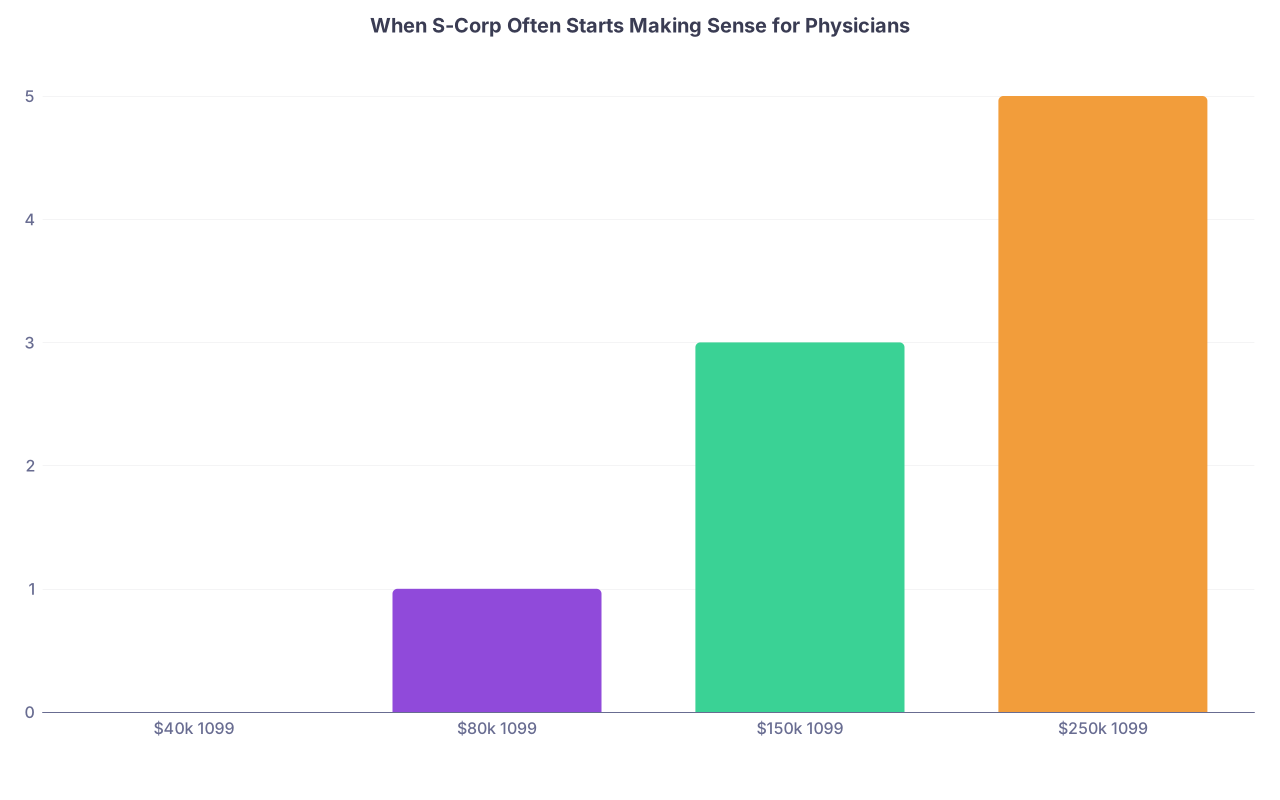
| Category | Value |
|---|---|
| $40k 1099 | 0 |
| $80k 1099 | 1 |
| $150k 1099 | 3 |
| $250k 1099 | 5 |
(Values here represent a rough “tax benefit score” where 0 = usually not worth complexity, 5 = often very worth it, assuming sustained income and proper setup.)
Year 2: Now You Turn “Good” Into “Efficient”
If Year 1 is survival plus basic optimization, Year 2 is where you actually get sophisticated.
You now have:
- A full 12 months of attending income
- Actual tax return with real numbers
- Clear sense of how much you can save every year
- Real 1099 pattern if applicable
Q1 of Year 2 (Months 13–15): Read Your Year 1 Tax Return Like a Business Owner
Most physicians never do this. Big mistake.
At this point you should sit with your CPA and go line by line:
- Total income vs AGI vs taxable income
- Which deductions you actually used:
- Standard vs itemized
- Retirement contributions impact
- HSA impact (if any)
- Effective tax rate vs marginal tax rate
Use that to decide:
Retirement account mix for Year 2
Now that you have a full-year picture, decide:
- Continue heavy pre-tax contributions?
- Start blending in Roth if you are clearly below the top brackets or expect higher income later (e.g., partnership track with big buy-in payouts)
Backdoor Roth IRA now becomes routine
If you cleaned up your IRAs in Year 1:
- Backdoor Roth should be executed early in the year, every year:
- Jan: Contribute to traditional IRA
- Shortly after: Convert to Roth IRA
- Backdoor Roth should be executed early in the year, every year:
Decide on 457b (if offered)
In Year 1 you might have been conservative. In Year 2 you can be more deliberate:
- Governmental 457b (state hospital, university):
- Usually safe to max if investment options are reasonable
- Non-governmental 457b:
- Creditor risk, plan risk, distribution risk
- Do not use this without understanding the legal risks. Many physicians reasonably skip these.
- Governmental 457b (state hospital, university):
Q2–Q3 of Year 2 (Months 16–21): Entity and Advanced Planning, In Order
If you have meaningful, stable 1099 income, Year 2 is the right time to formalize structure.
At this point you should:
- Finalize entity choice for your 1099 work
Timeline:
- CPA runs Year 1 actuals and projected Year 2 income for 1099 work
- You decide with them:
- Stay sole proprietor
- Form LLC taxed as sole prop
- Form LLC and elect S‑corp
Key factors:
- Amount of 1099 income
- Your state’s S‑corp rules and additional taxes
- Your willingness to run payroll and keep cleaner books
- Coordinate retirement plans across W‑2 and entity
This is where people screw sequencing. Example:
- You already maxed a 403b at your W‑2 job
- Then you open a solo 401k at your S‑corp and try to add another $23k “employee” deferral — you cannot
At this point you should:
- Treat employee deferral limit as global across all 401k/403b plans
- Use:
- W‑2 job for employee deferral and match
- S‑corp solo 401k for employer profit-sharing contributions (up to 20–25% of comp, within total 415 limits)
This coordination can add tens of thousands of pre-tax dollars, but only if sequenced correctly.
- Revisit state-specific strategies
By now you know whether your state tax burden stings.
Depending on your state and income, Year 2+ is when you consider:
- If you are in a high-tax state but have location-flexible 1099 work, routing that through an entity in a different state (legitimately) if your life actually supports that
- Use of qualified retirement plans and entity-level planning to reduce state taxable income
Get a local CPA and, if income is high enough, a tax attorney. Do not play residency games on your own.
Q4 of Year 2 (Months 22–24): Tune The Machine
By the end of your second year, your tax planning should feel less like chaos and more like a system.
At this point you should:
- Dial in recurring annual moves
These should now be on autopilot:
- January:
- Backdoor Roth IRA executed
- Update W‑4 if pay or marital status changed
- Throughout year:
- Max employer retirement accounts on planned schedule
- Quarterly estimates for any 1099 work, with percentage pre-set in your banking app
- Year-end:
- Tax-loss harvesting in taxable accounts (if investing outside retirement)
- Final charity decisions, including DAF top-ups in high-income years
- Only now consider more complex strategies
Once the basics run smoothly and you are saving heavily (20–30%+ of gross), then and only then:
- Evaluate:
- Defined benefit/cash balance plans (for very high, stable income)
- More nuanced asset location (what you hold in taxable vs Roth vs pre-tax)
- Charitable strategies tied to appreciated assets or business interests
Most new attendings try to do this in Month 3. That is backwards. You earn the right to complexity by first proving you can run the basics for a year or two.
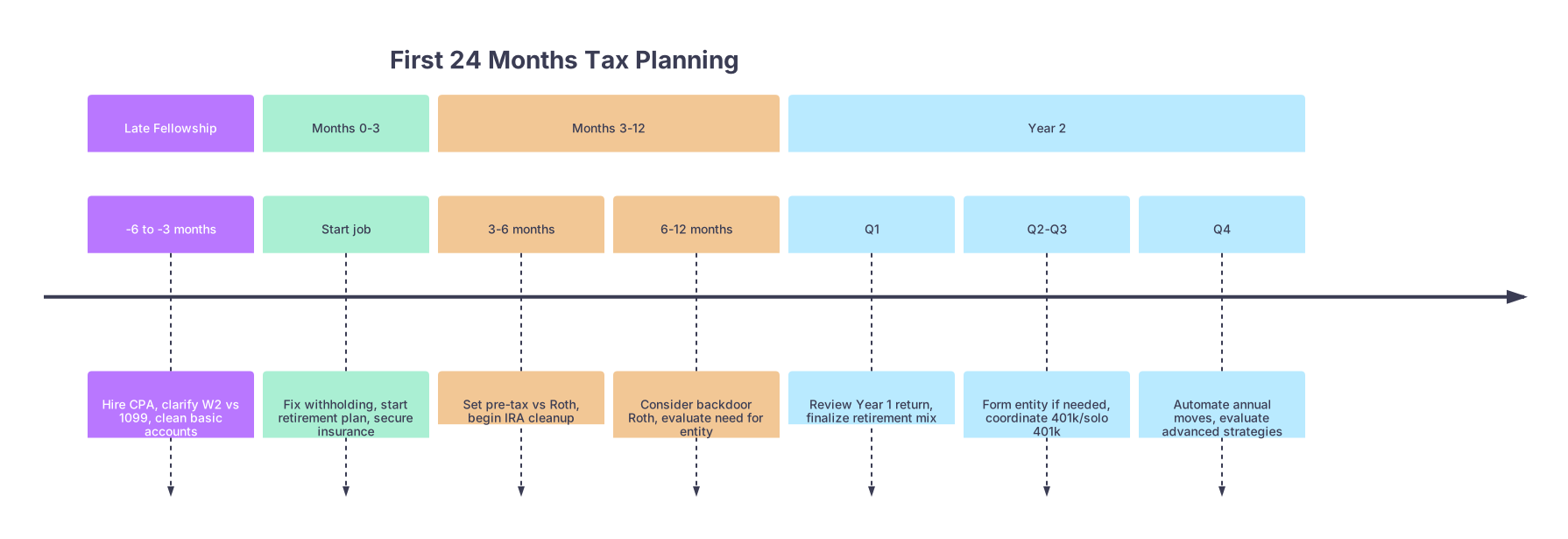
| Period | Event |
|---|---|
| Late Fellowship - -6 to -3 months | Hire CPA, clarify W2 vs 1099, clean basic accounts |
| Months 0-3 - Start job | Fix withholding, start retirement plan, secure insurance |
| Months 3-12 - 3-6 months | Set pre-tax vs Roth, begin IRA cleanup |
| Months 3-12 - 6-12 months | Consider backdoor Roth, evaluate need for entity |
| Year 2 - Q1 | Review Year 1 return, finalize retirement mix |
| Year 2 - Q2-Q3 | Form entity if needed, coordinate 401k/solo 401k |
| Year 2 - Q4 | Automate annual moves, evaluate advanced strategies |

Key Takeaways
- Sequence matters more than sophistication. Year 1 is for stabilizing cash flow, fixing withholding, maxing simple pre-tax accounts, and cleaning up IRAs. Year 2 is for entities and advanced planning.
- Let real numbers drive structure. Do not form S‑corps or adopt complex plans until you have at least 12 months of actual 1099 income and a full-year tax return.
- Automate the basics before you chase tricks. Once your retirement contributions, backdoor Roth, and estimates run like clockwork, the bigger tax wins become obvious and much safer to execute.


