

You are here
It’s January 5th. You just wrapped a brutal December in clinic. Collections look great on paper… but your CPA just told you you’re staring at a mid–six-figure tax bill.
You’ve heard other physicians say, “Once I switched to an S‑Corp, my tax life changed.” Your attorney mentioned an LLC could give you better protection. Right now, your practice is either a sole proprietorship, a single‑member LLC taxed as disregarded, or maybe a simple partnership.
You want to know: what’s the actual timeline to implement an S‑Corp or LLC structure for your physician practice, and what should you be doing at each step?
Here’s the month‑by‑month, then week‑by‑week, and finally day‑by‑day sequence I’d follow if you were sitting across the table from me.
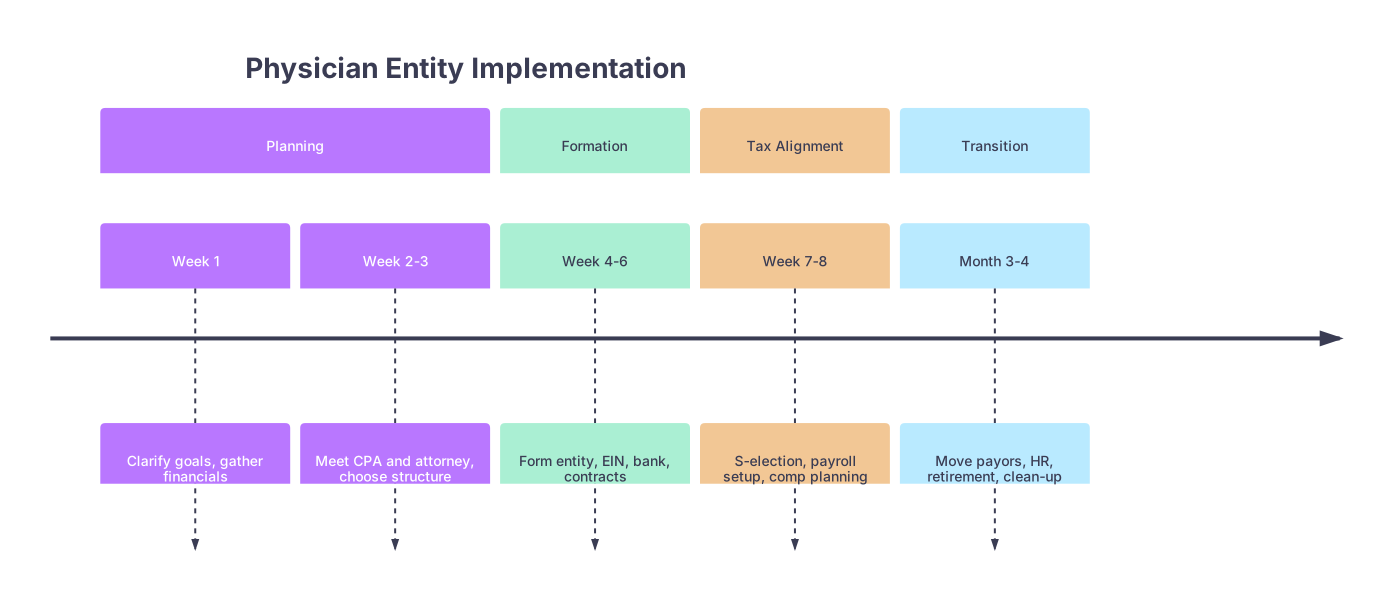
| Period | Event |
|---|---|
| Planning - Week 1 | Clarify goals, gather financials |
| Planning - Week 2-3 | Meet CPA and attorney, choose structure |
| Formation - Week 4-6 | Form entity, EIN, bank, contracts |
| Tax Alignment - Week 7-8 | S-election, payroll setup, comp planning |
| Transition - Month 3-4 | Move payors, HR, retirement, clean-up |
Phase 0 (2–4 weeks before you touch any forms): Decide why and whether
At this point you should not be filing anything with the state. You should be thinking and gathering.
Week 0: Clarify the goal
Block one evening and answer this for yourself in writing:
- Am I trying to:
- Lower self‑employment/Medicare tax?
- Limit liability beyond malpractice insurance?
- Clean up multi‑partner chaos?
- Prepare for sale/partnership buy‑in?
- What’s my rough:
- Annual collections?
- Net profit before paying myself?
- W‑2 income from hospitals/locums?
If your net profit from 1099 or practice income is under ~$150k, the S‑Corp juice often isn’t worth the squeeze. Over $250k, it almost always deserves a hard look.
At this point you should:
- Pull last 2 years of tax returns (personal + any business schedules).
- Pull last 12 months of P&L and balance sheet (or bank statements if that is all you have).
- Make a one‑page summary of:
- Total clinical income by source (W‑2 vs 1099 vs practice).
- Current retirement plans (solo 401(k), group 401(k), 403(b), 457, etc.).
- Any partners/owners and their %.
Week 1–2: Talk to your CPA and attorney (in that order)
Sequence matters.
First: CPA (tax)
You want numbers, not vibes.
Ask them, specifically:
- “If I formed an S‑Corp (or LLC taxed as S‑Corp) for my clinical income, how much would I have saved in the last tax year after your fees and payroll costs?”
- “What would you recommend as reasonable compensation for me, based on my specialty and market?”
- “How would this interact with my current retirement plan, backdoor Roth, and QBI deduction?”
If your CPA says “You’re a doctor, IRS might not like that” and stops there, get a second opinion. That’s lazy, not protective.
Then: Attorney (legal)
Now you care about entity type and liability.
Key questions:
- “Given my state and specialty, would you lean toward a:
- Professional Corporation (PC) electing S‑Corp,
- Professional LLC (PLLC) taxed as S‑Corp,
- Plain LLC taxed as sole prop/partnership?”
- “Does my state even allow physicians to use an LLC/PLLC?”
- “What’s the cleanest setup if I add partners in 1–3 years?”
At this point you should walk away with:
- A chosen tax treatment: S‑Corp now, S‑Corp later, or stay as you are.
- A chosen legal wrapper: PC, PLLC, or LLC (varies heavily by state and your board).

Phase 1 (Month 1): Choose the structure and form the entity
Once the decision is made, the next 4–6 weeks are about getting the shell built correctly.
Week 3: Final design decisions
At this point you should:
Decide what income is going into this entity:
- Just your private practice?
- Also locums/consulting?
- Exclude W‑2 hospital income – that stays W‑2.
Decide ownership:
- Solo owner now?
- Spouse involved? (Careful: community property states, and many states prohibit non‑physician owners of professional entities.)
- Future partners – build flexibility into bylaws/operating agreement.
Decide your compensation model:
- Fixed W‑2 salary + distributions?
- Salary + quarterly bonuses?
Write this down. You’ll forget the specifics when you’re knee‑deep in forms.
Week 4: File formation documents with the state
Your attorney (or a competent formation service if you’re very cost‑sensitive and in a simple state) will:
- Check name availability.
- Draft and file:
- Articles of Incorporation (for PC) or
- Articles/Certificate of Organization (for LLC/PLLC).
- Handle any professional licensing requirements for entity (some states require separate board approval for professional entities).
At this point you should:
- Pay the state filing fee.
- Decide your fiscal year (almost always calendar year for physicians using S‑Corp).
- Keep a digital folder for:
- Filed formation documents,
- State approval notices,
- Any board approval.
Turnaround time: anywhere from 2 days to 4 weeks depending on state and expedited options.
| Item | Typical Range |
|---|---|
| State filing time | 3 days – 4 weeks |
| State filing fees | \$100 – \$800 |
| Attorney formation fees | \$750 – \$3,000 |
| CPA tax structuring fee | \$500 – \$2,000 |
| Payroll setup (one-time) | \$0 – \$500 |
Week 4–5: Get an EIN and basic documents
Once the state approves the entity:
At this point you should:
- Have your CPA or attorney (or you, if you are comfortable) apply for:
- EIN from the IRS (online, same day).
- Receive:
- EIN letter (CP 575),
- Stamped Articles,
- Organizational documents:
- For corporation: Bylaws, shareholder agreement, initial minutes.
- For LLC: Operating agreement, member resolutions.
Do not skip the internal docs. I have seen partnerships implode because “we never actually signed anything; we just shook hands.” That works right up until it doesn’t.
Phase 2 (Month 1–2): Align banking, billing, and contracts
Forming the entity is the easy part. The messy work is moving the money.
Week 5: Open business accounts and update records
At this point you should:
- Open at least:
- One business checking account in the entity name.
- One business savings (for tax reserves).
- Get:
- A business debit card,
- Possibly a business credit card (for practice expenses only).
You also should:
- Update your accounting system:
- New QuickBooks/Xero file or new entity in your current setup.
- Chart of accounts that actually separates:
- Owner salary (W‑2)
- Owner distributions
- Employer payroll taxes
- Practice expenses (rent, staff, malpractice, etc.).
Week 6–8: Move payors and vendors
This is where most physicians get stuck. They form the LLC / S‑Corp and then keep depositing checks into their personal account or old entity “just for now.” That “now” lasts 18 months and creates a tax mess.
At this point you should start the transition:
Payer contracts and credentialing
- Update:
- Medicare/Medicaid enrollment (PECOS, etc.).
- Private insurers.
- Hospital/ASC contracts that pay you directly.
- Expect 30–90 days for some payors to update.
- Update:
Vendors and recurring payments
- Malpractice carrier – change named insured to the entity where appropriate.
- EHR, billing company, rent, utilities – update billing info to new business bank account.
Patients and front desk
- Update:
- Superbills,
- Statements,
- Website footer,
- Business cards (if anyone still uses them).
- Update:
For a few months, you’ll have income hitting both old and new accounts. That’s fine, as long as you and your CPA know which dates the new entity became effective for tax purposes.

Phase 3 (Tax side, Month 2): Elect S‑Corp (if that’s the plan)
You can have:
- A corporation taxed as an S‑Corp.
- An LLC taxed as an S‑Corp.
The tax election is what matters here.
Critical deadline: Form 2553 timing
At this point you should coordinate closely with your CPA. The S‑Corp election (Form 2553) has rules:
- To be effective for the current tax year, Form 2553 is generally due:
- By 2 months and 15 days after the beginning of the tax year, or
- Within 2 months and 15 days of forming the entity, in many practical setups.
- Late election relief is often available, but don’t be sloppy and rely on that.
In practice, if you want your new S‑Corp to start January 1st, you:
- Either form it late the prior year and elect effective Jan 1.
- Or form early in the year and backdate to Jan 1 if your CPA is comfortable and rules allow.
At this point you should:
- Review Form 2553 draft:
- Check effective date.
- Confirm shareholders and percentages.
- Confirm tax year (calendar, unless you have a very good reason).
Once filed:
- IRS will send a CP261 notice confirming S‑Corp election.
- Keep that letter permanently.
Phase 4 (Month 2–3): Set up payroll and reasonable compensation
This is where the tax savings happen. And where the IRS scrutiny lives.
Week 7–8: Decide your salary
You cannot just pay yourself $10,000 W‑2 and $390,000 distributions and call it a day. The IRS has shredded that strategy countless times.
At this point you should:
- Work with your CPA to set reasonable compensation, anchored to:
- Your specialty,
- Hours worked,
- Local/ national MGMA data,
- Mix of clinical vs administrative work.
Example for a full‑time outpatient internist grossing $500k in collections:
- Reasonable W‑2 salary might be in the $220–$280k range.
- Remaining profit can flow as S‑Corp distributions (after expenses and employer payroll taxes).
Do not expect your CPA to hit an “IRS-proof” number. There is no such thing. What you want is a number that a revenue agent would look at and say, “Okay, that’s not crazy.”
Week 8–9: Implement payroll
At this point you should:
- Choose a payroll provider (Gusto, ADP, Paychex, or one integrated with your CPA).
- Set:
- Pay frequency (monthly or twice monthly is common for owners),
- Tax withholdings,
- Employer contributions to retirement plan if applicable.
Make sure:
- The entity is the employer.
- Your W‑2 at year end will come from the new entity, not from you personally.
Common mistake I’ve seen: physician forms an S‑Corp, never sets up payroll, pays themselves only distributions, and their CPA scrambles in January to “recharacterize” some of those draws as wage. Do not do that. It’s sloppy and raises audit risk.
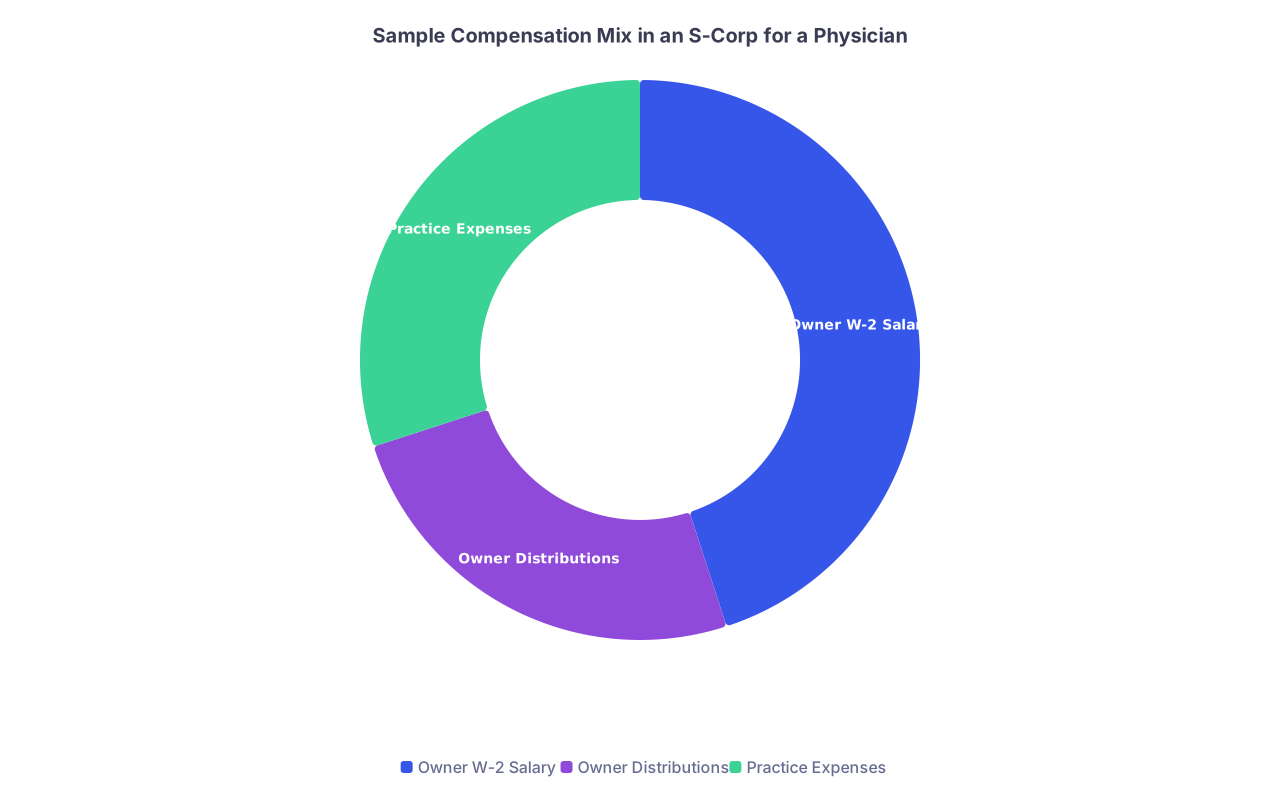
| Category | Value |
|---|---|
| Owner W-2 Salary | 45 |
| Owner Distributions | 25 |
| Practice Expenses | 30 |
Phase 5 (Month 3–6): Integrate benefits, retirement, and clean-up
Once the structure and payroll are running, now you refine.
Month 3–4: Align retirement plans and benefits
At this point you should sit down with your CPA and, if you have staff, a retirement plan consultant.
Key moves:
- Decide on the retirement plan:
- Solo 401(k) if it’s just you and spouse.
- Safe harbor 401(k) or cash balance plan if you have staff or partners and want bigger deductions.
- Ensure the plan sponsor is the new entity.
- Coordinate contributions:
- Employee deferral from your W‑2.
- Employer contribution from entity (profit sharing, cash balance).
Also:
- Review health insurance:
- Is the policy in your name or the entity’s?
- Are premiums being paid from the business and handled correctly on your W‑2 (for >2% S‑Corp shareholders)?
Month 4–6: Old entity / sole prop clean-up
At this point you should:
- Stop routing new income to the old structure.
- Zero out any remaining accounts tied to the old entity for new business.
- Work with your CPA and attorney to:
- Officially dissolve or inactivate old entities where appropriate.
- Document any transfer of assets, patient contracts, and goodwill into the new entity.
If you had a solo 401(k) or SEP IRA tied to the old EIN, make sure the plan is either:
- Properly amended with new sponsor/EIN, or
- Terminated and replaced, per the plan advisor’s guidance.

Condensed 90‑day checklist (Week‑by‑week)
If you want this mapped out cleanly, here you go.
Weeks 1–2: Decide if it’s worth doing
At this point you should:
- Gather financials (P&L, tax returns, income sources).
- Meet CPA → get specific projected tax savings number.
- Meet attorney → confirm acceptable entity types in your state.
- Decide: move forward or not.
Weeks 3–4: Form and organize
At this point you should:
- Finalize entity design: PC vs PLLC vs LLC, owners, income sources.
- File formation documents with state; pay fees.
- Receive approval; get EIN.
- Sign bylaws or operating agreement.
- Open business checking and savings.
- Update or start accounting software for the new entity.
Weeks 5–8: Move the money and make the election
At this point you should:
- File Form 2553 (S‑Corp election) if that’s the plan.
- Update:
- Payer contracts (Medicare, commercial).
- Vendor billing records.
- Malpractice, EHR, rent, etc.
- Start routing new income into the new business account.
- Decide your reasonable salary with your CPA.
- Set up payroll through the new entity and run first payroll.
Weeks 9–12: Integrate fully
At this point you should:
- Align retirement plan sponsorship with the new entity.
- Confirm health insurance and other benefits are correctly structured.
- Stop using old bank accounts for new business.
- Work with professionals to close or repurpose old entities and accounts.
- Create an annual rhythm:
- Quarterly reviews of salary vs distributions.
- Mid‑year tax projection to confirm strategy is working.

| Category | Value |
|---|---|
| Decision & Design | 25 |
| Formation & Docs | 10 |
| Banking & Payers | 15 |
| S-Election & Payroll | 35 |
| Retirement & Cleanup | 15 |
Three things to remember
The entity type alone does nothing. The tax savings show up only when you actually run payroll, set a defendable salary, and separate business and personal money.
Deadlines are real. Miss the S‑Corp election window or botch payroll, and you can wipe out a year of potential savings in one shot.
Do it once, do it right. Spend the first 90 days getting the structure, documents, and flows tight; then it just becomes maintenance instead of constant fixes.


