

Most new attendings waste their first high‑income years by winging their taxes. That is a very expensive mistake.
You are not a normal W‑2 employee. Between MS4 and your first attending paycheck, the tax rules around you change every single year. If you just “let TurboTax handle it,” you will overpay, miss key windows, and lock yourself into bad habits that follow you for a decade.
I’m going to walk you year‑by‑year, then season‑by‑season, from MS4 through early attending life. At each point: what you should set up, what deadlines you cannot miss, and which moves actually matter versus internet noise.
Big‑Picture Timeline: From MS4 To Attending
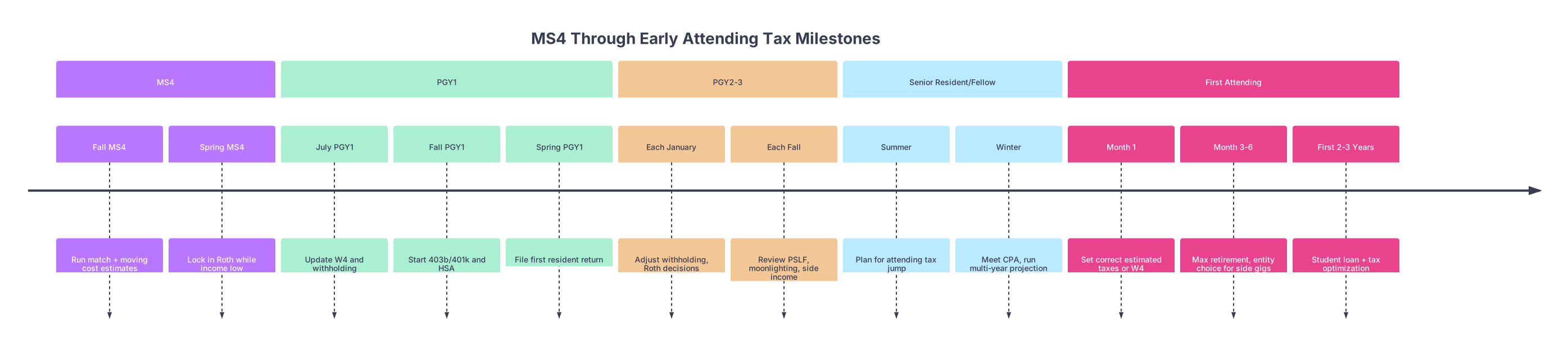
| Period | Event |
|---|---|
| MS4 - Fall MS4 | Run match + moving cost estimates |
| MS4 - Spring MS4 | Lock in Roth while income low |
| PGY1 - July PGY1 | Update W4 and withholding |
| PGY1 - Fall PGY1 | Start 403b/401k and HSA |
| PGY1 - Spring PGY1 | File first resident return |
| PGY2-3 - Each January | Adjust withholding, Roth decisions |
| PGY2-3 - Each Fall | Review PSLF, moonlighting, side income |
| Senior Resident/Fellow - Summer | Plan for attending tax jump |
| Senior Resident/Fellow - Winter | Meet CPA, run multi‑year projection |
| First Attending - Month 1 | Set correct estimated taxes or W4 |
| First Attending - Month 3-6 | Max retirement, entity choice for side gigs |
| First Attending - First 2-3 Years | Student loan + tax optimization |
MS4 Year: Low‑Income Tax Leverage (Final Student Year)
At this point you should treat your final student year as a tax planning “valley” you’ll never see again. Use it.
Fall MS4 (Sep–Nov)
Estimate your current‑year income
- Pull:
- 1099‑NEC from any tutoring, research assistant, or PRN work
- W‑2 from prior summer jobs
- Ballpark your total income. If it’s under roughly $45–50k, you’re in relatively low brackets.
- Pull:
Decide on Roth vs traditional (this year is almost always Roth)
- If your total income is low, every dollar into a Roth IRA is incredibly valuable.
- Goal: Get at least one full Roth IRA year funded while you’re still poor.
Open accounts (before December 31) At this point you should:
- Open a Roth IRA at a brokerage (Fidelity, Vanguard, Schwab—pick one and move on).
- If you had 1099 income and are feeling ambitious:
- Consider a solo 401(k) or SEP IRA for that self‑employment income.
- Reality: Most MS4s skip this. But if you made several thousand 1099, it’s real money.
Winter–Spring MS4 (Dec–Apr)
Fund prior‑year Roth IRA (deadline: tax filing date, usually April 15)
- Max for MS4 year: usually $6,500 (subject to IRS changes).
- You must have at least that much earned income that year.
Do your own taxes at least once
- Use software (TurboTax, FreeTaxUSA, etc.).
- Pay attention to:
- Standard deduction
- How Roth vs traditional contributions show (or don’t) on the return
- You’re learning the “language” you’ll be living in as an attending.
If you matched: plan upcoming move with tax in mind
- Moving expenses are not deductible for most people anymore, residents included.
- So you don’t move to “save taxes”; you move cheaply to keep cash.
PGY1 (Intern Year): First Real W‑2, First Adult Tax Return
This is where residents start making quiet, costly mistakes. Under‑withholding, ignoring retirement options, missing PSLF paperwork. Do not be that person.
Late Spring MS4 – Just Before PGY1 Starts
At this point you should:
Study your residency HR packet
- Identify:
- Retirement plan: 401(k)/403(b)? Roth option? Match?
- HSA eligibility: Do they offer a high‑deductible health plan?
- Disability and life insurance (tax implications on premiums/benefits).
- Identify:
Decide your first‑year retirement strategy
- With intern income (say $60–70k), Roth 401(k)/403(b) is usually better than traditional:
- Lower marginal rate now, higher later as attending.
- Still try to fund a Roth IRA if you can handle it.
- With intern income (say $60–70k), Roth 401(k)/403(b) is usually better than traditional:
Set up a basic tax file system
- One digital folder per year:
- “2025 Taxes” → subfolders for W‑2, 1099, student loan docs, receipts.
- One digital folder per year:
Early PGY1 (July–September)
Fix your W‑4 on day 1 or week 1
- HR will hand you a W‑4. Don’t blindly click through.
- Goals:
- File as Single (unless legally married).
- No fancy dependents/credits unless they actually apply.
- You want your withholding to approximate your real tax bill—not a $4,000 surprise in April.
- If you have big student loans and plan PSLF, over‑withholding is effectively lending the IRS 0% while your loans grow. Not smart.
Enroll in retirement plan quickly
- If eligible from day 1:
- Set at least 3–5% into Roth 403(b)/401(k), more if you can.
- If there’s any match, make sure you’re contributing enough to get 100% of the match. Always.
- Consider:
- Roth IRA on top if cash allows.
- If eligible from day 1:
Evaluate HSA
- If your program offers a high‑deductible plan + HSA:
- HSA contributions are triple tax‑advantaged.
- Even as a resident, contributing $500–$1,000 is worth it if your budget can handle it.
- If your program offers a high‑deductible plan + HSA:
Late PGY1 (Jan–Apr)
File your first resident tax return At this point you should:
- Have:
- W‑2 from residency
- 1098‑E for student loan interest
- Ensure:
- You’re getting the student loan interest deduction if eligible.
- You’re reporting any side income (moonlighting, tutoring, etc.) correctly on Schedule C and Schedule SE.
- If you have self‑employment income:
- Understand you’re now paying self‑employment tax (Social Security + Medicare).
- This is where most residents get blindsided.
- Have:
Check your withholding for next year
- If you owed more than $1,000: you under‑withheld.
- If you got a huge refund: too much was withheld.
- Adjust your W‑4 accordingly in March–April.
PGY2–PGY3 (Or Mid‑Residency): Refining and Adding Complexity
By now the basics should be automatic. This stage is about tightening the screws.
Each July (Start of Academic Year)
At this point each year you should:
Re‑evaluate retirement contribution levels
- Income nudges up slightly with PGY year.
- Decide:
- Do you maintain Roth 401(k)/403(b)?
- Do you still fund a Roth IRA?
- If your spouse has income and you file jointly, what’s the joint tax picture?
Confirm you’re not leaving match on the table
- Residents with 403(b) matches who don’t contribute enough are lighting money on fire.
- Fix it.
Review W‑4 again
- Life changes:
- Got married?
- Had a child?
- Spouse started/stopped working?
- All of these affect your tax bill. Update W‑4 so April is not a disaster.
- Life changes:
Each Fall (Sep–Nov)
Plan for moonlighting income before you start it
- If you’re adding shifts as 1099:
- Open a separate business checking account.
- Track:
- Income
- Relevant expenses (license fees, CME, work‑related phone portion, etc.).
- Consider:
- Solo 401(k) for this income, especially if residency plan is weak or capped.
- Understand tax hit:
- 22–24% federal + state + ~15.3% self‑employment tax on 1099 income.
- Translation: If you’re not saving 30–40% of each 1099 check for taxes, you’re playing with fire.
- If you’re adding shifts as 1099:
Run a simple year‑end tax projection
- You can do this in basic software by “mock filing.”
- Ask:
- Am I on track to owe a lot?
- Should I tweak W‑4 now versus next year?
Senior Resident / Fellow Years: Pre‑Attending Setup
This is the pivot. Your job now is to prepare the runway so that your first attending paycheck does not blow up your taxes.
12–18 Months Before Attending Job Start
At this point you should:
Get serious student loan + tax modeling
- If you’re going for PSLF:
- Make absolutely sure all your Employment Certification Forms (ECF) are up to date.
- Keep employment records. PSLF is documentation‑heavy.
- If you’re planning refinance and aggressive payoff as an attending:
- Map out:
- When your income jumps
- How that affects your filing status and deductions.
- Map out:
- If you’re going for PSLF:
Start using a simple net worth and tax log
- Track:
- Retirement account balances
- Loans
- Cash savings
- Helps a CPA later, and keeps you honest now.
- Track:
6–9 Months Before Attending Start (Offer Signed)
Compare contract options with tax in mind
- W‑2 hospital employed vs 1099 independent contractor vs partnership track.
- For 1099 heavy setups:
- You will almost certainly benefit from a separate business entity (usually an S‑Corp or LLC taxed as S‑Corp) once income is high enough.
- Do not create this blindly. Talk to a CPA who lives in physician land.
Meet a tax professional for the first real strategy session
- Not March 10 when they’re drowning in returns. Aim for Oct–Jan.
- Ask specifically:
- When should I plan to use Backdoor Roth IRA?
- Should I bother with an S‑Corp for anticipated side work?
- How should my spouse and I file (if married): MFJ vs MFS in the context of student loans and credits?
Transition Year: Resident Half‑Year, Attending Half‑Year
The year you become an attending is the most financially chaotic. You have low‑income months and high‑income months on the same return.
January–June: Final Resident/Fellow Months
At this point you should:
Max what you reasonably can on the way out
- If staying low‑income for most of the year:
- Roth 403(b)/401(k) still often makes sense until your attending salary hits.
- If staying low‑income for most of the year:
Track deductible items cleanly
- Many job‑search and relocation expenses are now non‑deductible for employees, but:
- If you’re doing 1099 or business work, some items can still be treated as business expenses.
- Keep receipts for:
- Licensing
- Board exam fees
- DEA (if not reimbursed)
- Some will be deductible if connected to self‑employment.
- Many job‑search and relocation expenses are now non‑deductible for employees, but:
Month 1–3 of Attending Job
Fix withholding immediately at the new job
- New W‑4 → new salary.
- At this point with a $250k attending income:
- You’re easily in the 24–32%+ federal bracket.
- If you’re also still on an old W‑4 settings from residency, you risk a massive under‑withholding.
Turn on retirement savings like you mean it
- Goal as early attending:
- Get to maxing your employer retirement plan (401(k)/403(b)) as fast as you reasonably can.
- Decide:
- Traditional vs Roth 401(k) now that you are in higher brackets:
- Most attendings in mid/high brackets should tilt toward traditional 401(k) for the tax deduction.
- You can still do Roth via Backdoor Roth IRA separately.
- Traditional vs Roth 401(k) now that you are in higher brackets:
- Goal as early attending:
Start quarterly estimated taxes if self‑employed
- If you have real 1099 income as an attending:
- You probably must pay quarterly estimated taxes (April 15, June 15, Sep 15, Jan 15).
- Set up:
- A business account where every payment lands.
- Auto‑transfer 30–40% of each 1099 deposit into a separate “tax” savings account.
- If you have real 1099 income as an attending:
First Full Attending Year: High‑Income Tax Systems
This is where the tax game changes from “just don’t mess it up” to “optimize strategically.”
January (Start of First Full Attending Year)
At this point you should:
Run a full‑year projected tax scenario
- Either with your CPA or using last year’s software with updated income numbers.
- Inputs:
- Base salary
- Expected bonus
- 1099 side income
- Retirement contributions you plan to make
- Filing status, dependents
- Output:
- Expected total tax bill
- Necessary withholding / estimates to avoid penalties.
Lock in retirement + HSA targets
- Plan:
- Max 401(k)/403(b) (employee portion).
- Max HSA if eligible.
- Backdoor Roth IRA for you (and spouse if eligible).
- Structure:
- Preferred for many high‑income physicians:
- Traditional 401(k) at work
- Backdoor Roth IRA annually
- HSA (invested, not spent) if health plan allows.
- Preferred for many high‑income physicians:
- Plan:
| Account Type | Typical Contribution Goal | Tax Treatment |
|---|---|---|
| 401(k)/403(b) | Up to annual IRS limit | Pre‑tax or Roth, payroll based |
| HSA | Up to annual IRS limit | Pre‑tax in, tax‑free growth and withdrawals for medical |
| Backdoor Roth IRA | Annual IRA limit per person | After‑tax in, tax‑free growth |
| Solo 401(k) (side gig) | Depends on profit | Additional pre‑tax/Roth on 1099 income |
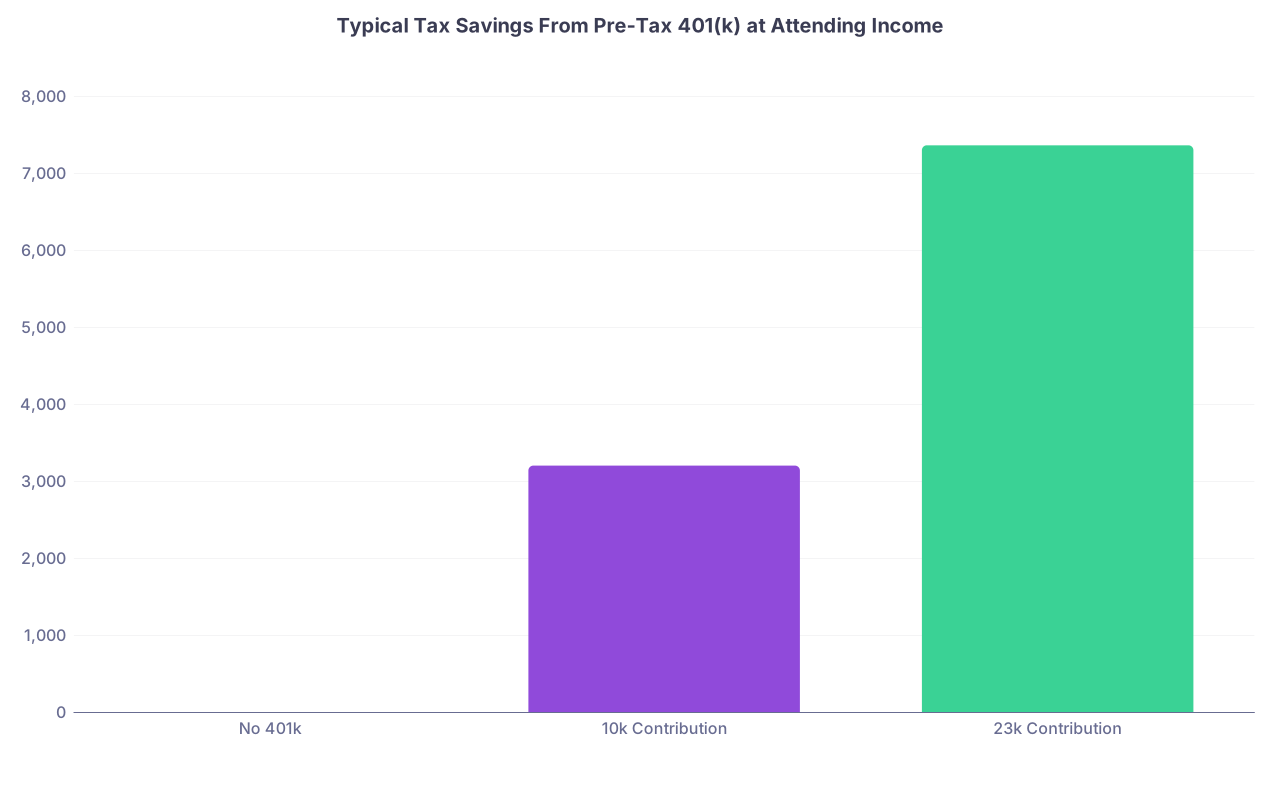
| Category | Value |
|---|---|
| No 401k | 0 |
| 10k Contribution | 3200 |
| 23k Contribution | 7360 |
(Assuming 32% marginal federal rate; state tax savings are extra.)
Spring (First Full Attending Year Tax Filing)
Hire and actually use a good CPA
- By now, you should not be self‑filing if:
- You have meaningful 1099 income
- You’re juggling PSLF vs refinance
- You’re married with complex finances
- Your CPA should:
- File your return
- Project this year + next year
- Propose at least 2–3 specific moves (S‑Corp, change retirement mix, adjust estimates, etc.).
- By now, you should not be self‑filing if:
Implement a tax‑aware cash‑flow system
- At this point you should stop living “paycheck to paycheck” mentally.
- Set up:
- Automatic transfers:
- From checking → taxable brokerage
- From checking → high‑yield “tax” savings (if needed for 1099 estimates)
- You want taxes and investing off your mental to‑do list.
- Automatic transfers:
Summer–Fall (Fine‑Tuning)
Entity and S‑Corp decisions (if side income is real, not theoretical)
- If 1099 income is ≥$80–100k and expected to continue:
- Your CPA should model S‑Corp vs sole proprietor.
- Potential benefit:
- Reduce self‑employment tax via a reasonable salary + distribution split.
- Pitfall:
- Don’t open an S‑Corp because some guy in a Facebook group said so. Get real numbers.
- If 1099 income is ≥$80–100k and expected to continue:
Start building a habit of year‑round micro‑planning
- Twice per year:
- Check YTD income and tax.
- Adjust:
- 401(k) contributions
- HSA contributions
- Brokerage investment plan
- Confirm quarterly estimates are enough.
- Twice per year:
Visual Summary: Tax Complexity Over Training
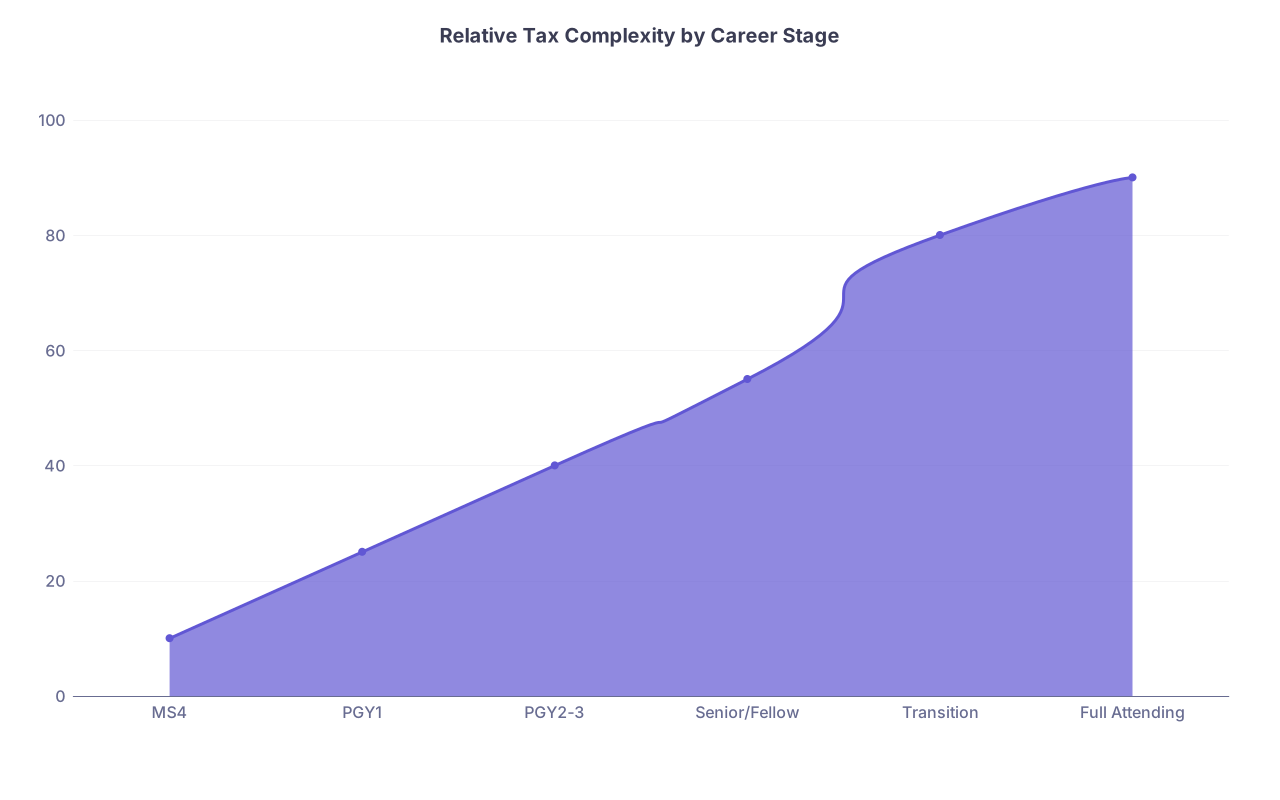
| Category | Value |
|---|---|
| MS4 | 10 |
| PGY1 | 25 |
| PGY2-3 | 40 |
| Senior/Fellow | 55 |
| Transition | 80 |
| Full Attending | 90 |
(Scale is relative complexity, not a score; the point is the steep jump around transition and full attending years.)
FAQs (4 Only)
1. Should I hire a CPA as a resident or wait until I’m an attending?
If your situation is simple—single, W‑2 only, no big side gigs—you can handle residency taxes yourself with software and save the fee. The moment you add real 1099 income, get married with complex student loans, or approach your transition year to attending, it’s time to bring in a CPA who actually understands physicians. Waiting until you’re already buried in attending income is what leads to big penalties and “why did no one tell me this?” moments.
2. Is Backdoor Roth IRA really necessary, or can I just use Roth 401(k)?
Early on (MS4 and resident), plain Roth IRA through the front door is usually fine. Once your attending salary pushes you over the Roth IRA income limits, the Backdoor Roth becomes your only route to Roth IRA contributions. Roth 401(k) at work is not a substitute—it’s a different bucket, with different rules. Most high‑income physicians do some mix of traditional 401(k) + Backdoor Roth IRA to balance current tax savings with future tax‑free growth.
3. How much should I set aside for taxes from moonlighting or 1099 work?
If you want a simple rule that rarely fails: stash 30–40% of every 1099 payment into a separate “tax” savings account immediately. That covers federal income tax, state tax in many states, and self‑employment tax. Then do proper estimates with your CPA to refine the number. Residents who do not separate this money almost always spend it and then panic in April.
4. What’s the single most important tax move in my first attending year?
Getting withholding and retirement contributions right in the first 2–3 months. That means:
- Correct W‑4 for your actual income and family situation.
- Aggressive, but realistic, 401(k)/403(b) contributions (usually traditional at attending income).
- Setting up Backdoor Roth IRA and HSA if eligible.
If you nail those early, everything else becomes tweaking instead of damage control.
Key Takeaways:
- Every stage from MS4 to full attending has different tax moves; what’s smart as an intern (Roth everything) can be dumb as a high‑income attending.
- Fix your W‑4 and retirement contributions at each transition—new job, new PGY year, first attending role, first year with side income.
- By the time you hit your first full attending year, you should have a CPA, a plan for Backdoor Roth + pre‑tax retirement, and a system for handling 1099 taxes automatically—not reactively.


