

It’s July 5th. Your first real paycheck as an attending just hit your account. It’s…a lot more than residency. Then you look at the withholdings column and feel slightly sick. Federal tax, state tax, Social Security, Medicare, maybe 403(b), maybe HSA. You realize: no one has actually walked you through what to do, month by month, so you are not blindsided next April.
That is what this is. A month‑by‑month tax planning checklist for your first attending year.
I’m assuming:
- You finished residency/fellowship this June.
- You start as an attending July 1 (or close).
- You’ve got resident‑level savings, attending‑level income, and almost no tax planning infrastructure.
We’ll walk July through next June. At each point: here’s what you do this month, so you don’t get wrecked by taxes later.
Big‑Picture Timeline: Your First Attending Year
Let’s anchor the whole year before zooming in.
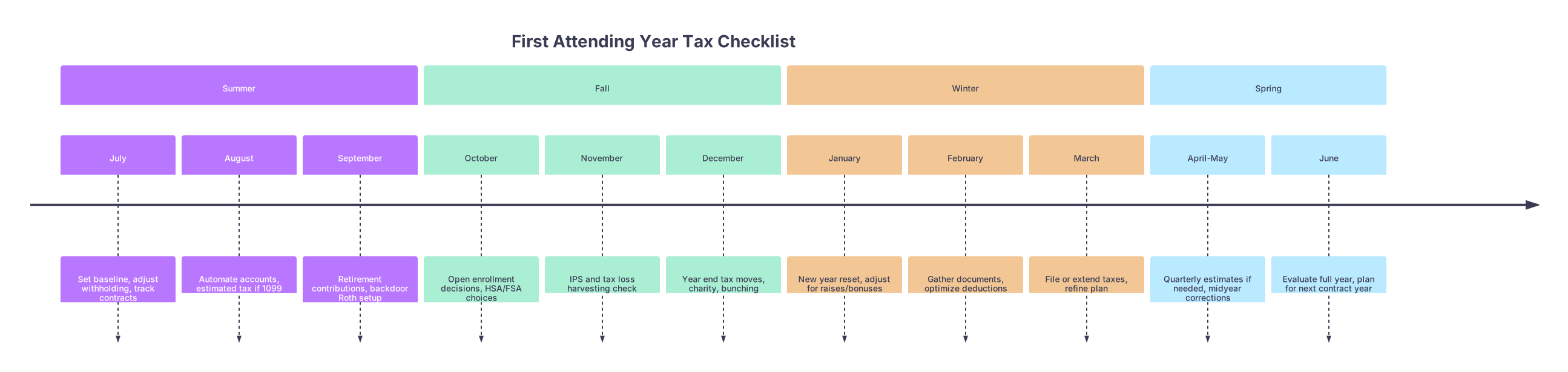
| Period | Event |
|---|---|
| Summer - July | Set baseline, adjust withholding, track contracts |
| Summer - August | Automate accounts, estimated tax if 1099 |
| Summer - September | Retirement contributions, backdoor Roth setup |
| Fall - October | Open enrollment decisions, HSA/FSA choices |
| Fall - November | IPS and tax loss harvesting check |
| Fall - December | Year end tax moves, charity, bunching |
| Winter - January | New year reset, adjust for raises/bonuses |
| Winter - February | Gather documents, optimize deductions |
| Winter - March | File or extend taxes, refine plan |
| Spring - April-May | Quarterly estimates if needed, midyear corrections |
| Spring - June | Evaluate full year, plan for next contract year |
July: Orientation Month – Figure Out Your Tax Baseline
July is not the month to optimize everything. It’s the month to see the field.
At this point you should:
- Dissect Your First Pay Stub
Pull your first paycheck and actually read it. Line by line.
You’re looking for:
- Filing status your employer used (single, married, etc.)
- Federal withholding amount
- State withholding amount
- Retirement contributions (401k/403b/457b)
- HSA/FSA contributions (if any)
- Other pre‑tax deductions (health, dental, vision premiums)
If you see something that looks wrong (married vs single, too many dependents, no retirement deferral even though you elected it), email HR/payroll. Do not wait six months.
- Roughly Estimate Your Annual Income
You can’t plan taxes without a ballpark number.
- Take base salary + guaranteed bonus + typical shift differentials.
- Ignore “maybe” bonuses; plan on guaranteed pieces.
Example:
$320,000 base + $20,000 quality bonus likely = $340,000 target income.
- Check Your Federal Tax Withholding vs Reality
At this point you should at least know if you’re wildly under‑withheld.
Use any decent online paycheck calculator or IRS Tax Withholding Estimator with:
- Your gross annual income estimate
- Your state
- Retirement contributions you plan to make
Then compare:
- Projected tax owed for the year vs
- Projected withholding if each paycheck looks like the first
If your projected withholding is way below projected tax owed → you’ll write a big check next spring.
If that gap is huge (>$5–10k), you adjust now, not in March.
- Fix Your W‑4 (Federal) and State Withholding
Log into your employer portal and update:
- W‑4:
- Check filing status (single vs married filing jointly).
- Add extra flat dollar withholding per paycheck if needed.
- State withholding form:
- Most states have their own version. Adjust similarly.
Target: you want your combined federal withholding + any 1099 estimated taxes (we’ll get to that) to be within $1–2k of what you’ll actually owe.
- Create a Simple Tracking Sheet
Not a 12‑tab monster. A single Google Sheet with:
- Salary job: employer name, W‑2 only? Y/N
- Any 1099 work: group name, rate, expected hours/month
- Retirement accounts: 401k/403b/457b plan names and limits
- Benefits: whether you have HSA, FSA, etc.
You’re building the reference sheet you’ll bless yourself for in March.
August: Multiple Income Streams – Get 1099 and Accounts Under Control
By August, the schedule is a little less chaotic. Time to lock in structure.
At this point you should:
- Confirm Whether You Have ANY 1099 Income
Ask yourself bluntly:
- Urgent care moonlighting?
- Telemedicine shifts?
- Locums weekends?
- Medical surveys/consulting?
If yes: those do not have tax withheld automatically, and they will surprise you if you pretend they don’t matter.
- Decide if You Need Quarterly Estimated Taxes
Rule of thumb for 1099:
- Set aside 30–40% of 1099 gross into a separate “tax” savings account.
- If total extra tax owed from 1099 will likely exceed ~$1–2k, you should make quarterly estimated payments.
Federal quarterly deadlines:
- April 15, June 15, September 15, January 15
In your first attending year starting in July, the ones that will hit you:
- September 15 (for July–Aug 1099) – optional if small
- January 15 (for Sep–Dec 1099) – big one for moonlighters
If you’re already deep into 1099, talk to an accountant sooner rather than later.
- Open the Right Accounts (If You Have 1099)
If you have any meaningful 1099 income, treat it like a tiny business.
By the end of August you should have:
- Separate business checking (even if you’re just a sole prop with your own name)
- If 1099 is >$10–15k/year: a Solo 401k or SEP‑IRA (solo 401k usually better for backdoor Roth compatibility)
- A simple system to log expenses: malpractice, CME, licensing, exam fees, home office (if legitimate), etc.
- Automate the Savings Flow
This is where most new attendings fail. They “mean to” save for taxes; they just don’t.
Set up automatic transfers each payday:
- From main checking →
- X% to long‑term investment account
- X% to “Tax Savings – 1099” if applicable
- X% to emergency fund if not yet solid (not tax, but necessary)
If you never see the money, you don’t spend it. That’s the point.
September: Retirement and Roth Strategy Month
By September, you’ve seen 2–3 months of paychecks. Time to lock in tax‑advantaged saving.
At this point you should:
- Maximize (or At Least Rationalize) Your 401k/403b
2024 employee contribution limit: $23,000 (under 50). That number may change next year, but the logic won’t.
Decide:
- Will you max it? Yes/no.
- If yes, adjust contribution % so by December 31 you hit the limit.
- If no, set a specific target (e.g., $15,000) and contribution rate to match.
Pre‑tax vs Roth 401k?
- If you’re in a high bracket now (most attendings are), I strongly favor pre‑tax 401k/403b for your first years. You can always do Roth later when income stabilizes or drops.
- Set Up Backdoor Roth IRA Mechanics
If your income is attending‑level, you’re likely over the direct Roth IRA income limit. So you use the backdoor:
Basic steps:
- Open a traditional IRA (with $0 balance initially)
- Open a Roth IRA
- Each year:
- Contribute non‑deductible amount to traditional IRA (e.g., $6,500)
- Convert to Roth IRA shortly after
Key tax landmine: the pro‑rata rule. If you have pre‑tax money sitting in any IRA (traditional, SEP, SIMPLE), your backdoor Roth gets messy.
So by end of September, you should:
- Confirm you have no orphan pre‑tax IRAs lingering from residency or a prior job. If you do, consider rolling them into your current 401k/403b to “clear the decks.”
- Check for a 457(b) Option
If you’re at a hospital system, you may also have:
- Governmental 457(b) – usually good, extra $23k pre‑tax space.
- Non‑governmental 457(b) – more nuanced, tied to employer solvency, evaluate carefully.
At this point:
- If it’s governmental and you plan to stay, it’s often worth using.
- If it’s non‑gov, read the distribution rules and creditor protection details before you touch it.
October: Open Enrollment – Tax Choices Hidden in Benefits
HR open enrollment usually drops in October/November. This is a pure tax month in disguise.
At this point you should:
- Choose the Right Health Plan – HSA vs FSA
If a High Deductible Health Plan (HDHP) is offered:
- With an HSA, you get:
- Pre‑tax contributions
- Tax‑free growth
- Tax‑free withdrawals for qualified medical expenses
That’s triple tax‑advantaged. For many young, healthy attendings, an HDHP + max HSA is very attractive.
2024 HSA limits (approx, check current):
- Individual: ~$4k+
- Family: ~$8k+
If you don’t have HDHP or don’t choose it:
- You may have a Healthcare FSA (use‑it‑or‑lose‑it, with minor rollover). Still tax‑advantaged, but less flexible than HSA.
- Elect Dependent Care FSA If Applicable
If you have kids in daycare or after‑school care:
- Dependent Care FSA lets you pay up to $5,000 pre‑tax for qualified child care.
- That’s an easy win if you’re already paying that much.
- Review Disability and Life Insurance Through Employer
Not exactly tax, but related:
- Employer long‑term disability premiums paid with after‑tax dollars → benefits tax‑free (good).
- Employer pays premium → benefits taxed (less ideal but common).
Know which it is; it changes how much income replacement you actually get.
- Confirm Pre‑Tax vs Post‑Tax Premiums
For other benefits, see if premiums are pre‑tax (reducing taxable income) or after‑tax. It affects withholding and your real tax rate.
November: Investment Hygiene and Loss Harvesting
By November, your taxable investment accounts might have some gains/losses.
At this point you should:
- Look for Tax Loss Harvesting Opportunities
If you started investing mid‑year (or even earlier):
- Check for positions in your taxable brokerage account (not retirement) with unrealized losses.
- Consider selling losers and moving into a similar (but not “substantially identical”) ETF/fund to maintain exposure.
This can:
- Offset capital gains
- Up to $3,000 per year can offset ordinary income
- Excess carries forward
Just avoid wash sale rules (buying back the same or substantially identical security in the 30 days before/after sale).
- Clarify Your Investment “Policy”
You don’t need a 15‑page Investment Policy Statement. But you do need something like:
- Target stock/bond mix (e.g., 80/20 or 70/30)
- Which accounts hold what (tax‑efficient placement)
- Automatic contribution schedule
Why is this in a tax checklist? Because poor asset placement costs you taxes every single year.
December: Year‑End Tax Moves and Cleanup
December is where you can still fix some things. After December 31, a lot of doors close.
At this point you should:
- Verify You’re On Track With 401k/403b, 457(b), HSA, FSA
Run a quick check:
- Will your year‑to‑date contributions hit:
- Desired 401k/403b number?
- HSA max (if eligible)?
- 457(b) target?
If you’re behind and cash flow allows, crank up contributions for the last few paychecks.
- Bunch Charitable Giving If You Itemize
With the higher standard deduction, many physicians don’t itemize every year. Strategy:
- “Bunch” giving into one tax year to exceed the standard deduction.
- Use a Donor Advised Fund (DAF): contribute a large amount in December, get deduction this year, give to charities over time.
If you have appreciated stock in a taxable account:
- Donating shares directly to a DAF lets you avoid capital gains and still get deduction at fair market value. Strong move.
- Finalize Any Big Deductions This Year vs Next
Think:
- CME expenses (if unreimbursed and legitimately deductible based on your situation)
- Business equipment/software for 1099 work
- Licensing or board exam fees for self‑employment
If you run a true 1099 “business,” timing big purchases in December vs January can shift deductions between tax years. Use that intentionally.
January: New Year Reset – Adjust for Raises, Bonuses, and Reality
January is Second Chance Month. You’ve got actual data from 6 months of attending income.
At this point you should:
- Re‑Estimate Annual Income with Actual Numbers
Now you know:
- True base salary (plus raises/scale advancements)
- Typical bonus size or shift differential
- Actual 1099 rhythm (if any)
Update your annual income estimate. Then:
- Re‑run the IRS Tax Withholding Estimator.
- Adjust W‑4 and state forms again if needed.
- Re‑set Retirement Contributions for the New Calendar Year
New year = new contribution limits.
Make sure:
- Your 401k/403b contributions are set to hit the new annual limit.
- Your HSA payroll deductions are set to max out (if eligible).
- You plan your backdoor Roth IRA contribution for this year (you can do it any time during the year, but I like early).
- Reassess Moonlighting and 1099
If you’re burnt out on moonlighting or your tax bill is creeping up, this is when you decide:
- Cut back on 1099 work?
- Or keep it and commit to quarterly estimated payments and proper business structure?
Pick one. Drifting in the middle is how you get surprise tax pain.
February: Document Gathering and Deduction Reality Check
By February, W‑2s and 1099s should be in your inbox.
At this point you should:
- Collect All Tax Documents Methodically
You want:
- W‑2s from all employers (residency + attending if in same calendar year)
- 1099‑NEC / 1099‑MISC / 1099‑K for any side work
- 1099‑INT / 1099‑DIV / 1099‑B from banks and brokerages
- 1098‑E for student loan interest (if applicable)
- 1098‑T or education credits (less common as attending, but still)
- Mortgage interest statement (1098) if you bought a home
Create a single folder (physical or digital) and dump everything in it.
- List Out Potential Deductions/Credits You Actually Have
For most early attendings, the realistic list is small:
- Student loan interest (phases out with higher income)
- State and local taxes (capped at $10k)
- Mortgage interest (if you own)
- Charitable contributions (if itemizing)
- Retirement contributions (already reduced W‑2 wages)
- HSA contributions outside payroll, if any
If you’re 1099:
- Home office (if actually used regularly and exclusively)
- Pro‑rated utilities, internet
- CME, licensing, exam fees
- Professional dues, board fees
- Malpractice (if not reimbursed)
- Decide: DIY vs CPA
At this point, you make a grown‑up decision:
- If your situation is: 1 W‑2 job, small taxable account, no 1099 → you can use quality tax software.
- If you have: multiple 1099 streams, K‑1s, backdoor Roth, big DAF moves, or a house purchase + relocation → I strongly recommend using a CPA who routinely works with physicians.
March: File (or Extend) and Fix the Next Year
March is where you see how well or badly you did.
At this point you should:
- Prepare and Review Your Return for Patterns
Whether you use software or a CPA, don’t just sign and move on.
Look for:
- Size of refund or amount owed
- Effective tax rate (total tax / total income)
- Which deductions actually mattered
If you owe a big amount:
- That’s your cue to adjust withholding or quarterly estimates immediately, not complain and repeat.
- Set a Clear Withholding Target for the Coming Year
You want next spring to be boring. That means:
- Aim to be within $1–2k of break‑even (small refund or small amount owed).
- Adjust:
- W‑4 extra withholding per paycheck
- State withholding
- Quarterly estimates (if 1099)
- If Needed, File an Extension — But Pay What You Owe
If you’re not ready by April:
- File Form 4868 for an extension. That extends the filing, not the payment.
- You still need to pay your best estimate by April 15 to avoid penalties/interest.
April–May: Mid‑Year Course Correction
Spider sense check time. You don’t wait until December to realize you’re off.
At this point you should:
- Check Year‑to‑Date Withholding and Income Again
Pull a current pay stub:
- Look at YTD gross and YTD federal/state withholding.
- Do a quick extrapolation for the full year.
- If 1099 is larger than you expected, update your quarterly estimates for June and September.
- Reassess 1099 Work and Time vs Tax Tradeoff
You’ll probably feel it by now:
- Are those extra shifts actually worth it after:
- Marginal tax rate
- Self‑employment tax
- Extra fatigue?
You might decide some of that time is better spent on board prep, a fellowship app, or just seeing your family. That is a financial decision too.
June: Close the Loop and Plan the Next Attending Year
One full attending year nearly done. Time to zoom out.
At this point you should:
- Review the Entire Year’s Big Numbers
On that simple tracking sheet from July, add:
- Actual total W‑2 wages
- Actual total 1099 income
- Actual total taxes paid (federal + state)
- Actual total retirement contributions
- HSA/FSA usage
- Student loan balance change (not tax, but related)
- Decide What You’ll Change for Year Two
Examples:
- Increase pre‑tax retirement from 15% to 20%.
- Actually use a Solo 401k for 1099.
- Stop pointless taxable investing and focus on HSA + 401k + backdoor Roth first.
- Move to an HDHP and max the HSA.
- Cut low‑yield moonlighting that only pushes you into a higher tax bracket.
- If You Don’t Have One Yet, Hire a Tax Pro for a Once‑Yearly Review
You don’t necessarily need quarterly CPA handholding, but a 1–2 hour annual tax planning session can:
- Stress‑test your 1099 structure
- Optimize retirement account choices
- Flag state tax and residency issues (especially if you moved)
Think of it as insurance against expensive mistakes.

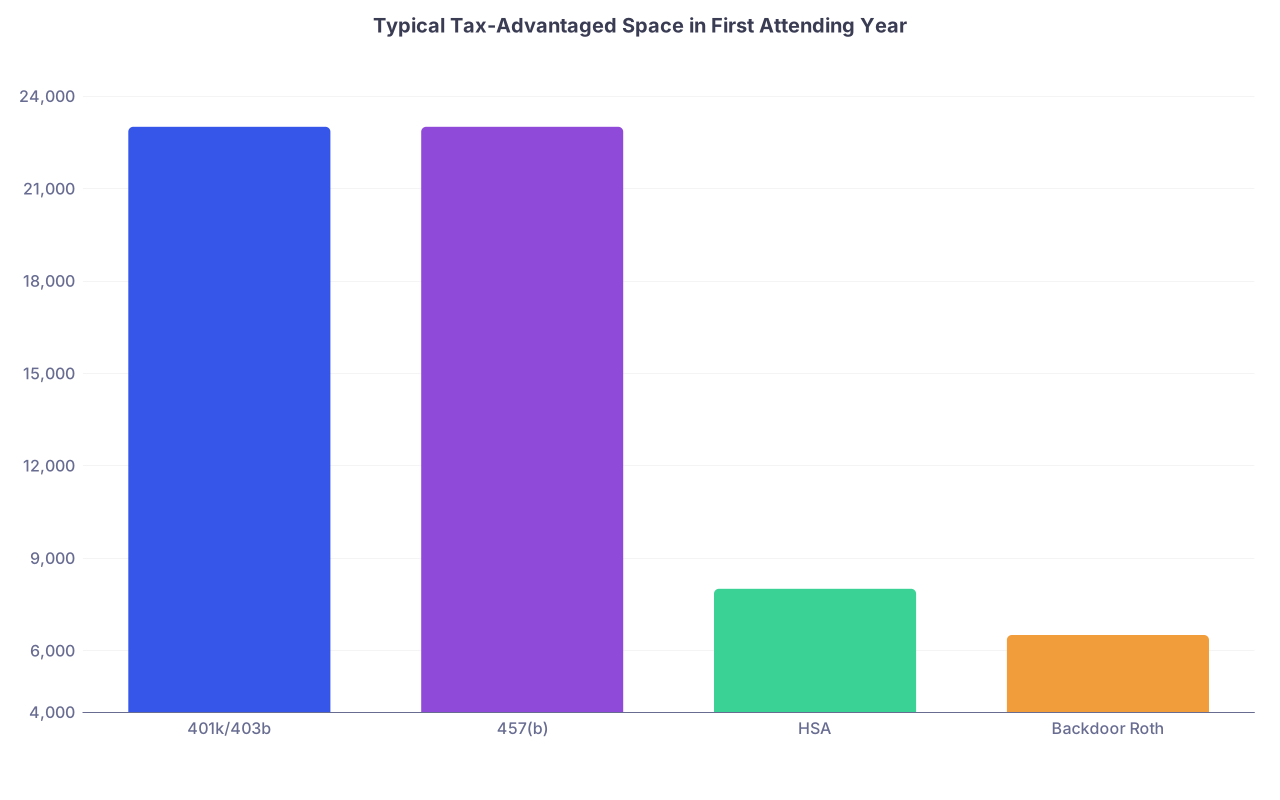
| Category | Value |
|---|---|
| 401k/403b | 23000 |
| 457(b) | 23000 |
| HSA | 8000 |
| Backdoor Roth | 6500 |
Quick Reference: First Attending Year Tax Checklist
| Month | Key Tax Tasks |
|---|---|
| July | Analyze pay stub, fix W-4, start tracking |
| August | Identify 1099, open business/tax accounts |
| September | Lock 401k plan, clear IRAs, plan backdoor |
| October | Open enrollment, HSA/FSA, benefits choices |
| November | Tax loss harvesting, investment cleanup |
| December | Year-end contributions, charity, bunching |
| January | Re-estimate income, reset contributions |
| February | Gather tax docs, list deductions, pick CPA |
| March | File/extend, adjust withholding for next yr |
| April–May | Midyear check, update estimates, adjust 1099 |
| June | Annual review, plan year two improvements |
Today’s actionable step:
Pull your most recent pay stub and your employment contract. Open a blank note or spreadsheet and do three things right now:
- Write down your projected annual income based on the contract.
- Write down your year‑to‑date federal withholding from the pay stub.
- Run the IRS Tax Withholding Estimator and see if your withholding is on pace or way off.
If it’s off by more than a couple thousand dollars on an annual basis, log into your HR portal and submit a new W‑4 with an extra flat dollar amount withheld per paycheck. That single 15‑minute move will save you a lot of pain next April.


