

The nightmare scenario you’re afraid of as a new attending doctor is not hypothetical. It happens all the time.
You work your tail off, your income finally jumps, you feel like you can breathe… and then a huge tax bill hits that you absolutely do not have the cash to cover. And you’re suddenly Googling “what if I owe the IRS more than I have” at 1 a.m., convinced you’ve already ruined your financial life before it even started.
Let me say this bluntly: owing more taxes than you’ve saved is bad, stressful, and common. It is not the end of your career, your license, or your life.
Let’s walk through what actually happens, what the real worst-case scenario is (it’s probably not what you’re imagining), and what you can do right now if this is you.
First: You’re Not the Only “Smart Doctor” Who Screwed This Up
You didn’t miss some obvious memo everyone else got. The system sets you up for this.
Here’s the trap:
- As a resident/fellow, your paycheck is tiny but your taxes are straightforward. Withholding usually covers it.
- You become an attending. Income jumps from $65k to $250k+ overnight.
- You pick up locums, moonlighting, 1099 shifts, telemedicine, or consulting. No one withholds taxes for you on these.
- You’re drowning in a new job, new city, maybe new baby, student loans. You tell yourself, “I’ll figure out the tax stuff later.”
- “Later” becomes April. And now the IRS wants $20k… $40k… $80k. And your bank account has… not that.
I’ve seen:
- A new hospitalist who owed $32k in federal taxes and had $4k in savings.
- An anesthesiologist with multiple 1099 gigs who owed over $100k after their first year as an attending because no one told them about estimated quarterly taxes.
- A surgeon who legit thought “filing jointly” meant their spouse’s W-2 withholding would “average it out.”
None of them lost their license. None of them went to jail. All of them felt sick to their stomachs and ashamed. And every single one of them worked through it.
So yeah, it’s a mess. But it’s a fixable mess.
What Actually Happens If You Can’t Pay Your Full Tax Bill
Let’s kill the horror-movie version in your head.
If you file your tax return and can’t pay in full:
- The IRS does not immediately empty your bank account.
- The IRS does not immediately notify your employer or hospital.
- You do not get arrested for “tax evasion” because you miscalculated estimated payments.
What actually happens looks more like this:
- You file your return showing a balance due.
- You either:
- Pay what you can, or
- Request a payment plan (installment agreement).
- The IRS adds:
- Interest (currently around credit-card-ish levels, changes over time).
- Penalties:
- Failure-to-pay penalty (0.5% per month of what you owe, capped at 25%).
- Possibly underpayment of estimated tax penalties.
- You slowly pay it down with a structured plan, while interest/penalties accrue until it’s paid off.
Is it annoying and expensive? Yes. Financially dangerous if you ignore it? Also yes.
But the key word here: manageable.
The True Worst-Case Scenario (And Why You’re Nowhere Near It)
You’re probably imagining some IRS agent showing up in your OR and dragging you out mid-case because you owe $30k.
Here’s what actually qualifies as “disaster land” with taxes:
- You don’t file for years.
- You ignore every notice.
- You lie on your returns (fraud).
- You hide income deliberately.
- You cash checks under the table and never report anything.
That’s how you get into trouble with audits, liens, levies, wage garnishment, and, in the really bad fraud cases, criminal stuff.
But that’s not you. You:
- Made more than you expected.
- Didn’t adjust withholding or do estimated payments correctly.
- Ended up under-saving and now owe more than you can write a check for.
That’s not criminal. That’s “welcome to attending life, you under-withheld.”
Just to be concrete, here’s how your situation compares to actual catastrophe:
| Situation | How Bad Is It Really? |
|---|---|
| Owe $20k–$80k but file on time | Stressful, but fixable |
| Can’t pay in full, set up payment | Common, manageable |
| Ignore IRS letters for years | Serious, leads to collections |
| Lie or hide income deliberately | Potentially criminal |
| Never file a return at all | Major red flag, big problems |
So let’s move out of vague panic mode and into “okay, what do I actually do next.”
Step 1: Stop Avoiding the Number
The anxiety spikes because you’re dealing with a shadow, not a number.
You have to know:
- Exactly how much you owe (federal + state).
- Exactly how much cash you have right now.
- Exactly what your after-tax monthly income is.
If your tax return isn’t done yet, get it done. Don’t guess.
And if the number makes you feel like you’re going to throw up? That’s normal. Sit with it for a second. Then we attack it.
Step 2: File the Return. Even If You Can’t Pay.
This is non-negotiable: filing late is way more painful than paying late.
Two separate penalty categories:
- Failure-to-file: generally 5% of the unpaid taxes per month (capped at 25%). This one is brutal.
- Failure-to-pay: 0.5% per month of unpaid taxes (also capped at 25%). Annoying, but manageable.
So if you’re thinking, “Maybe I should just delay filing until I can pay” – no. That’s how you take a bad situation and make it worse.
If you’re already late on filing? File as soon as possible. Every month you wait is lighting more money on fire.
Step 3: Decide How to Pay – IRS Plan vs. Other Options
You basically have a menu of ways to handle a tax bill that’s bigger than your bank account.
Option A: IRS Installment Agreement (Most Common)
You ask the IRS for a payment plan. They say yes surprisingly often.
Rough idea:
- If you owe under a certain amount (recently around $50k for “streamlined” plans), you can often set it up online without much drama.
- Payments are auto-drafted monthly.
- Interest and penalties continue until it’s fully paid.
Pros:
- No huge lump sum.
- It’s “legalized” paying over time instead of ignoring the problem.
- You keep your cash cushion for emergencies.
Cons:
- Interest + penalties add up.
- It’s another monthly bill on top of your loans, rent, everything else.
Option B: Pay Part in Cash, Part on a Plan
If you’ve got some savings but not enough:
- Put a chunk down to reduce interest/penalty base.
- Set up a plan for the rest.
Example: You owe $40k. You have $12k in savings.
- Pay $10k now.
- Keep $2k as emergency buffer.
- Put remaining $30k on a payment plan.
You don’t want to drain everything to zero and then have one flat tire turn into a credit-card disaster.
Option C: Credit Card / LOC / Refinance vs IRS
People get tempted to throw the tax bill on a credit card to “get rid of it.” Dangerous instinct.
The IRS actually charges interest rates that are usually lower than typical credit cards. On top of that, the IRS doesn’t mess up your credit the way credit-card utilization does (unless it goes extreme).
Sometimes using:
- A low-interest personal loan,
- A 0% promo card you are absolutely sure you can pay before it jumps,
- A home equity line of credit (if you own),
can make sense. But that’s surgical, not default.
For most new attendings, letting the IRS be your “lender” via a payment plan is actually less risky than juggling credit cards.
Step 4: Stop It From Getting Worse Next Year
The truly miserable version of this is doing it again next year. And a third year. Then suddenly you’re that attending with a secret six-figure tax hole they’re too ashamed to talk about.
You need a system. Not vibes. A system.
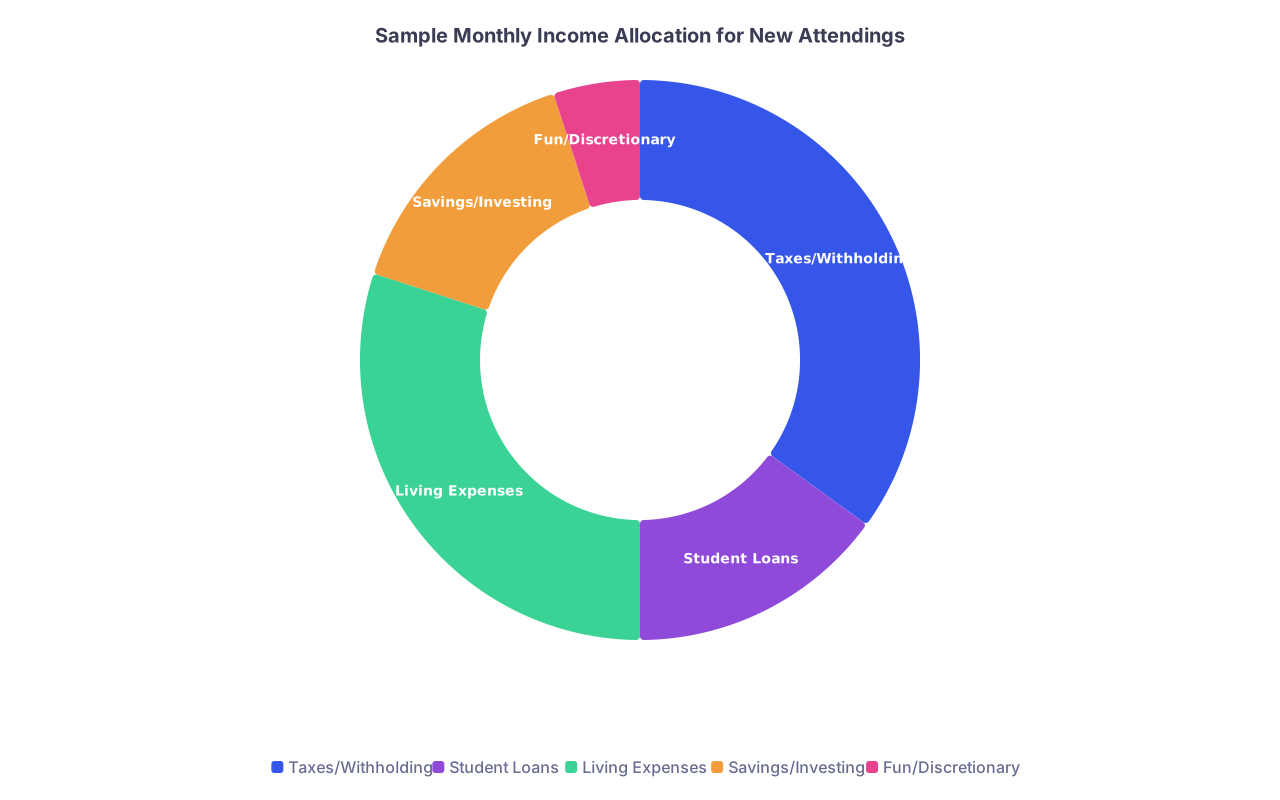
| Category | Value |
|---|---|
| Taxes/Withholding | 35 |
| Student Loans | 15 |
| Living Expenses | 30 |
| Savings/Investing | 15 |
| Fun/Discretionary | 5 |
Basic rule of thumb as a high-earning doc with 1099 or under-withholding risk:
- Assume 30–40% of gross 1099 income needs to go to taxes (federal + state, depending where you live).
- Every time money hits your account from a 1099 gig, immediately move 30–40% into a separate “tax holding” savings.
Not at the end of the month. The same day. Before you can talk yourself out of it.
If you’re W-2 and got burned because withholding was too low:
- Update your W-4 and state withholding now.
- Run a projection with a CPA or a good tax calculator using your attending-level income. Make them show you the actual safe withholding numbers.
You should know roughly: “If I keep working like this, my total tax bill next year will be about $X, and I’ll have about $Y already withheld/paid by year-end.”
If you’re guessing, you’re setting yourself up to repeat this.
Step 5: Get Help From Someone Who Actually Understands Doctor Income
You do not win extra points for DIY-ing this while you’re already sleep-deprived and anxious.
Find:
- A CPA or EA who works with physicians regularly.
- Someone who understands:
- W-2 + 1099 mix,
- moonlighting,
- locums,
- S-corp/LLC setups (if that’s relevant later),
- and your state’s tax quirks.
Red flag: any tax person who shrugs off a huge underpayment like, “Eh, everybody does that, we’ll see what happens next year.” No. You want someone slightly obsessive who will sit there and map out reality with you.
Ask them specifically:
- “If my income next year is about $X from W-2 and $Y from 1099, how much should I be withholding/setting aside each month?”
- “What safe harbor rules apply so I don’t get crushed with underpayment penalties again?”
- “Can you help me set up estimated quarterly payments or adjust W-2 withholding enough to cover everything?”
Then actually do what they tell you. Even if it means less fun money for a while.
What About My Medical License, Hospital Credentialing, Loans?
This is where your brain probably goes at 3 a.m.:
- “Will this show up when I re-credential at my hospital?”
- “Is this a reportable ‘financial incident’ on licensing?”
- “Will I lose my job if they find out I owe taxes?”
Short version:
- Simply owing taxes and being on a formal payment plan is not typically a license issue.
- Tax liens (if it got that bad) can affect credentialing in some settings because they show up on background/credit checks, but most people don’t get there if they’re actively working with the IRS.
- Student loan servicers don’t care about your tax debt directly; what hurts is if it makes you miss payments.
The problem isn’t “owing taxes.” The problem is ignoring it until it spills into every part of your financial life.
You staying on top of it – even if that just means “I filed, I set up a plan, and I’m paying” – is how you keep it contained.
A Quick Reality Check: You’re Actually in a Better Position Than You Think
I know it doesn’t feel like it, but you have three massive advantages compared to the average person with a big tax bill:
High and stable earning potential.
You’re not a gig worker whose income could vanish tomorrow. Even a “bad year” for you as an attending is still strong income.Time.
You’re early. If you fix this now, this mistake becomes a nasty story you tell residents one day as a warning, not a permanent hole.Predictable expenses.
You generally don’t have ten kids, a failing business, and three ex-spouses (yet, hopefully). Your life is relatively structured.
This doesn’t minimize how awful it feels. But it does mean this isn’t permanent. It’s a surge of pain you work through over a few years.
If You’re Panicking Right Now, Do This Today
Don’t build a 10-step life plan tonight. Just take the next tiny, unambiguous action.
Here’s what that action should be:
- Log in to wherever you file taxes. TurboTax, CPA portal, whatever.
- Get your exact number: total amount owed (federal + state).
- Write it down on paper. “I owe $____ in taxes for year . I have $ in cash right now.”
- If you’ve already filed and can’t pay in full:
- Go to the IRS site and read about setting up an installment agreement.
- Start the process or email your tax person and literally write:
“I can’t pay my full bill. Help me set up a payment plan with the IRS this week.”
- If you haven’t filed yet:
- Email or text your CPA tonight:
“I need to file even though I can’t pay yet. Can we finalize my return this week?” - Or, if you DIY: block off 2 hours this weekend and get the return done.
- Email or text your CPA tonight:
That’s it for today. Don’t solve next year. Don’t solve retirement. Solve getting this year accurately on paper and into the system.
Tomorrow or this weekend, you can open your paystub, look at your withholding, and start fixing the pattern.
For now, pull up your return or your CPA’s email and write that one sentence asking for help. Then send it.


