

What actually happens if you worked part‑time as an employee, moonlighted as an independent contractor, and now your taxes are a complete Frankenstein of W‑2s and 1099s—are you in real trouble, or is this just… normal chaos?
Let me say this bluntly: you did not “break” your taxes by having both W‑2 and 1099 income.
You might have:
- Underpaid estimated taxes.
- Set yourself up for a nasty April surprise.
- Created a more complicated return than TurboTax makes it sound.
But you didn’t do something illegal just by having mixed income. This is very, very common for physicians.
The scary part is what happens if you ignore the details. That’s where people get burned. Penalties. IRS letters. That sick feeling when you realize the moonlighting money wasn’t really “extra,” it was just untaxed.
Let’s walk through this like two people sitting at a table with a pile of forms and a calculator, trying to make sure you don’t get wrecked by a technicality.
First: No, Mixing 1099 and W‑2 Income Isn’t “Wrong”
You’re not the only one whose year looked like this:
- W‑2 from your main attending job / resident salary
- 1099‑NEC from moonlighting, locums, telehealth, call coverage, or consulting
Programs and hospitals do this all the time. One residency I know literally told residents, “You’ll get a W‑2 from us and a 1099 from moonlighting—just give it to your accountant.” That was the entire guidance. Helpful.
So let’s get one thing clear so you can breathe:
- W‑2 = employee. Taxes withheld automatically.
- 1099 = independent contractor / self‑employed. No taxes withheld.
The IRS doesn’t care that both happened in the same year. They care that:
- You report everything.
- You pay what you owe (and not two years late).
The problem isn’t the structure. It’s the follow‑through.
The Ugly Part: Why 1099 Income Feels Like a Trap
Here’s why your stomach drops when you realize you’ve got 1099 income.
With W‑2:
- Federal income tax is already withheld.
- Social Security and Medicare (FICA) are already withheld.
- You rarely get a massive surprise unless your withholding was way off.
With 1099:
- Nobody withholds anything.
- You are the employer and the employee.
- You pay “self‑employment tax” (roughly 15.3% on the first chunk of income, plus some Medicare after that).
- And you still owe normal income tax on top.
So that “extra” $20k you made moonlighting?
Once you take:
- Self‑employment tax
- Federal income tax
- Possibly state income tax
It’s not really $20k usable cash. It might feel like $10–13k after all taxes, depending on your bracket and state.
Here’s the part that freaks people out: if you didn’t make quarterly estimated tax payments during the year, you might owe a big chunk at once. And possibly a penalty.
Let me visualize that for you.
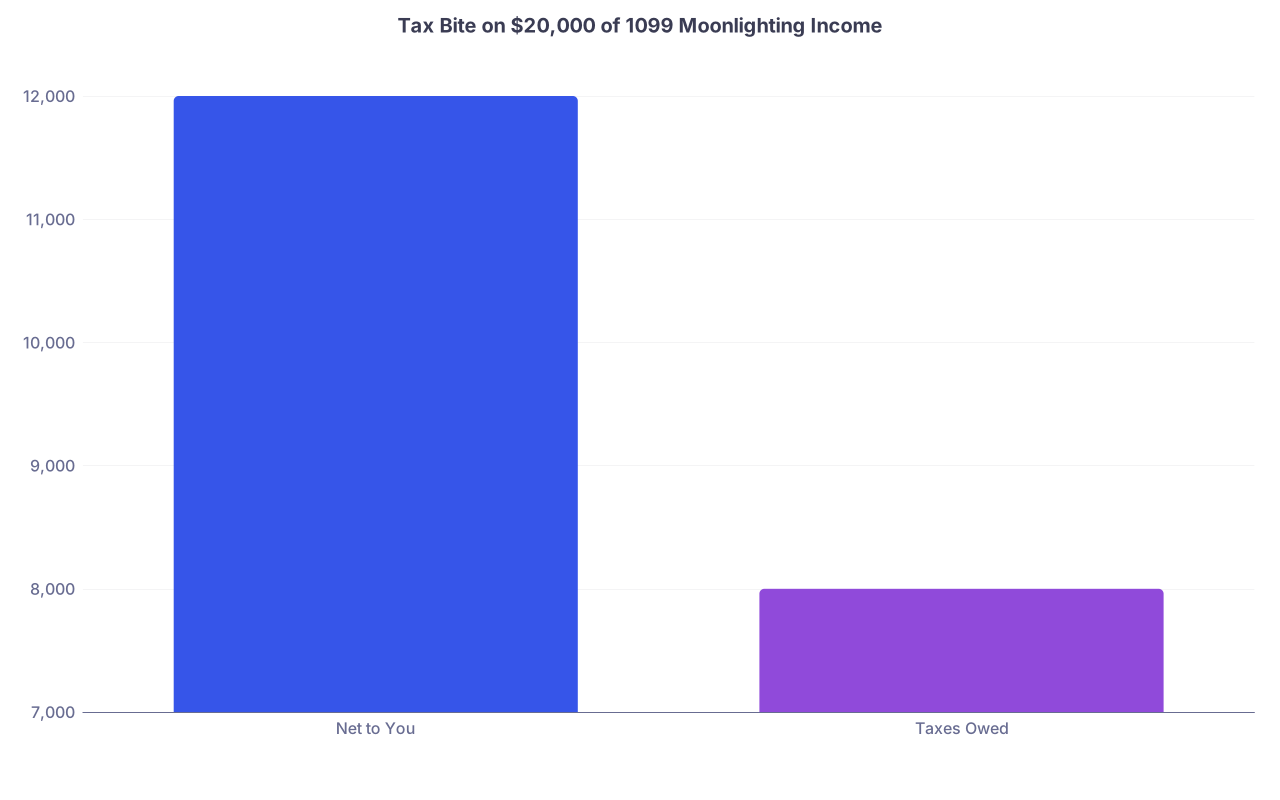
| Category | Value |
|---|---|
| Net to You | 12000 |
| Taxes Owed | 8000 |
That’s the actual problem. Not that you “mixed” W‑2 and 1099. It’s that 1099 income feels “pre‑tax rich” and “after‑tax painful.”
How Mixed W‑2 + 1099 Actually Shows Up on Your Return
Let’s walk the structure, because if you understand the map, the anxiety drops a lot.
Typical setup if you’re just a person (no LLC/S‑Corp, just you):
- W‑2 income: goes on Form 1040 directly from your W‑2.
- 1099‑NEC (most common for physicians): flows to Schedule C (Profit or Loss From Business).
- Schedule C profit: then flows back to Form 1040 as self‑employment income.
- Self‑employment tax on that profit: calculated on Schedule SE.
So your 1099 world is basically:
- Schedule C: income minus expenses.
- Schedule SE: self‑employment tax on the net from Schedule C.
If you did nothing shady and you:
- Enter all your W‑2s correctly.
- Enter all your 1099s correctly.
- Include all your legitimate expenses (licensing, CME, malpractice if you pay it, some mileage, etc.).
- Include any estimated taxes you already paid.
…then the IRS is not going to come after you for simply having both. That’s normal.
They will, however, happily charge you penalties if:
- You owe too much at once and paid too little during the year.
- You “forgot” a 1099 and they match your return to the 1099 their system already has.
So the two big dangers:
- Underpayment / penalties.
- Missing income.
Not “mixing” income.
Did I Underpay? The Penalty Question
The question everyone secretly cares about: “Am I getting hit with penalties?”
The IRS expects you to pay taxes throughout the year, not just in April. They call this “pay as you go.”
You do this in two ways:
- Withholding from W‑2.
- Quarterly estimated payments for 1099 income.
If you had 1099 income and made zero estimated payments, you might still be okay if your W‑2 withholding was high enough to cover everything. But most residents/attendings don’t have that dialed in.
Rough rule (not exact, but sanity‑check level):
- If your total due at tax time (after withholding and credits) is under $1,000 → you’re probably fine, no underpayment penalty.
- If it’s more than that → you might face a penalty, depending on a few safe harbor rules.
Here’s the safe harbor idea in plain English:
If you paid during the year (through W‑2 withholding + any estimates) at least:
- 90% of what you actually owe for this year, or
- 100% of last year’s total tax (110% if your income is higher),
then even if you owe more in April, they typically don’t slap you with an underpayment penalty.
So if last year you:
- Only had W‑2 resident income
- Paid $7,000 in total tax
And this year you: - Paid at least $7,000 during the year again …you may be safe on penalties even if this year’s final bill is higher.
But if:
- Your tax last year was low, and
- You added a ton of 1099 income this year,
- And made no adjustments to withholding or estimates…
You might owe a decent chunk + a few hundred bucks of penalty. Annoying, but not catastrophic.
This is where a CPA actually earns their fee: they can run the underpayment calc and see if you’re within safe harbor.
Common 1099 Mistakes Physicians Make (That Actually Matter)
I’ve seen these over and over:
Ignoring tax planning until March/April.
The IRS doesn’t care that you were on nights. If you work 1099 shifts, planning late is what makes it hurt.Not tracking expenses.
A lot of docs basically gift the IRS free money because they don’t treat their 1099 work like a business, even though that’s exactly what it is.Assuming software will “figure it out.”
Tax software is dumb if you feed it bad or incomplete info. It’s a calculator, not a planner.Thinking an LLC magically changes tax reality.
Forming an LLC doesn’t make income less taxable by itself. It’s mostly legal separation / structure, not a tax shield.Forgetting about self‑employment tax.
They see their marginal rate, say 24%, and think “I’ll owe 24%.” Then SE tax shows up and wrecks the math.
What You Should Do Right Now (Yes, Before Panicking More)
If this tax year is still in progress, you’ve actually got time to fix some of it. If it’s already over, you still have damage control options.

| Step | Description |
|---|---|
| Step 1 | Have both W-2 and 1099 |
| Step 2 | Estimate total 1099 income |
| Step 3 | Estimate tax rate |
| Step 4 | Make estimated payment |
| Step 5 | File return carefully |
| Step 6 | Adjust W-2 withholding |
| Step 7 | Check for missed 1099 |
| Step 8 | Consider CPA review |
| Step 9 | Year still open? |
Here’s the triage:
Gather everything.
W‑2s, 1099‑NEC, 1099‑INT, 1099‑MISC, any letters from agencies, plus any notes on:- CME
- Licensing
- DEA fee
- Malpractice you personally paid
- Mileage to PRN sites, etc.
Ballpark your 1099 tax hit.
Crude but useful:- Take your total 1099 income.
- Subtract a reasonable estimate for expenses (even 5–10% if you have nothing better yet).
- Multiply the remaining by ~30–40% (fed + SE + state for many physicians).
That gives you the “oh god” number you might roughly owe for that income.
If the year is still open: adjust now.
- Increase W‑2 withholding (HR form, usually online).
- Or make a quarterly estimated payment to the IRS and your state.
Strongly consider using a CPA at least this year.
Especially if:- This is your first year with 1099.
- You made >$5–10k from 1099.
- You’re planning to keep doing it.
You can DIY if you love this stuff and are pretty detail‑oriented. But most physicians are already burned out and under‑slept. The $300–800 for a CPA can literally save you more than that in missed deductions + penalty avoidance.
Quick Comparison: W‑2 vs 1099 For Physicians
Just so it’s crystal clear what you’re dealing with:
| Feature | W-2 Employee | 1099 Contractor |
|---|---|---|
| Taxes Withheld | Yes | No |
| Self-Employment Tax | No | Yes |
| Deduct Business Exp? | Limited | Yes, on Schedule C |
| Retirement Options | 401(k)/403(b) | Solo 401(k)/SEP IRA |
| Common For | Main job, residency | Moonlighting, locums |
You didn’t mess up by having both. You just accidentally made your life complex.
Welcome to grown‑up physician money.
Extra Twist: Retirement and Deductions You Might Be Missing
One bright spot in the 1099 chaos: if you keep doing it, there’s planning upside.
With 1099 income, you may be able to:
- Open a solo 401(k) or SEP IRA and defer a chunk of that income.
- Deduct legitimate business expenses:
- CME
- Licensing
- Board fees
- Malpractice (if not reimbursed)
- Telehealth equipment portion, etc.
But that only helps if:
- You treat it as a business.
- You track things.
- You don’t leave it for future‑you to guess about twelve months from now.
I’ve watched attendings finally hire good tax help after three messy 1099 years and discover they overpaid by thousands because they claimed almost no expenses and didn’t use any retirement options. The IRS won’t email you and say, “Hey, you paid too much, want it back?” You have to fix it.
What If I Already Filed and Realized I Screwed Something Up?
Two big fears:
- “I forgot a 1099.”
- “I think I mis‑categorized something or missed a ton of expenses.”
If you forgot a 1099:
- The IRS already has it.
- Their computer matches it to returns.
- If it’s missing, you’ll likely get a letter later saying “hey, you owe more.”
You can:
- File an amended return proactively (Form 1040‑X).
- Or wait, get the notice, and then pay.
Proactive usually feels better than waiting for the letter and living in dread.
If you missed expenses:
- You might have overpaid.
- You can also file an amended return to claim them and reduce what you owe or get money back.
Amending is not an admission that you’re evil or trying to cheat. People amend all the time. The IRS has a form for it because they expect screwups.
The Emotional Side No One Talks About
The tax side of mixed W‑2/1099 income hits a specific nerve for physicians:
- You already feel behind on “adult life” because of training.
- You finally start making extra money.
- Then the government shows up and takes a terrifying chunk, and you feel like you did something wrong.
You didn’t. You just crossed from the “everything withheld for me” world into the “I’m a tiny business” world without a guidebook.
If you feel:
- Embarrassed you didn’t know this stuff.
- Anxious you’ll get audited.
- Guilty you didn’t do estimates.
You’re in the majority.
The move now isn’t to beat yourself up. It’s to not repeat the same year again.
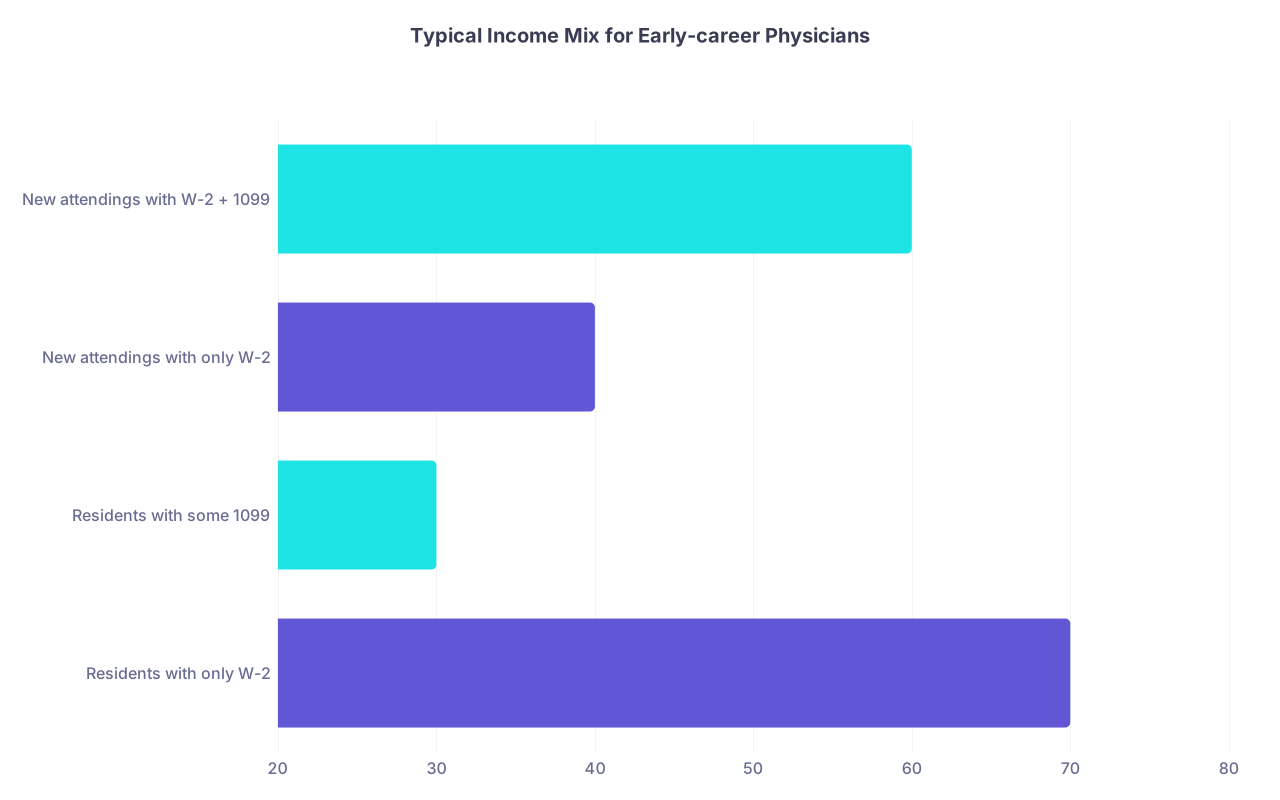
| Category | Value |
|---|---|
| Residents with only W-2 | 70 |
| Residents with some 1099 | 30 |
| New attendings with only W-2 | 40 |
| New attendings with W-2 + 1099 | 60 |
You’re not an outlier. You’re in that last group: W‑2 + 1099. It just feels scarier because no one trains you for it.
FAQ (Exactly What You’re Probably Still Worried About)
1. Can I get audited just because I have both W‑2 and 1099 income?
No. Having both is normal and very common for physicians. Audits are triggered by mismatched income, glaring inconsistencies, huge random deductions with no basis, or sometimes just random selection. The risk comes if you don’t report a 1099 the IRS already has on file, not from simply having one.
2. What if I can’t pay the full amount I owe from my 1099 income this year?
You’re not going to prison for not being able to cut a single giant check. The realistic path is: file on time, pay what you can, then set up a payment plan with the IRS. It’s not fun, but it’s way better than not filing or pretending it will go away. Penalties and interest add up slower than the horror stories make it sound if you deal with it early.
3. Do I really need to pay quarterly estimates, or can I just fix it with extra withholding?
Both work. If your main employer lets you crank up withholding enough on your W‑2, that can cover the 1099 tax. Some people prefer that because it’s automatic. Others use quarterly estimates. The key is: something has to happen during the year. Doing nothing and just waiting for April is where the pain comes from.
4. Can I deduct scrubs, stethoscope, and my car because I’m 1099 now?
Not carte blanche. You can deduct ordinary and necessary expenses related to your 1099 work specifically. Scrubs and equipment if they’re required and not reimbursed can sometimes be tied to that. Car expenses? Only the portion specifically used for 1099 work (driving to a PRN site, not your regular W‑2 job). This is where a CPA is incredibly helpful, because the line between “reasonable” and “audit bait” isn’t always obvious.
5. I formed an LLC for my moonlighting—does that fix anything?
Not by itself. If you’re a single‑member LLC and didn’t elect S‑Corp status, the IRS basically ignores the LLC for tax purposes and you still file Schedule C. The LLC can be useful for legal structure and contracts, but it doesn’t magically lower your taxes. That’s one of the most oversold myths in physician Facebook groups.
6. I’m terrified I missed something—what’s the safest move if I don’t trust myself?
Hand everything to a CPA who works with physicians and say, “I have W‑2 and 1099 income, this is my first mixed year, I’m worried I underpaid and missed deductions. Can you walk through this with me?” If they shrug or seem casual about it, find someone else. A good CPA will check for missed 1099s, review your expenses, look at prior year taxes, and help you set up a plan for this year and next. That one meeting can cut your anxiety by 80%.
Open your paystub portal and your 1099 email right now and make a simple list: each W‑2, each 1099, and a rough total of 1099 income. That’s your starting point. Once those numbers are real instead of floating in your head, you can decide if you need a CPA, more withholding, or an estimated payment—today, not when the IRS letter shows up.


