

The scariest letters a doctor can imagine aren’t “MD” or “DO.” They’re “IRS.”
And when you’ve claimed “business” expenses for CME trips—especially the ones that also felt a little like vacations—your brain goes straight to worst case: audit, penalties, fraud, losing your license, orange jumpsuit. All because you went to a conference in Hawaii and dared to write it off.
Let me say this as plainly as possible: claiming CME as a business expense is not inherently sketchy. What matters is how you did it, how much you stretched it, and what paper trail exists if someone actually looks.
You’re not crazy for worrying. But you’re also probably not a criminal.
Let’s walk through the scary parts piece by piece.
First: Are CME Trips Legit Business Expenses At All?
Short answer: yes. Very much yes.
The IRS concept here is “ordinary and necessary” expenses for your trade or business. For a physician, CME is almost the textbook example of that. You’re literally required to do CME to keep your license and hospital privileges. Boards, hospitals, states—everyone wants CME credits.
So in principle, these are legitimate business expenses:
- Conference registration fees
- Required course materials
- Travel to and from the conference location
- Lodging for the business portion
- Reasonable meals tied to the business days
Where you start to feel queasy (and where the IRS starts to care) is when there’s a vacation layer wrapped around that CME.
Think:
- You flew the whole family to Orlando for an “Ortho conference” and spent 3.5 days at Disney
- You stayed an extra week in Maui after a 2‑day conference and deducted the whole week of hotel
- You took business-class flights, resort-level hotel suites, and labeled everything “CME”
Those aren’t inherently illegal. But they’re exactly the kind of thing that, in an audit, the IRS agent circles and says, “Let’s talk about this.”
The Ugly Question: “Did I Cross a Line?”
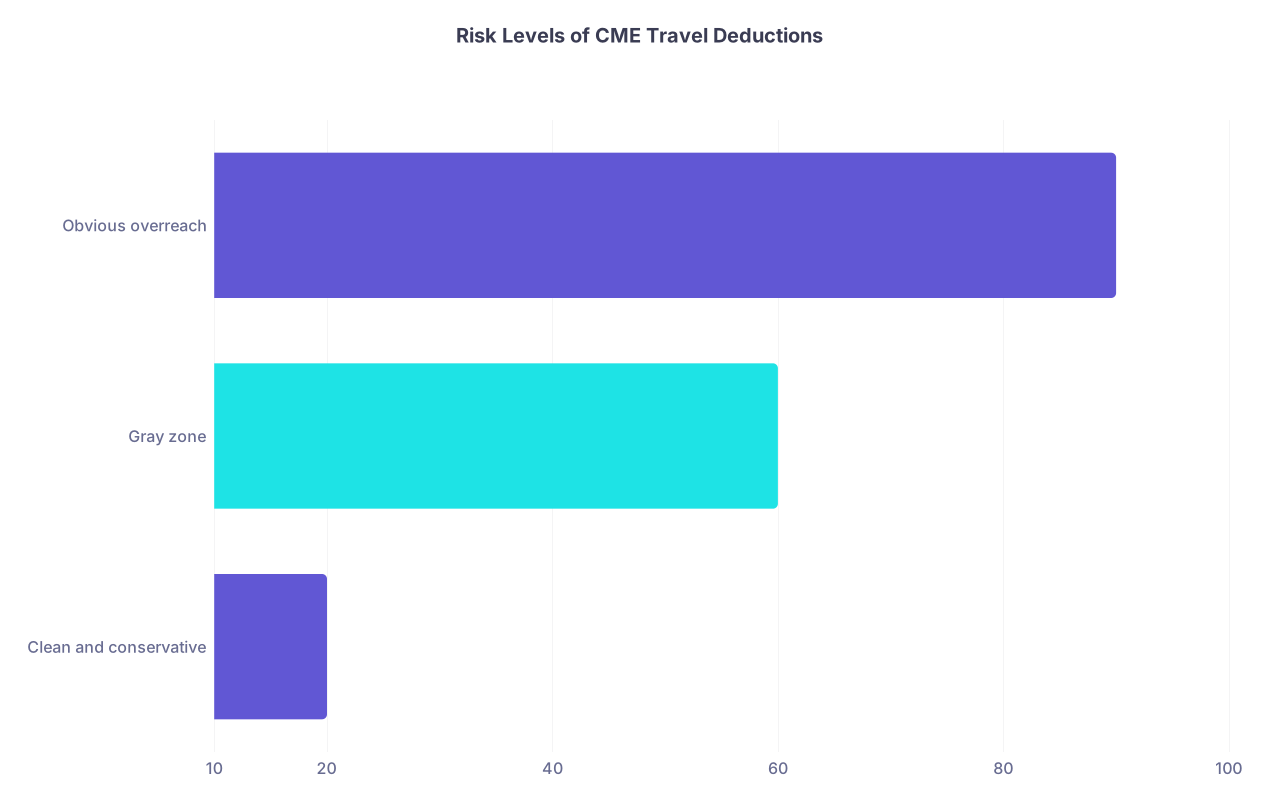
Let’s be brutally honest. There are levels of “line crossing.”
| Category | Value |
|---|---|
| Clean and conservative | 20 |
| Gray zone | 60 |
| Obvious overreach | 90 |
Think about where you fall.
Scenario 1: Clean and conservative
You:
- Went to a clearly medical conference (ACC, ASH, AAOS, etc.)
- Traveled alone or with family but only deducted your part
- Stayed at the conference hotel for the conference days only
- Didn’t deduct extra vacation days
- Kept emails, receipts, agenda, registration
If this is you, you’re fine. Genuinely. The odds of this being a problem are minimal, and even in an audit, this stuff gets allowed all the time.
Scenario 2: Gray zone
You:
- Wrapped a few vacation days on either side of the CME
- Deducted the full airfare, including spouse/partner “by mistake”
- Deducted hotel for both business and extra days together and didn’t separate
- Didn’t keep great records, but you can probably reconstruct them
This is where the anxiety kicks in, because it wasn’t fraud, but it also wasn’t meticulous.
Most likely outcome, if ever questioned? They disallow part of it. You pay a bit of extra tax, maybe some interest. It’s annoying and expensive, not life-ruining.
Scenario 3: Obvious overreach
You:
- Labeled a family vacation as “CME travel” based on one dinner with a colleague
- Used a sketchy tax person who said, “We can make this a business write‑off”
- Claimed hotel, flights, theme park tickets, spouse/kids, excursions as “conference”
- Did this on repeat, year after year
That’s when you wander into “if they look closely, this is hard to defend” territory.
But even then, the usual IRS response isn’t handcuffs. It’s: disallowed deductions, back taxes, interest, and possibly penalties. The TV‑drama version of tax crime is extremely rare and reserved for people doing this at scale, knowingly, over many years, and lying when caught.
The Big Fear: “Could I Get in Serious Trouble For This?”
Here’s the ladder of bad outcomes you’re mentally climbing at 2 a.m.:
| Level | Likely Outcome |
|---|---|
| 1 | IRS ignores it forever |
| 2 | Mild questions, you send receipts, all good |
| 3 | Some deductions reduced, you owe a bit more tax |
| 4 | Accuracy/Negligence penalty added |
| 5 | Civil fraud investigation (rare) |
Most physicians live between Level 1 and 3. Especially if:
- You actually attended CME
- The conference existed
- You can show you, in good faith, thought this was a business expense
The IRS reserves criminal cases for:
- Fabricated expenses (fake conferences, fake receipts)
- Systematic underreporting of income
- Huge, repeated abuse that looks intentional
A real example I saw:
Hospitalist, 3 years out, went to a pulmonary conference in San Diego. Stayed 10 days, CME was 3 days. Deducted:
- Full 10 days of resort hotel
- All meals for family of four
- SeaWorld tickets as “client entertainment” (there was no client)
She got audited. The agent disallowed the extra 7 days of hotel and all the family‑related stuff. She owed back taxes and interest. No fraud charges. No license issues. It sucked, but life went on.
That’s the pattern. Overreaching = corrected and fined. Fraud = different conversation.
You’re probably worrying at a “fraud” level when the reality is, worst case, “this might cost me financially if they ever look.”
The Nasty Gray Area: Mixed Business + Vacation
This is where things actually get complicated—and where a lot of docs unintentionally cross lines.

| Step | Description |
|---|---|
| Step 1 | Travel for CME |
| Step 2 | Deduct airfare |
| Step 3 | Airfare questionable |
| Step 4 | Deduct hotel for business days |
| Step 5 | Allocate business vs personal |
| Step 6 | Mostly CME days? |
| Step 7 | Hotel for CME days only? |
Here’s the basic logic the IRS uses:
If the primary purpose of the trip is business:
- Your airfare is generally deductible (your ticket, not your spouse’s or kids’)
- Lodging is deductible for the days spent doing business
- Meals can be partially deductible for business days
If the primary purpose is personal:
- Airfare usually isn’t deductible
- Only expenses directly tied to the CME itself might be okay (like the registration fee)
Where does CME fit?
If you flew to Chicago only because of an ACC conference, and you stayed 4 days for 3 days of meetings, and then went home? Clearly business.
If you flew your family to Cancun for 9 days, went to 2 mornings of “CME lectures” inside the resort, and spent the rest of the time on the beach? The IRS is going to look at you like… come on.
The IRS also expects allocation:
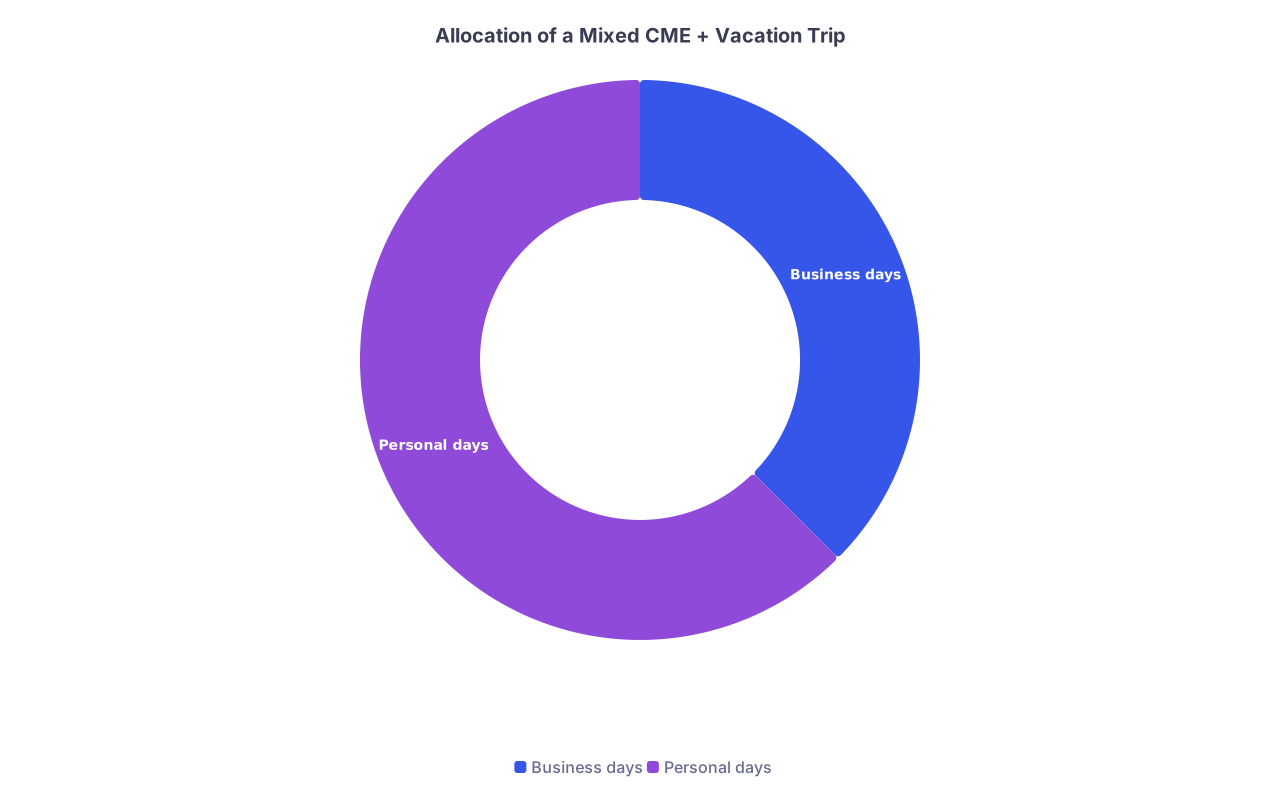
- If hotel is $400/night for 7 nights and the conference is 3 days, they’re fine with 3/7 of that as deductible, not 7/7
- If you rented a car and used it for both conference and sightseeing, you might have to split that too
Your anxiety is probably coming from knowing, deep down, that you didn’t really do that clean allocation.
“I Put It All as ‘Business’—What If I Get Audited?”
This is the real fear: you already filed. Maybe for years. It’s done. You can’t un‑submit a return.
So now you’re spiraling:
- “Will they go back and re-audit all my years?”
- “Do I have to amend everything?”
- “Should I just never deduct CME again to not look suspicious?”
Take a breath.
First, most returns never get audited. Physicians are higher risk than average, yes, but we’re not public enemy number one. Unless something on your return is screaming “this is insane,” you’re probably just blending into the noise.
Second, if the numbers are large—like, say, you’re a W‑2 employed hospitalist making $280k and you’re claiming $40k/year of “unreimbursed business expenses” for CME, travel, etc.—that’s more likely to raise eyebrows. But if your CME travel is in the few-thousand range and not utterly disproportionate, it doesn’t automatically become a bullseye.
Third, if an audit happens, your job is not to be perfect. Your job is to be:
- Credible
- Organized enough to show you weren’t inventing things
- Willing to accept that some stuff might get disallowed
That usually ends with:
- Adjusted tax
- Interest
- Maybe a 20% “accuracy-related” penalty if they think you were careless
That’s annoying, yes. But it’s not career-ending.
“Should I Amend My Returns To Fix This?”
This is where people really get stuck. They realize they probably over‑deducted, and now they’re haunted by whether to fix it.
There’s no one answer for everyone, but here’s how I’d think about it:
If your situation looks like:
- A couple of CME trips where you deducted full travel, but realistically some part was personal
- The dollar amounts aren’t gigantic compared to your income
You’re probably in: “Learn from it going forward, don’t panic‑amend everything” territory.
If your situation looks like:
- Large, repeated, clearly personal travel labeled as “CME”
- Huge ratios (like $25k/year in ‘CME travel’ that is mostly beach resorts)
- You feel sick reading this because you know it’s obviously not defensible
Then I’d seriously consider getting a CPA or tax attorney to look at your past returns and talk through whether targeted amendments make sense. Don’t DIY this part if it’s big.
You do not need to rush and file a flurry of panicked amended returns tonight. Talk to someone competent, show them the numbers, and let them help you decide how far to go.
“Could This Affect My Medical License or Credentialing?”
I know your brain went there. “If the IRS says I did something wrong, does that equal ‘unprofessional’ and suddenly my license is at risk?”
This is how it usually plays out in real life:
Civil IRS issues (like overstated deductions, even with penalties) almost never touch your license. State boards and hospitals care about:
- Patient harm
- Substance issues
- Serious criminal convictions
For your CME deductions to become a board‑level problem, you’d generally need:
- A criminal tax conviction (actual tax fraud)
- Something on the scale of: fake entities, fake documents, six‑figure evasion, lying to investigators
That’s not you because you claimed hotel for an extra day or didn’t separate the family airfare. That’s you being sloppy or optimistic, not organizing a crime ring.
So no, your entire career is not hanging by a thread over that Miami cardiology conference.
What You Should Do Differently Going Forward
You can’t undo what’s already filed. But you can stop feeding the anxiety machine by tightening things up from this year forward.
Here’s what “defensible” looks like for future CME trips:
- Keep the conference registration and agenda. Screenshot the schedule, save the emails, keep proof of your attendance.
- If you bring family, only deduct your share of airfare and lodging. If the room is the same price whether it’s one person or four, note that somewhere.
- Only deduct lodging for actual business days. If the conference is 3 days and you stayed 7, only 3 days are business.
- Don’t try to write off theme parks, excursions, or spouse airfare as business, unless your spouse is truly part of your business and that’s legitimately defensible.
- Work with a tax pro who actually understands physicians, not some guy who boasts about “getting clients big refunds.”
| Category | Value |
|---|---|
| Business days | 3 |
| Personal days | 5 |
The goal here is simple: if, five years from now, someone from the IRS looks at a trip, you don’t feel your stomach drop. You can calmly say, “Here’s why I deducted what I did.”
You’re Not the Only One Who’s Done This
I’ve watched this pattern over and over:
- PGY‑5 or first‑year attending suddenly starts making “real money”
- Finds a CPA who says, “You’re missing out on legit deductions”
- Gets told “CME travel is deductible” with very little nuance
- Slowly starts pushing the line as they see the tax savings
Then, 3–5 years later, the anxiety kicks in. Usually at 11:42 p.m. with TurboTax open, and a half‑finished 1040 on the screen.
You’re not uniquely reckless. You’re just a doctor who was never really taught taxes, trying to do your best in a system that is intentionally confusing.
Concrete Step You Can Take Today
Don’t try to fix your entire tax life in your head.
Do one focused thing:
Open your calendar and email, pick one prior CME trip you deducted, and reconstruct what actually happened—dates, costs, which expenses were clearly business, which were clearly personal. Write it down.
Then ask: “If someone questioned this, could I defend at least the majority of what I claimed?”
If the answer is “yes, mostly,” you’re probably in that annoying‑but‑not‑disastrous gray zone.
If the answer is “absolutely not,” that’s your signal to schedule a real sit‑down with a tax pro and decide, on facts, not fear, what to do next.


