

Last winter, a cardiologist from a big-name private group called me after getting his K‑1. “I made $1.1 million,” he said, “but my taxable income is $1.55 million. How the hell is that possible?” He wasn’t dumb; he was just seeing, for the first time, how his group’s partnership structure was built to protect the senior partners—not him.
Let me walk you through what the elite groups actually do with K‑1 income. Not the sales pitch they give at the recruitment dinner. The real mechanics behind physician K‑1s, why your “take-home” doesn’t match your production, and how the partnership documents quietly decide who wins and who gets squeezed.
First, the Reality: Your K‑1 Isn’t “Income,” It’s the Story They Chose to Tell
Here’s the part recruiters never explain well:
Your K‑1 is not a simple statement of “what you made.” It’s a tax allocation of the group’s economic story for that year—structured by lawyers, CPAs, and the senior partners who hired them.
If you’re a partner or track-to-partner getting a K‑1, what you see is the end result of layers of decisions:
- How compensation is labeled (guarantee vs distributions vs bonus)
- How overhead and debt are allocated
- How buy-ins and buy-outs are timed and structured
- How ancillary entities (ASC, imaging, real estate) are split off or folded in
In elite groups, those decisions are never random. They’re designed around three goals:
- Maximize after-tax cash to senior partners
- Make the group look financially disciplined to buyers or hospitals
- Keep junior partners happy enough not to leave, but not powerful enough to control terms
You’ll never see those three goals spelled out in the operating agreement. But they drive every major structural choice.
The Basic Structures: What They Don’t Put in the Brochure
Most physicians hear one of these phrases during recruitment: “You’ll be W‑2 initially, then K‑1 as partner,” or “We’re all K‑1 from day one; true partnership model.” The label is the least important part.
Behind the scenes, elite groups are usually some mix of:
- Professional Corporation (PC/PLLC) for each doc
- Central Entity (Partnership/LLC) that runs the group
- Ancillary Entities (ASC LLC, imaging LLC, real estate LLC)
How those talk to each other determines your K‑1.
Here’s the simplified version of what actually happens in sophisticated setups:
| Structure Type | What You See | What’s Really Happening |
|---|---|---|
| Pure W‑2 employed | Salary + bonus | You’re labor, zero equity |
| W‑2 + ASC K‑1 | Salary + small K‑1 | Hospital/PE holds control, crumbs flow to you |
| Single entity K‑1 partnership | All comp on one K‑1 | Clean, but easy for seniors to skew allocations |
| Multi‑entity with PC + central LLC | K‑1 from PC or LLC, maybe 1099s | More moving parts, more room for planning (and games) |
The top-tier groups almost never use a simple, single-entity model once they’re past 10–15 physicians. Too blunt. Too little control. They want flexibility: who gets what, when, and what tax label it wears.
How K‑1 Income Really Gets Built: The Levers They Pull
You’ll hear “profit sharing,” “distributions,” “draws,” “guarantee,” “productivity.” All of that is just plumbing feeding into a few boxes on the K‑1. What matters is how they move pieces between those boxes.
Let’s break down the real levers.
1. “Compensation” vs “Distributions”
Inside elite groups, the starting point is simple: they decide what portion of your economic value is treated like “compensation” and what portion is “profit.”
They rarely use those words. Instead you’ll hear:
- Base or guaranteed draw
- Productivity or RVU-based true-up
- Quarterly or annual distributions
- Ancillary distributions
Here’s how it actually plays:
Guaranteed draw or “base” is typically modeled to approximate what you’d earn as W‑2 in the same market. That number is not random; they peg it at a level that’s competitive enough to recruit but low enough to preserve partner-level profit.
Profit distributions are where the real money and planning live. Profits from professional fees, ancillaries, real estate, management fees—all can end up here, allocated by formula.
On the K‑1, those flows show up in different boxes (ordinary business income, guaranteed payments, portfolio income, rental income, etc.). Senior partners work very hard to keep more in favorable buckets and less in the “guaranteed payment” box that looks and feels like W‑2.
2. Guaranteed Payments: The Quiet Tax Trap
Guaranteed payments are the dirty little secret of physician partnerships.
They’re often used for:
- New partner “base income”
- Medical director stipends
- Call pay
- Leadership comp
From a tax standpoint, guaranteed payments are basically W‑2 in K‑1 clothing:
- Fully subject to ordinary income tax
- Fully subject to self-employment tax
- Deductible to the partnership
So what do elite groups do? They push as much as possible for junior partners into guaranteed payments and keep more flexible distributions for themselves.
Here’s what I’ve seen repeatedly:
- Junior partner: $600K economic value → $420K guaranteed payments + modest distributions
- Senior partner: $900K economic value → $350K guaranteed payments + heavy distributions + ancillary K‑1s
Result? The junior doctor’s effective tax rate is often higher despite earning less overall.
The Hidden Architecture: Debt, Overhead, and Buy-In
If you want to understand a group’s true priorities, ignore the recruitment dinner and study three things:
- How overhead is allocated
- How debt is allocated
- How buy-ins and buy-outs are priced and funded
This is where K‑1s become weapons.
Overhead: Who Carries the Weight?
Elite groups do not split overhead naïvely 1/N. They slice it up surgically, and usually not in your favor if you’re new.
Common moves:
Hospital-based docs (ED, anesthesia, hospitalists) get heavier overhead allocation because “they don’t need office infrastructure.” That rationale is convenient. It frees more office profit for partners with clinic revenue, ASC, and ancillaries.
Newly arriving subspecialists get “growth overhead” loaded onto them: new clinic build-outs, marketing, recruiter costs. That burden shows up as reduced profit allocation on their K‑1 for the first few years.
Internal service departments (billing, management, compliance) are often “valued” and “charged” to clinicians as if they were third-party vendors. Those internal transfer prices are set by the partners who benefit from them.
You won’t see “we’re padding overhead to keep junior profit down” in any slide deck. You’ll feel it in the K‑1.
Debt: Who Pays for Yesterday’s Decisions?
I’ve watched young partners walk into $2–3 million of group debt they didn’t create—new ASC build, EMR overhaul, previous buy-out obligations. They don’t notice what that really means until their first or second K‑1.
Elite groups play with:
- Capital accounts: Your share of equity vs debt
- Special allocations: Certain types of income or deductions allocated only to certain partners
- Targeted capital: Allocations built to engineer a specific pattern of ownership over time
The reality: if you didn’t sit at the table when the debt was taken on, you’re probably subsidizing someone else’s exit or expansion.
I’ve seen a private cardiology group where the outgoing senior partners built themselves a gold-plated buy-out funded largely by bank debt. The incoming cardiologists “bought in” at a modest cash number, felt good, then spent the next 10 years plowing a chunk of their K‑1 income into amortizing the old guard’s exit package.
On the surface: “You own 1/N of the group; here’s your K‑1.”
Underneath: “You now help pay for decisions made 12 years ago that you never consented to.”
Buy-In: Valuation Games and K‑1 Engineering
The way elite groups design buy-ins tells you who they're protecting.
You’ll see variations like:
- Low buy-in, high future profit participation
- High buy-in, “lower” ongoing overhead
- Staged buy-in: financial interest now, full governance later
Behind the scenes, the group’s advisors are modeling how that buy-in affects:
- Capital accounts
- Future allocation of profits and losses
- How attractive the group looks to a PE/hospital buyer
Smart groups structure buy-in so that:
Existing partners don’t take a hit on day one. Your capital “funds growth” or “funds your share of existing equity.”
Your K‑1 shows less profit the first few years because you’re loaded with:
- Higher share of depreciation
- Higher share of interest expense
- Lower share of ancillaries until you’re “fully vested”
So you’re technically getting “tax benefits” from depreciation and interest, but in real terms, your distributable cash is suppressed compared to what a true equal partner would see.
They’ll call it “ramp up.” The K‑1 shows you something else: structural subordination.
The Side Entities: Where the Real Money Hides
If you want to know whether a group is truly elite, look at how many K‑1s their partners get. One? Maybe solid. Three, four, five? Now we’re talking.
The real professionals use entity layering to control economics and tax character.
Typically you’ll see combinations like:
- Main professional LLC/partnership – professional fees
- ASC LLC – facility fees
- Imaging LLC – technical component
- Real estate LLC – building ownership
- Management company – admin/management fees
Each K‑1 has different rules:
- Different ownership percentages
- Different classes of units (common vs preferred)
- Different thresholds for distribution
- Different eligibility (full partner only, founding partner only, etc.)
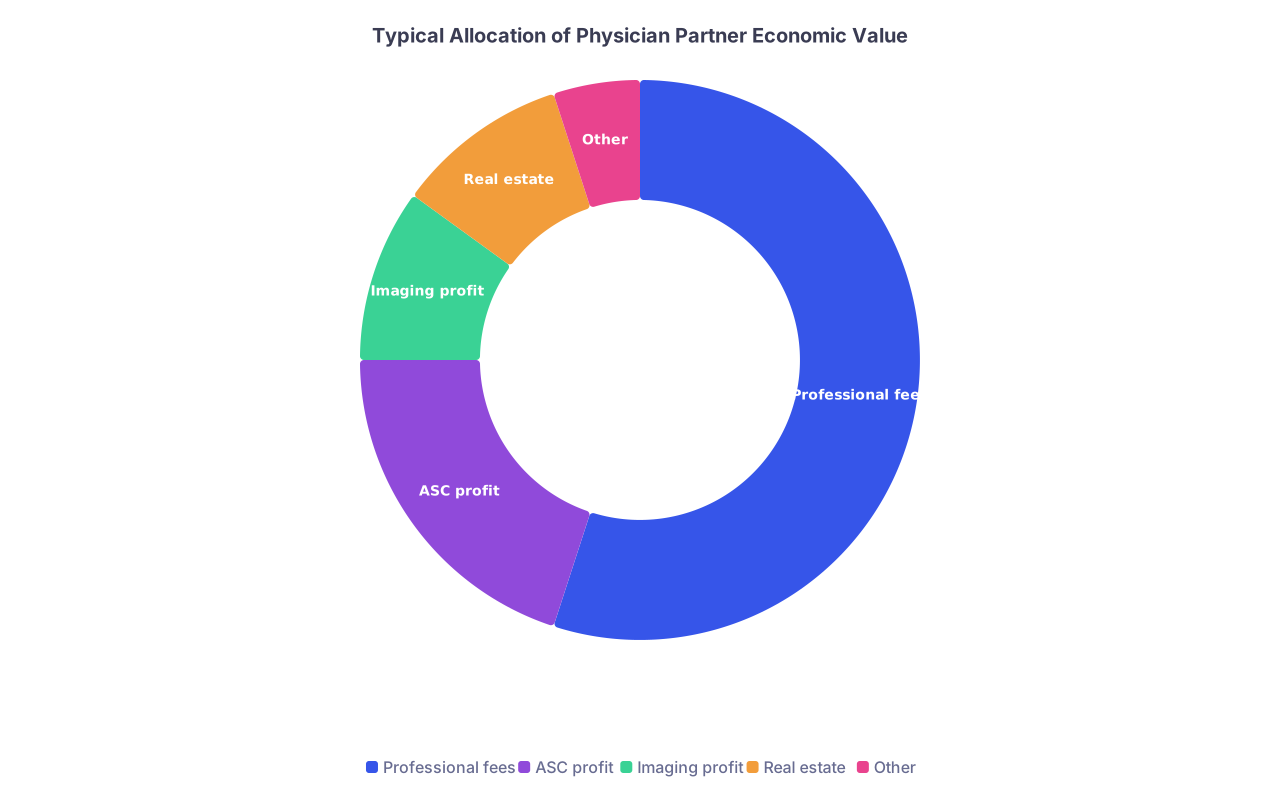
| Category | Value |
|---|---|
| Professional fees | 55 |
| ASC profit | 20 |
| Imaging profit | 10 |
| Real estate | 10 |
| Other | 5 |
Here’s what that chart means in practice: a partner “making $1M” might actually have:
- $550K from professional services (heavily burdened by comp models and overhead)
- $450K from multiple ancillaries (often governed by very different rules)
The professional services K‑1 is where junior partners join early. The ancillary K‑1s are gated:
- 2–3 years as partner before eligible
- Additional buy-in required
- Founders keep super-voting interests or preferred distributions
So you can be “full partner” clinically and still be locked out of the more tax-efficient, higher-margin income streams.
They’ll describe it as “phased in participation.” What it actually is: controlled access to the better kinds of K‑1 income.
The Tax Angle: How Elite Groups Actually Reduce Tax for Themselves
Now to the part you probably expected first: the tax strategies. They do matter. But they’re built on top of the structural advantages I’ve just walked through.
Here’s what the sophisticated groups are doing with K‑1 income behind the scenes.
1. Character Engineering: Ordinary vs Rental vs Portfolio
Not all K‑1 income is treated equally. Elite groups run the numbers and intentionally push income into better-character buckets.
Examples:
Real estate LLC income – often treated as rental income, may not be subject to self-employment tax, but can qualify for QBI with proper structuring. Equity tends to sit with more senior partners.
ASC/ancillary income – generally ordinary business income, but with higher margins and less “personal service” attribution in some structures. Some groups intentionally differentiate physician services from facility/technical components to build more QBI-eligible income.
Management company income – sometimes carved out to family members or separate entities, creating planning opportunities the rank-and-file partners will never see.
Meanwhile, your main professional K‑1 is loaded with income that’s:
- Ordinary
- Subject to self-employment tax
- Volatile, due to overhead and call burden
You’re playing a higher-tax game while older partners enjoy better-characterized income streams.
2. QBI (199A) Games: Who Really Benefits?
The Qualified Business Income deduction (QBI) changed the playbook.
Physicians are in a “specified service” business, which limits QBI at higher incomes. But elite groups and their advisors didn’t shrug and move on. They restructured.
Typical plays:
- Splitting service vs non-service components (management, tech, facility)
- Utilizing multiple entities so one stays under thresholds or qualifies differently
- Shifting certain income to spouses or family entities engaged in “non-service” roles
Here’s what I’ve seen often:
Junior partners sit squarely above the QBI phase-out limits, with income unattractively categorized and no real QBI benefit. Senior partners, with better entity access and smarter income character, can still squeeze meaningful QBI out of the structure.
Not by accident. By design.
3. Retirement and Deferred Comp Through the Back Door
You’ll hear this line: “As a partner, you control your own retirement.” True. But elite groups engineer additional retirement-style advantages through entity structure.
They might:
- Set up cash balance plans where contributions are proportional to income, but voting on plan design is controlled by older, higher earners
- Use deferred comp or phantom equity through management entities
- Allocate more stable, lower-volatility income streams (like rent) to older partners approaching retirement
What you see in your K‑1 as “just income” is, for them, an intentionally smoothed glide path into retirement, with tax-sheltered buildup and predictable distributions. You get volatility, call pay, productivity risk.
Roughed up on the front end while they float out.
The PE and Hospital Buyer Angle: Why K‑1 Structure Matters Even More Now
When a private group is thinking about selling to PE or a hospital, they don’t start with “max value to everyone equally.” They start with: how do we preserve the economics for the founding core?
Before a sale, the group (with consultants) will often:
- Clean up books to show stable, high-margin K‑1 income at the partnership level
- Adjust partner compensation so the practice looks more profitable and the physicians look more replaceable
- Tweak buy-ins and ownership classes so more junior partners technically “own” something…that the buyer values less
They want the pro forma to say: “Here is a business that generates X millions a year independent of any one doctor.” That looks great to buyers. It often means: “We’ve suppressed comp to the working docs relative to the entity profit.”
You feel that in your K‑1 as:
- Higher allocated profit
- But not necessarily proportionate cash (because of debt service, buy-out obligations, retained earnings)
Then the sale happens. The founders get a big check largely based on those optimized K‑1s. You get:
- Maybe a smaller check
- An employment contract
- And a future where your K‑1 shrinks or disappears, replaced by W‑2 plus possibly a tiny “equity roll” in the PE platform
The years you spent with messy, tax-inefficient K‑1s? They were part of the story that built the valuation for someone else’s payday.
How to Read the Red Flags Before You Sign
If you’re already in one of these setups, you can’t unwind it easily. But you can stop pretending you’re powerless or ignorant. And if you’re evaluating offers, you have zero excuse to sign blind.
Here’s how serious groups expect a savvy physician to behave (and what they quietly respect, even if they act annoyed):
Ask for the full operating/partnership agreement and ancillary agreements. Not just the “summary” HR made. The real thing. If they hesitate, that’s your answer.
Ask to see a de-identified K‑1 for:
- A new partner in year 1–2
- A mid-career partner
- A senior partner within 5 years of retirement
You’re not trying to see names. You’re trying to see patterns. I’ve watched candidates walk away from “dream groups” after they saw those differences laid bare.
Ask explicitly:
- How is overhead allocated?
- How is debt allocated?
- What income streams are not available to new partners, and why?
- How are buy-outs funded—cash from buyers, debt, or future partner sweat?
If their answers are vague, jargon-heavy, or condescending, that tells you everything you need to know. Elite but fair groups will explain the logic clearly. Elite but predatory groups hide behind complexity.
Have a physician-focused tax attorney or CPA read the documents. Not your cousin who does small business returns. Someone who has actually seen physician K‑1 games before. They’ll spot:
- Guaranteed payment traps
- Lopsided capital accounts
- Ancillary entities you’re not being told about
- Buy-out formulas that assume fantasy-level growth
- Special allocations that always seem to favor “Class A” or “founding” units
Pay a few thousand dollars now or bleed tens of thousands a year in silent structural disadvantage. Your choice.
If You’re Already In: What You Can Actually Do
You’re thinking: “Great, I recognize half of this. Now what?” Fair.
You’re not going to blow up a 40-partner group as one mid-career doc. But you’re not without leverage.
You can:
Understand your K‑1 line by line and build a relationship with the group’s CPA—separately. Ask pointed questions. Document answers.
Push for transparency: sponsor a partner meeting focused solely on compensation and K‑1 structure. Ask leadership to model scenarios: new partner, mid-career, senior partner, with numbers.
Band together with other mid-career partners. One squeaky wheel gets ignored. Five to ten aligned physicians asking for specific structural changes get attention.
Negotiate on the way in to ancillaries or new entities. That’s when terms are most pliable, especially if your subspecialty or production is hard to replace.
Have an exit strategy if the structure is rigged and leadership refuses change. The most sophisticated groups know: if too many mid-career producers walk, the whole system collapses. Use that knowledge.
The Bottom Line: What You Should Remember
Three things to carry with you:
Your K‑1 is not a neutral document; it’s the expression of a power structure. Senior partners and their advisors wrote the rules.
Elite groups use multiple entities, special allocations, and strategic overhead/debt distribution to protect senior economics and optimize their tax position—often at the cost of junior partners.
You either read the playbook before you join—or you become part of someone else’s exit strategy. Understanding the structure, asking for real documents and sample K‑1s, and getting true expert review is not being “difficult.” It’s the minimum standard for a physician playing at this level.


