

The most dangerous part of a private equity deal for physicians is not the headline purchase price. It’s the tax landmines buried in the fine print you never read.
I’ve sat in rooms with PE deal teams, hospital executives, and physician groups where everyone is talking valuation, multiple of EBITDA, and “alignment.” Do you know what the PE tax counsel is talking about on a separate call? How to structure the deal so the physician-sellers pay more tax than they realize, while the fund optimizes its own after‑tax return. And yes—they quietly assume most of you will sign without understanding it.
Let’s walk through what really happens, and which tax clauses young physicians consistently miss.
How PE Actually Looks At You On Paper
Private equity does not see “Dr. Patel, busy GI doc with a full clinic.” They see an asset package: cash flows, contracts, and tax attributes.
Behind closed doors the discussion sounds like this:
“If we push more comp from W-2 to K-1, they’ll think it’s a win. But we keep carry-friendly equity and they shoulder more ordinary income. Build in a strong non‑compete so they can’t leave even if they later realize the tax hit.”
To understand the tax clauses, you need to understand how you appear on their Excel:
| Bucket | How They Think About It | Typical Tax Treatment For You |
|---|---|---|
| Upfront Cash | Purchase of equity / buy‑in | Capital gain or ordinary income |
| Rollover Equity | Future upside alignment | Capital asset with risk |
| Ongoing Comp | Salary, bonus, productivity pay | W-2 or K-1 ordinary income |
| Ancillary Deals | Real estate, imaging, labs | Mix of capital gain, rent, ordinary |
The game is to push as much of your economics into ordinary income boxes and as much of their upside into lightly-taxed capital gains and carried interest. The contract is where that gets locked in.
The “Purchase Price” That Isn’t: Ordinary Income Masquerading As Capital Gain
Here’s a dirty secret: not all “purchase price” is actually capital gains to you. Program directors love RVUs; PE loves character of income.
On the surface, they’ll tell your group: “We’re paying 10x EBITDA. Huge number. Big win.” But the lawyers then slice that number into buckets:
- True purchase of equity (potential long-term capital gain)
- Personal goodwill (sometimes gain, sometimes attacked by IRS)
- Non‑compete / non‑solicitation payments (ordinary income)
- Consulting agreements (ordinary income, often self-employment tax)
- “Catch‑up” compensation or bonus (ordinary income)
I’ve watched a 38‑year‑old orthopod in a high‑profile MSO deal brag about a “$1.5M buyout” he thought was all capital gain. The closing binder told a different story: about half was allocated to non‑compete and “consulting services.” Result: huge ordinary income spike that year, plus self-employment tax on part of it. His effective tax rate on that “deal” was north of 45%.
The clause you overlook is usually called “Allocation of Purchase Price” or buried in the tax section referencing IRC §1060. The agreement will say something like:
“The Parties agree to allocate the Purchase Price among the Acquired Assets in accordance with Schedule 2.3, consistent with Section 1060…”
Translation: they’ll decide what portion of this deal is capital gain for you versus ordinary income, and you’re agreeing up front to file your tax return that way.
If your personal lawyer or tax advisor doesn’t fight that allocation before closing, you are locking in the tax hit permanently.
The Rollover Equity Trap: Phantom Value, Real Tax Bills
Your “second bite at the apple” is where PE really plays games.
You’ll hear: “We want you aligned. You’re rolling 20% into NewCo equity. That’s where the big upside is.” That can be true. Or it can be a cleverly disguised way to shift value from your taxable cash today into future, much-riskier, maybe-never-liquid equity.
Here’s how the ugly version works:
- You “sell” your practice for $X.
- You’re required to roll 20–30% of your proceeds into equity of a new holding company or MSO.
- That rollover equity is often structured at a higher valuation multiple than cash (PE’s favorite phrase: “you’re coming in at the same multiple as us”).
- Your compensation post-close is quietly ratcheted down in ways that reduce your ability to build wealth outside the deal.
Worse, if the lawyers botch the structuring (or, less charitably, structure it in the fund’s favor), your rollover can trigger unexpected tax. I’ve seen Section 351 and 721 exchanges referenced in deal documents that residents and young attendings have never even heard of.
The critical tax issues with rollover equity:
- Is your rollover tax‑free at closing, or do you recognize gain now?
- Are you rolling pre‑tax or after‑tax proceeds?
- What happens tax-wise if there’s a “liquidity event” later—are you sitting on capital gain or some weird partnership ordinary income?
If the agreement mentions “profits interests,” “Class B units,” or “incentive units,” your taxation can get complex fast. And no, the PE associate who brought lunch to the diligence day is not going to explain it clearly.
Employment Agreements: Where Your Tax Reality Actually Lives
In every PE deal with a physician group, there are really two negotiations:
- The enterprise sale (practice/MSO deal)
- Your individual employment/compensation agreement
Young physicians obsess over the multiple on the first and completely underestimate the second. That’s a mistake. From a tax and cash-flow perspective, your life is defined by the employment agreement.
Typical playbook after PE comes in:
- Salary shifts: fixed base may look solid, but RVU/productivity thresholds quietly rise.
- Bonus schemes: tied to metrics that weren’t mentioned in your sales pitch deck.
- W‑2 vs K‑1: restructuring entities so more of your income is reported on a K‑1 “to make you a partner” while stripping true partnership powers.
Here’s the thing no one tells you: moving income from W‑2 to K‑1 does not automatically make it more tax‑efficient. In many PE platforms, it actually increases your exposure to self-employment tax, and the structure is set up to protect the fund, not to optimize your tax picture.
The tax clauses buried in your employment agreement usually control:
- Whether you’re treated as an employee or independent contractor for tax purposes
- Whether restrictive covenants (non‑competes) are tied to income allocations that can be treated as ordinary income
- Whether “forfeited” equity or bonuses trigger tax on vesting, not on payment
Most younger physicians never have an independent tax attorney review their employment agreement separate from the corporate practice sale. That’s a mistake I’ve seen people regret for a decade.
The Phantom Income Problem: K‑1s That Haunt You
If you end up as a member of an MSO or holding company post‑PE, you may be getting K‑1s every year. Many of you think that means “I’m an owner. That’s good.” Not always.
Let me describe a situation I’ve seen more than once:
- You hold a small equity interest in the MSO after the deal.
- The MSO uses leverage (debt) to juice returns.
- The MSO allocates taxable income to you on a K‑1 based on your ownership percentage.
- But the MSO retains cash to pay down debt, expand, or meet covenants.
- Net result: you owe tax on “income” you never received in cash.
That’s phantom income. And PE platforms love the flexibility to distribute or retain cash as they see fit. You? You just get the K‑1.
The LLC/partnership agreement and tax section often give management broad discretion on distributions. I’ve seen language like:
“The Company shall make tax distributions at the discretion of the Board, which may consider liquidity needs of the business and other capital requirements.”
That sounds reasonable. Until you realize they can under‑distribute and you have to fund tax liabilities from your after‑tax clinician salary.
You want to see—and negotiate:
- Mandatory minimum tax distributions (often pegged to the highest combined marginal federal + state rate of any member)
- Clarity on timing of distributions vs. K‑1 issuance
- Who bears any audit adjustments under the centralized partnership audit regime (yes, this is now a real risk allocation item)
If you sign the LLC agreement blindly, you’re agreeing to however the PE fund chooses to balance their capital plan with your tax bills.
Non‑Competes, Non‑Solicits, And The Tax Bite You Never See Coming
Non‑competes are not just about where you can work. They’re also a tax weapon.
When part of your “purchase price” is allocated to your agreement not to compete or solicit patients/staff, the IRS views that as compensation for services. That’s ordinary income to you. Not capital gain. Full freight tax.
Deal lawyers on the PE side know they can often push a chunk of the economics into these covenants because:
- They want strong restrictions to protect the platform.
- They know you’ll focus on the total check, not the allocation.
Example: Dermatology platform sale. One partner was shocked when his CPA explained that out of his $800K “buyout,” about $250K was allocated to non‑compete and consulting fees. At a combined 40‑45% tax rate, that portion cost him six figures more in tax than if it had been capital gain. And he’d already signed away any right to dispute the allocation.
The contract will usually state that both parties “agree to file consistent with this allocation.” Translation: you’re pre‑committing not to argue with the IRS later that it should be capital gain.
If you don’t have someone on your side pushing back on that schedule before closing, you will not fix it afterward. Period.
State And Local Tax: The Layer Everyone Forgets
Here’s another quiet conversation that never makes it to the physician town hall:
“If we do a multi‑state MSO, how do we spread the state tax exposure? Can we push apportionment so more of the income shows up in lower‑tax states?”
They’re thinking about the fund and the entity. No one is modeling the fact that a young anesthesiologist living in California may be picking up K‑1 income from operations in other states, all feeding into a brutal CA tax bill.
Common state-level traps:
- You become a partner/member in an entity doing business in multiple states → suddenly you have filing obligations in states you’ve never set foot in.
- Composite returns and withholding may or may not be done for you.
- State rules on non‑compete enforceability interact with how they allocate payments to covenants (which affects character of income).
If you’re in a high‑tax state—CA, NY, NJ, MN, etc.—you can easily add 8–13% on top of your federal bill, and the structure of the deal can magnify that.
The 83(b) Election And Vesting Games
Younger physicians often receive some form of “growth equity” or “profits interests” that vest over time. This is sold as:
“We’re giving you upside if we grow this thing. Skin in the game.”
Done right, this can be powerful. Done wrong, it’s a tax mess.
Key issues that quietly show up in your documents:
- Are your equity or units subject to vesting based on time or performance?
- Are you taxed when you receive them, when they vest, or when they’re sold?
- Did anyone tell you about an 83(b) election and the 30‑day fuse?
I’ve seen too many physicians who receive restricted units, never hear the words “83(b) election,” those units explode in value over a few years, and then they pay ordinary income rates on vesting instead of capital gains later. That’s a six‑figure mistake in a strong exit.
The company counsel will not chase you to file 83(b). They’re not your lawyer. If you miss the window, they’ll shrug and keep moving.
How To Protect Yourself Without Killing The Deal
You do not need to become a tax attorney. You do need to stop being the only person at the table who doesn’t have one.
Here’s what I tell residents and young attendings who are about to be swept into a PE rollup:
- Get your own counsel. Not the firm recommended by the PE sponsor. Your own physician‑side deal lawyer plus a tax advisor who has actually seen PE physician platforms. It will cost you five figures. It can save you six or seven.
- Insist on seeing, and understanding:
- The purchase price allocation schedule
- The LLC/partnership agreement (if any equity rollover or K‑1 income exists)
- Your individual employment agreement, separate from the group docs
- Model the tax. Literally, have your CPA run:
- “Deal as drafted” tax outcome for years 1–3
- “No deal” projection
- Sensitivity if distributions are lower than projected or exit is delayed
To be blunt: if the deal only looks good before-tax, it’s not a good deal for you.
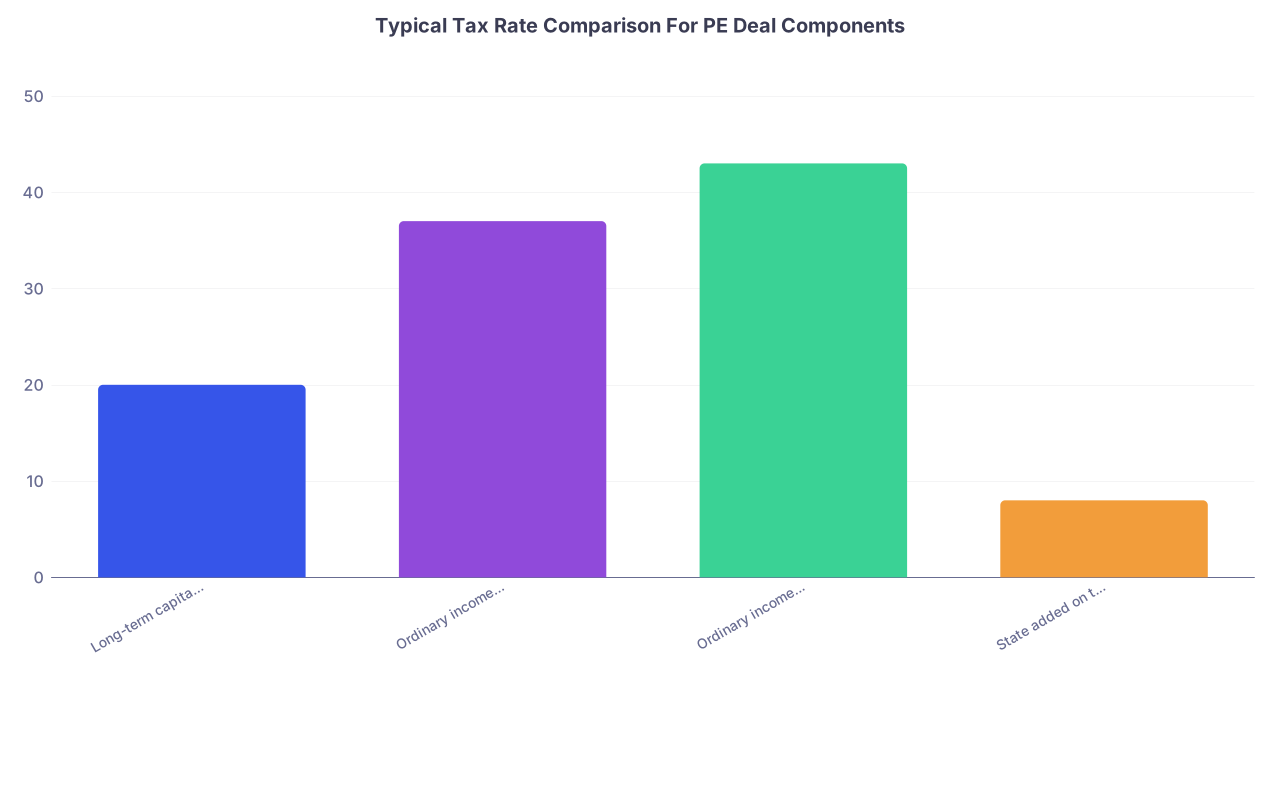
| Category | Value |
|---|---|
| Long-term capital gain | 20 |
| Ordinary income W-2 | 37 |
| Ordinary income K-1 with SE tax | 43 |
| State added on top | 8 |
Timeline Of When Tax Mistakes Become Permanent
Most of the irreversible mistakes happen far earlier than you think.
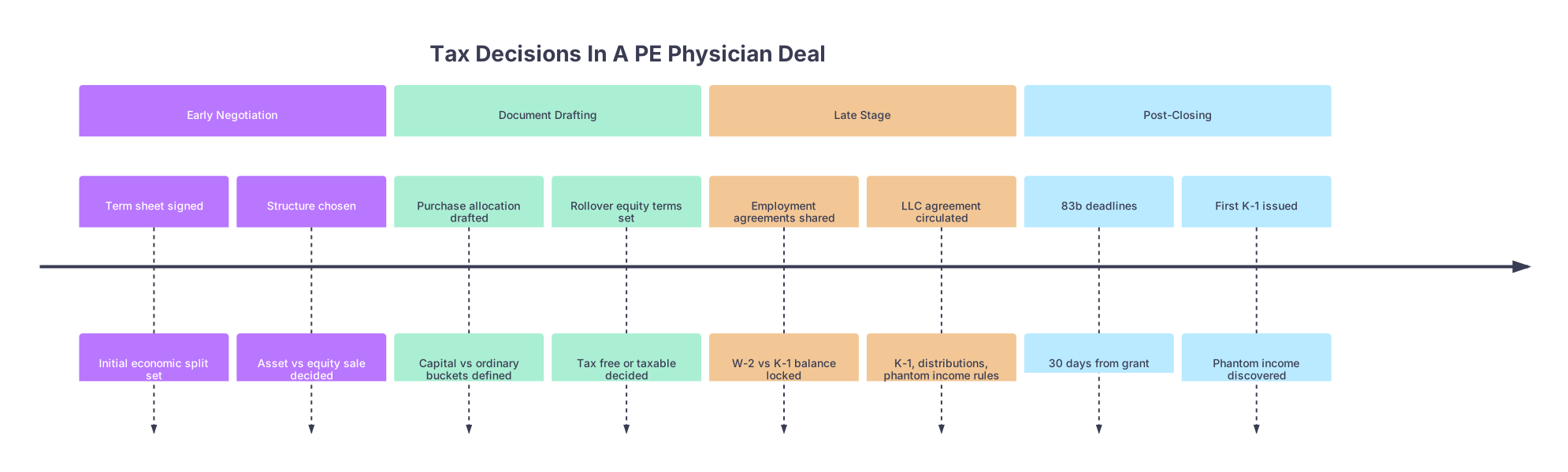
| Period | Event |
|---|---|
| Early Negotiation - Term sheet signed | Initial economic split set |
| Early Negotiation - Structure chosen | Asset vs equity sale decided |
| Document Drafting - Purchase allocation drafted | Capital vs ordinary buckets defined |
| Document Drafting - Rollover equity terms set | Tax free or taxable decided |
| Late Stage - Employment agreements shared | W-2 vs K-1 balance locked |
| Late Stage - LLC agreement circulated | K-1, distributions, phantom income rules |
| Post-Closing - 83b deadlines | 30 days from grant |
| Post-Closing - First K-1 issued | Phantom income discovered |
If you’re only paying attention at the “post‑closing” stage, you’re reacting, not negotiating. By then, all the tax levers are cemented.
A Quick Reality Check: Why You’re At A Disadvantage
I’ll be blunt. The average young physician walking into a PE deal is badly outgunned:
- The PE side has tax counsel, deal counsel, and a modeling team that lives in Excel and the Internal Revenue Code.
- The hospital/health system may have its own legal and tax staff aligned with “strategic priorities,” not your 1040.
- You have…maybe a general business attorney who helped with your first employment contract and your own CPA who mostly files returns.
The unspoken assumption in those floors of glass offices is that the physicians will chase prestige and headline numbers, and will not drill down on tax character, allocations, or K‑1 terms. And nine times out of ten, they’re right.
The physicians who do push back—who demand tax distributions protections, more favorable allocation, or true capital gain treatment—are annoying in the short term. But they’re the ones who aren’t quietly writing massive checks to the IRS while wondering where their “big liquidity event” went.

Bottom Line: What Young Physicians Overlook Again And Again
Let me strip this down to the recurring pattern I see:
- You focus on purchase price, multiple, and base salary.
- You ignore purchase price allocation, rollover equity terms, and K‑1 mechanics.
- You assume “equity” always means tax-efficient upside. It does not.
- You sign restrictive covenants without understanding they’re tied to ordinary-income payments.
- You find out about phantom income when you’re already on the hook.
Private equity is not inherently evil. Some deals are genuinely win–win and can be transformative for a group. But tax complexity is where asymmetry of knowledge gets weaponized.
If you remember nothing else, remember this: the PE fund is optimizing after‑tax IRR. You need to be optimizing after‑tax life.
FAQs
1. Is every private equity deal automatically bad for physicians from a tax perspective?
No. There are deals where physicians get meaningful upfront capital gains, sensible rollover equity, and reasonable K‑1 structures with proper tax distributions. The problem is not PE itself; the problem is signing what’s put in front of you without independent review. The same structure can be mildly tax‑efficient or brutally tax‑inefficient depending on how the allocation schedules, rollover mechanics, and distribution policies are written.
2. If I’m just an employed physician in the group, not a partner, do I still need to care about these tax clauses?
Yes. Even if you don’t see a big upfront check, PE deals usually come with new employment agreements, compensation models, and at times “equity” grants. Those affect your ongoing ordinary income, your exposure to self-employment tax, and your future capital gains (or lack of them). The tax language in your employment and equity documents can lock in bad treatment even without a big buyout.
3. Can I fix a bad tax allocation or phantom income problem after the deal closes?
Realistically, almost never. Once you’ve signed an agreement that specifies a purchase price allocation or LLC distribution policy, you’re stuck unless management and the sponsor voluntarily renegotiate—something they rarely do just to help one physician with a tax problem. The IRS also expects buyer and seller to report consistent allocations, so you can’t simply change it on your return without raising a red flag.
4. What type of professional should I hire to review a PE deal from a tax angle?
You want two separate skill sets: a physician‑side transaction attorney who has actually worked on PE deals with medical groups, and a tax advisor (CPA or tax attorney) who routinely reviews partnership/LLC agreements, K‑1 structures, and purchase price allocations in healthcare. Your local generalist lawyer or the CPA who only does compliance for small practices is usually not enough. This is specialized work, and the other side absolutely has specialists looking out for their interests.
Key takeaways:
First, in a PE deal, the real battle is over how you’re taxed, not just how much you’re paid. Second, the ugliest surprises—ordinary income disguised as purchase price, phantom K‑1 income, and nasty non‑compete allocations—are all hidden in tax and allocation clauses most physicians never read. Get real representation, demand to see the numbers after tax, and stop being the only person at the table who isn’t playing this game on purpose.


