

The most expensive tax mistakes physicians make are not about bad investments. They are about elections you never filed.
You can be meticulous with receipts, max out your retirement accounts, even hire a CPA—and still quietly lose six figures over your career because a handful of IRS election forms were never filed on time. Once the deadline passes, the door often slams shut. Retroactive “fixes” are limited, painful, and sometimes impossible.
This is the silent danger: you do not feel the loss. You just pay 10–30% more tax every year and call it “the system.”
Let me walk you through the five tax election forms I see physicians forget again and again—attendings, practice owners, even high-income academics who should know better. Missing these does not just sting in April. It compounds over decades.
1. The S Corporation Election (Form 2553) – The Classic “I’ll Do It Next Year” Disaster
If you practice as an independent contractor or own a small practice and you are not at least evaluating an S corporation election, you are playing the game on hard mode.
Form 2553 is how you tell the IRS: “Treat this eligible entity as an S corporation.” Miss the timing, and you are stuck as a sole proprietor or partnership for that year. That often means:
- Paying self-employment tax (Social Security + Medicare) on every dollar of profit instead of only on reasonable salary.
- Losing the ability to split income between wages and distributions.
- Complicating retirement and benefit planning for the year.
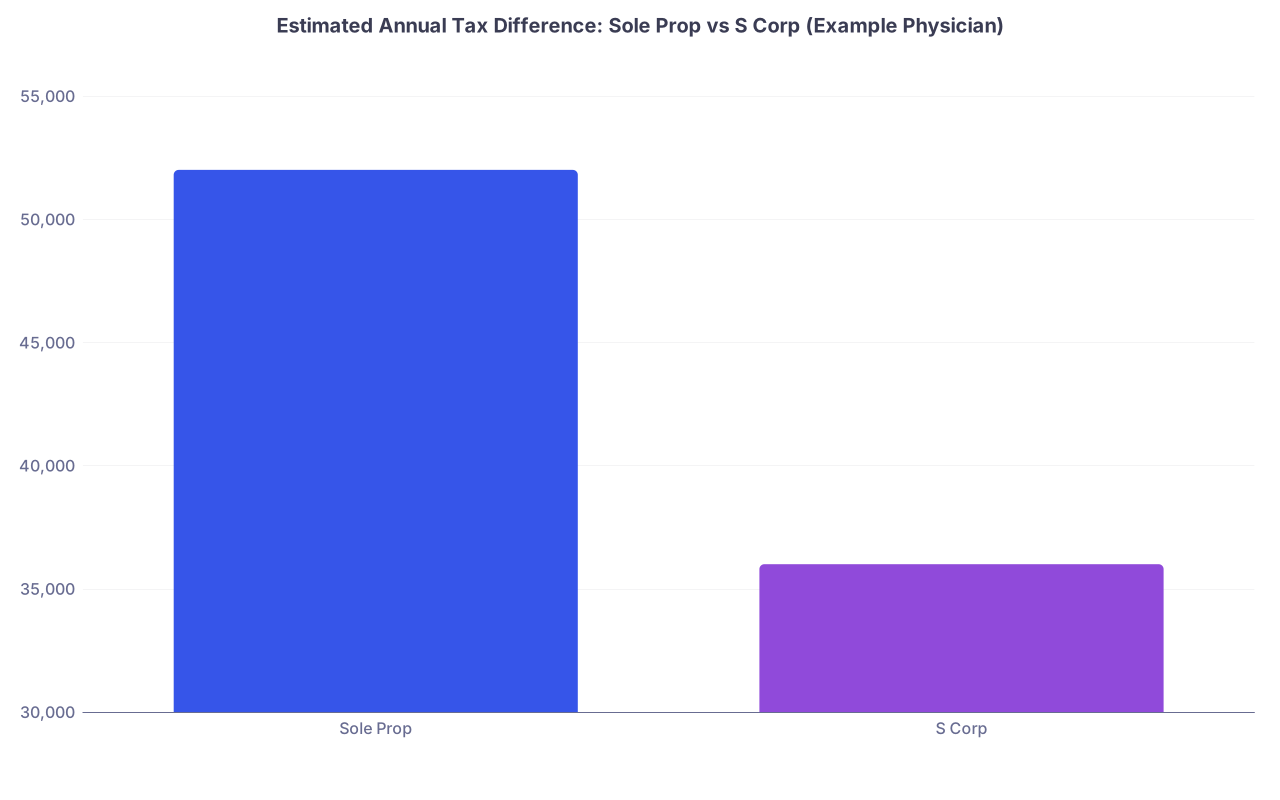
| Category | Value |
|---|---|
| Sole Prop | 52000 |
| S Corp | 36000 |
This is not theoretical. I have seen pain like this:
- Hospitalist making $380,000 on 1099, operating as a sole proprietor for three years. Finally talks to a tax advisor. Realistic S corporation savings: $12,000–$18,000 per year in payroll tax alone. Lost permanently for the prior years. Why? No timely Form 2553. No late-election relief request. No plan.
- Pain clinic owner with $700,000 net profit. CPA mentions S corp “could have helped” but says “we can start next year.” That “next year” comment cost her roughly $25,000–$35,000 for the current year.
The timing trap
The IRS rules are very specific:
- General rule: File Form 2553 no later than 2 months and 15 days after the beginning of the tax year the election is to take effect.
- For a calendar-year business wanting S status for 2026: deadline is March 15, 2026.
Missed it? There is a “late S election relief” pathway if you meet certain conditions (reasonable cause, consistent treatment, etc.). But do not depend on that as your base plan. I have seen these denied.
Where physicians screw this up
Typical failure patterns:
- You start locums or moonlighting “just for a bit” as a sole proprietor. Then the income explodes. You tell yourself you will incorporate “once things stabilize.” Years go by.
- Your attorney forms an LLC but never coordinates with a tax professional. You assume “LLC” = “tax efficient.” It does not. An LLC is a legal wrapper. The S election is tax treatment. Totally different layers.
- Your CPA does not bring it up. So you assume it does not apply.
The worst mistake: waiting until tax filing season to think about this. By March or April of the next year, you are already late for many fixes.
How to avoid this
If any of these are true, you should be having an S corp conversation now, not “later”:
- You earn >$200,000 from 1099 clinical work or from a small practice.
- Your practice or side business has consistent profit above what a “reasonable” physician salary would be.
- You file as a partnership or single-member LLC and just “accept” your tax bill without understanding alternatives.
Do not just “ask your CPA if an S corp is good.” Ask: “Have you modeled my tax liability as a sole prop/partnership versus S corp, including reasonable compensation analysis and payroll setup, starting this year?”
2. The Qualified Joint Venture Election – Married Doctors Accidentally Running a Partnership
Many married physician couples accidentally create a partnership for tax purposes. They think they are independent contractors “together” or co-owners of a small practice. They split income and expenses. They both work in the business.
The IRS may treat that as a partnership. That means:
- Form 1065 partnership return required.
- K-1s issued.
- More complexity. More fees. More opportunities for mistakes.
There is a specific election that can simplify this if you meet the rules: the Qualified Joint Venture (QJV) election for spouses.
Using it lets you avoid filing a partnership return and instead file two separate Schedule C’s on your joint Form 1040 (one for each spouse).

Where people blow this
They:
- Never realize they are technically a “partnership” because both spouses materially participate.
- File everything under one spouse’s Schedule C “to keep it easy.”
- Ignore the fact that both spouses are earning self-employment income and both could be building Social Security and retirement contributions.
The QJV election is not a separate form like 2553. You “elect” it by the way you file: two Schedule C’s and a statement that you are making the qualified joint venture election. But if you are eligible and you do not structure it correctly, you can end up:
- Filing an unnecessary (and error-prone) partnership return.
- Misreporting income and self-employment tax for each spouse.
- Wasting planning opportunities (retirement, health insurance, income splitting).
Common physician scenario
- Two married hospitalists both doing 1099 locums “through our little side company.”
- They are in a community property state and randomly assign income to one spouse.
- No partnership return. No QJV election. No clarity.
- Eventually, IRS notices mismatch or the business grows and the CPA says, “We need a partnership return now.”
Can it be fixed? Sometimes. But retroactively cleaning up multiple years of messy joint income is expensive and stressful.
How to avoid this
If you and your spouse are BOTH:
- Co-owners of a small business (clinical or non-clinical)
- Filing jointly
- And both materially participating in the business
Then you must decide: partnership with 1065 and K‑1s, or QJV with two Schedule C’s.
Do not “accidentally” drift into one by default. That is how you get CP2000 notices and late partnership penalties.
3. The 83(b) Election – For Equity, Side Ventures, and Physician Founders
If you are an academic physician doing biotech consulting, a cofounder in a startup, or involved with a private practice using equity-like compensation, the 83(b) election can be the line between a tax bill now and a tax catastrophe later.
Formally, an 83(b) election applies when you receive property (often restricted stock) in connection with services, and that property is subject to vesting.
The basic idea:
- Without 83(b): You pay ordinary income tax as the stock vests over time, based on its value at each vesting date. If the company grows, each vesting chunk can trigger large income.
- With 83(b): You elect within 30 days of the grant to pay ordinary income tax on the current value (often very low) of the unvested stock. Future appreciation is then taxed as capital gains when you sell.
Miss the 30-day window? There is almost no mercy. The IRS is brutal about this deadline.

| Step | Description |
|---|---|
| Step 1 | Receive Restricted Stock |
| Step 2 | Tax on low initial value |
| Step 3 | Future growth taxed as capital gain |
| Step 4 | Ordinary income at each vest date |
| Step 5 | High tax if company value rises |
| Step 6 | File 83b within 30 days |
How physicians get burned
I have seen:
- A physician informatics lead granted restricted shares in a health-tech startup, told verbally “We will take care of everything.” No one mentions 83(b). Company grows 10x. Vesting triggers massive W‑2 income and tax liability over several years, just as the physician is trying to focus on clinical work and young kids at home.
- An academic surgeon involved in a device startup receives founder shares. The lawyer emails an 83(b) form and says “you may want to talk to a tax advisor.” The email sits. The 30 days pass. Too late.
You cannot meaningfully fix a missed 83(b). There are rare exceptions, but if you are banking on that, you are gambling.
Red flags that you might need this election
- You are granted equity or “units” that vest over time (4-year vesting, 1-year cliff, etc.).
- Your grant paperwork mentions “Section 83(b)” anywhere.
- You sign a shareholder or unit agreement and have no memory of discussing tax at all.
If you see any of that, do not sign and forget it. You have a hard 30-day countdown from the grant date to file the election with the IRS. Blow it, and the cost may show up years later when your equity is finally worth something.
4. Late or Missing Depreciation Elections – Real Estate and Equipment
Physicians love real estate. They also love buying equipment and vehicles “through the practice.”
What they forget is that a lot of the tax benefit is not automatic. It depends on elections related to depreciation and expensing that must be made on a timely filed return.
Missing or mishandling these can produce:
- Depreciation you can never accelerate.
- Lost bonus depreciation.
- Messy basis calculations and capital gain surprises when you sell.

Common elections physicians ignore or misunderstand:
- Section 179 expensing election for equipment and certain property.
- Bonus depreciation elections (taking it, or electing out for strategic reasons).
- Grouping elections for real estate professional status and aggregation of rental activities.
- Elections regarding alternative depreciation systems in certain situations.
A typical ugly scenario
- Cardiologist buys into an imaging center and then buys a building through an LLC.
- CPA does “standard” depreciation but does not discuss cost segregation, grouping, or section 179 strategy.
- A few years later, cardiologist tries to qualify as a real estate professional or leverage passive losses, only to find that the required grouping elections were never made and are not simple to fix retroactively.
Or:
- Practice buys $300,000 of equipment late in the year.
- CPA casually uses straight-line depreciation, no bonus, no 179.
- When asked why, the CPA says “I do not like bonus depreciation” without modeling the impact. That is not a tax strategy. That is laziness.
Why this matters so much
Depreciation is not just about “saving tax now.” It affects:
- Your taxable income each year.
- Your ability to offset passive and active income.
- The recapture tax hit when you eventually sell or upgrade property.
Many of the key decisions are elections on that year’s return. If you file without them, you lose optionality.
How to avoid this
When you acquire:
- A building
- A surgery center interest
- Major diagnostic equipment
- High-value vehicles tied to the practice
You should be asking your tax advisor before year-end:
- Are we using bonus depreciation? Why or why not—show me the numbers.
- Are we using Section 179? To what extent, and what does that do to future years?
- Do we need any grouping elections for rental or practice entities this year?
If your tax preparer cannot clearly answer those basic questions, you are flying blind.
5. The Qualified Electing Fund (QEF) / PFIC Elections – Hidden Landmine in “Simple” Investing
This one surprises most physicians. The mistake is assuming that any mutual fund or ETF in a foreign account or certain foreign-based funds in U.S. accounts are “just regular investments.”
They are not always. Some are PFICs—Passive Foreign Investment Companies. PFICs have their own complex regime and a set of elections (like QEF and mark-to-market) that radically affect how and when income is taxed.
If you own foreign funds and you do not make elections early, you can end up with:
- Punitive interest charges on “excess distributions.”
- Ordinary income treatment instead of capital gains.
- Nightmarish tax compliance in later years.
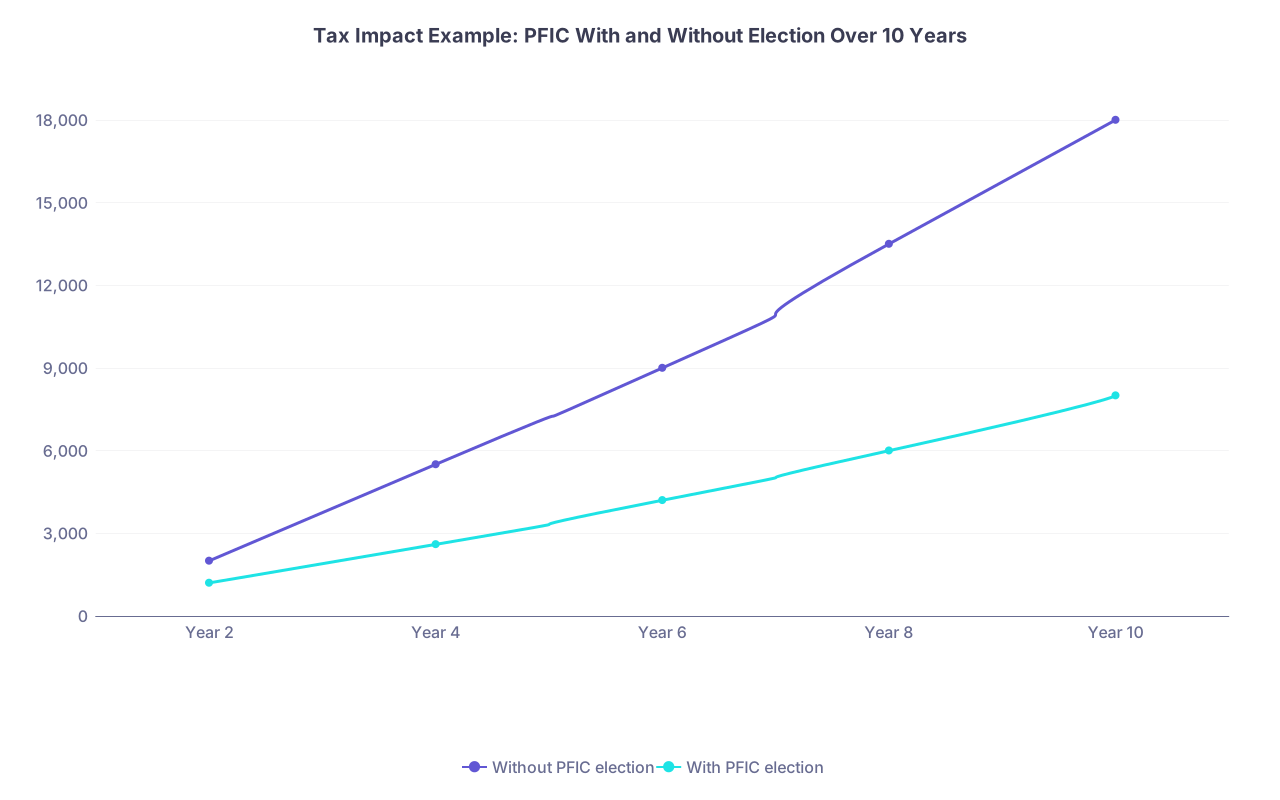
| Category | Without PFIC election | With PFIC election |
|---|---|---|
| Year 2 | 2000 | 1200 |
| Year 4 | 5500 | 2600 |
| Year 6 | 9000 | 4200 |
| Year 8 | 13500 | 6000 |
| Year 10 | 18000 | 8000 |
How physicians step on this landmine
I see this with:
- International medical graduates who keep or open investment accounts in their home country with local funds.
- High-income physicians using foreign robo-advisors or expat platforms while temporarily working overseas.
- “Tax-efficient” product pitches involving offshore or foreign-domiciled funds.
Years go by. No one asks about PFICs. No elections (like QEF or mark-to-market) are made. Then, during a more sophisticated review, a new advisor spots PFIC holdings going back 5–10 years.
Cleaning that up retroactively is expensive, messy, and sometimes impossible without taking the hit.
Why early elections matter
Some PFIC-related elections can:
- Smooth out taxation year to year.
- Avoid the punitive “throwback tax” and related interest.
- Convert ugly, complicated treatment into something closer to regular fund taxation.
But many of these elections must be made in the first year of owning the PFIC or at least very early in the holding period. The longer you wait, the uglier the math.
Warning signs you have PFIC exposure
- You invest directly in foreign mutual funds or foreign ETFs, especially through non-U.S. platforms.
- Your account statements list funds with no U.S. ticker symbols.
- Your tax preparer never asks for foreign account statements beyond basic FBAR/FATCA questions.
The mistake is assuming “it is just an investment.” The IRS does not see it that way.
Quick Comparison: What These Elections Can Cost You If You Ignore Them
| Election / Form | Typical Deadline | Common Impact of Missing It |
|---|---|---|
| S Corporation (Form 2553) | 2.5 months after tax year start | Higher self-employment tax for year |
| Qualified Joint Venture | At time of filing return | Unneeded partnership return / bad SE tax |
| 83(b) Election | 30 days from grant date | Massive ordinary income when equity vests |
| Depreciation Elections | Timely filed tax return | Lost bonus/179, worse long-term tax |
| PFIC / QEF Elections | First PFIC year or early holding | Punitive tax, complex reporting |
The Underlying Pattern: “File Later” Thinking Will Cost You
None of these elections are flashy. They are not the stuff of Instagram finance posts or physician Facebook group bragging.
They are paperwork. Boring deadlines. Forms that feel optional until they are not.
But this is the pattern I repeatedly see in physicians who quietly overpay the IRS for an entire career:
- They start a side business, but delay talking to a tax pro until “it is bigger.”
- They sign equity or operating agreements without a tax review.
- They assume their CPA will “tell them if anything special is needed.”
- They only think about taxes at filing time, when half the decisions are already locked in stone.
By the time you feel the problem, the deadlines are gone.

| Step | Description |
|---|---|
| Step 1 | New Income or Investment |
| Step 2 | Plan elections and structure |
| Step 3 | File correct elections on time |
| Step 4 | Lower long term tax burden |
| Step 5 | Default tax treatment |
| Step 6 | Missed elections and higher tax |
| Step 7 | Limited or no retroactive fixes |
| Step 8 | Talk to tax advisor before year end |
How to Stop Missing These Elections
You do not need to become a tax attorney. But you do need a system.
Here is the minimum adult-level process if you earn physician-level income:
Any time one of these happens, you schedule a tax planning call within 30–45 days:
- You sign a new independent contractor agreement (1099).
- You start or buy into a practice, imaging center, ASC, or real estate deal.
- You are granted equity, units, or restricted stock.
- You open foreign accounts or invest in non-U.S. funds.
You ask specifically:
- “Are there any elections we should consider this year related to this activity?”
- “What forms and deadlines apply if I want S corp / 83(b) / PFIC elections, etc.?”
- “What do we lose if we do nothing?”
You do this before December 31, not in March.
If your CPA only “does the taxes” and never talks to you about elections, structures, or modeling alternatives, that is not tax planning. That is data entry with a license.
You are a physician. You see what happens when patients delay screening or ignore early symptoms. Tax elections are the financial version of that. By the time it hurts, it is often too late.
FAQ (Exactly 5 Questions)
1. My CPA never mentioned S corporation or 83(b). Does that mean I do not need them?
No. It means nothing. Many CPAs are excellent at compliance but passive on planning. You need to ask explicitly: “Given my income, structure, and equity, should we be considering any elections this year? Which ones, and what would they save or cost?” If they cannot answer that with specifics, you may need a second opinion.
2. I already missed an election deadline. Should I bother talking to someone, or is it just over?
You should absolutely talk to someone. Some elections (like S corp) have late-election relief pathways if you qualify. Others (like 83(b)) are nearly impossible to fix. A good tax professional can at least tell you which doors are still open instead of you guessing and compounding the problem over multiple years.
3. I am W‑2 only with no side gigs. Do these elections still matter to me?
Less so, but not zero. If you have no 1099 income, no practice ownership, no rental property, and no equity grants or foreign investments, your exposure is lower. But things change fast: one consulting agreement, one startup advisory role, one rental property purchase and suddenly these elections become very relevant. The moment you step outside pure W‑2, you need a planning conversation.
4. How do I know if I have PFIC exposure in my investments?
Start by listing all accounts and all funds: U.S. brokerage, foreign accounts, expat platforms, “offshore” or international funds. If any holding is a foreign mutual fund or ETF without a U.S. ticker, raise that with a tax professional familiar with PFICs. If your preparer stares blankly at the word “PFIC,” that is your cue to get help elsewhere for that piece.
5. What is the one step I can take this week to avoid these mistakes going forward?
Pull out three things: your latest tax return, any business or practice ownership documents, and any equity or foreign investment agreements. Book a 30–60 minute meeting with a tax professional who works regularly with physicians and business owners. Ask them one focused question: “Looking at these, what elections should I have made in the past, and what elections should we be preparing to file in the next 12 months?”
Open your calendar right now and block one hour this month for a tax planning meeting—not tax preparation. In that meeting, ask specifically about these five categories of elections and what deadlines apply to you this year.


