

The IRS is not going to show up at your hospital shift tomorrow and arrest you for missing quarterly tax payments.
Let’s start there, because I know exactly where your brain is going: “I’m a doctor, I should know better, I’m probably going to get audited, I’m going to owe six figures, my license will be in jeopardy, my life is over.”
No. You messed up something that a huge number of locums docs and 1099 physicians mess up the first year: you didn’t save for quarterly estimated taxes. The consequences are annoying, stressful, and possibly expensive. But they are fixable. And they’re very rarely catastrophic.
I’m going to walk through what actually happens now, what the IRS can and can’t do, how bad the damage realistically is, and how to dig yourself out without nuking your sanity.
What Actually Happens When You Don’t Pay Quarterly Taxes
Here’s the unsexy truth: the IRS mostly doesn’t care when you pay during the year, as long as they eventually get paid, within certain rules. The “quarterly” thing is about timing and penalties, not morality.
You did locums. You got 1099 income. Nobody withheld taxes. You spent the money (or at least didn’t park enough of it in a tax account). Now it’s tax time and you’re staring at your numbers thinking:
“I owe what?!”
Let’s break down what happens:
- You file your tax return late or on time, but with a big balance due
- The IRS calculates:
- Your actual federal income tax
- Maybe self-employment tax (for 1099 work)
- A possible underpayment penalty for not paying quarterly
- Interest on what was essentially an “unpaid balance” during the year
There is no:
- Instant audit because you’re a physician
- Automatic criminal charge
- Suspension of your medical license
You get:
- A tax bill
- Possibly a penalty
- Some interest
- A knot in your stomach
That’s it.
How Bad Is This Financially? Let’s Rip the Band-Aid Off
The part you’re scared of is: “Did I just accidentally sign up for a six-figure disaster?”
Probably not. But let’s do some math so it’s not just vague dread.
Say you did $200,000 of locums income as a 1099. No withholdings. No estimated payments. You used the money for loans, living, maybe a house down payment.
Federal wise, the damage looks roughly like:
- Income tax: depends on your total income, filing status, deductions
- Self-employment tax: ~15.3% on the first chunk of income, then 2.9% Medicare above that, plus 0.9% if you’re high income
So even ballpark, a big chunk of that 1099 needs to go to taxes.
Now, about penalties. People imagine some massive punishment. In reality:
- The underpayment penalty is basically interest for paying too late
- The effective rate often ends up around 3–8% of the underpaid amount for the year, depending on rates and timing
So if you owed, say, $60,000 in taxes that you didn’t pay during the year, you might be looking at something like a few thousand in penalties and interest. Annoying. But not your-career-is-over-level bad.
To give you a rough sense:
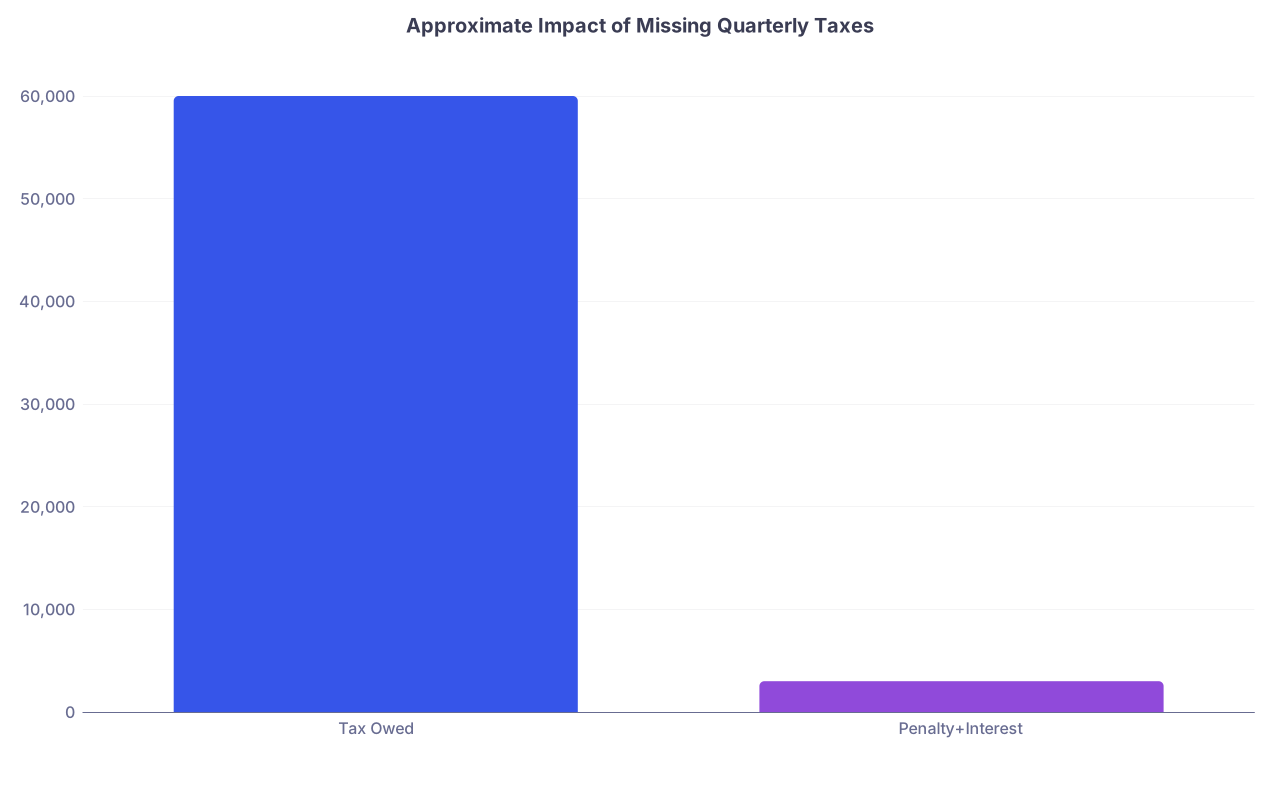
| Category | Value |
|---|---|
| Tax Owed | 60000 |
| Penalty+Interest | 3000 |
That’s not a quote or a guarantee. Just a reality check: the tax itself is the big number. The penalty for missing quarterlies is usually a much smaller add-on.
What the IRS Actually Does (Versus the Horror Story in Your Head)
People talk about the IRS like it’s this vengeful monster. It’s a slow, understaffed bureaucracy with calculators.
Here’s the real sequence:
- You file your return showing a big balance due
- You either:
- Pay in full by the deadline, or
- You don’t, because you can’t
If you can pay in full:
- You pay
- Penalty and interest get included
- You move on with your life and fix it for next year
If you can’t pay in full:
- You can request a payment plan (installment agreement)
- As long as you file and communicate, they’re generally fine with this
No one is calling your job. No one is sending letters to credentialing. They’re sending boring, vaguely threatening but mostly automated notices to your mailbox.
The big principles:
- Filing late is worse than paying late
- Hiding is worse than owing
You want to get on record, file, and then figure out payment.
Step-by-Step: What You Should Do Right Now
You want a checklist because your brain is spiraling. So here:
1. Stop guessing and calculate the damage
Pull:
- All 1099s from locums companies
- Any W-2s from regular employment
- Any other income (moonlighting, consulting, etc.)
Then either:
- Use tax software (TurboTax, etc.) to run a mock return
- Or better: hire a CPA who actually understands physicians and 1099 work
This will tell you:
- Total tax owed
- How much has already been paid via withholding (if any)
- The remaining balance due
- Any estimated penalties
You cannot work this problem emotionally until you see a real number. Right now you’re fighting a ghost.
2. File on time even if you can’t pay in full
This part matters more than people think.
Two separate things:
- Late filing penalty (ugly)
- Late payment penalty + underpayment (less awful)
File your return by the deadline (or file an extension if you absolutely must, but that doesn’t delay payment, just the paperwork). Even if the number terrifies you.
People think, “I’ll just wait till I can pay, then file.” No. That’s how you rack up avoidable penalties.
3. Pay what you realistically can now
Even if you can’t pay the full amount:
- Pay something when you file
- The more you pay early, the less interest and penalty stack up going forward
Scrape together what you can:
- Extra shifts (yeah, I know, that hurts)
- Temporary lifestyle tightening
- Pausing or reducing extra investment contributions for a bit
- Delaying large discretionary purchases
Not forever. Just to reduce the bleeding.
If You Can’t Pay It All: Payment Plans and Not Fully Imploding
Let’s say the balance due is bigger than you can cover without torching your life.
You have options.
| Option Type | Rough Use Case |
|---|---|
| Pay in full | You have cash or can free it |
| Short-term plan | You can pay within a few months |
| Long-term plan | You need up to several years |
| Credit line/loan | Lower interest than IRS |
| Retirement tap | Last resort only |
IRS payment plans (installment agreements)
If you owe under a certain threshold (which a lot of docs do), you can usually set up a payment plan online. It’s basically:
- You agree to pay monthly
- Interest and some penalties continue, but it’s structured
- As long as you pay on time and file future returns, they mostly leave you alone
Do I love paying the IRS interest? No. But it’s better than panicking and ignoring the problem.
Should you use loans or credit instead?
Sometimes, yes. If:
- You can get a personal loan / HELOC / reasonable-interest option
- The interest is lower than what the IRS is charging
- You’re disciplined enough not to let this snowball into “doctor with high income and lifestyle debt spiral”
Absolutely do not yank a ton out of retirement accounts for this unless it’s truly “no other way.” You get hit with taxes and penalties there too. It’s often a second wound to fix the first.
Will This Get Me Audited? Will It Affect My License?
You’re a physician, so your professional anxiety takes everything to its worst possible endpoint: “My license. My reputation. My job. My credentialing.”
For normal “I didn’t pay quarterlies and now I owe a lot” situations:
- This is not an audit trigger by itself
- This is not reported to your medical board
- This is not something locums agencies see
An audit is more likely from:
- Huge, unexplained deductions
- Not reporting 1099 income at all
- Major mismatches between reported income and what third parties report
Simply owing a large balance because your withholdings or quarterly payments were wrong isn’t special. It’s common.
Does it feel good? Absolutely not. Does it end careers? No.
The Self-Employment Tax Punch in the Gut
If this is your first 1099/locums year, there’s another piece that hurts: self-employment tax.
Locums income isn’t just regular income tax. You’re also paying both sides of Social Security and Medicare on that income (as if you’re both employer and employee). That’s why your tax bill feels like it came from another planet.
Roughly:
- Social Security portion on the first chunk of income
- Medicare on all earned income
- Extra 0.9% Medicare surtax if you’re high income
Point is: your “tax rate” on 1099 money may look closer to 30–40%+ depending on your situation, when you add everything up. That’s why people say “save 30–40% of 1099 income for taxes” as a rule of thumb.
You didn’t. So now you’re feeling the full impact all at once.
You’re not stupid. You’re just seeing the hidden side of what your W-2 employer normally paid for you.
What You Do Differently Next Year (So This Never Happens Again)
Okay, enough self-flagellation. You survived this round. Now how do you not repeat it?
Here’s the simple, boring structure that actually works:
Open a separate tax savings account
- Online savings works fine
- Name it “TAXES – DO NOT TOUCH”
Every single time you get a locums deposit:
- Immediately move 30–40% into that tax account
- Before you pay rent, loans, or buy anything
Work with a CPA who understands:
- Locums
- 1099 income
- Entity options (LLC, S-corp, etc., if/when appropriate)
Set calendar alerts for quarterly estimates
- April 15
- June 15
- September 15
- January 15
Yes, the dates are stupid and not true calendar quarters. Doesn’t matter. Put them in your calendar with obnoxious reminders.
Quick Visual: What You’re Moving From and To

| Step | Description |
|---|---|
| Step 1 | Locums Income Hits Checking |
| Step 2 | Spend / Loan / Living |
| Step 3 | Tax Shock in April |
| Step 4 | Skim 30 to 40 percent to Tax Account |
| Step 5 | Pay Quarterly Estimates |
| Step 6 | Smaller or No Surprise Bill |
The only real difference between panic and calm is the step where you peel off money before you emotionally count it as yours.
Emotional Side: The Shame Spiral You’re Probably In
Let me just say this bluntly: a lot of really smart, really accomplished physicians have done exactly what you did.
I’ve seen:
- Attendings 10+ years out who still don’t understand estimated taxes
- People with $400k+ incomes crying in April because they owe $70–90k they didn’t see coming
- Folks with prestigious fellowships who feel dumber about taxes than they did as an MS1 walking into anatomy lab
You’re tying this to your intelligence and competence. It’s not that. The system is confusing, no one taught you, and locums companies are more than happy to send you gross checks and let you find out the hard way.
This is not moral failure. It’s a technical screw-up with a financial cost. That’s all.
When You Should Absolutely Get Professional Help
You don’t always need a CPA. But in your situation—first real 1099 year, big balance, no quarterlies—I’d strongly consider it if:
- Your locums income was >$50k
- You also had W-2 income
- You’re thinking about an LLC or S-corp
- You’re already in panic mode and not thinking clearly
A good CPA can:
- Make sure you’re not overpaying (lots of docs do)
- Properly deduct business expenses (travel, CME, licensing, etc.)
- Help with penalty abatement requests in some cases
- Set up a real plan for next year so you’re not reliving this horror
You want someone who has seen 1099 physicians a hundred times, not a random tax preparer who asks, “So…what’s locums?”
FAQ (Exactly the Stuff You’re Afraid to Ask Out Loud)
1. Am I going to get in legal trouble for not paying quarterly taxes?
No, not for this alone. Quarterly payments are about timing. The issue is underpayment and lateness, not criminal behavior. As long as you report all your income accurately and file your return, this is a money problem, not a legal/criminal one.
2. Can the IRS go after my medical license or report me to my hospital?
For normal underpayment situations like this? No. Tax debt isn’t automatically reported to your board or your employer. The IRS wants money, not revenge. Unless you’re doing something extreme like tax fraud, this doesn’t touch your license.
3. Is it ever smart to put the tax bill on a credit card?
Usually no. Credit card interest is often worse than IRS interest. The only time it might make sense is a low- or 0%-intro APR situation that you’re absolutely sure you’ll pay off before it spikes. Even then, it’s risky. A structured IRS payment plan or a reasonable-rate loan is often better.
4. Can I get the underpayment penalty waived?
Sometimes. There’s something called “first-time penalty abatement” if you’ve been compliant in past years. Or if you had a reasonable cause (major life event, disaster, etc.). A CPA can help word this correctly. But don’t count on it like a guarantee—think of it as a possible bonus, not the plan.
5. I’m scared to file because the number I owe will be huge. Should I wait until I have more money?
No. Waiting almost always makes it worse. Filing late adds more penalties. File the return, see the real number, pay what you can, and set up a plan for the rest. The IRS is much kinder to “I filed on time and I’m working on it” than “I disappeared for a year because I was scared.”
The Bottom Line
Two or three key things to remember:
- You’re not the first physician to skip quarterlies and get slammed with a tax bill. You won’t be the last.
- File on time, tell the truth, pay what you can, and use a payment plan if you need to. This is annoying, not career-ending.
- Fix the system going forward: skim 30–40% of every locums check into a tax account and actually pay the estimates next year. Your future self will sleep better.


