

The fear that moonlighting will put you on the IRS radar is wildly overblown—and also not completely crazy.
You’re not insane for worrying they’ll flag you, audit you, decide you did something wrong and then years later hit you with a giant bill when you’re finally an attending. This is exactly the kind of thing that keeps meticulous, overworked residents up at 2 a.m. scrolling Reddit threads about “IRS red flags.”
Let’s walk through this like someone who’s legitimately scared of doing taxes “wrong,” not like some chill personal finance bro who says “it’s all fine” while you’re imagining prison.
Because there are ways to screw this up. But they’re not the ones you probably think.
The blunt truth: moonlighting doesn’t put you on a list by itself
Moonlighting as a resident doesn’t make you “suspicious” to the IRS. At all.
The IRS doesn’t have a “moonlighting doctors” watch list. They have computers that match:
- What employers and contractors report you earned
vs. - What you report you earned
That’s it. That’s the whole game 95% of the time.
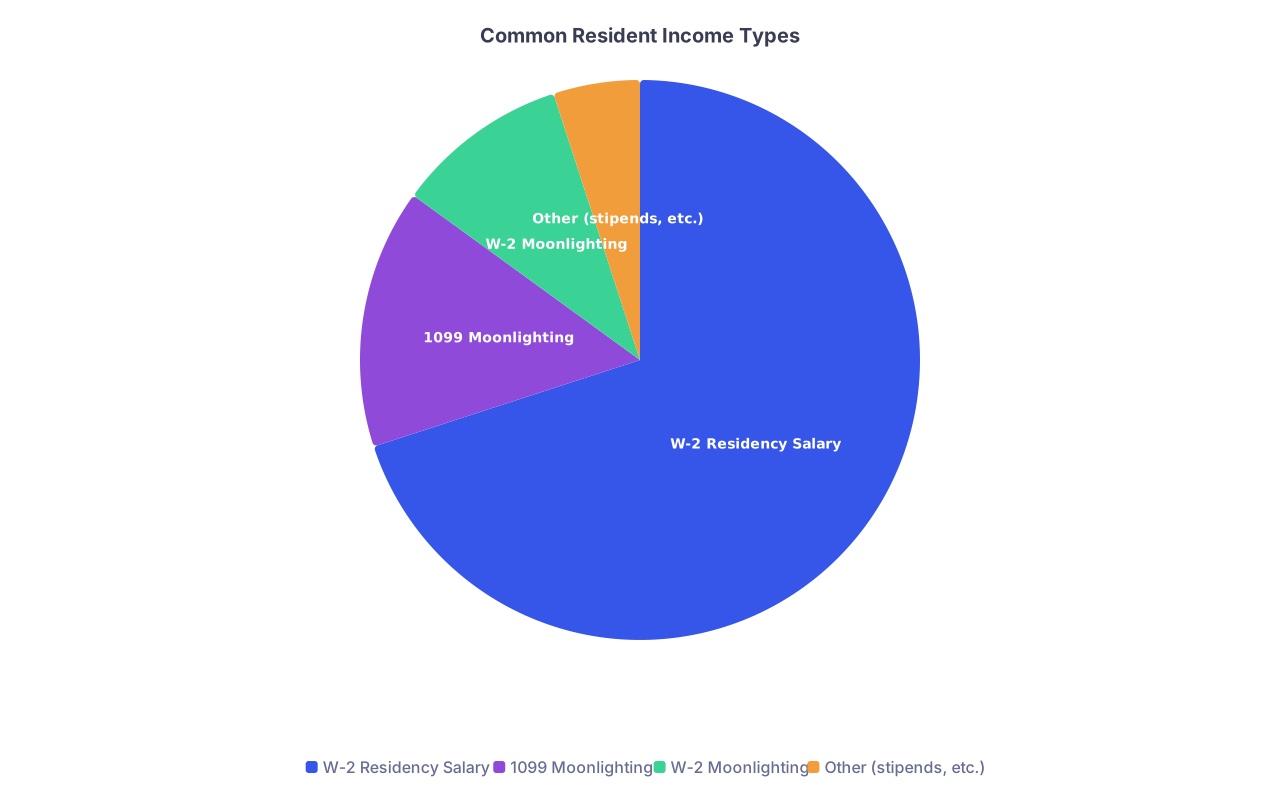
| Category | Value |
|---|---|
| W-2 Residency Salary | 70 |
| 1099 Moonlighting | 15 |
| W-2 Moonlighting | 10 |
| Other (stipends, etc.) | 5 |
If the hospital or group you moonlight for issues a W‑2 or a 1099-NEC and you report that exact income on your return, the IRS computer shrugs and moves on.
They care about mismatches. Missing income. Obvious nonsense. They do not care that you’re exhausted and picking up extra shifts to pay rent and loan interest.
Where residents get into trouble isn’t “having moonlighting income.” It’s:
- Not understanding what kind of income it is (W‑2 vs 1099)
- Not handling self-employment tax correctly
- Guessing instead of tracking
- “I’ll fix it later when I’m an attending” thinking
Moonlighting itself is not inherently risky. Sloppy handling of it is.
How the IRS even sees your moonlighting (and why mismatches scare them)
Here’s the part your anxiety brain is fixated on: “How would they even notice me?”
They notice you because other people report what they paid you.
If you get:
- A W‑2 → employer sends copy to IRS
- A 1099-NEC → payer sends copy to IRS
- Sometimes even without a form (like >$20K + 200 transactions via payment processors), there are reports floating around
Your tax return is basically your sworn statement that “Yes, this is what I earned.” Their computers run a giant matching game.

If something that got reported to them doesn’t show up from you, that’s a red flag.
Not “raid this person’s house” red flag. More like “send them a letter with math on it” red flag.
That letter is usually a CP2000 notice:
“Hi, looks like you forgot this 1099 from ABC Anesthesia Group. Here’s what we think you should have paid.”
Annoying? Yes. Catastrophic? Usually not, unless you shrug and ignore them for years.
The key point: if you report all your moonlighting income, you’re not the kind of problem they care about. You’re boring. You want to be boring to the IRS.
W‑2 vs 1099 moonlighting: the fork in the road that actually matters
The real “IRS risk” with moonlighting isn’t that you’re doing it. It’s what type of income it is and whether you treat it correctly.
Here’s the basic split:
| Feature | W-2 Moonlighting | 1099 Moonlighting |
|---|---|---|
| Form You Receive | W-2 | 1099-NEC |
| Taxes Withheld | Yes (income + FICA) | Usually none |
| Self-Employment Tax | No | Yes |
| Schedule Used | Just 1040 + maybe state | Schedule C + SE |
If your moonlighting is W‑2 (some hospitals do this):
- They withhold federal income tax, Social Security, Medicare
- It just stacks on top of your residency W‑2
- You don’t deal with self-employment tax on this income
- Less room to mess up
If your moonlighting is 1099 (very common with locums/ED/hospitalist shifts):
- Nobody withholds taxes for you
- You owe both income tax and self-employment tax (about 15.3%, subject to caps)
- You probably need Schedule C and Schedule SE
- You should be making quarterly estimated payments
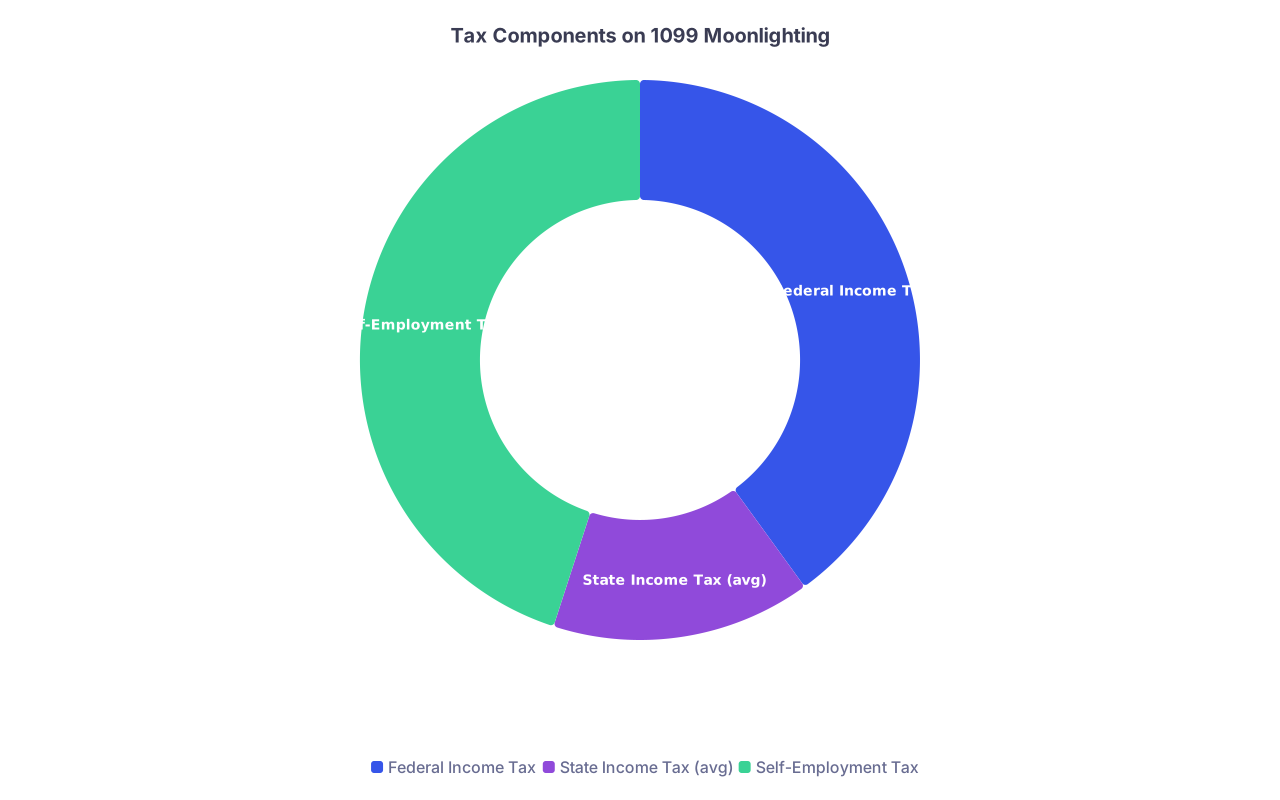
| Category | Value |
|---|---|
| Federal Income Tax | 40 |
| State Income Tax (avg) | 15 |
| Self-Employment Tax | 45 |
If you treat 1099 moonlighting like a “fat bonus check” and spend all of it, that’s where the IRS later becomes a problem. Not because they’re mad you moonlighted, but because you show up underpaid by thousands.
And then you’re hit with:
- Back taxes
- Penalties
- Interest
While you’re maybe a PGY-3, still broke, and already financially fried.
What actually raises IRS eyebrows (and what doesn’t)
You know that list of “IRS audit red flags” that floats around? Half of it is garbage or wildly misinterpreted. But some patterns do matter.
What does not freak them out by itself:
- Being a resident physician
- Having both W‑2 and 1099 income
- Having a relatively high income for your age
- Filing as single with a normal-looking return
- Claiming reasonable business expenses tied to moonlighting (if you’re 1099)
What does make their systems twitchy:
- Big mismatches between forms they have (W‑2/1099) and what you report
- Not reporting a 1099 at all
- Claiming absurd expenses for your 1099 work (like 80% of your income as “meals and travel”)
- Repeatedly underpaying and racking up penalties
- Math that just doesn’t make sense (like reporting way less income than they know about)
Let me be harsh for a second: the resident who gets dinged isn’t the one nervously triple-checking their return. It’s the one who goes, “Eh, I think I made about 15K from moonlighting, I’ll just type that in,” when there are three different 1099s totaling $23,847.
Or the one who hears “you can deduct stuff for 1099 income” and suddenly has $20K of “home office” expense on $25K of moonlighting.
If your income and deductions are honest and reasonably documented, you’re fine. Not perfectly safe forever, but you’re not a juicy target.
The nightmare scenario in your head vs. reality
Let’s just name what you’re actually afraid of:
You’re imagining that five years from now, after fellowship, you finally have a decent salary, maybe a mortgage, possibly a baby, and then—boom—the IRS comes back and says:
“Hi, remember that $18K of moonlighting in PGY-2 you messed up? You owe $9K plus penalties plus interest. Pay in 30 days.”
That scenario does happen. But not because of moonlighting itself. It happens because someone:
- Didn’t report all the 1099s
- Ignored IRS letters
- Or used some shady “tax guy” who basically made stuff up
Here’s what actually happens if you screw up once, in a non-fraud way:
- IRS matching notices your 1099 didn’t match your return
- They send you a CP2000 letter with their proposed change
- You either agree (and pay) or dispute
- If you respond like a functioning adult, the world doesn’t end

| Step | Description |
|---|---|
| Step 1 | 1099 Moonlighting Issued |
| Step 2 | You File Tax Return |
| Step 3 | No IRS Action |
| Step 4 | CP2000 Notice Sent |
| Step 5 | Adjust Tax and Pay or Dispute |
| Step 6 | Additional Notices and Possible Collections |
| Step 7 | Income Matches? |
| Step 8 | You Respond? |
The apocalypse version—liens, levies, garnishments—comes from one thing: ignoring them. Repeatedly. For a long time.
The resident who keeps copies of their W‑2s and 1099s, files on time, and responds to letters? That person might have a painful year if they underpaid, but they don’t get ruined.
How to moonlight and sleep at night (at least about taxes)
Let’s make this ultra-practical, because you’re not sitting around with infinite time to learn tax law. You’re writing notes and eating graham crackers at 1 a.m.
Here’s the minimum to keep you off the “real problems” list:
Track every entity that pays you.
If you pick up shifts through three different groups, expect three different W‑2s/1099s. Make a simple list in your phone:
“Tax year 2025: Residency W‑2, Hospital A PRN W‑2, Locums Group X 1099.”Create a moonlighting-only bank account.
Especially if 1099. All moonlighting income in there, all related expenses out. Clean separation. If you ever get questioned, this is your sanity.If you’re 1099, assume ~30–35% of each check is not really yours.
That’s federal + state + self-employment in many places. Stick that amount in savings immediately. Don’t touch it. You will hate me less in April.Use tax software or an actual CPA who understands doctors.
Not your cousin who “does his own taxes” and thinks moonlighting is just “extra W‑2.”
A real CPA will force you to list every W‑2 and 1099. That alone prevents 80% of issues.Do not get cute with deductions.
You can deduct legitimate business expenses for 1099 work. Fine. But “legitimate” is not:- Your entire rent because you sometimes chart at home
- Every meal you buy post-call
- A $3,000 laptop when you also got a free one from the hospital
If you’d feel stressed explaining it out loud to a stern stranger, don’t deduct it.
Keep stuff. For at least 3 years.
W‑2s, 1099s, receipts for any bigger expenses you deduct. Throw them in a folder—physical or digital. If something comes up, you’re not digging through email from 4 years ago.
How realistic is an audit for a resident with moonlighting?
You’re not going to love this, but here’s the real talk: the chance of a full-blown field audit for a straightforward resident return is tiny.
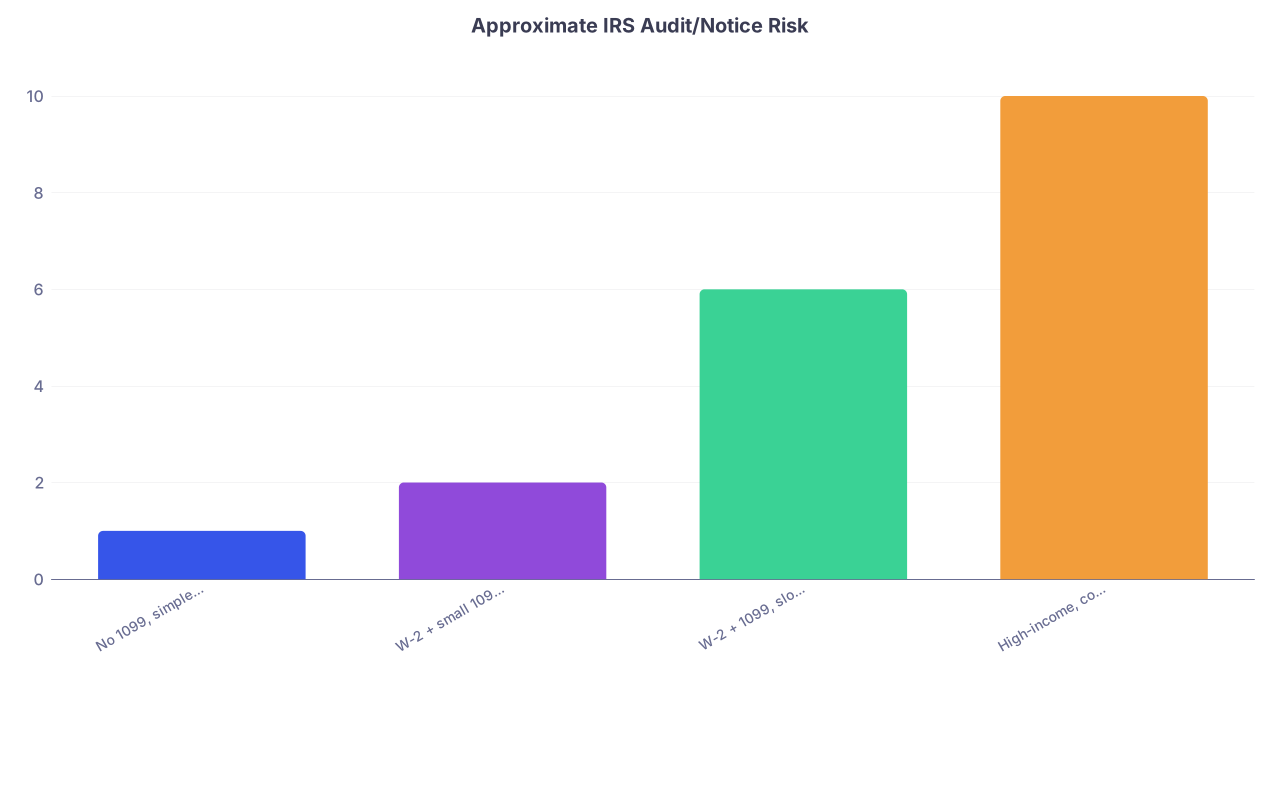
| Category | Value |
|---|---|
| No 1099, simple W-2 | 1 |
| W-2 + small 1099, good prep | 2 |
| W-2 + 1099, sloppy | 6 |
| High-income, complex return | 10 |
The far more likely scenario is:
- If you mess up → computer notice (CP2000)
- If you do okay → nothing
Residents are not lucrative people to audit. You don’t have rental properties, K‑1s, offshore accounts, or huge businesses. The IRS has limited resources. They pick their battles.
You know who they like more than you? High-income self-employed folks with massive Schedule C losses every year. That’s not you. You’re a tired PGY-2 trying not to bounce your credit card.
So yes, a notice is possible. A full dramatic audit with someone sitting at your kitchen table flipping through receipts? Very, very unlikely—unless you go out of your way to look like a liar.
When you should actually worry enough to get help immediately
There are times when the appropriate reaction is, “Okay, I’m in over my head. I need a tax pro now.”
These include:
- You’ve been moonlighting 1099 for 2–3 years and… have never made estimated payments
- You realize you forgot a 1099 from a prior year and the numbers are big
- You get a CP2000 and it’s for a lot more income than you remember
- You tried DIY with complex stuff (partnership K‑1s, S‑corp from some side hustle, etc.) and now the IRS is sending multiple confusing letters
In those cases, a good CPA or enrolled agent is absolutely worth the cost. They can:
- Amend prior returns
- Negotiate payment plans
- Minimize penalties where possible
- Translate the bureaucratic nonsense so you can breathe again
The worst thing you can do is freeze and do nothing because it feels overwhelming. The IRS is annoying, but they’re actually very structured. Problems get way worse with silence, not with honest “Okay, let’s fix this.”
Bottom line: what your anxiety is getting wrong (and right)
Your anxiety is right about this:
You can mess up moonlighting taxes and create a future headache.
Your anxiety is wrong about this:
Moonlighting itself doesn’t make you a target, and the IRS isn’t lying in wait for residents.
If you:
- Report every W‑2 and 1099
- Treat 1099 income as a mini-business and respect the tax on it
- Avoid fantasy deductions
- Keep basic records
…then you’re exactly the sort of taxpayer the IRS barely notices.
Not because you did something magical. Just because you’re boring. And in this one narrow domain of your life? Boring is perfect.
FAQ (you’re probably still thinking about these)
1. What if I already messed up last year’s moonlighting income? Am I screwed?
Probably not. If you realize you underreported income (like you “forgot” a 1099 or guessed too low), you can file an amended return (Form 1040‑X). Do it before they send you a notice if you can. You’ll owe the extra tax plus some interest, maybe small penalties, but voluntarily correcting looks much better than waiting for their computer to catch it. If the amount is big or spans multiple years, talk to a CPA.
2. My moonlighting group didn’t send me a 1099, so do I still have to report it?
Yes. Unfortunately, the rule is: all income is taxable, whether or not you got a form. The absence of a 1099 doesn’t make it “invisible”; it just makes it slightly harder to track. You should still report what you actually earned. Payment processors or the group may still have reported something to the IRS, and even if they didn’t, you’re signing under penalty of perjury that your return is accurate.
3. Can I deduct my medical license, DEA, and CME for my moonlighting?
If you’re 1099 and those expenses are legitimately required for that work, yes, generally they’re ordinary and necessary business expenses. If your moonlighting is W‑2, it’s trickier—unreimbursed employee expenses are basically not deductible for most people after the 2017 tax law changes. This is where a CPA who knows physician tax planning earns their fee. Don’t just randomly throw stuff into “expenses” because someone on a forum said so.
4. Will starting to moonlight suddenly screw up my student loan repayment or forgiveness?
It can affect income-driven repayment plans because your AGI goes up when you earn more. That’s not an IRS issue, but it’s a real financial planning one. More income might mean higher monthly payments and could slightly reduce the eventual benefit of PSLF if you’re going for that. It’s not a reason to avoid moonlighting, but it is a reason to run the numbers before you add a ton of extra income and then get blindsided when next year’s IDR payment jumps.


