

Your accountant is not your financial savior. For most physicians, “my accountant handles it” is the single most expensive sentence in their vocabulary.
I have seen W‑2 hospitalists making $450k overpay six figures in taxes over a decade while confidently saying, “My CPA is good, he’s been doing this for 20 years.” Same person had no entity, no accountable plan, no retirement optimization, no real estate pro strategy, nothing. Just a clean 1040 and a big refund that made him feel warm and fuzzy.
The warm and fuzzy feeling? That’s the tax code laughing at you.
Let’s be blunt: most physicians are not under‑served by the IRS. They’re under‑served by their own passivity and by accountants who are paid to file, not to strategize.
What Your Accountant Actually Does (And What They Don’t)
Most doctors think “accountant” and imagine some hybrid of tax attorney, CFP, and money wizard who wakes up at night thinking about your AGI. That’s fiction.
Here’s what a typical CPA actually does for a physician client:
- Takes the numbers you give them
- Runs them through software
- Applies baseline compliance (standard deductions, basic credits)
- Files your return on time
That’s it. That’s tax preparation. It’s critical. It keeps you out of prison. It is not tax planning.
Tax planning is:
- Choosing the right entity structure
- Designing compensation between W‑2, 1099, S‑Corp salary, and distributions
- Coordinating retirement plans (401(k), cash balance, defined benefit, backdoor Roth, etc.)
- Using accountable plans, home office rules, and fringe benefits correctly
- Pairing income with investments (real estate, depreciation, QBI, harvesting)
- Timing income and deductions over multiple years, not just this April
Most CPAs don’t do that unless you pay them specifically, ask very direct questions, and bring ideas to the table. Many still won’t, because it’s not their business model. They’re running a high‑volume form‑filing operation.
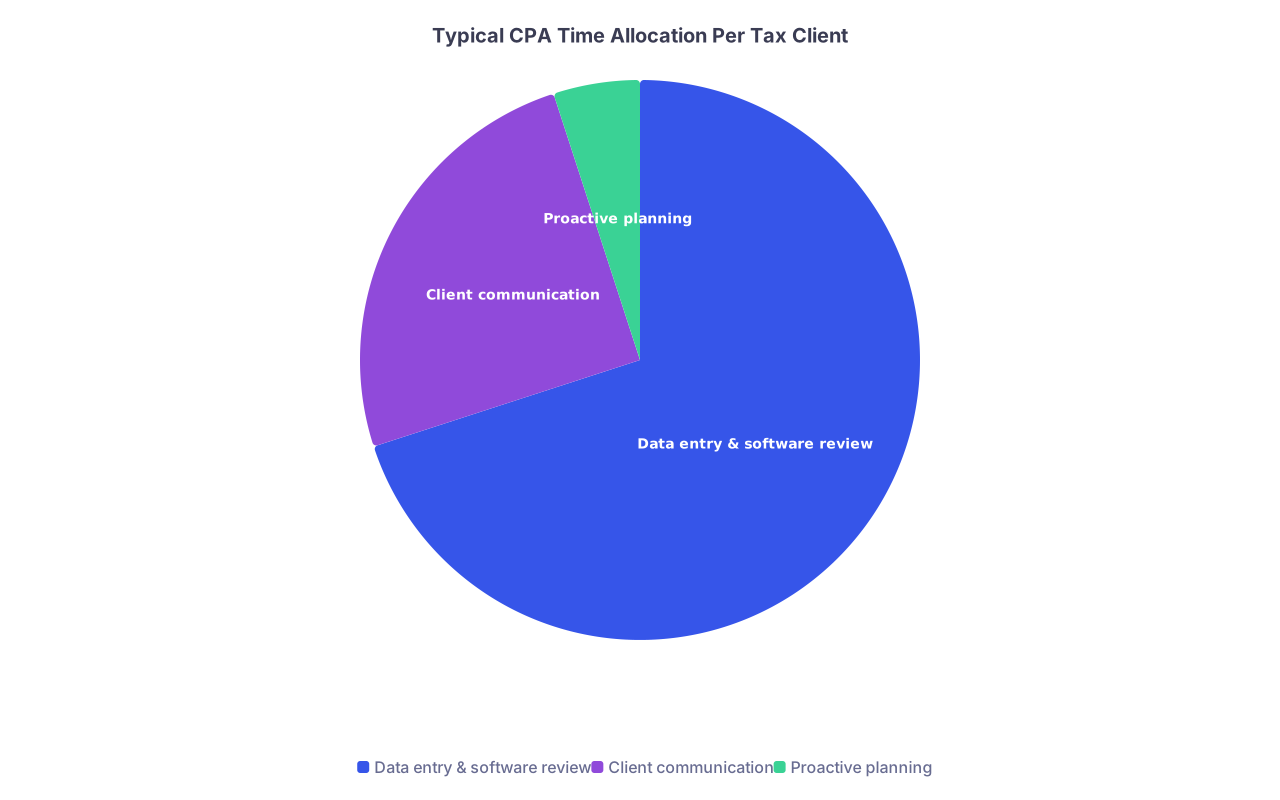
| Category | Value |
|---|---|
| Data entry & software review | 70 |
| Client communication | 25 |
| Proactive planning | 5 |
If you’ve ever had a “tax meeting” that lasted 20 minutes in March and consisted of: “Send me your W‑2s, 1099s, and donation receipts,” you do not have a tax planner. You have a tax historian. They record what already happened.
And historians do not create savings. Strategists do.
The Biggest Tax Myths Doctors Believe (Because No One Corrected You)
Let me knock down a few sacred cows I see constantly in physician circles.
Myth 1: “If there was a big tax saving I could do, my accountant would tell me.”
No. They wouldn’t. Not necessarily.
Most accountants:
- Are not paid enough per return to spend hours looking for opportunities.
- Do not want the liability of “aggressive” strategies unless you explicitly ask.
- Assume a high‑earning physician is risk‑averse and just wants clean, conservative filing.
Here’s the part no one likes hearing: your CPA doesn’t lose money if you overpay. You do. Their incentive is to avoid errors and audits, not to minimize your lifetime tax bill.
A very basic example: a dual‑income physician couple earning $900k combined, fully W‑2, no planning.
I’ve seen versions of this:
- No 1099 side work funneled through an S‑Corp
- No spousal income split in an entity
- No defined benefit or cash balance plan offered through a practice structure
- No accountable plan for work‑related expenses in a small side entity
All of this is standard playbook stuff for many business owners. But physicians often sit outside that world, so nothing gets suggested.
The accountant just takes the W‑2s, plugs them in, maybe maximizes a traditional 401(k), and calls it a day. You are “fully compliant” and still lighting $30k–$80k a year on fire compared to what’s possible if you structured your world differently.
Myth 2: “I’m W‑2, so there’s nothing to do. Taxes are just what they are.”
This one is half‑true and still dangerously lazy.
Yes, pure W‑2 employees have fewer knobs to turn. You can’t suddenly “deduct your car” because you saw it on TikTok. You can’t claim bogus home office deductions if you’re rounding in a hospital 60 hours a week.
But “there’s nothing to do” is nonsense. Here’s what is very often on the table even for W‑2 docs:
- Turning legit side work (telemed, consulting, speaking, chart review) into a properly structured LLC taxed as S‑Corp once the income is there
- Maxing and coordinating retirement plans through multiple employers (many physicians leave tens of thousands of pre‑tax space unused because HR never explained it)
- Backdoor Roth IRAs, and in some systems, the Mega Backdoor Roth via a 401(k) after‑tax contribution plan
- Health Savings Accounts as stealth retirement accounts
- Nonqualified deferred compensation in large systems (analyzed properly, not blindly used)
- Spousal planning (spouse 1099 side income, solo 401(k), etc.)
The W‑2 label is not your prison. It’s just one part of the framework you work inside. The rest is optional. And rarely offered to you on a silver platter.
Myth 3: “If my return looks complicated, that means I’m optimizing.”
A 60‑page return can be nothing but cluttered investments, unmanaged K‑1s, and a mess of small deductions that don’t move the needle.
Sophisticated physician tax planning usually shows up as:
- Thoughtful entity choices
- Serious retirement plan contributions
- Strategic real‑estate moves
- Timing of equity comp or practice sale gains
Not 800 line items of $50 expenses and TurboTax‑level tactics.
If your complexity isn’t backed by strategy, all you’ve done is make auditing you more annoying, not more profitable.
Where the Real Six‑Figure Leaks Happen
You want numbers, not vague warnings. Here’s where the money actually leaks out for physicians.
Leak #1: Wrong or Missing Entity Structure
This one’s predictable.
- A full‑time 1099 anesthesiologist making $500k still filing Schedule C as a sole proprietor.
Difference when moving to a well‑advised S‑Corp structure, paying a reasonable salary and taking the rest as distributions, plus adding a defined benefit or cash balance plan?
Not rare to see $30k–$60k per year in combined tax and retirement optimization. Every year.
Even more basic: multiple 1099 side gigs dumped on a Schedule C with no:
- Accountable plan
- Home office where clearly supportable
- Retirement plan attached
That’s just laziness. Usually on both sides: physician never asked, accountant never proposed.
Leak #2: Under‑used or Poorly Coordinated Retirement Plans
Physicians love to say, “Yeah, I max my 401(k).” Good. That’s step one.
But I routinely see:
- Physicians eligible for a 403(b) plus governmental 457(b) who are only doing one.
- Partners in a group who could have a cash balance plan but never pushed the conversation.
- Spouses with 1099 income who have no solo 401(k) set up.
Let’s be concrete. A combined 401(k) + cash balance structure for a high‑earning group doctor can allow $100k–$200k+ per year in pre‑tax savings, depending on age.
Compare that to “I max my 401(k) at $23k and that’s it.”
You don’t need exotic tax shelters. You just need to actually use the advanced retirement structures available to business owners… which physicians mostly are, or could be, if they behaved like it.
| Scenario | Annual Pre-Tax Potential |
|---|---|
| 401(k) only | ~$23k–$30k |
| 401(k) + 457(b) (if available) | ~$46k–$60k |
| 401(k) + Cash Balance Plan | ~$80k–$200k+ |
| 401(k) + Cash Balance + Spouse Solo | Often $150k–$250k+ |
Leak #3: Not Pairing Real Estate With Your Income Properly
I’m not talking about buying whatever shiny turnkey rental someone pitched on YouTube.
I’m talking about this: when physicians actually commit to real estate as a business, not a hobby, and qualify for real estate professional status (REPS) in a way that stands up in an audit, the tax effects are massive.
- Cost segregation + bonus depreciation on even one decent property can generate six figures of paper losses in year one.
- If you (or your spouse) legitimately qualify as a real estate professional, those losses can offset your W‑2 or 1099 physician income, not just passive income.
This isn’t for everyone. It’s work. It must be done carefully. It requires documentation and an accountant who knows how to do it correctly.
But when doctors say, “If that were a thing, my CPA would have told me,” I know they’ve never actually asked, “Can we map out a path for my spouse to pursue REPS while I’m still full‑time clinical?”
Because in most cases, no one is volunteering that roadmap.
Leak #4: Timing and Clustering of Income and Deductions
The tax code is not annual. It’s multi‑year. The IRS looks year by year, but you shouldn’t.
Examples where planning actually matters:
- Large one‑time payments: signing bonuses, partnership buy‑ins/buy‑outs, practice sales, PSLF tax‑bombs, stock vesting or option exercises.
- Bunching deductions in a single year to climb over the standard deduction (charitable contributions, property taxes timing, elective medical expenses, donor‑advised funds).
- Planning Roth conversions in low‑income years (fellowship, sabbatical, part‑time phase‑out, early retirement gap years).
Your accountant, in March, with 400 other returns in the queue, is not back‑projecting your income 3 years out and saying, “You’re going to sell your practice in 2027, so we should consider X, Y, and Z this year.”
That’s on you to initiate. And if you don’t, you’ll just pay whatever the IRS demands each April. Clean. Compliant. Wasteful.
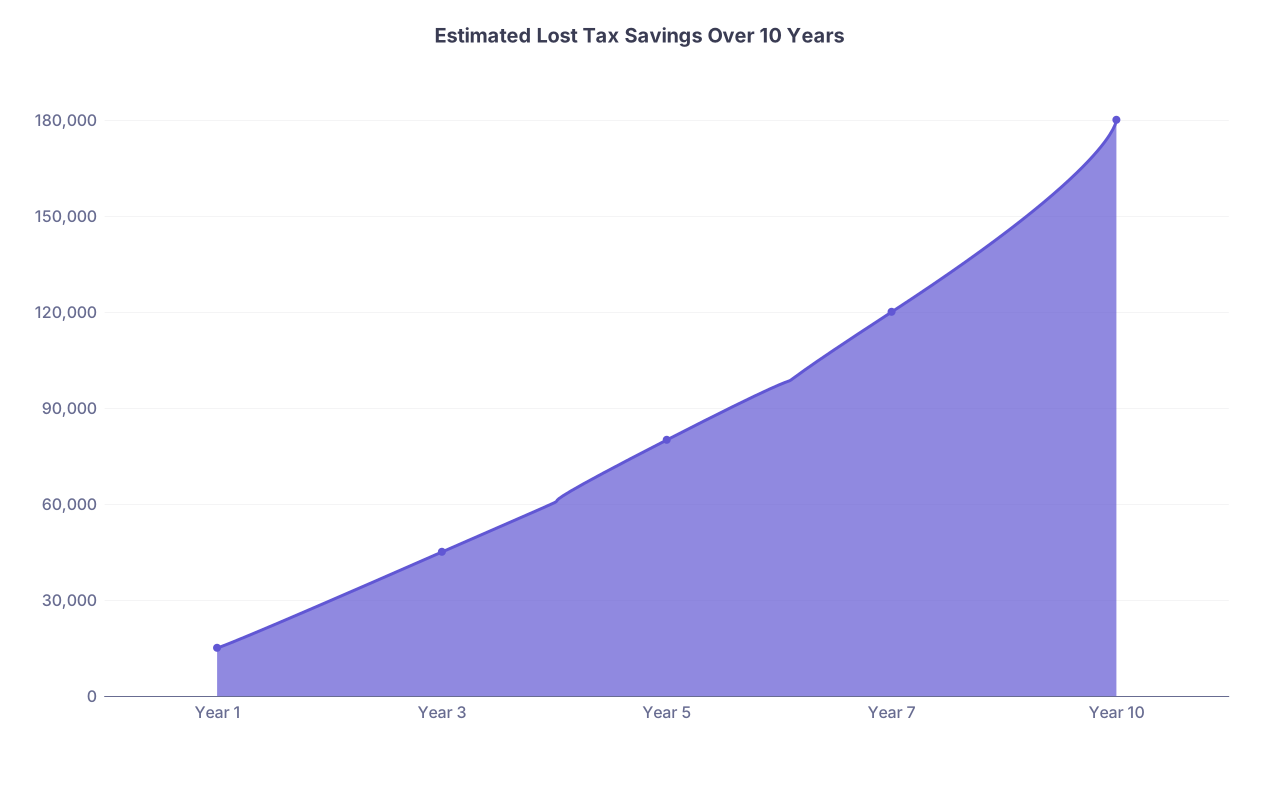
| Category | Value |
|---|---|
| Year 1 | 15000 |
| Year 3 | 45000 |
| Year 5 | 80000 |
| Year 7 | 120000 |
| Year 10 | 180000 |
How to Work With an Accountant Without Getting Fleeced by the Code
The solution is not “fire your accountant and DIY everything.” That’s another bad myth. You’re a physician, not a tax attorney.
The solution is to change how you see the relationship.
Step 1: Accept This Reality – You Are the Tax CEO
The IRS sees you as a business, whether you see yourself that way or not. Especially once you crack ~300k+ income.
CEOs do not say “My CFO handles it” and then never read a report. They:
- Set goals
- Ask informed questions
- Approve strategies
- Hire and fire based on performance
You don’t need to become a tax expert. You do need baseline literacy.
Enough to ask things like:
- “Given my current income mix, what’s the most logical entity structure?”
- “How much additional pre‑tax retirement space could we unlock if I structured my side work differently?”
- “Should my spouse have their own entity or retirement plan?”
- “Are we doing anything with cost segregation, depreciation, or REPS, and if not, why?”
- “Show me, in dollars, how much your current strategy is saving me versus the baseline ‘W‑2 only, 401(k) only’ default.”
If your accountant can’t explain these in plain English or keeps brushing them off, that’s your red flag. Not the IRS.
Step 2: Separate Tax Preparation From Tax Planning
Ask explicitly: “Do you offer proactive tax planning as a separate engagement? What does that look like?”
Real planning usually means:
- Off‑season meetings (summer/fall), not 10 minutes in March
- Projections for this year and next, not just a look backward
- Written recommendations and implementation steps
You may pay more. Good. You should. A planning‑oriented CPA who saves you $30k/year is not expensive at $5k. The $800 form‑filler who costs you $30k/year is.

Step 3: Use Real Checkpoints, Not Blind Trust
Once a year, sit down with:
- Last year’s return
- A basic projection for this year
- Your life plans for the next 3–5 years (career moves, practice sale, real estate, early retirement, college for kids, etc.)
And ask, “Given where I’m heading, what are we not doing yet that we should be?”
If the answer is consistently, “Nothing really, you’re doing fine,” as your income climbs and your life becomes more complex, that is almost always wrong. The code is too big and too slanted toward high earners with good advice for you to be “fully optimized” by accident.

| Step | Description |
|---|---|
| Step 1 | Spring - File Prior Year Return |
| Step 2 | Summer - Strategy Meeting |
| Step 3 | Fall - Implement Changes |
| Step 4 | Winter - Estimate Tax & Adjust |
Common Pushbacks Doctors Give (And Why They’re Weak)
I’ve heard all the objections. Let’s hit the big three.
“I don’t have time for this.”
Fine. Then you have time to donate $30k–$50k per year to the federal government beyond what the law actually requires. This is not about memorizing the code. It’s about 2–3 focused hours a year of being the CEO of your own financial life.“I’m not comfortable with aggressive strategies.”
Good. You shouldn’t be. Neither am I. Most big savings for physicians are not “aggressive.” They’re basic: choosing an S‑Corp, adding a cash balance plan, using a donor‑advised fund for charitable bunching, structuring legitimate REPS correctly. If your CPA labels all of that “aggressive,” they’re outdated or lazy.“But my accountant is really nice and we’ve been with him for 15 years.”
Kindness does not reduce your marginal tax rate. Loyalty is admirable in friendships and marriages, not in professional services that cost you six figures over time. If your accountant is great, they’ll welcome more informed questions and planning. If they get defensive, you have your answer.

What “Getting It Right” Actually Looks Like for a Physician
Let me sketch a realistic, not fantasy, scenario.
Mid‑career cardiologist:
- $600k W‑2 at big hospital system
- $120k 1099 from moonlighting and consulting
- Spouse not employed clinically but willing to manage real estate
- Two kids, mortgage, some equity investments
A vanilla accountant gives you:
- W‑2 entered, 1099 as Schedule C income
- 401(k) maxed, maybe 457(b)
- Standard deduction or basic itemized, depending
- Total tax around what the software spits out
A planning‑oriented approach might create:
- S‑Corp for the 1099 income, paying reasonable salary, rest as distributions
- Solo 401(k) attached to that S‑Corp for significantly more pre‑tax space
- Cash balance plan through a group or side practice, if structure allows
- Spouse qualifying for REPS with properly documented hours and active real estate portfolio
- Cost segregation on a small multi‑family property, generating large paper losses to offset active income
- Donor‑advised fund funded in a high‑income year to bunch several years’ worth of giving
Is every single piece right for everyone? No. That’s not the point. The point is: these levers exist. They are used all the time by business owners with far less income than you. Most physicians simply never get in the room where these conversations happen.

| Category | Value |
|---|---|
| Vanilla filing | 230000 |
| With planning | 185000 |
Over ten years, even a modest $25k/year improvement is a quarter of a million dollars. More commonly, for high earners with 1099 work and real estate, the number is far higher.

Stop Hiding Behind “My Accountant Handles It”
Here’s the uncomfortable truth:
- Your accountant is not the problem. Your abdication is.
- The tax code is absurdly complex—but heavily tilted toward people who treat their finances like a business. That can be you, if you stop acting like a passive W‑2 drone with a stethoscope.
- Six‑figure tax mistakes do not come from fraud or audits. They come from never asking better questions and never demanding actual planning.
You don’t need to become a tax nerd. You do need to retire the phrase “My accountant handles it” and replace it with: “My accountant executes the strategy we design.”
That single shift? Worth a lot more than whatever refund you’re currently proud of.


