

What if that “$50,000 charitable deduction” your CPA bragged about at the holiday party is actually saving you less tax than your colleague’s quiet $8,000 gift—and boxing you into a worse long‑term plan?
Let me be blunt: physicians love the idea of “donating for the tax write‑off,” and most are doing it in a way that’s mathematically lazy and strategically dumb.
The tax code is not a punch card where every dollar donated gets you a dollar off your bill. You’re playing in a world of brackets, thresholds, phase‑outs, standard deductions, and state quirks. If you don’t understand how those interact, you’re not “smartly giving.” You’re just giving—sometimes in the least efficient way possible.
Let’s dismantle a few sacred cows.
The Big Myth: “I’ll Give More Because It’s a Great Tax Break”
Here’s the core misunderstanding: a charitable deduction does not mean the government “pays” for a big chunk of your donation.
You get a deduction that reduces your taxable income, not a dollar‑for‑dollar credit off tax owed.
If you’re in a 37% federal bracket and you donate $10,000 in a way that’s actually deductible (we’ll get to that “if” in a second), the most you’re saving—ignoring state—is $3,700. You are still $6,300 poorer than before you donated. The government did not “match” you. It just discounted the pain.
That’s the best‑case simple scenario. Many physicians are nowhere near that best case in practice.
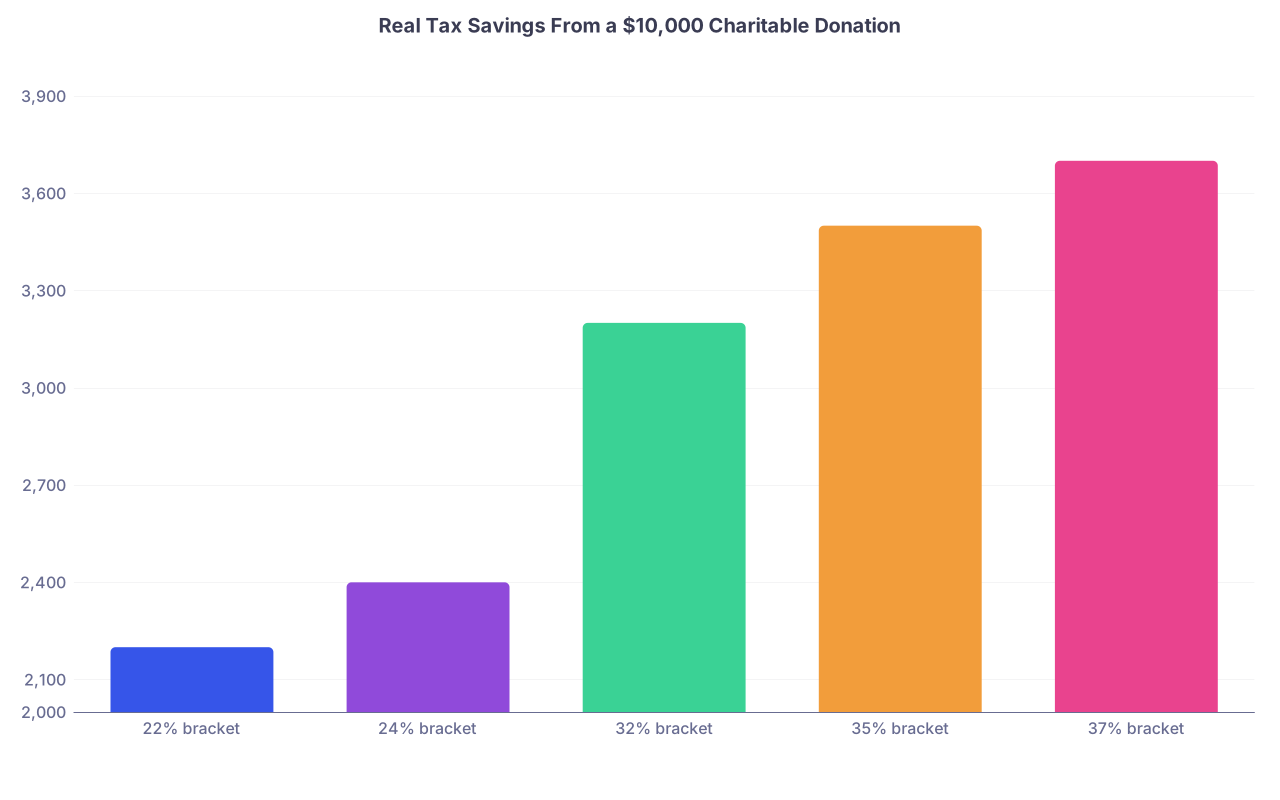
| Category | Value |
|---|---|
| 22% bracket | 2200 |
| 24% bracket | 2400 |
| 32% bracket | 3200 |
| 35% bracket | 3500 |
| 37% bracket | 3700 |
The deeper problem: a ton of donations never get you that full value because of one number most high‑income professionals barely understand—the standard deduction.
The Standard Deduction Is Quietly Killing Many “Tax‑Smart” Gifts
For 2024, the standard deduction for married filing jointly is in the neighborhood of $29,000 (it adjusts annually). That means the first ~$29k of itemized deductions do nothing more for you than “check the box.” You only get extra tax benefit from donations that push you above that line.
Walk through this with a pretty typical attending couple:
- Married filing jointly
- Mortgage almost paid off (so tiny interest)
- High income, but kids nearly done with daycare, 529s funded
- Property and state income taxes well above $10k, but capped by the SALT limit
- They give “a steady $10k a year to charity”
Their Schedule A might look like this:
| Category | Amount |
|---|---|
| State + local taxes (SALT) | $10,000 |
| Mortgage interest | $4,000 |
| Charitable contributions | $10,000 |
| Total itemized | $24,000 |
Standard deduction (approx) for MFJ: ~$29,000.
Result: they don’t itemize. They take the standard deduction. Their “$10,000 deduction” for charity is functionally worth $0 of extra tax savings.
They’re giving like high‑income people. But tax‑wise, they’re being treated like they gave nothing at all.
So when a physician tells me, “We donate 10k every year, it really helps at tax time,” I usually ask: “Are you actually itemizing?” Nine times out of ten: blank stare. Followed by, “Um… our CPA handles that.”
Translation: could be getting no marginal tax benefit and have no idea.
The fix is not “stop giving.” The fix is to stop giving in a random annual pattern that wastes your leverage.
Bunching: The Strategy Almost No One Uses (But Should)
If you’re going to give, at least weaponize the structure.
Instead of $10,000 every year, suppose that same couple “bunches” their charitable contributions into every third year using a donor‑advised fund (DAF). Something like:
- Year 1: Donate $0
- Year 2: Donate $0
- Year 3: Donate $30,000 into a DAF
You can still give from the DAF to your charities on your same annual schedule. The charity doesn’t care when you send it to the DAF; they care when the DAF sends it to them.
But tax‑wise, the difference is dramatic.
In Years 1 and 2, they just take the standard deduction. No big deal.
In Year 3:
- SALT: $10,000
- Mortgage interest: $4,000
- Charitable: $30,000
- Total itemized: $44,000
Now compare: they’re getting an extra ~$15,000 of deductions above the standard that year. If they’re in the 35% bracket, that’s roughly $5,250 of real tax savings—vs essentially nothing when spreading the same $30,000 across three years.
Same total giving over three years. Much higher tax efficiency.
Most physicians have never heard this once from their CPA. Or they heard “you could use a DAF” in passing, with no modeling. Which is why I say: “physician giving is often well‑intentioned but poorly engineered.”
Cash vs Appreciated Assets: Another Commonly Missed Lever
The next myth: “We give cash because it’s simpler.” Translated: “We like paying more tax than we have to.”
If you have a taxable brokerage account (most attendings do, or should), odds are good you’re sitting on long‑term appreciated securities: index funds, ETFs, individual stocks that have doubled or tripled.
For a high‑income physician, the federal long‑term capital gains rate is usually 15–20%, plus the 3.8% NIIT, plus whatever your state layers on. Let’s say roughly 23.8% federal effective.
Give $10,000 of Apple shares you bought for $4,000 years ago directly to charity (or your DAF), and three things happen:
- You get a charitable deduction for the full $10,000 fair market value (subject to AGI limits).
- You never pay capital gains tax on the $6,000 gain.
- The charity, being tax‑exempt, liquidates and pays no tax either.
If you instead:
- Sell the stock
- Realize the gain
- Pay capital gains tax
- Then donate the net…
you’ve just burned thousands of dollars that didn’t need to be burned.
The data on this is clear: high‑income households that donate appreciated assets instead of cash get substantially more “tax bang” for every dollar of charity. Vanguard, Fidelity, Schwab all push this in their white papers. Yet I routinely see physicians dumping $20–30k cash per year to charity while sitting on six figures of appreciated index funds.
Is cash always wrong? No. But as a default for a high‑income doc with a taxable portfolio, it’s rarely optimal.
“I’ll Just Leave a Big Bequest Later” – Another Half‑Truth
You also hear: “We don’t give much now, we’ll just leave a big charitable bequest in our will. Better tax planning.”
Sometimes that’s correct. Often it’s lazy.
For most physicians, especially those under the current (very high) federal estate tax exemption, your estate will not be subject to federal estate tax at all. That means a charitable bequest doesn’t actually reduce federal estate tax—because there was none.
Could it help with state estate or inheritance taxes? Possibly, depending on where you live. But for many, the better tax arbitrage occurs during life: you get income tax deductions now (when you’re in a high bracket) rather than a mostly symbolic estate tax reduction later.
I’ve sat with families where the math was ugly:
- Combined net worth: $4–6M
- Age mid‑50s
- No realistic federal estate tax exposure under current rules
- But they’d been told for years, “Keep building, then leave a big chunk to charity later for tax reasons.”
In reality, a smart lifetime giving strategy using a donor‑advised fund, appreciated assets, and bunching would have given them substantially more tax benefit over the decades—and more control over how and when the giving impacted their cash flow and kids.
There’s a role for charitable bequests and CRTs and all the complex alphabet soup. But “I’ll leave it all when I die” is usually more emotional procrastination than optimized tax planning.
When Donations Backfire on Physicians
Let’s go through a few ways charitable giving can be neutral or even harmful from a tax planning standpoint.
1. Giving Big in Years You’re in Lower Brackets
Physician income is lumpy. Fellowship year, part‑time, early retirement, sabbatical, burnout break, major practice change—all can cut your AGI significantly in certain years.
I’ve seen people give $40,000 in a year they also:
- Took unpaid maternity leave
- Had huge pre‑tax contributions
- And sold a practice at a loss
They were effectively in a much lower marginal bracket than usual. That same $40,000 deduction would have been worth dramatically more had they:
- Seeded a DAF in their peak income year
- Then granted to the end charity from the DAF during their “low income” year
Emotionally, it feels good to give when you have time and energy and a cause in front of you. But tax‑wise, loading that giving into your highest income years is often smarter. The mismatch between emotional timing and tax timing is where many physicians leave money on the table.
2. Letting Charitable Deductions Interfere With Other Planning
If you’re trying to qualify for:
- QBI deduction shenanigans
- ACA subsidies during a part‑time or locums stretch
- Certain education‑related credits for kids (yes, some docs qualify in lower‑income years)
Dumping a big deduction in the wrong year can sometimes push your AGI or taxable income into or out of critical ranges. Donations aren’t free moves; they interact with phaseouts, credits, and other planning opportunities.
I’ve seen a couple blow thousands of dollars of potential ACA subsidy by not understanding how their deductions and Roth conversions played together. Charitable giving was just one puzzle piece they moved blindly.
3. Donating Assets You Should Keep
There’s also the flip side: over‑engineering charity to the point of sabotaging your own solvency.
If you’re in your late 30s, behind on retirement savings, still with six figures of student loans, and you’re trying to impress people (or yourself) with large “strategic” donations, that’s not tax planning. That’s self‑sabotage with a spreadsheet.
I’m not your pastor or rabbi. I’m looking at balance sheets. If your charitable intent is outpacing your financial independence reality, the “tax savings” are irrelevant. You’d probably be better off:
- Getting your savings rate and debt under control first
- Then gradually ramping up higher‑leverage giving (DAFs, appreciated assets) once your core plan is secure
No amount of deduction magic fixes structural under‑saving.
State Tax: The Forgotten Multiplier
Federal tax hogs all the attention, but your state can quietly double the value of smart giving.
If you’re a physician in California, New York, New Jersey, Minnesota, etc., you’re often dealing with 8–13% state income tax. Many of those states follow federal itemization rules pretty closely. Some don’t. Some disallow certain deductions. Some cap them differently.
But here’s the key: if your state does allow charitable deductions on top of federal, a well‑timed, bunched, appreciated‑asset donation can save:
- 30–37% federal
- Plus 8–13% state
Now you’re at 38–50% total marginal benefit on that donation. Which changes the calculus quite a bit. Suddenly, that $10,000 donation might be saving you $4,000–$5,000 in combined taxes—if structured correctly and in the right year.
Again: if you’re below the standard deduction or itemizing poorly, your effective savings could still be far less.
TL;DR: When Are Donations Great Tax Moves for Physicians?
Putting it all together, charitable giving starts looking like an actually good tax play for physicians when:
- You’re in a high marginal bracket (federal + state) and
- Your total itemized deductions exceed the standard by a meaningful margin and
- You’re giving in bunched years rather than drip‑feeding small amounts annually and
- You’re using appreciated assets and donor‑advised funds rather than only cash and
- You’re timing large gifts with your highest income years, not your lowest
If none of that is true, your donations are still morally good. But they might be tax‑mediocre or tax‑stupid.

| Step | Description |
|---|---|
| Step 1 | Plan to donate |
| Step 2 | Consider bunching and DAF |
| Step 3 | Donate appreciated securities |
| Step 4 | Cash gifts less efficient |
| Step 5 | Proceed with large gift |
| Step 6 | Delay or reduce amount |
| Step 7 | Over standard deduction? |
| Step 8 | Have appreciated assets? |
| Step 9 | High income year? |
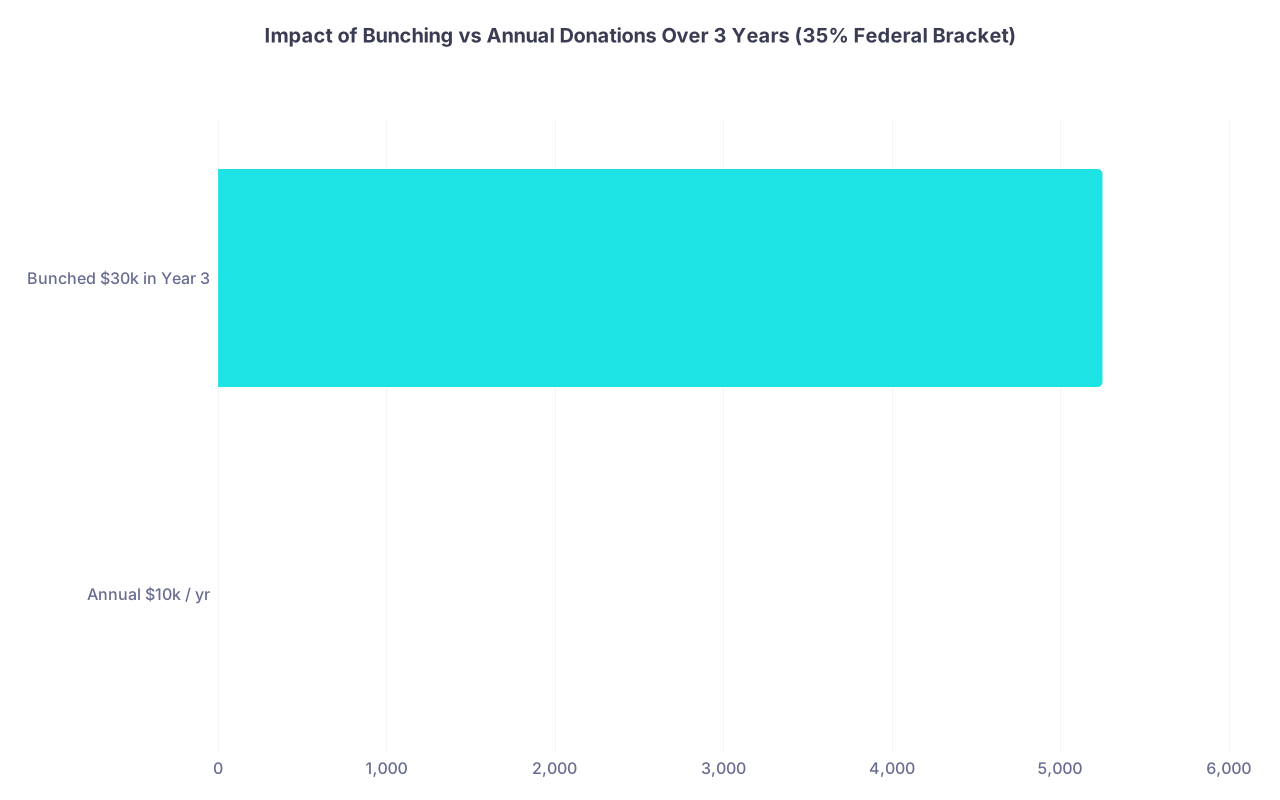
| Category | Value |
|---|---|
| Annual $10k / yr | 0 |
| Bunched $30k in Year 3 | 5250 |

The Bottom Line for Physicians
Three points, no fluff:
- A donation is not automatically a “great tax move.” Until you’re above the standard deduction and in a high marginal bracket, the tax benefit may be modest or zero.
- Structure matters more than size. Bunching gifts, using donor‑advised funds, and donating appreciated assets routinely double or triple the tax efficiency of the same charitable intent.
- Timing is leverage. The same $20,000 gift can be mediocre in a low‑income year and powerful in a peak‑income year, especially in high‑tax states.
Give because you care. But if you’re a physician in high brackets, stop donating like a random tourist and start donating like someone who actually reads their tax return.


