

Locums tenens doctors do not automatically win the tax game. In fact, many get absolutely wrecked by taxes their first few years.
Let me be blunt: the “go 1099, write everything off, pay almost nothing in taxes” fantasy that recruiters and Reddit threads sell you is nonsense. Locums can be a tax advantage. It can also be a tax disaster if you do it wrong, in the wrong state mix, or at the wrong income level.
You are not a hedge fund. You are a high‑W2‑earner who swapped a paycheck for a check with no withholdings and far more responsibility. The IRS does not care that you’re “independent” now.
Let’s break the big myths and talk about what actually happens on the tax return.
Myth #1: “Locums always pay less tax than W‑2 physicians”
No. Sometimes yes, sometimes neutral, sometimes worse. It depends on:
- Your income level
- Your state mix (where you work and where you live)
- How you’re structured (sole prop vs S‑corp vs multi‑member entity)
- Your deductions relative to your income
- Whether you’re still getting any significant W‑2 income
Here’s the core math reality most people ignore:
- Federal income tax brackets are the same whether you’re W‑2 or 1099. $350k is $350k.
- Locums adds a new tax: self‑employment (SE) tax (your half of Social Security + Medicare plus what your “employer” would’ve paid).
- The potential offsets:
- Business deductions (travel, CME, licenses, etc.)
- Retirement contributions (Solo 401(k), SEP‑IRA, maybe cash balance plan)
- S‑corp salary vs distribution optimization (limited, and oversold online)
At $400–600k, you are typically not “saving” 20–30% versus being employed. Best case, you’re re‑characterizing income, shaving a few percent off the effective rate, and shoving more into tax‑deferred buckets. Worst case, you add complexity, screw up quarterly estimates, get hit with penalties, and lose any theoretical savings.
The tax win is conditional, not automatic.
Myth #2: “Self‑employment tax is just a small extra cost”
I hear this constantly from doctors who haven’t actually looked at their 1040 Schedule SE.
Self‑employment tax is basically both halves of FICA:
- 12.4% Social Security on net earnings up to the annual wage base
- 2.9% Medicare tax on all net earnings
- 0.9% Additional Medicare surtax on wages/SE income above thresholds ($200k single, $250k MFJ)
For 2025, assume a Social Security wage base in the ballpark of $170k (it adjusts annually). Here’s the punchline: on your first ~$170k of net locums income, you’re paying full freight.
If, as a W‑2, you were already maxing Social Security at your main job, and then you add locums 1099 income, guess what? On the locums income, Social Security starts at zero again. Different employer. Different wage base. You eat both sides via SE tax.
Here’s a rough comparison that trips people up:
| Scenario | W‑2 Employed Only | Locums 1099 Only |
|---|---|---|
| Federal income tax brackets | Same | Same |
| Employee Social Security (6.2%) | Yes | Included in SE |
| Employer Social Security (6.2%) | Hidden benefit | You pay via SE |
| Employee Medicare (1.45%+) | Yes | Included in SE |
| Employer Medicare (1.45%) | Hidden benefit | You pay via SE |
| Retirement match | Possible | None |
Locums means you explicitly pay both sides of Social Security/Medicare. On high income, the Social Security portion caps out, but that Medicare piece never goes away. It’s not “small.”
Does this make locums bad? No. It just means your baseline tax drag goes up before any planning starts to help you.
Myth #3: “I’ll just form an S‑corp and avoid a ton of tax”
This one is everywhere. Most of it is half‑truth.
What an S‑corp does not do:
- It does not magically exempt all your earnings from tax.
- It does not change your federal income tax brackets.
- It does not give you twice the retirement space “automatically.”
What it actually does:
- Lets you split income into “reasonable salary” (subject to payroll taxes) and “distributions” (not subject to Social Security/Medicare).
- Adds compliance costs: payroll, payroll tax filings, separate corporate return (Form 1120‑S), possibly state S‑corp tax.
If you’re earning $120k as a part‑time locums doc, the S‑corp might not be worth the overhead and risk of picking an unreasonably low salary.
If you’re earning $450k+ purely from 1099 locums, then S‑corp status can save real money on Medicare taxes. But even here, the game is modest, not magical.
Example I see in practice:
- Locums IM doc netting $400k
- Reasonable salary set at $220k, distributions of $180k
- Payroll taxes only on the $220k, not the full $400k
You save 2.9% Medicare (plus 0.9% surtax on part) on the $180k distribution piece. That’s real money—several thousand a year—but not the 20–30% slash many on YouTube promise.
Then subtract:
- S‑corp setup fees
- Bookkeeping
- Payroll service
- Tax prep for 1120‑S + K‑1 + personal return
For many, it’s still worth doing at scale. But it’s not a silver bullet. It's a tuning knob.
Myth #4: “Business deductions will wipe out most of my tax”
This is the classic “I’ll just write it off” fantasy. I’ve lost count of how many locums docs tell me their colleague is “paying almost nothing in tax” because “they put everything through the business.”
Let’s be specific.
Legit, common deductions for locums:
- Licensing, DEA, board fees
- CME, conferences, board review
- Malpractice coverage (if not covered by agency)
- Travel directly tied to assignments (flights, hotels, rental car)
- Home office (if actually used and documented correctly)
- Professional services: tax prep, legal, bookkeeping
- A portion of phone, internet if business‑related use is substantial
What is not a magical deduction:
- Your entire personal car lease because “I drive to the hospital sometimes”
- Family vacations disguised as conferences with 1 hour of CME per day
- 100% of your cell phone when your teenager uses it more than your patients
- Clothes that are “for work” but are not mandated uniforms
The IRS rule is boring and unforgiving: “ordinary and necessary” for your business. Abuse it, and an audit becomes very expensive, very fast.
The key math problem: most high‑earning locums physicians cannot generate 30–40% of their gross as legitimate deductions without fabricating nonsense. Your malpractice, licensing, and flights just are not that big relative to $350–500k of income.
If you spend $20k on real deductions at a 35% marginal rate, you’re saving $7k in taxes… by spending $20k. A tax deduction is not a discount. It’s a partial rebate.
Spending a dollar to save 35 cents is still spending 65 cents.
Myth #5: “Retirement account options are way better as locums”
Here’s where there is a genuine win—if you actually use it.
As a W‑2:
- You’re stuck with whatever your employer offers: maybe a 401(k) or 403(b), maybe a match, maybe not.
- Annual employee deferral limit is shared across all plans (401(k), 403(b), 457(b) is separate).
As a 1099:
- You can create a Solo 401(k) or SEP‑IRA (or paired with a defined benefit/cash balance plan if your income is high and stable enough).
- You can stack “employer” contributions up to the IRS limit (and beyond with a cash balance plan).
This is a real lever. And unlike sketchy “write‑offs,” the IRS expects and likes retirement contributions.
Let’s map it quickly:
| Feature | W‑2 Employed Only | Locums 1099 Only |
|---|---|---|
| Employee 401(k) deferral | Yes (subject to plan) | Yes via Solo 401(k) |
| Employer contributions | Employer‑dependent | You control up to IRS limits |
| Cash balance plan option | Rare, employer‑driven | Possible via own practice |
| Flexibility of investments | Sometimes limited | Often broader (custodian choice) |
But again, this is not automatic. I’ve seen plenty of locums docs:
- Skip Solo 401(k) setup for years
- Forget to fund before deadlines
- Blow their tax savings on lifestyle inflation instead of pre‑tax contributions
If you’re not aggressively using the retirement space you create as a 1099, you’re leaving the best part of the locums tax advantage on the table.
Myth #6: “State taxes are basically the same either way”
For locums, state tax is where things get weird, not simple.
Two realities collide:
- Multi‑state filing – You may owe in every state where you physically work, even for a few weeks.
- Home‑state rules – Your state of residence might tax all your income and give you partial credits for taxes paid elsewhere. That “credit” can be incomplete.
If you live in a:
- No‑income‑tax state (TX, FL, NV, WA, etc.) and do locums in high‑tax states:
You may only owe those other states. Could be okay. But compliance is annoying. - High‑tax state (CA, NY, NJ, MN) and do locums in other high‑tax states:
Congratulations, you’ve entered the ninth circle of apportionment hell.
I’ve seen:
- A CA‑based anesthesiologist doing locums in OR, WA, and AZ who ended up with 4+ state filings, underwithholding, and several thousand a year in penalties/interest because no one planned.
- A Texas‑based hospitalist doing locums in CA and MA who was shocked that avoiding TX tax didn’t mean “no state tax”—it just outsourced tax to California and Massachusetts.
You can make smart choices:
- Prefer no‑tax or low‑tax states when possible
- Limit the number of states you work in
- Avoid long assignments in high‑tax states unless the pay reflects the tax hit
But do not imagine that “I’m a locums doc so I pick my tax home.” That’s not how state statutes work.
The Real Levers Locums Doctors Actually Have
Let me cut the noise and get to what genuinely moves the needle. Most of the tax upside of locums comes from discipline, not loopholes.
You can actually win if you:
Treat it like a real business from day one
Separate accounts. Bookkeeping. Track receipts. No commingling with personal.
A clean P&L lets your CPA do real planning instead of reconstruction.Plan SE tax and estimates, not react to them
Run a projection mid‑year. Adjust quarterly estimates. Overpay slightly if you must. The “surprise” $40–60k bill every April is completely avoidable.Maximize legitimate retirement contributions
- Solo 401(k) with both employee and employer contributions.
- Consider a defined benefit/cash balance plan if consistent high income and a long‑term plan to stay locums or small‑group independent.
This is how high‑income locums move their effective tax rate from ugly to reasonable.
Use S‑corp when the math supports it, not because Twitter said so
I start seriously considering S‑corp when someone’s 1099 net is consistently over ~$250–300k and they’re comfortable with extra paperwork. Below that, case‑by‑case.Be selective with assignments by state
Negotiating $30–40/hr more in a high‑tax state can be meaningless after taxes and travel. Sometimes the “lower” rate in a no‑tax state is better after you do the math.
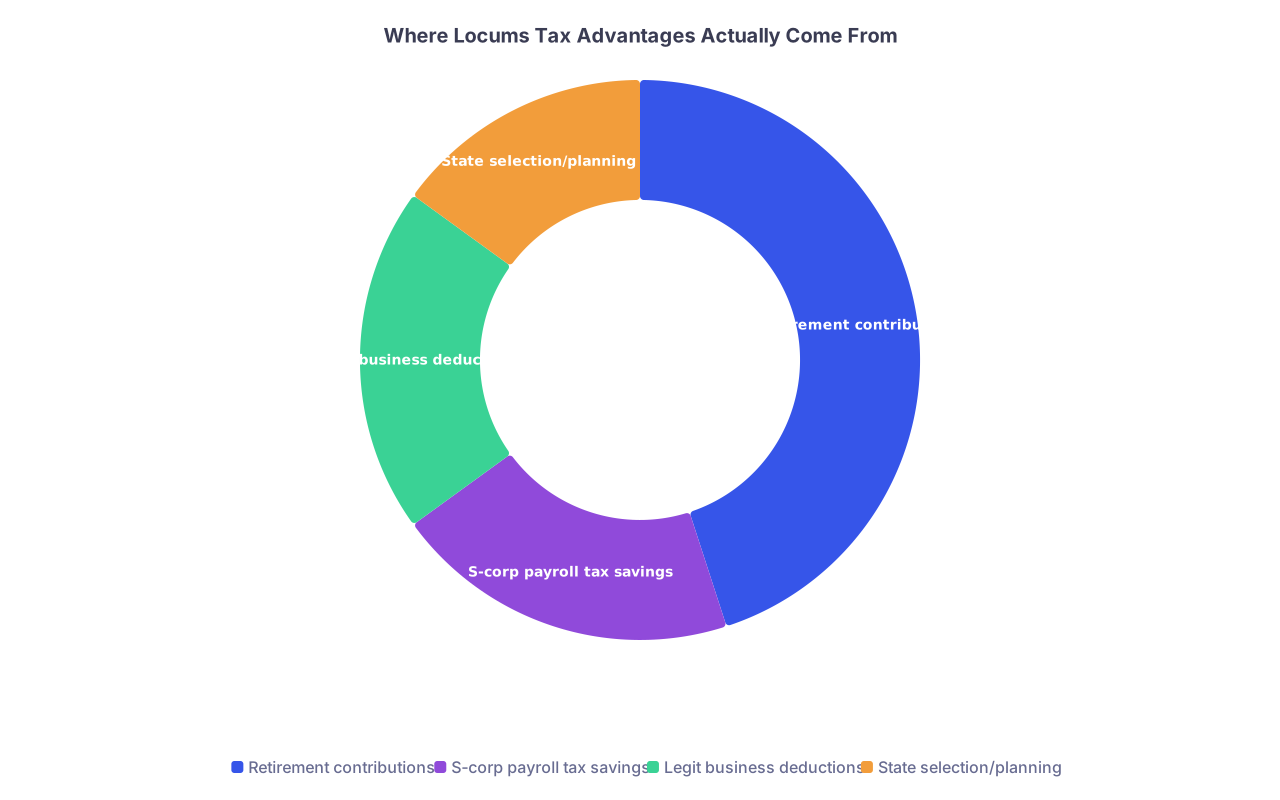
| Category | Value |
|---|---|
| Retirement contributions | 45 |
| S-corp payroll tax savings | 20 |
| Legit business deductions | 20 |
| State selection/planning | 15 |
What Actually Goes Wrong (Common Locums Tax Fails)
I’ll give you the patterns I’ve seen repeat:
- First‑year locums doc makes $350k 1099, saves “about 25%” in a savings account, files taxes, owes $120k+. Underpaid estimates, no SE planning, no Solo 401(k) set up. Smashed.
- Dual‑earner couple, spouse W‑2 physician, other spouse locums. They assume Social Security wage base is shared. It’s not. Big SE tax surprise.
- Physician listens to colleague: “my CPA writes everything off.” They start expensing borderline personal stuff. Audit letter arrives. CPA disappears from the story. Now it’s just them and the IRS.
The doctors who come out ahead on taxes as locums aren’t the ones with the most exotic structure. They’re the ones who:
- Keep clean books
- Use big, boring tools (retirement, entity choice, reasonable deductions)
- Actually pay attention to projections mid‑year

So, do locums tenens doctors “win” on taxes?
Sometimes. But not by default. And not for the reasons usually shouted online.
Three takeaways and you can ignore the noise:
Locums is not a tax loophole. It’s a business model shift that trades employer‑paid payroll tax, benefits, and simplicity for control and complexity. Without disciplined planning, your tax bill can be higher than as a W‑2.
The real advantage is flexibility, not magic deductions. You can choose your retirement setup, your entity type, and partially your state mix. Use those levers intelligently and you might trim a few points off your effective tax rate and massively improve long‑term wealth building.
If you are not willing to run this like a business—get help early or do not expect a tax win. A good CPA who actually understands physician 1099 income, S‑corps, and multi‑state issues is not optional at $300–500k. They’re the difference between “locums is a tax hack” and “why do I owe six figures every April?”
The nuanced reality: locums can be tax‑efficient, but it’s not automatic. You either manage it intentionally, or the IRS manages it for you.


