
You’ve been sold a lazy half‑truth: “If you’re W‑2, there’s nothing you can do about taxes.” That line is wrong, and expensive.
Yes, 1099 income opens more doors. No, that does not mean a straight‑salaried W‑2 physician is helpless. I see W‑2 attendings routinely leaving five figures on the table every year because they’ve internalized this myth and stopped asking better questions.
Let’s break this down like an attending tearing apart a bad consult note.
The Core Myth: W‑2 = Powerless, 1099 = Genius
The myth goes like this:
- “W‑2 income is the worst kind of income.”
- “Only business owners and 1099 docs can deduct anything.”
- “If I’m employed by a hospital, I’m stuck with whatever my W‑2 shows.”
There’s a kernel of truth here, which is why this myth survives.
- The Tax Cuts and Jobs Act (TCJA) killed unreimbursed employee business expenses for most people through 2025. So you cannot just list your CME, scrubs, and work iPad as itemized deductions like your older colleagues might have done ten years ago.
- W‑2 income is subject to full payroll taxes and cannot be “recharacterized” as distributions the way some business owners can.
But that’s not the same as “you can’t save on taxes.”
You are not limited to employee deductions. You have the entire personal, investment, and retirement side of the tax code still wide open.
And if you have even a whiff of side income, you have business planning options too.
First Reality Check: Where Do Physicians Actually Save on Taxes?
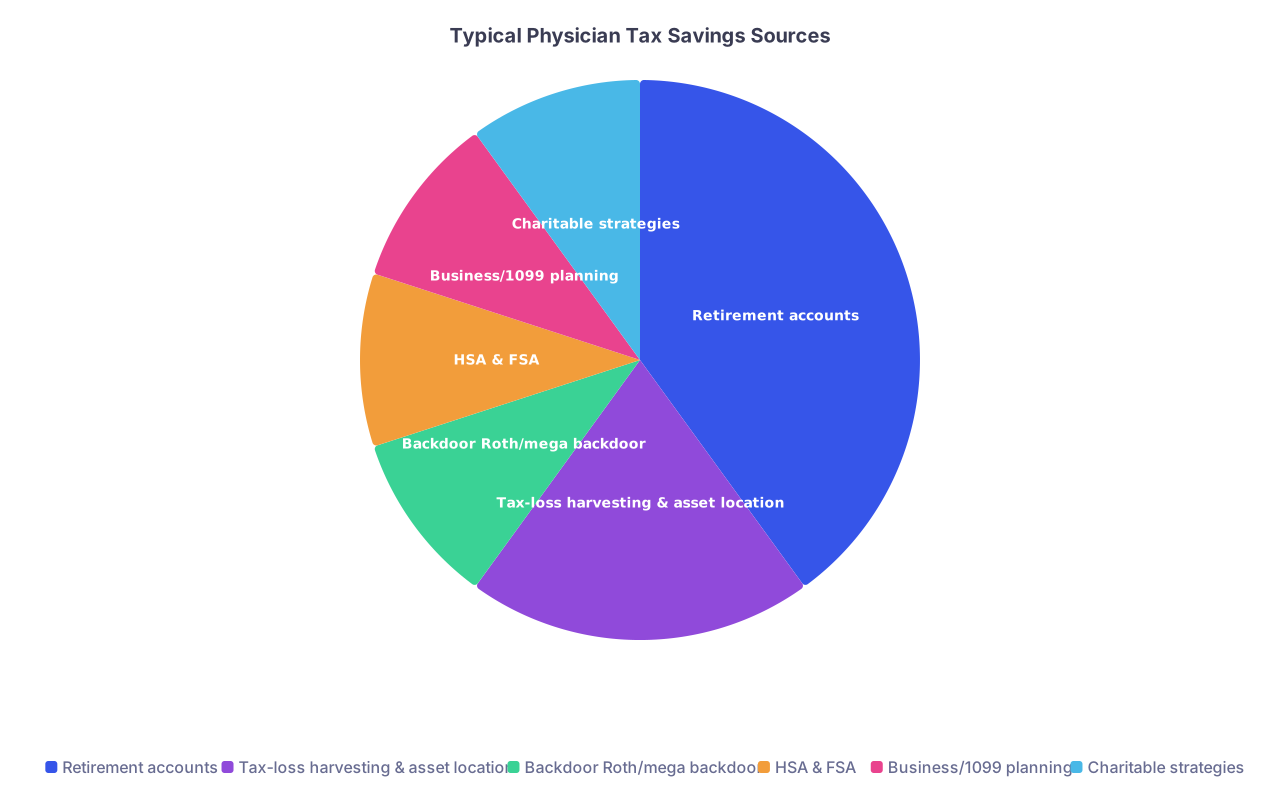
| Category | Value |
|---|---|
| Retirement accounts | 40 |
| Tax-loss harvesting & asset location | 20 |
| Backdoor Roth/mega backdoor | 10 |
| HSA & FSA | 10 |
| Business/1099 planning | 10 |
| Charitable strategies | 10 |
Look at high‑earning physicians who do keep good money after tax. The ones who are not constantly shocked every April.
Their biggest tax wins usually come from:
- Retirement accounts (401(k), 403(b), 457(b), cash‑balance plans)
- Smart investing (tax‑efficient funds, tax‑loss harvesting, asset location)
- Roth strategies (backdoor Roth IRA, sometimes mega backdoor Roth)
- HSA / FSA usage
- Charitable planning (donor‑advised funds, bunching deductions)
- If they have it, business/1099 planning layered on top
Notice what’s missing: “Writing off my scrubs and UpToDate subscription.”
Those little “business owner” deductions matter way less than the big levers of tax deferral, tax‑free growth, and capital gains management. And those big levers? W‑2 docs get them too.
Big Lever #1: Retirement Accounts – Where W‑2 Docs Actually Have an Edge
If you are a W‑2 physician at a large system, your available retirement space is often better than what many independent docs can build without serious expense.
Typical setup at a large employer:
- 401(k) or 403(b) with $23,000 salary deferral limit (2024; plus $7,500 catch‑up if 50+)
- Employer match or non‑elective contribution
- Sometimes a 457(b) (governmental or non‑governmental)
- Sometimes a defined benefit / cash‑balance plan
| Account Type | 2024 Limit (Approx) |
|---|---|
| 403(b) employee deferral | $23,000 |
| 403(b) employer contribution | Up to ~$46,000 (combined 69k) |
| 457(b) deferral | $23,000 |
| 401(a)/cash balance (if offered) | Varies (often $20k–$50k+ value) |
I’ve seen employed cardiologists deferring $23k to 403(b), another $23k to a governmental 457(b), plus receiving $30–40k in employer contributions to a cash balance plan. That’s $70–$90k/year being sheltered from current income tax.
A solo 1099 cardiologist has to:
- Hire an actuary and TPA for a custom cash balance plan
- Deal with admin, compliance, fees
- Make both “employer” and “employee” contributions from their own cash flow
Worth it? Often yes. But let’s not pretend the W‑2 doc is doomed here. They’re pushing very similar numbers without lifting a finger.
If you’re W‑2 and you are not:
- Maxing all available retirement accounts, and
- Understanding whether your 457(b) is governmental (portable, generally safer) vs non‑governmental (employer risk, more nuance)
…then you are ignoring your single biggest, easiest tax lever.
Big Lever #2: Roth Access – The Backdoor Isn’t a Loophole, It’s Standard
A lot of physicians still think: “I make too much for a Roth IRA.”
Incorrect. You make too much for a direct Roth IRA contribution. That’s different.
The backdoor Roth IRA is simple:
- Contribute to a non‑deductible traditional IRA.
- Convert to Roth IRA shortly after.
- Avoid the pro‑rata mess by not having pre‑tax IRA balances (or rolling them into your 401(k)/403(b) first).
Being W‑2 does not change your eligibility here at all.
In fact, W‑2 physicians frequently have a cleaner slate:
- No SEP‑IRAs from old locums gigs
- No old SIMPLE IRAs
- Everything is already in employer plans
Two attendings, same income:
- Attending A (W‑2 only) can easily do backdoor Roth for self and spouse = $7,000 x 2 = $14,000/year (2024 numbers; plus catch‑up if 50+).
- Attending B (1099 with SEP‑IRA) either has to roll SEP into a solo 401(k) or deal with pro‑rata complications.
Over 20 years with moderate growth, that backdoor Roth pair is potentially six figures of tax‑free money. W‑2 status is not stopping you. Apathy is.
Big Lever #3: HSA, FSA, and Employer Benefits – The Hidden Tax Shelter Pile
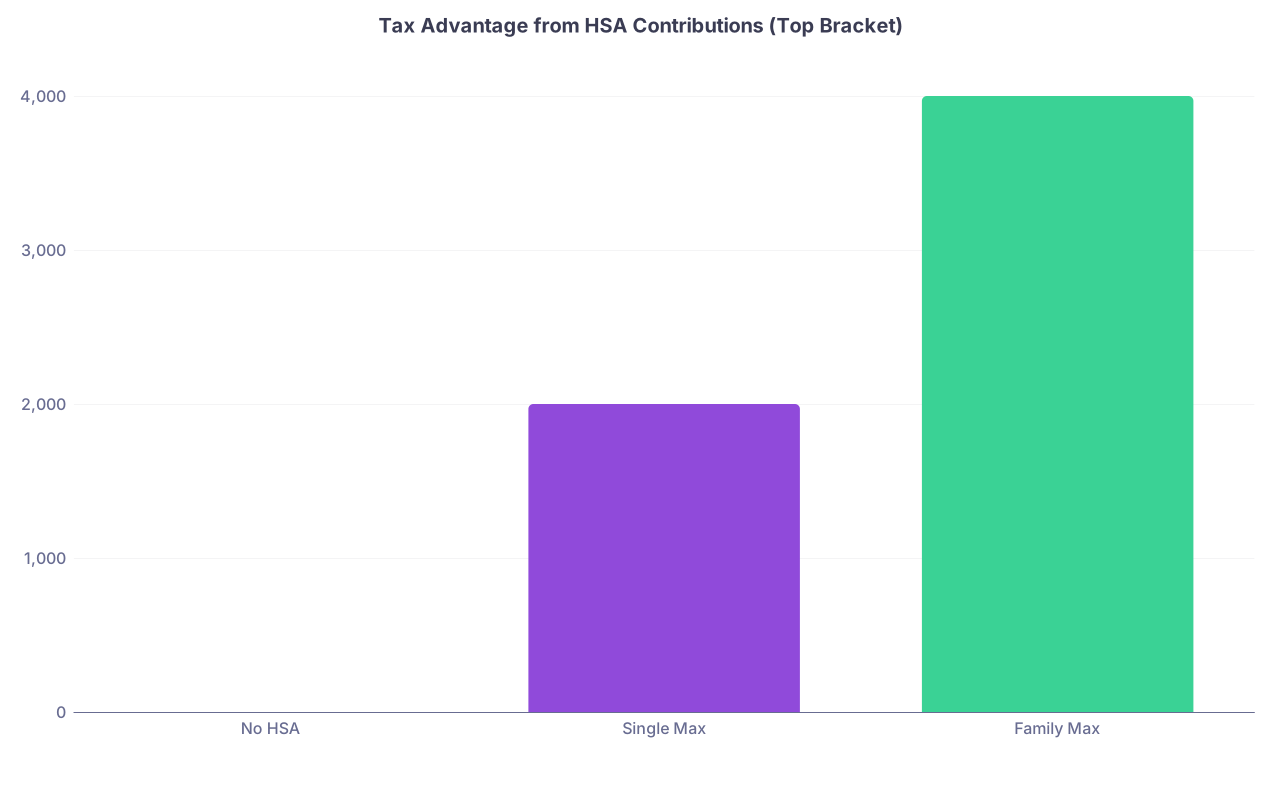
| Category | Value |
|---|---|
| No HSA | 0 |
| Single Max | 2000 |
| Family Max | 4000 |
You know what hospitals actually do well? Benefits packages. And they come with tax advantages you ignore because they sound boring.
Typical menu:
- Health Savings Account (HSA) if you have a high‑deductible plan
- Triple tax advantage: pre‑tax in, tax‑free growth, tax‑free qualified withdrawals
- In practice: many high‑income docs use HSAs as stealth retirement accounts and pay current healthcare out of pocket
- Dependent care FSA
- Health FSA (if not using HSA)
- Commuter benefits
- Group disability and life (not always optimal, but often underpriced)
That HSA alone:
- Family max (2024): $8,300 (plus $1,000 catch‑up if 55+)
- Top combined marginal rate for many physicians (federal + state): easily 40%+
- Roughly $3,000+ in avoided tax on money you likely would have spent on healthcare anyway
The 1099 doc? Has to set up their own HDHP, their own HSA provider, and manage all that solo. Again: more control, more hassle.
The employed W‑2 doc? Logs into the benefits portal. Checks a box. Gets the benefit.
You can ignore it, but don’t complain about having no tax tools if you aren’t even using the basic ones handed to you.
Big Lever #4: Investment Tax Planning – This Has Nothing To Do With W‑2
Here’s where the “W‑2 is doomed” narrative really falls apart.
Your investments do not care if your day job pays you as W‑2 or 1099. Once money is in a brokerage account, the tax code looks at:
- Is the income interest, dividends, or capital gains?
- Are gains short‑term or long‑term?
- Is it in a taxable account vs IRA vs Roth?
This is where real long‑term tax efficiency lives:
- Using low‑turnover index funds and ETFs to minimize taxable distributions
- Tax‑loss harvesting during down markets to bank losses that offset gains and up to $3,000/year of ordinary income
- Asset location: putting bonds and high‑yield stuff in tax‑deferred accounts, keeping tax‑efficient equity index funds in taxable
- Avoiding high‑turnover active funds and unnecessary buying/selling
None of this depends on your W‑2/1099 status.
I’ve watched W‑2 hospitalists with a basic three‑fund portfolio and clear asset location pay less in taxable investment drag than some private‑practice owners trading individual stocks and active funds all year long.
Being a “business owner” does not magically make you tax‑smart. Often it just adds chaos and overconfidence.
Big Lever #5: Charitable Strategy – Not Just “I Give, So I Deduct”
Want to know a tax planning move almost tailor‑made for high‑income W‑2 physicians who give regularly?
Donor‑advised funds (DAFs) and bunching.
Year‑to‑year, your charitable giving might not push you above the standard deduction, especially if your mortgage interest is low and SALT is capped at $10k. Result: you give, but get minimal tax benefit.
Bunching strategy:
- Instead of giving $10k/year for 5 years, you contribute $50k to a DAF in one year.
- In that year, you itemize and get a much larger deduction.
- The DAF then distributes $10k/year to the charities, just like you would have.
Layer on top of that:
- Donating appreciated stock or ETF shares to the DAF
- Avoiding capital gains on those positions
- Rebalancing your portfolio more tax‑efficiently
Again: nothing here cares whether your paycheck is W‑2.
“But What About All The Deductions I Don’t Get?”
Let’s list the classic gripes W‑2 docs throw out, and be blunt about the impact.
Things you can’t usually deduct as a plain vanilla W‑2 employee anymore (post‑TCJA, through at least 2025):
- CME paid out of pocket (if not reimbursed)
- Licensing and board fees (if not reimbursed)
- Professional society dues (if not reimbursed)
- Work‑related travel not reimbursed
- Home office for your W‑2 job
This feels unfair because your older colleagues brag about deducting all this a decade ago. But how big is this, really?
A realistic example:
- $3,000 CME
- $1,000 dues/fees
- $1,500 small equipment, phone allocation, etc.
Total: $5,500.
At a 40% marginal rate, that’s about $2,200 of tax savings—if you were allowed to deduct it.
Not nothing. But compare that to:
- Not maxing an extra $23k into a 457(b) (could easily cost you $9k+ in annual taxes at similar rates)
- Not using an HSA (another $2–3k/year)
- Not using backdoor Roths (huge long‑term tax‑free growth)
- Running a tax‑inefficient brokerage portfolio (thousands/year, compounded for decades)
Sacrificing those giant, permanent tax advantages just so you can “feel” like a business owner writing off a laptop is objectively bad math.
The Hybrid Reality: You Don’t Have To Choose One Box
Here’s the actual landscape for many physicians in 2024+: hybrid.
- W‑2 from the main job for stability, benefits, loan forgiveness eligibility, malpractice coverage
- 1099 from moonlighting, telemedicine, consulting, expert witness work, or small niche side gigs
That small 1099 stream, if treated as a legitimate business, opens:
- Solo 401(k) (on top of your W‑2 plan, subject to annual/overall limits and coordination rules)
- Business deductions for genuinely business‑related costs
- Home office tied to the 1099 work
- Increasing long‑term optionality if you grow that side business
The move for many W‑2 docs is not to blow up their employment to chase more deductions. It’s to:
- Max every W‑2 benefit and retirement option first
- Then add a carefully structured, high‑margin 1099 stream where it actually makes sense clinically and personally

| Step | Description |
|---|---|
| Step 1 | W2 Physician |
| Step 2 | Increase 401k 403b HSA |
| Step 3 | Consider scalable side work |
| Step 4 | Set up solo 401k and deductions |
| Step 5 | Optimize investments and Roth |
| Step 6 | Max employer accounts? |
| Step 7 | Have 1099 income? |
Where W‑2 Doctors Actually Shoot Themselves In The Foot
The harsh truth: the tax code is not your biggest enemy. Your behavior is.
Common, expensive mistakes I see W‑2 physicians make:
- Not even knowing all the retirement plans available at their institution
(“Wait, I have a 457(b)?” shows up in my inbox far too often.) - Leaving employer match on the table
- Sitting on huge cash balances instead of investing in tax‑efficient funds
- Mixing pre‑tax and after‑tax IRA money so thoroughly that backdoor Roths become messy
- Never reevaluating their benefit elections or health plan choice
- Handing their CPA a pile of forms once a year and calling that “tax planning”
You do not need to become a tax attorney. But if you keep insisting “there’s nothing I can do as W‑2,” you will stop looking for the moves that actually matter. And you’ll pay for that.
The Bottom Line: It’s Not the W‑2, It’s the Strategy
Being a W‑2 physician changes which levers you pull, not whether you have any.
If you’re W‑2:
- You probably have excellent, plug‑and‑play retirement and benefit options that many 1099 docs have to fight to replicate.
- You absolutely can use backdoor Roths, HSAs, smart investment strategies, and charitable planning.
- You may choose to add 1099 income later as a scalpel, not a sledgehammer, once you’ve exhausted the “easy” tools.
If you’re not using these, that’s not the W‑2’s fault.
Years from now, you won’t remember the line on your paystub. You’ll remember whether you treated your tax life like something that just “happened” to you, or something you actually took ownership of.
FAQ (Exactly 4 Questions)
1. Is it ever worth trying to convert my W‑2 job into a 1099 arrangement just for taxes?
Usually no. If your hospital is offering to convert you from employee to independent contractor without changing your compensation, that’s typically a bad deal: you lose benefits, have to cover both sides of payroll taxes, and assume more risk. The only time it starts to make sense is when the pay increase and control are large enough to offset lost benefits and extra admin. Taxes are just one input, not the main driver.
2. Can a W‑2 doctor still deduct CME if the employer doesn’t reimburse it?
Under current law (through at least 2025), unreimbursed employee expenses like CME are not deductible for most physicians at the federal level. The workaround is not a cheat—it’s structural: negotiate for employer‑paid CME, use employer benefits, and, if you have legitimate 1099 work, align some educational expenses with that business. But claiming big W‑2 related deductions directly on Schedule A is largely gone.
3. If I have both W‑2 and 1099 income, can I max a solo 401(k) on top of my hospital 403(b)?
You can usually have both, but there are coordination rules. Your employee elective deferral limit ($23,000 in 2024) is shared across all plans. However, the employer/“profit‑sharing” portion is separate per unrelated employer, subject to overall caps. Translation: you often can still put additional money into a solo 401(k) from 1099 income, but how much depends on your W‑2 contributions and your 1099 net income. This is where a competent CPA or retirement plan consultant actually earns their fee.
4. Are tax strategies different if I’m pursuing PSLF or other loan forgiveness as a W‑2 doc?
Yes. If you’re working at a qualifying nonprofit and pursuing Public Service Loan Forgiveness, your AGI affects your income‑driven repayment. Strategies that lower current taxable income—maxing pre‑tax retirement accounts, HSA contributions, sometimes even filing status decisions—can reduce required payments and increase eventual forgiveness. In that context, smart tax planning does double duty: lowers your tax bill now and shrinks your loan payments along the way.