

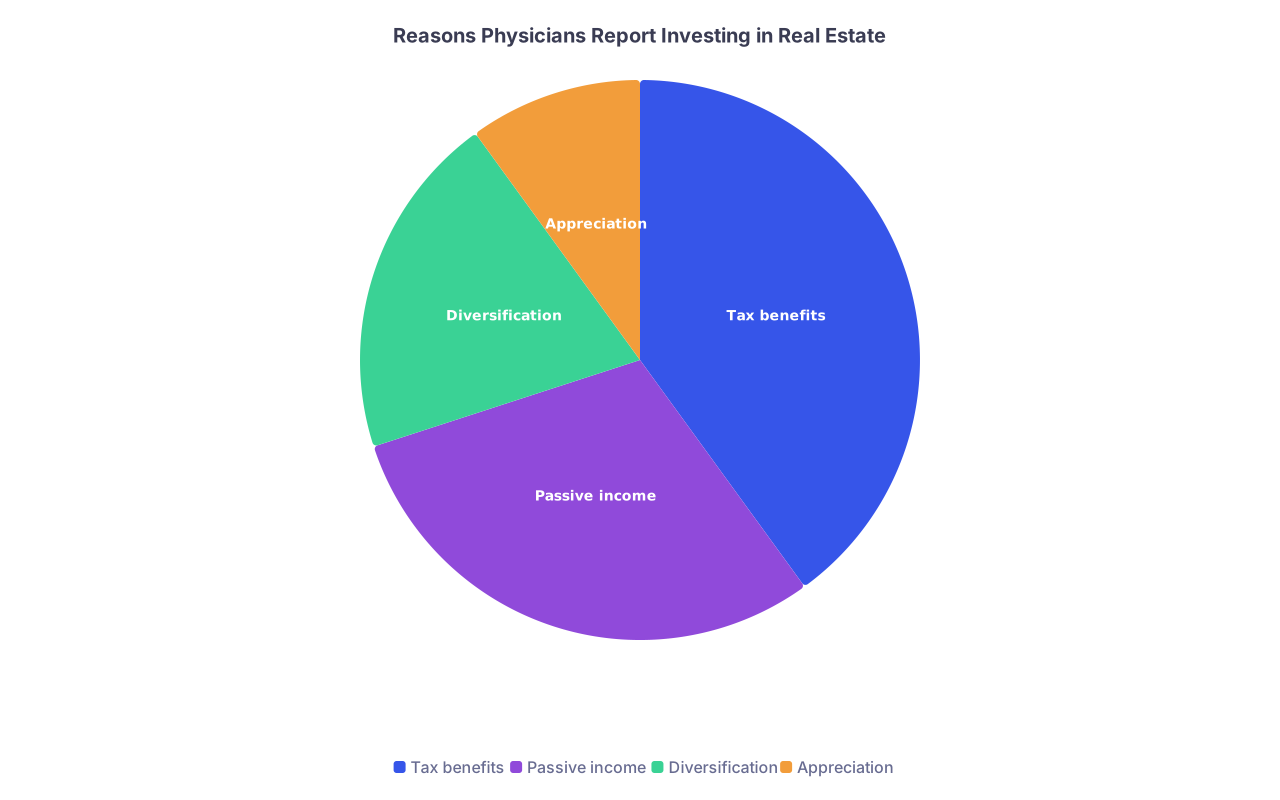
62% of physician-investors in one advisor survey said they were “primarily motivated by tax benefits” when buying real estate.
That’s backwards.
The people who talk the loudest about “infinite tax-free wealth through real estate” are usually:
- Selling a course
- Selling a fund
- Or trying to justify a bad purchase they already made
Let’s tear this apart properly.
Real estate can be a powerful tool for physicians. You can dramatically reduce taxable income in some situations. You can shelter income and grow wealth tax-efficiently.
But the idea that “real estate is the ultimate physician tax haven” is oversold, misused, and in some cases financially dangerous.
You do not fix a high tax bill by buying a mediocre property.
You fix a high tax bill by understanding how the rules actually work.
The 3 Big Real Estate Tax Myths Physicians Keep Getting Sold
| Category | Value |
|---|---|
| Tax benefits | 40 |
| Passive income | 30 |
| Diversification | 20 |
| Appreciation | 10 |
Let me start with the myths, because these are what drive bad decisions.
Myth 1: “Real estate is passive income with huge tax write-offs”
Reality: For tax purposes, rental real estate is usually passive, which is the exact opposite of what you want if your goal is to offset W‑2 clinical income.
Most physicians I’ve worked with are shocked when they learn this. You buy a $1M syndication interest, get a big paper loss from depreciation, and think:
“Great, this will offset my $600K salary.”
No. Not unless you or your spouse qualify as a real estate professional and materially participate (more on that later).
By default, passive losses from rentals can only offset passive income. They do not reduce your W‑2, partnership, or 1099 clinical income. For most physicians, those losses are trapped as “suspended passive losses” that only help you:
- Offset other passive income (from other rentals, syndications, etc.), or
- Reduce gain when you sell the property or interest
That’s still useful. But it’s not the fantasy TikTok is selling you.
Myth 2: “Cost segregation and bonus depreciation let you wipe out your taxes”
I see this pitch constantly:
“Dr. Smith bought a $2M apartment building, did a cost seg study, took $800K of bonus depreciation, and wiped out all her clinical income taxes. You can too!”
Here’s the reality:
- Yes, cost segregation and bonus depreciation can generate huge paper losses.
- No, those losses usually cannot offset your physician income unless you qualify as a real estate professional and meet strict participation rules.
And even when you do qualify, you’re not eliminating tax. You’re pulling deductions forward from future years into this year. It’s timing, not magic. You still recapture depreciation when you sell (at up to 25% federal, plus state).
front-load deductions. You do not erase tax from the universe.
Myth 3: “Real estate always beats index funds after taxes”
This one’s cute.
You’ll see pro-real-estate folks cherry-pick:
- High leverage returns in a bull market
- Heavy upfront depreciation
- Ignoring transaction costs, illiquidity, and risk of concentration
They compare their best deal to a generic “7% stock market return” and call it a day.
What data actually shows:
- Broad stock index funds in taxable accounts are extremely tax-efficient for high earners (low turnover, long-term capital gains, qualified dividends).
- Many physicians buying small residential rentals or blindly investing in syndications end up with lower after-tax, risk-adjusted returns than a simple 60/40 portfolio.
Real estate can outperform. But it requires:
- Good deal selection
- Reasonable leverage
- Competent management
- And not overpaying for “tax benefits”
Most doctors skip at least two of those.
How Real Estate Tax Benefits Actually Work (The Non-Guru Version)
Now the part the gurus usually skate past: the mechanics.
The core tax levers in real estate
Most of the “magic” comes from a few standard features:
- Depreciation – Non-cash expense spreading the cost of a building over 27.5 years (residential) or 39 years (commercial).
- Cost segregation & bonus depreciation – Accelerate that depreciation into earlier years by carving out shorter-lived components (5, 7, 15 years) and, under current rules, bonus-depreciating a big chunk of them.
- Interest and operating expense deductions – Straight-forward: mortgage interest, property taxes, repairs, management, etc.
- 1031 exchanges – Defer capital gains and depreciation recapture by rolling from one property to another.
- Capital gains treatment – Lower long-term capital gains tax on appreciation if held >1 year.
Nothing mystical. Just fairly generous rules for an asset class the government wants people to invest in.
The huge catch: passive vs non-passive
For most physicians, this is the brick wall.
The tax code splits income and losses into:
- Active/non-passive – Wages, self-employment, your clinical practice
- Passive – Rental real estate (by default) and businesses you don’t materially participate in
Passive losses can’t offset active income. So that beautiful $200K paper loss from a cost seg on your rental? It does not reduce your $700K anesthesia salary. It just sits there until you have passive income or dispose of the asset.
Two key exceptions worth understanding:
- Real estate professional status (REPS)
- Short-term rentals with material participation
Real Estate Professional Status: The Most Abused Buzzword in Physician Finance

Real estate professional status is where things can get very interesting for physicians. It’s also where people get reckless and invite audits.
Here’s what the law actually requires (IRS Section 469):
To be a real estate professional for tax purposes, in a given year you must:
- Spend more than 750 hours in real property trades or businesses, and
- Spend more than half of your total working hours in those real estate activities
Plus, to treat your rentals as non-passive, you must also materially participate in them (or elect to group them).
Specifics that trip people up:
- A full-time clinician working 2,000 hours/year? Hard to argue you spent >1,000 hours in real estate and still slept.
- Charting and admin count toward your clinical total. You cannot pretend you only worked “40 hours per week.”
- Travel time can be scrutinized. So can vague calendar entries like “worked on real estate – 5 hours.”
So who realistically qualifies among physicians?
- Spouses who do not work clinically and legitimately run the real estate portfolio.
- Part-time physicians who truly cut back to, say, 0.4 FTE and spend the rest in bona fide real estate operations.
- Physicians who leave clinical work entirely and transition to full-time real estate.
That’s it. The idea that a full-time surgeon can casually “add REPS” on the side is fantasy. The IRS has litigated this multiple times, and courts are not sympathetic to hand-wavy logs and wishful thinking.
When REPS actually helps
If you or your spouse genuinely qualify:
- Your rental real estate activities can be treated as non-passive.
- Materially participating rentals can generate losses that offset your clinical income.
- A big cost seg study on a large property can wipe out a significant chunk of taxable income in that year.
That’s powerful.
But here’s the part most people conveniently ignore: you’re trading like-for-like. You’re:
- Giving up time you could work clinically
- Taking on another real job (real estate)
- Pulling future deductions into the present
It’s a career decision, not a side-hustle checkbox.
Short-Term Rentals: The “Loophole” Everyone’s Whispering About
| Category | Value |
|---|---|
| Short-term rental | 200 |
| Long-term rental | 330 |
Now the fashionable tactic: short-term rentals (STRs).
The pitch goes like this:
“Buy an Airbnb, manage it actively, and you can use the losses to offset W‑2 income without REPS.”
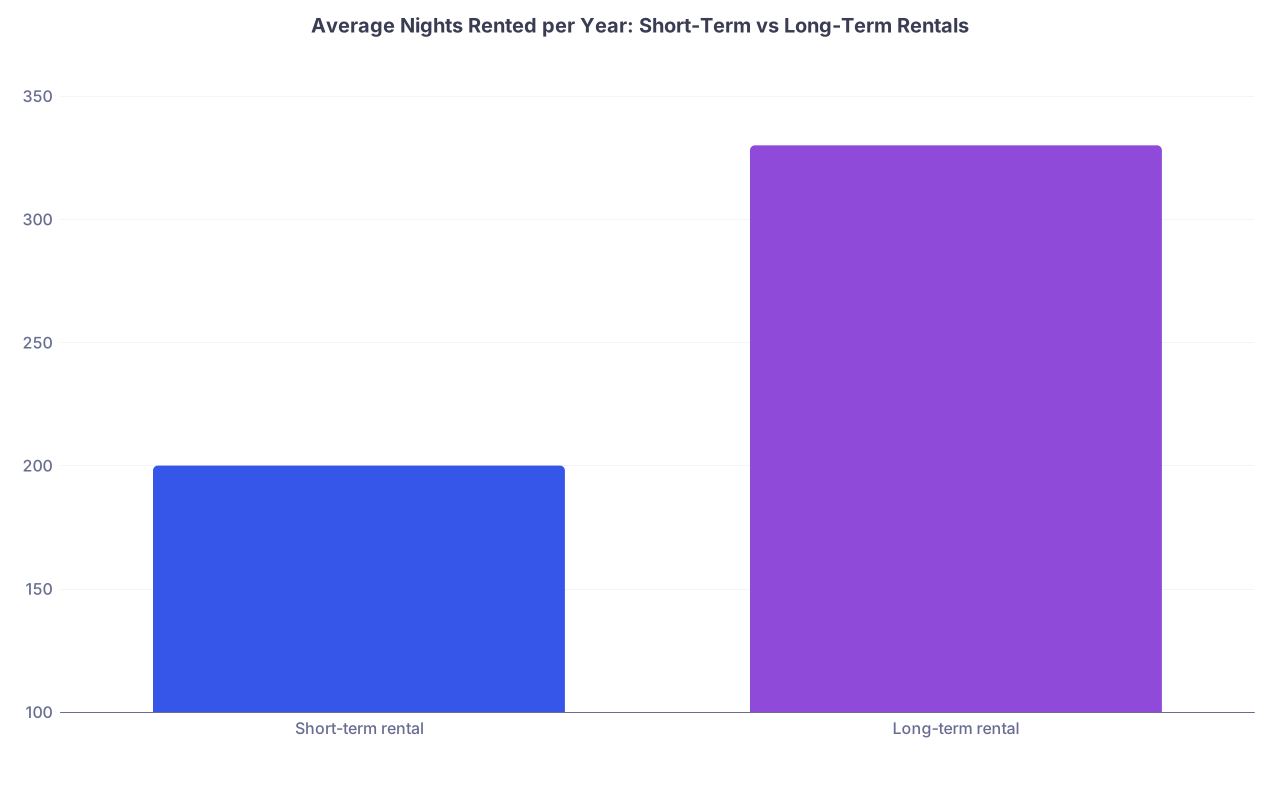
There is some truth here. Unlike long-term rentals, short-term rentals with an average stay of 7 days or less are not automatically treated as “rental activities” under the passive loss rules. If you also materially participate, losses can be treated as non-passive.
Material participation usually means satisfying one of the tests, commonly:
- 500+ hours of participation, or
- You do “substantially all” of the work, or
- 100+ hours and more than anyone else involved
Now, if you:
- Buy a high-cost STR property
- Do a cost seg study with bonus depreciation
- Genuinely manage it yourself at a high level
You can indeed create big losses that offset clinical income in that year.
But here’s why I’m not in love with the “buy an Airbnb to save taxes” movement for physicians:
It pushes you into the worst possible operator profile
You’re a high-opportunity-cost professional trying to run a hospitality business nights and weekends. That is rarely optimal.It encourages overpaying for properties
When your main goal is “a $200K loss this year,” you stop underwriting deals on actual cash flow and risk. Dangerous.The rules are nuanced and evolving
Misclassify, under-document, or rely on a weak material participation claim, and you can lose in audit years later—plus penalties and interest.
The STR strategy can work, but it’s not a free lunch. It’s a hospitality business you must operate well, not a tax hack you skim over in a Facebook group.
Real Estate vs Simple Index Investing: What the Numbers Actually Show
| Feature | Direct Real Estate | Stock Index Funds (Taxable) |
|---|---|---|
| Tax on cash flow | Often sheltered by depreciation | Taxed annually on dividends |
| Tax on growth | Capital gains + dep. recapture | Mostly deferred until sale |
| Effort required | High (if direct) | Very low |
| Concentration risk | High (few assets) | Low (broad diversification) |
| Liquidity | Low | High |
Most of the “real estate always wins” arguments compare:
- Highly leveraged, hand-picked real estate in a boom market
to - Unleveraged, average stock returns, usually misquoted
A more sober comparison:
- A physician with a $500K taxable brokerage account, invested in low-turnover index funds, is typically paying an effective tax drag in the low single digits annually.
- That same $500K used as equity in leveraged rentals or syndications might produce better or worse after-tax returns depending on:
- Deal quality
- Leverage level
- Fees (especially in syndications)
- Your tax situation
The reality: from a pure tax-efficiency standpoint, broad stock index funds in taxable accounts are already very good. Real estate isn’t required to “fix” them.
What real estate actually does:
- Adds different tax levers (depreciation, exchanges).
- Adds different risks (operator risk, illiquidity, local market risk).
- Requires more effort and due diligence.
If you want more wealth and lower taxes, you don’t start by asking, “What’s the coolest vehicle?”
You start with: “Do I want to run or co-own real businesses (properties) or not?”
When Real Estate Does Make Sense as a Tax Strategy for Physicians

Let me be fair. There are scenarios where the “real estate as tax strategy” story is not hype.
Here’s where I’ve seen it work well:
High-earning physician couple, non-clinical spouse runs the real estate portfolio
- Spouse legitimately qualifies for REPS and manages several properties.
- They do cost segs on large properties to generate losses.
- Those losses offset the physician’s income; they build a serious portfolio over 10–20 years.
Late-career physician transitioning out of clinical work
- Starts buying and self-managing more real estate.
- Gradually shifts hours from medicine to real estate, eventually qualifying for REPS.
- Uses accumulated knowledge and scale to run it like a business, not a hobby.
Physician with true interest and aptitude for operating an STR portfolio
- Treats short-term rentals as a serious business with systems, not as a toy.
- Underwrites deals primarily on cash flow and return on invested capital, secondarily on tax timing.
Passive investments used to shelter other passive income
- Physician already has significant passive income streams.
- Uses real estate depreciation to offset those, even without REPS.
- Clear, rational play for someone with multiple K‑1s.
The common thread: taxes enhance an already sound investment or business strategy. They’re not the reason to buy.
Red Flags: When “Tax Benefits” Are a Sales Tactic, Not a Feature
| Category | Value |
|---|---|
| Tax savings emphasized | 55 |
| Cash flow emphasized | 20 |
| Total return emphasized | 15 |
| Capital preservation emphasized | 10 |
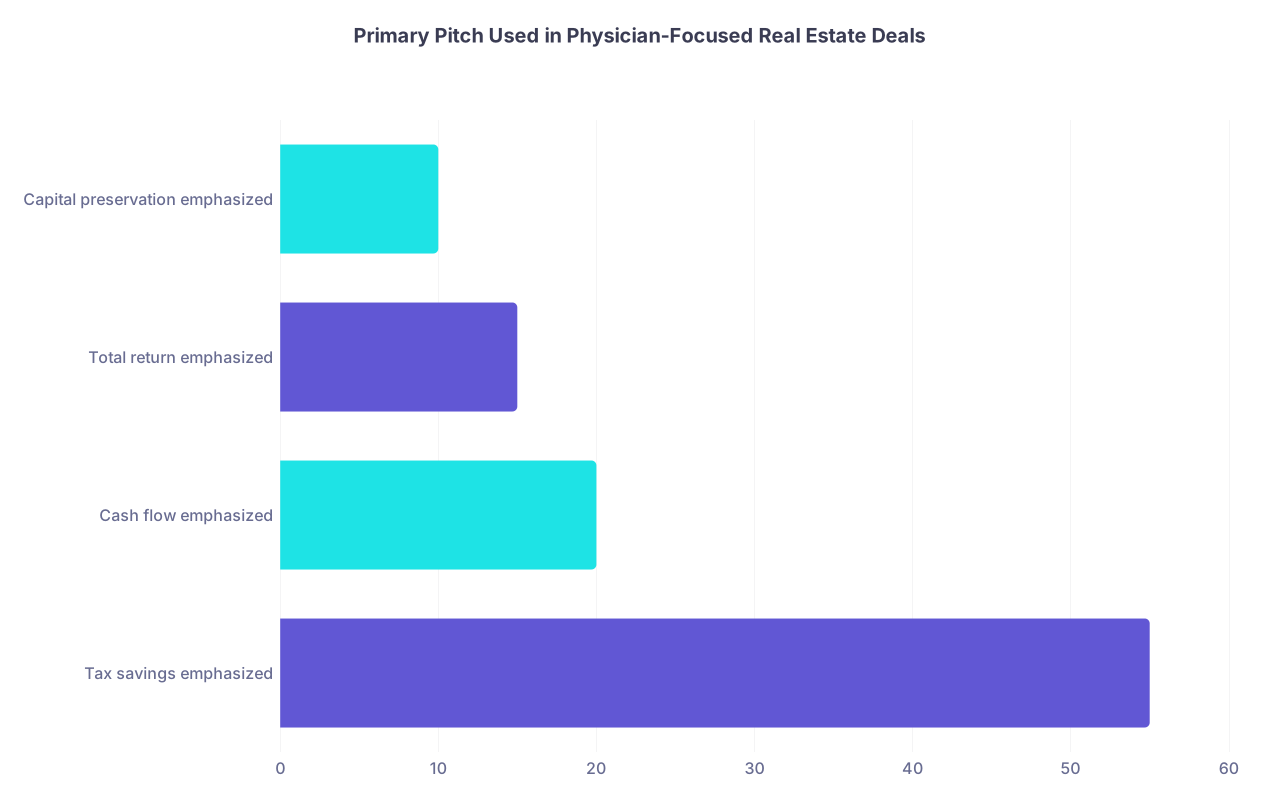
Watch out for any deal or advisor who:
- Leads the conversation with “how much tax you’ll save” more than:
- Net operating income
- Capitalization rate
- Sponsor track record
- Debt structure
- Promises or implies that you’ll offset your W‑2 income without clearly explaining passive vs non-passive rules
- Waves away documentation or REPS requirements with “everyone does it”
- Can’t show a model of returns without the tax benefits and still have it look decent
If the numbers only “work” because of aggressive tax assumptions, the numbers don’t work.
So… Is Real Estate the “Ultimate Physician Tax Haven”?
No.
It’s a flexible, sometimes powerful tool set in a complex tax code. For the right physician, in the right circumstances, real estate can:
- Accelerate deductions
- Smooth cash flow
- Defer and shape when you recognize income
But it is not a magic portal where tax disappears and all deals are good deals.
Use real estate tax benefits intelligently if:
- The investment stands on its own first.
- You understand passive vs non-passive treatment.
- You’re not faking real estate professional status.
- You’re willing to own the operational and concentration risk.
If all you really want is less tax on your income, fix your entity structure, retirement contributions, and basic tax planning first. Then decide—coldly—whether real estate is a business you actually want to be in.
Key points to walk away with:
- Real estate tax benefits are real, but most physicians can’t use rental losses to offset W‑2 or practice income without genuinely changing how they spend their time.
- Any deal that only looks attractive because of “tax savings” is almost always a bad deal. Underwrite the investment, not the deduction.
- For many physicians, boring index funds plus solid baseline tax planning beat overhyped, high-fee real estate plays pretending to be “ultimate tax havens.”


