

Most physicians are using HSAs like a checking account. That is a tax planning mistake.
If you are a physician with a solid income and you are not treating your HSA as a stealth retirement account and tax shelter, you are leaving money on the table every single year.
Let me walk through this surgically, the way you would approach a complex case: pre‑op planning (eligibility and structure), operative technique (how to actually execute advanced strategies), and long‑term follow‑up (withdrawal and documentation discipline).
1. The Triple Tax Advantage: Why HSAs Are Not “Just” Savings Accounts
Most doctors know the slogan but do not actually use it to its full extent.
The triple tax advantage of a Health Savings Account:
- Contributions are pre‑tax (or tax‑deductible)
- Growth is tax‑free
- Qualified withdrawals are tax‑free
That combination is extremely rare in the U.S. tax code. Even your 401(k) and Roth IRA cannot pull off all three simultaneously.
Let’s put some numbers on it for a physician household maxing the HSA.
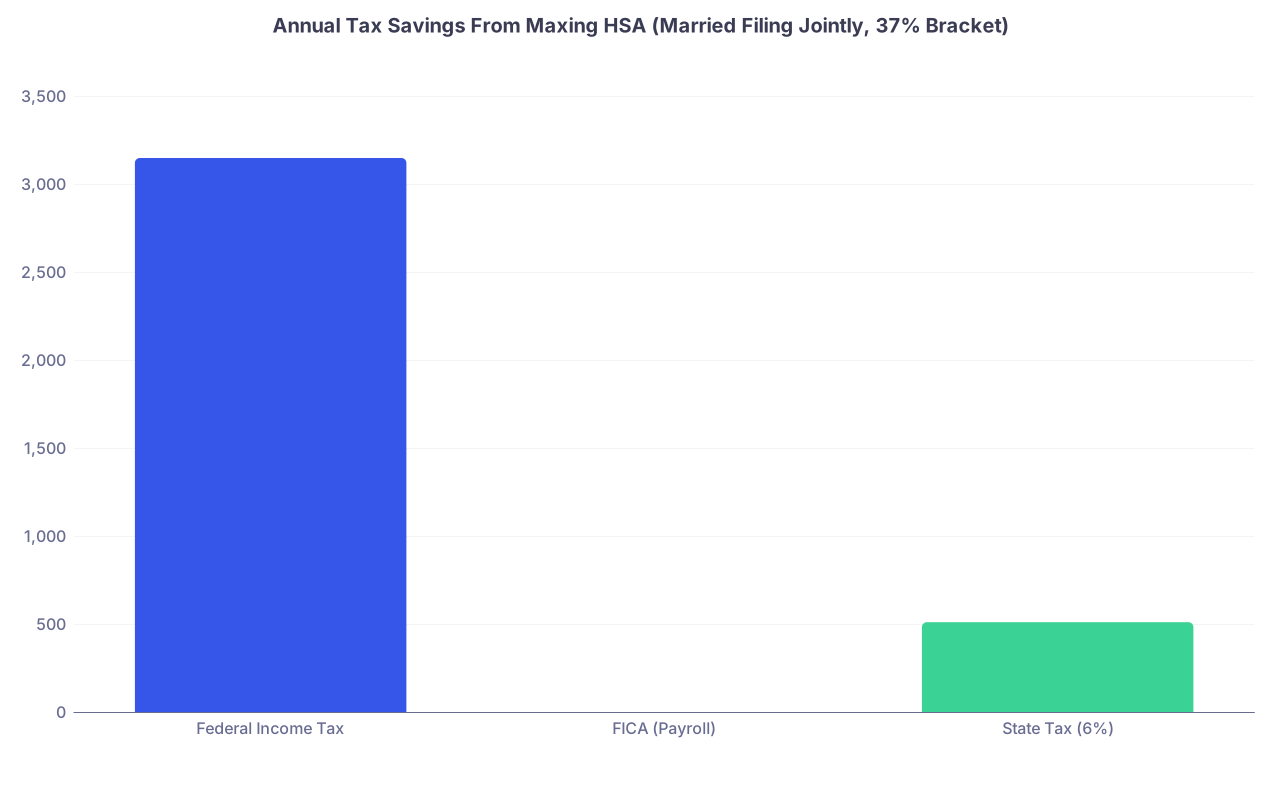
| Category | Value |
|---|---|
| Federal Income Tax | 3148 |
| FICA (Payroll) | 0 |
| State Tax (6%) | 510 |
Assumptions:
- Family HSA contribution limit 2025: $8,300 (I will use round numbers near current law; update annually)
- Marginal federal tax rate: 37%
- State tax rate: 6%
- HSA funded via pre‑tax payroll deductions (so no FICA savings for you as an employee, but yes for your practice on employer side)
Your immediate annual tax savings: roughly 43% of your contribution in combined fed+state. Around $3,500–$3,700 each year. That is before any compounding.
Now extend this over time.
If you:
- Max the family HSA every year for 20 years
- Invest it in a diversified portfolio with 6–7% annualized returns
- Avoid touching it for current medical expenses
You are very realistically looking at a mid–six-figure tax‑free pile in your 50s or early 60s that can be withdrawn for medical expenses without paying a cent in tax.
That is the baseline. Now we layer on physician‑specific strategy.
2. HSA Eligibility and Plan Design for Physicians
The first place physicians mess this up is at the plan level. They either assume:
- “I am a high utilizer, so an HDHP is bad for me,” or
- “My hospital’s PPO is better because co‑pays feel smaller.”
Often wrong, especially for two‑physician households or high earners with cash reserves.
What qualifies as an HSA-eligible plan?
You (and your spouse, if on the same plan) must be covered by a High Deductible Health Plan (HDHP) that meets IRS rules:
- Minimum deductible (2025 family ballpark): ~$3,200
- Maximum out‑of‑pocket (OOP) limit (family): ~$16,000
- No first-dollar coverage for anything except preventive care
If your plan gives you copays for office visits before the deductible, it is probably not HSA-eligible. Many hospital systems offer both a “traditional PPO” and a “HSA-compatible HDHP.” You want the latter if you are going to use advanced strategies.
Physician-specific decision points
Here is how I see this in actual physician households:
- Dual‑physician couple, no chronic conditions, income $500k+: HDHP + HSA is almost always the right move. You can easily cash-flow the deductible and let the HSA grow.
- Physician + nonworking spouse + young kids: still often HDHP favorable, especially if employer HSA contributions are strong. But pediatric frequent flier visits can tilt the calculus; run the numbers.
- Physician with chronic disease, frequent expensive medications: sometimes the rich PPO with low OOP makes more sense, but not always. Compare total premium + expected OOP + lost HSA benefits.
Do the math, not the vibes.

3. The “Stealth IRA” Strategy: Spend Cash, Save Receipts, Invest the HSA Aggressively
This is where you separate casual HSA users from people who actually understand the tax code.
Most people:
- Contribute to their HSA
- Spend from the HSA debit card for every copay and prescription
- Keep the balance low
That is fine for a nurse making $60k. It is inefficient for a physician in the top bracket.
The core play
You do the opposite.
- Max the HSA every single year.
- Invest the HSA in broad, low‑cost index funds—just like a 401(k).
- Pay all current medical expenses from taxable cash (checking/credit card).
- Save every receipt and EOB in a digital archive.
- Decades later, reimburse yourself from the HSA—tax‑free—whenever you want, for those past expenses.
No time limit under current IRS rules, as long as:
- The expense was incurred after the HSA was established, and
- You were HSA-eligible at the time, and
- You were not already reimbursed from elsewhere, and
- You have documentation.
That gives you a way to convert what would normally be taxable retirement withdrawals into tax‑free cash in your 50s, 60s, whenever.
Concrete example
You start an HSA at age 35.
From 35–50:
- You contribute $8,000 a year
- You invest it, average 6.5%
- By 50, you have around $210,000+ in the HSA
- Over those 15 years, you paid $3,000–$5,000/year in family medical expenses from taxable cash, not the HSA
- You kept receipts totaling, say, $45,000
At age 50, you can log into your HSA custodian and pull out $45,000 completely tax‑free, transferring it to your checking account, justified by past receipts. Meanwhile, the rest of the HSA stays invested and continues compounding tax‑free.
No one in HR explains this to you because almost no one thinks beyond “use your HSA debit card.”
4. Advanced Receipt Strategy: Document Like You Chart
If you are going to reimburse yourself years later, you better be meticulous. Just like documentation in the chart, if it is not documented, it did not happen.
At a minimum, you want:
- Date of service
- Provider or vendor
- Description of service or item
- Proof of payment
- Confirmation that insurance did not also reimburse you (EOBs help)
How to systematize this
Here is how I have seen physicians do this cleanly:
- Set up a dedicated email folder and cloud drive folder named “HSA Receipts.”
- Every time you get an EOB or receipt, forward it to that folder or snap a photo with a scanning app (not just your camera—use something that makes PDFs).
- Rename files with:
YYYY-MM-DD_Provider_Amount.pdf - Maintain a simple spreadsheet or note: date, provider, amount, brief description, “reimbursed: no/yes”.
You do not need to send this to the HSA custodian now. You only need it if you are audited later. The burden of proof is on you, not on them.

| Step | Description |
|---|---|
| Step 1 | Pay Medical Expense With Cash |
| Step 2 | Get Receipt or EOB |
| Step 3 | Scan or Save as PDF |
| Step 4 | Upload to HSA Folder |
| Step 5 | Log in Spreadsheet |
| Step 6 | Track Total Unreimbursed Expenses |
| Step 7 | Later Decide on HSA Reimbursement |
5. Investment Strategy Inside the HSA: Treat It Like Long-Term Money
Too many physicians leave their HSA in a 0.5% cash fund “just in case.” That destroys the whole stealth IRA strategy.
If your plan is:
- To use the HSA for this year’s bills → Yes, stay more conservative, keep some cash.
- To use the HSA as a long‑term tax‑free growth engine → You invest like you do in your 401(k)/Roth.
Basic allocation for physicians
Most mid‑career physicians with 15–30 years to retirement and decent risk tolerance go with some mix of:
- 60–90% broadly diversified stock index funds (US + international)
- 10–40% bonds or stable value, depending on age and risk
Inside the HSA, if you are doing the cash-pay, save‑receipts strategy, you can arguably be more aggressive here than in your taxable accounts. The tax shelter is that valuable.
But one catch: Many HSA custodians force you to keep a cash “threshold” (e.g., first $1,000–$2,000 must stay in cash). Accept it and invest the rest.
| Approach | Typical Use Case | Risk Level |
|---|---|---|
| All cash | Short-term spenders | Low |
| 60/40 stocks/bonds | Moderate risk, 10–15 yr view | Medium |
| 80–100% stock index | Long-term, stealth IRA use | High |
6. Using Your Practice or Employer to Supercharge the HSA
Employees typically think, “I can only put in what the IRS lets me.” Owners and partners have more levers.
Employee vs owner differences
If you are:
- Hospital-employed W‑2 physician: You are limited to the annual HSA family/individual cap, including employer contributions. Your strategy is mainly allocation and receipt management.
- Partner in a group / S‑corp / C‑corp owner: You can structure employer contributions and plan design more creatively, within legal limits.
A few advanced plays I have seen in private practices:
- Employer HSA contributions as part of total compensation.
- E.g., practice contributes $2,000 per physician to the HSA, and physician can defer the rest via pre‑tax payroll up to the IRS cap.
- Pairing HDHP + HSA with a limited-purpose FSA (for dental/vision only).
- Lets you keep HSA funds invested while using FSA for predictable ortho/dental/vision needs.
- Designing the practice’s health plan to stay HSA-eligible while still being relatively generous.
- Higher deductible, but employer funds part of it with HSA contributions.
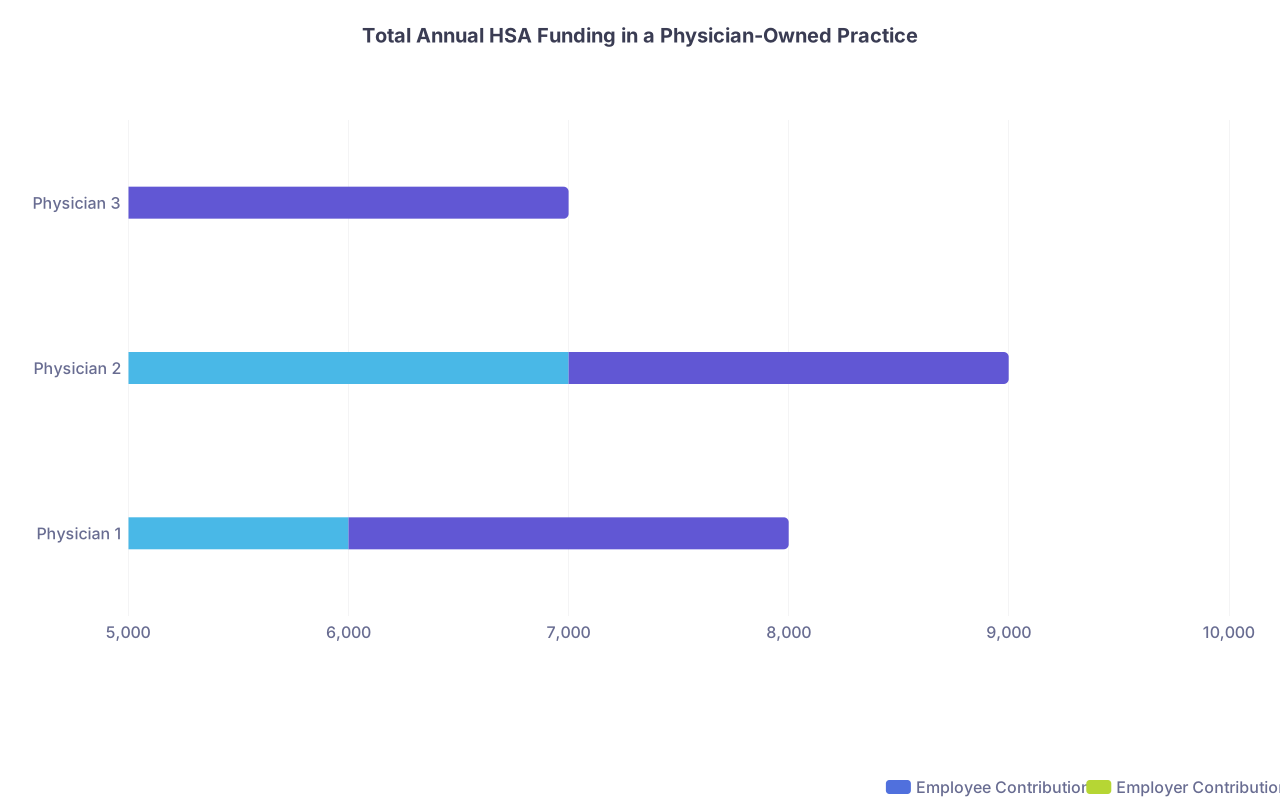
| Category | Employee Contribution | Employer Contribution |
|---|---|---|
| Physician 1 | 6000 | 2000 |
| Physician 2 | 7000 | 2000 |
| Physician 3 | 5000 | 2000 |
You still cannot exceed the IRS annual family/individual contribution cap per “HSA family,” but you can shift more of the funding to the employer side, which generates payroll tax savings for the practice.
7. HSAs Across Your Career: Early Career, Peak Earnings, and Retirement
Your HSA strategy should not look the same at 32 as it does at 62. Let me break it down by phase.
Early career (residency / fellowship / first few years attending)
Reality check:
- Many residents do not have HSA-eligible plans at all. Your GME program usually offers a cheap PPO, not an HDHP. So HSA might not even be on the table.
- First few years out, you are often buried under loans and buy-ins. You may not max retirement and HSA simultaneously.
If you do have an HSA-eligible plan early:
- Any amount you can put in is valuable because the years of compounding are long.
- Even $1,000–$2,000 per year invested in a stock index fund during residency can grow meaningfully.
Peak earnings (mid‑career attending)
This is your main HSA accumulation window.
Typical physician in this stage:
- Maxing 401(k) or 403(b)
- Doing backdoor Roth IRA
- Building taxable brokerage
- Possibly doing defined benefit / cash balance plan if a partner
HSA should sit near the top of the priority list, ahead of taxable investing and usually tied with backdoor Roth in priority. It is that tax‑efficient.
My common order for high-income docs:
- Get full employer match (401(k)/403(b)).
- Max HSA.
- Max 401(k)/403(b).
- Backdoor Roth IRA(s).
- Taxable brokerage and other vehicles.
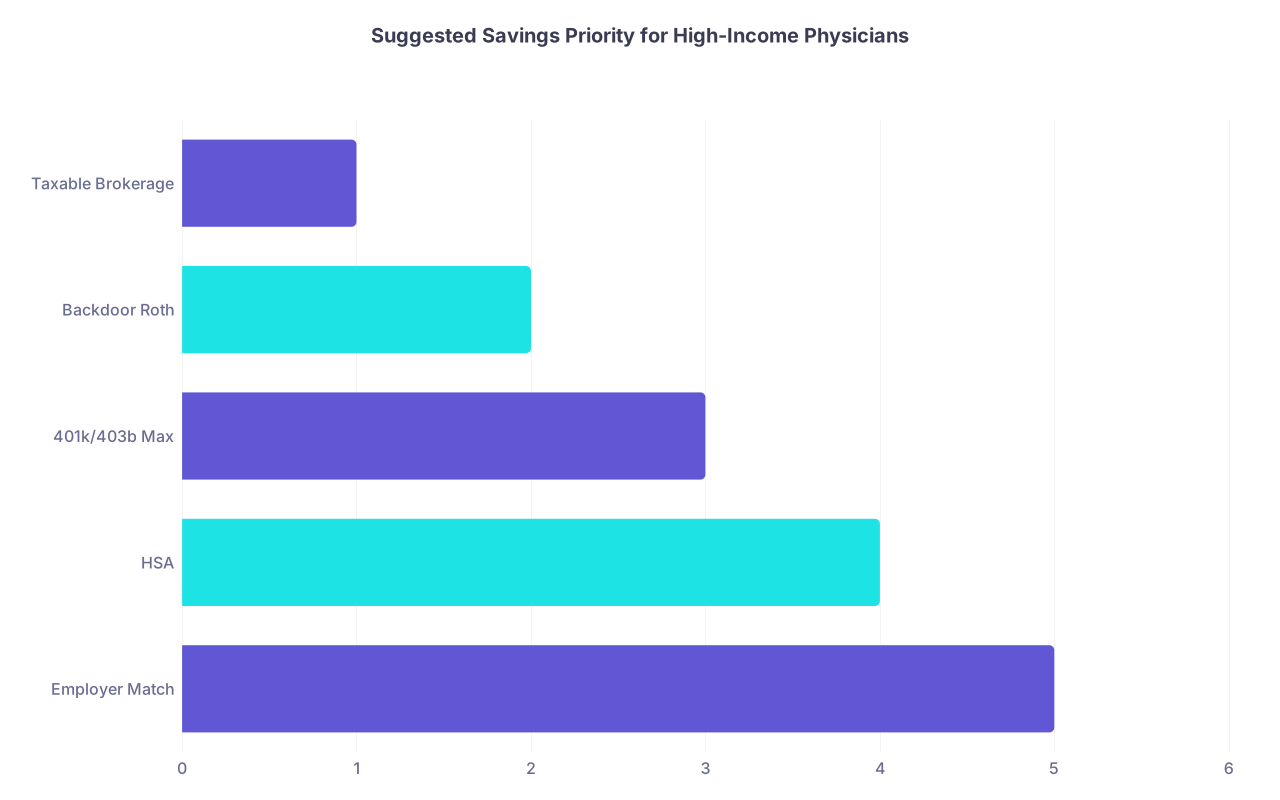
| Category | Value |
|---|---|
| Employer Match | 5 |
| HSA | 4 |
| 401k/403b Max | 3 |
| Backdoor Roth | 2 |
| Taxable Brokerage | 1 |
(The numbers here reflect priority rank, not dollars.)
Pre‑retirement and retirement
Once you are within 5–10 years of retirement, your HSA looks more like:
- A tax‑free pool for Medicare premiums, long‑term care insurance premiums (within limits), and out‑of‑pocket healthcare.
- A reimbursement engine for decades of saved receipts if you have used the stealth IRA approach.
After age 65:
- You can withdraw HSA funds for non‑medical purposes without penalty. You pay ordinary income tax, just like a traditional IRA.
- That means in the worst case, an HSA behaves like an extra IRA. Not bad.
But optimal use is still for medical expenses, which in retirement are not exactly scarce.
8. Common Pitfalls and Physician-Specific Traps
Physicians are not immune to basic tax errors. I see the same HSA mistakes repeatedly.
1. Treating FSA and HSA like interchangeable tools
You cannot have:
- A general purpose FSA and
- An HSA for the same coverage period
…unless the FSA is “limited-purpose” (dental and vision only) or post-deductible.
If you or your spouse enroll in a general medical FSA, you likely blow your HSA eligibility for that year. HR will not rescue you. You have to know this going in.
2. Contributing while ineligible
Two big offenders:
- You enroll in Medicare (any part other than Part A retroactive effects) but keep contributing to HSA. Not allowed.
- You switch mid‑year to a non-HDHP but still put in the “full-year” HSA amount without prorating via the last-month rule and testing period rules.
If you mess this up, you owe taxes and a 6% excise penalty on the excess until corrected.
3. Paying for ineligible expenses
HSA‑qualified expenses are similar, but not identical, to what you think of under “medical.” You cannot pay:
- Health insurance premiums (with a few specific exceptions—COBRA, long‑term care within caps, Medicare once eligible, and coverage during unemployment)
- Non-dependent children’s expenses who are not dependents on your tax return
- Cosmetic surgery without medical necessity
And no, you cannot use your HSA to buy your spouse a Peloton and call it rehab gear.
4. Using HSA as a checking account while hoarding taxable investments
This one I see constantly.
Physician has:
- $25,000 sitting in an HSA cash account earning 1%
- $200,000 in a taxable brokerage, 80% in stock index funds
- Pays this year’s $4,000 medical expenses from the HSA to “use the tax-free money”
That is backwards.
Better alignment:
- Invest the HSA aggressively
- Pay medical expenses from taxable brokerage (which reduces eventual capital gains) or from cash flow
- Preserve the HSA tax shelter long-term
9. Coordinating HSAs With the Rest of Your Physician Tax Plan
An HSA does not live in isolation. It interacts with:
- Backdoor Roth IRA strategy
- Mega backdoor Roth (if your plan allows after‑tax 401(k) contributions)
- 529 plans for kids
- Taxable brokerage and real estate
A few practical integration tips:
- Do not skip the HSA in order to put more into a 529. Your kids can get loans. You cannot get retirement loans. The HSA’s tax profile is superior.
- In years with unusually high medical expenses (infertility treatments, major surgery), consider selectively tapping the HSA if you truly need liquidity—but try to restore the balance ASAP via future contributions.
- If your spouse is not working, consider having the family on your HDHP, you max the family HSA, and they maintain a limited-purpose FSA if their side gig allows (less common, but I have seen it in dual-physician households).
The HSA is one of the few don’t‑overthink‑it vehicles in an otherwise messy tax landscape. But the mechanics and sequencing do matter.
10. Quick Compliance Checklist for Physicians Using Advanced HSA Strategies
Think of this as your pre‑op checklist. Before you start doing stealth IRA tricks, confirm:
- Your health plan is truly HSA‑eligible (check SPD, not just HR emails).
- You have not enrolled in a general purpose FSA (you or spouse).
- You are not on Medicare, TRICARE, or another disqualifying coverage.
- Total contributions (employee + employer + your own) do not exceed the annual family/individual limit.
- You have a system for saving receipts and EOBs.
- Your HSA balance above your cash “comfort amount” is invested in a rational, low-cost portfolio.

If those are all “yes,” you are likely using your HSA in the top 5–10% of sophistication among physicians.
Key Takeaways
- An HSA is not a glorified checking account; used properly, it is one of the most powerful triple-tax-advantaged vehicles available to physicians.
- The highest‑yield strategy for high-income physicians is to max the HSA annually, invest it aggressively, pay current medical costs from taxable cash, and maintain meticulous receipt records for future tax‑free reimbursements.
- Plan design, eligibility, and coordination with FSAs, Medicare, and the rest of your retirement strategy matter. Get those wrong, and you lose the advantage; get them right, and your HSA becomes a stealth, tax‑free medical war chest in retirement.


