

The worst retirement mistake successful physicians make is clinging to a 401(k)-only mindset long after their income outgrows it.
For a mature, high-earning practice, relying only on a 401(k)/profit-sharing plan is like trying to funnel a firehose through a drinking straw. That is exactly where a properly designed defined benefit (DB) or cash balance plan can be a weapon—not a “nice-to-have”.
Let me break this down specifically, because most of what you hear about pensions in medicine is either outdated, oversimplified, or driven by someone selling a product.
1. What a Defined Benefit Plan Actually Is (In Physician Language)
A defined benefit plan is not “another 401(k).” It solves a very specific problem:
You want to move a lot of pre-tax money out of your practice quickly, with much larger annual deductions than a 401(k)/profit-sharing plan will allow, especially in your last 5–15 high-income years.
Mechanically, here is what it is:
- A qualified retirement plan under ERISA, like a 401(k), but:
- Your benefit is defined as a promised retirement benefit, not just contributions.
- Contributions are actuarially determined each year based on:
- Your age
- Your compensation
- Your years to retirement
- Investment assumptions
Translation:
Older, higher-earning physicians get very large allowable contributions, often low-to-mid six figures per year, on top of 401(k)/profit-sharing.
The variation used most commonly in medical practices is the cash balance plan, which is technically a type of defined benefit plan but behaves like a hybrid:
- On paper, it promises a hypothetical account balance growing at a fixed crediting rate (say 4–5%).
- Behind the scenes, the actuary sets annual required contributions to fund those promised balances.
You still get the massive deductions. You just see them expressed as “pay credits” into notional accounts.
Here is why physicians care:
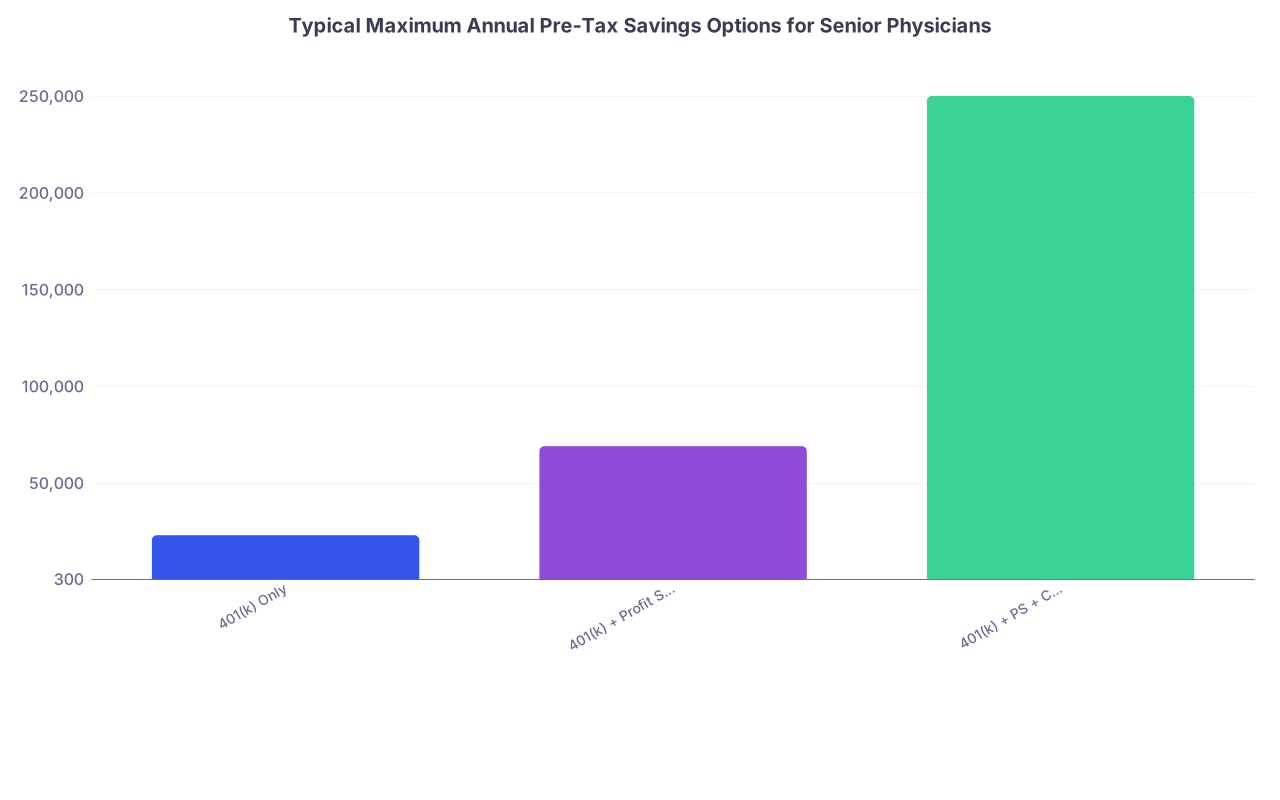
| Category | Value |
|---|---|
| 401(k) Only | 23000 |
| 401(k) + Profit Sharing | 69000 |
| 401(k) + PS + Cash Balance | 250000 |
Assumptions: Age 50+, using catch-up contribution, and generous profit-sharing / cash balance design. The exact numbers move each year, but the order of magnitude is right.
The key point: If your practice generates $800k–$1.5M per physician, a $66k–$70k cap (401(k)+profit-sharing) is not cutting it. The tax leakage is enormous.
2. The Profile: Which Physician Practices Are an Actual Fit?
Not every group should touch a DB or cash balance plan. There are very clear “this makes sense” and “absolutely not” profiles.
Let me split this in two: practice-level traits and physician-level traits.
Practice-Level: When a Defined Benefit Plan Makes Sense
You are more likely an excellent candidate if your practice has:
High, stable profitability
Think: per-partner compensation consistently above $500k (and often $800k–$1.5M), with multi-year stability.
Classic fits:- Mature anesthesia groups
- Radiology practices
- Orthopedic surgery groups
- Cardiology groups
- Single-specialty GI groups
- Large dermatology or ophthalmology practices
Low or manageable staff-to-owner ratio
This is where most practices blow it. You cannot ignore staff.
With a defined benefit or cash balance plan, you almost always must contribute something for eligible non-physician staff (or at least for key long-term staff).
High staff count + long tenure + high wages = expensive.
Good fits:- 3–10 physician partners
- 5–25 total staff
- Willingness to do tiered benefits (owners vs staff) within legal bounds
Existing 401(k)/profit-sharing structure in place
Strong indicator you are ready for the “next layer”:- Safe harbor 401(k) already
- Profit-sharing contributions annually
- No major compliance or participation issues
DB plans usually sit on top of a 401(k)/profit-sharing combo.
Predictable practice horizon (not trying to sell in 1–2 years)
You do not start a DB plan if you are about to:- Sell to a hospital system or private equity
- Merge into a much larger group with very different economics
- Retire in 1–2 years with no one to take over
A 5–10 year runway is ideal. You can make shorter work if income is very high and stable, but don’t play games with a 2-year horizon unless you are working with a very experienced actuary and ERISA counsel.
Administrative maturity
You have:- A real practice manager
- A CPA who does more than just your tax return
- A benefits advisor / TPA you actually trust
This is not a plan you manage out of a shoebox.
Physician-Level: Which Individual Doctors Benefit Most?
At the physician level, DB/cash balance plans are tailored weapons for:
Age 45–65 physicians in their peak earning years
Why? Because the formula allows bigger annual contributions as you age.
A 58-year-old neurosurgeon can often put $200k–$300k+ per year into a cash balance plan. A 35-year-old FP cannot justify that sort of funding under normal assumptions without contortions.High-tax-bracket physicians who actually care about after-tax math
If you are in:- 37% federal bracket
- Plus state tax (CA, NY, NJ, MN, etc.)
Your marginal rate can easily be 45–50%.
Now multiply that by an extra $150k–$250k deduction per year. The immediate tax savings alone are often $70k–$120k each year. Those numbers get people’s attention.
Physicians playing “catch-up” on retirement
I see this constantly:- 52-year-old partner
- Paid off practice debt, kids almost done with college
- Net worth is fine, but not at “walk-away” level
- Suddenly realizes 401(k)+taxable accounts are not going to fund the lifestyle they want at 60
A defined benefit / cash balance design is one of the few legal tools where you can compress 20 years of savings into 8–10 years.
Partners with long-term commitment to the group
Defined benefit plans hate churn.
If you have:- High partner turnover
- Frequent entry/exit of owners
You can design around it, but every change has funding and benefit implications.
Strongest fits: senior partners committed through a planned retirement age, with junior partners gradually buying in under a clear formula.
Physicians who already max everything else
If you are not even maxing your 401(k), stop. Fix that first.
DB plans make sense after:- 401(k) employee deferral maxed
- Profit-sharing allocation maxed (usually 20–25% of comp up to the limit)
- HSA funded
- Reasonable taxable investing underway
Then you look at defined benefit.
To make this concrete:
| Scenario | Fit Level |
|---|---|
| 56-year-old orthopedic surgeon, $1.1M income, 4-partner group | Excellent |
| 48-year-old radiologist, $800k income, small group, low staff | Strong |
| 38-year-old hospital-employed internist, W-2, no partnership | Not a fit |
| 60-year-old solo dermatologist, 2 staff, selling in 7 years | Good |
| 45-year-old GI in large PE-owned rollup, no control over benefits | Not a fit |
3. The Tax Mechanics: Why High-Earning Physicians Actually Use These
Enough theory. Let’s talk numbers.
Assume:
- 58-year-old orthopedic surgeon
- S-corp practice, stable income: $1.0M W-2/guaranteed comp
- Lives in a high-tax state with combined effective marginal rate ~45%
Without defined benefit:
- 401(k) employee deferral: ~$23,000 (with catch-up; numbers change annually)
- Employer profit-sharing: up to plan limit (~$43,500)
- Total qualified: ~ $66,500–$70,000
With defined benefit / cash balance:
- Same 401(k)+profit-sharing
- Plus cash balance contribution: say $200,000 (very realistic at 58)
- Total qualified: ~$270,000
Tax impact:
- Extra $200,000 deduction
- At 45% marginal rate → ~$90,000 tax saved this year
- Over 7 years of continued work:
- $200,000 × 7 = $1.4M additional pre-tax contributions
- $90,000 × 7 = $630,000+ in cumulative tax savings
- Plus tax-deferred growth
Is it “worth it” to commit to contributions and plan maintenance? For a surgeon staring at a 7-year runway and $630k+ in tax savings: usually yes.
Now, here is what the IRS cares about:
You are not allowed to fund these like a game. The actuary must certify annual contributions based on reasonable assumptions. You can usually fund within a range each year (minimum required vs maximum deductible), but this is not a switch you flip on and off casually.
For a mature group, that range gives planning flexibility:
- Great income year? Fund closer to maximum.
- Tight year? Stay near minimum but still maintain the plan.
4. Staff Costs and Design Tricks (Where Most Practices Get Burned)
This is the part nobody wants to talk about. You cannot (legally) create a huge defined benefit plan exclusively for owners and give staff nothing.
We are in ERISA world here. That means:
- Minimum coverage rules
- Non-discrimination testing
- Top-heavy rules
In English: Owners cannot get wildly better benefits than staff without satisfying certain mathematical fairness tests.
However, there are design tools to keep staff costs manageable while still rewarding long-tenured employees.
Common approaches I have seen work in physician groups:
Owner-only DB plan with separate 401(k)/profit-sharing for staff
Sometimes you can structure:- Cash balance/DB plan for owners only (if testing allows)
- Beefed-up profit-sharing for staff to keep the numbers compliant
This can work best when: - Staff are younger
- Staff wages are lower
- There are relatively few highly paid non-owner physicians or executives
Tiered profit-sharing contributions
For example:- Owners: 20–25% of comp
- Staff: 5–7.5% of wages
Tests must pass, but your TPA can often make the math work.
Eligibility and vesting levers
You do not want:- High turnover staff fully vesting in generous contributions immediately.
Reasonable strategies: - Waiting period: 1 year of service before entry
- 3-year cliff vesting or graded 6-year schedule
This is specifically important in specialties with high MA or front-desk turnover.
- High turnover staff fully vesting in generous contributions immediately.
Use of cash balance “grouping”
In advanced cases, you can assign different benefit levels to different classes:- Owner-physician group: high accrual rate
- Non-owner physicians: moderate
- Staff: minimal or via DC plan only
All must be tested as a whole. You need a very competent actuary/TPA for this.
Let me underline something:
If you ignore staff impact and run only owner numbers, you will think a DB plan is the best thing ever. Then your TPA runs discrimination testing and suddenly you either:
- Have to give staff much larger contributions than you expected
- Or the plan fails nondiscrimination and must be redesigned
Do not shortcut this. Run integrated projections: owner + staff, across 5+ years.
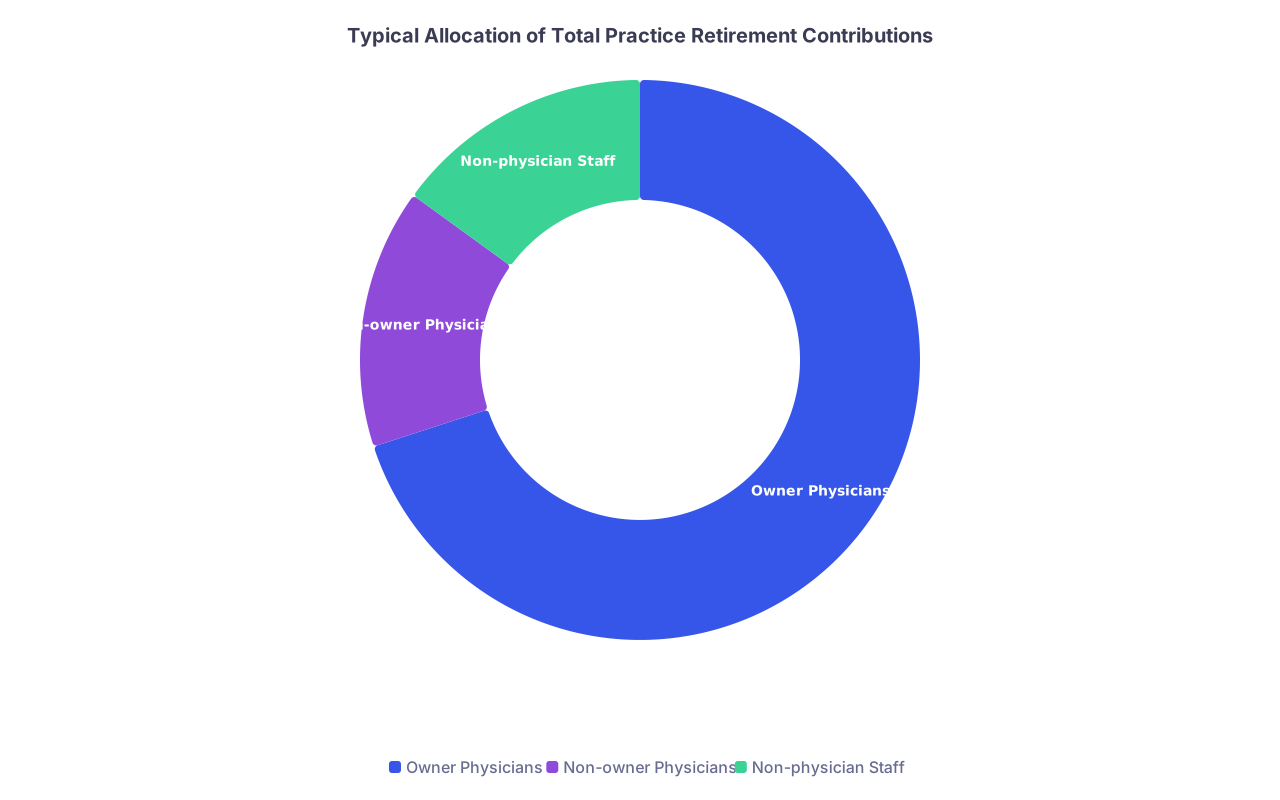
| Category | Value |
|---|---|
| Owner Physicians | 70 |
| Non-owner Physicians | 15 |
| Non-physician Staff | 15 |
Those percentages are a realistic outcome for many mature practices: owners get the bulk of dollars, but staff still receive meaningful contributions.
5. The Legal and Structural Realities You Cannot Ignore
You are now squarely in ERISA and IRS-qualified plan territory. The complexity jumps compared to a simple 401(k).
There are a few legal and structural issues that decide whether this will be a smooth experience or a litigation-grade headache.
1. Plan Sponsorship and Entity Structure
The plan sponsor is usually the practice entity (PC, PLLC, S-corp, partnership). Here is where it gets fun:
- If you have multiple entities (ASC, imaging center, real estate, etc.), controlled group rules may require you to consider employees across entities.
- Common ownership thresholds matter (80%+ typically).
- You cannot just decide “we’ll only cover the ASC docs” if IRS rules say your controlled group is broader.
This is where a competent ERISA attorney plus your CPA need to talk to each other, not work in silos.
2. Fixed vs flexible funding reality
You will hear: “Defined benefit plans require fixed contributions; no flexibility.” That is lazy advice.
Reality:
- Each year, there is a minimum required contribution range and a maximum deductible limit.
- Within that corridor, you usually have flexibility, but there are consequences for:
- Consistent underfunding (can trigger excise taxes)
- Overfunding (benefit limits, future deduction caps)
You treat this as a long-term funding strategy, not a year-by-year whim.
3. Obligations when a partner leaves or retires
This is one of the least understood areas by physician partners signing on to DB plans.
Key questions your partnership agreement must answer:
How are accrued benefits handled when a partner:
- Fully retires at normal retirement age?
- Leaves early?
- Is kicked out?
- Dies or becomes disabled?
Who funds the unfunded liability if a partner exits?
- The group as a whole?
- That specific partner out of their buyout?
Are benefits portable (rolled into an IRA in lump sum) or structured as annuities?
I have seen groups implement fantastic DB plans and then blow up partner relationships because they did not align the plan document with the partnership agreement. Fix that upfront.
4. Investment management versus crediting rate
Especially for cash balance plans, you have two related but distinct concepts:
- Actual portfolio returns (what your investments do)
- Crediting rate (what you promise on paper to plan participants)
You want to avoid:
- Aggressive investing + conservative crediting rate that generates excess funding issues
- Or the reverse: underperforming the crediting rate badly and having to play catch-up with higher contributions
Most groups settle into:
- A relatively conservative allocation (lots of high-quality bonds, some equities)
- A crediting rate in the 3–5% range
You can also use variable crediting designs tied to market indices, but complexity jumps.
6. Red Flags: When a DB or Cash Balance Plan Is a Bad Idea
Sometimes the right advice is: walk away.
Here are clear “this is not for you” indicators:
Unstable or volatile income
If your group’s revenue swings wildly, and partners are not committed to smoothing compensation, mandatory contribution plans are a big risk.High staff count with long tenure and high wages
Example:- 8 physicians
- 50 staff, many with 10–20 years of service
You might still do something, but the staff cost may be so high that it wipes out owner benefit.
High partner turnover and no real governance
If your group:- Kicks out partners frequently
- Brings in and out part-time physicians regularly
- Has no serious partnership agreement
You are going to fight about who funds what every time someone leaves.
Doctors who only care about current cash, not long-term net worth
Some partners will look at a $200k cash balance contribution and only see “my take-home dropped by $110k” this year rather than:- “I lowered my tax bill by $90k and moved $200k into protected, tax-deferred assets.”
If the culture is anti-saving, forcing a DB plan can blow up group politics.
You are within 1–2 years of a major sale or alignment
Starting a plan right before a sale makes sense only in narrow, highly engineered scenarios. For most, it is not worth the administrative and funding commitment for such a short period.
7. Implementation Path: How a Mature Practice Should Actually Do This
Let me give you the sequence that works in the real world instead of the “here is a product” version.

| Step | Description |
|---|---|
| Step 1 | Partner Interest |
| Step 2 | Preliminary Modeling |
| Step 3 | Staff Impact Analysis |
| Step 4 | ERISA Counsel Review |
| Step 5 | Partner Vote and Policy |
| Step 6 | Plan Document and Setup |
| Step 7 | Investment Policy and Funding |
| Step 8 | Annual Review and Adjustments |
Step-by-step:
Preliminary owner-only modeling
Your advisor runs:- Owner ages, incomes, expected retirement horizon
- Rough DB/cash balance contribution ranges
This answers: is there even enough juice here to justify going further?
Staff cost and nondiscrimination modeling
Now the real work:- Load staff census (ages, compensation, tenure)
- Test different designs:
- Owner-only DB vs DB + DC integration
- Different eligibility and vesting rules
- Varying contribution tiers
You want a 5–10 year projection of:
- Owner contributions
- Staff contributions
- Total owner tax savings
If your advisor is not doing multi-year modeling, they are winging it.
Partner-level buy-in and policy
Decide:- Who is in the plan and who is not (sometimes senior partners only at first)
- Target contribution ranges
- Treatment of late-joining partners and exiting partners
Put this in writing alongside your partnership agreement.
ERISA attorney and plan document
You are defining:- Plan type (traditional DB vs cash balance)
- Normal retirement age
- Benefit formulas and crediting rates
- Eligibility rules
Do not sign boilerplate. Tailor it to your partnership and business reality.
Investment policy
Work with a fiduciary advisor to:- Align asset allocation with funding goals
- Understand risk of underperformance vs overperformance relative to crediting rate
- Decide on active vs passive, bond-heavy vs balanced, etc.
Annual cycle
Each year:- Actuary calculates required and maximum contributions
- Partners decide how aggressively to fund within the permitted range
- Contributions get allocated and deposited
- Investment performance is reviewed and strategy adjusted if needed
This sounds like a lot—and it is more complex than a simple SEP IRA—but for a mature, profitable practice, the benefit-to-complexity ratio is often very favorable.
8. Protected Assets and Exit Strategy: Thinking Beyond Taxes
One last dimension most physicians only appreciate later: asset protection.
In many states, qualified plan assets (like a DB or cash balance plan) enjoy very strong creditor protection. That matters for:
- Malpractice exposure (beyond policy limits)
- Business disputes
- Personal liability in non-medical areas
You are not putting money into just another investment account. You are:
- Lowering current taxes
- Building a retirement war chest
- Placing it in one of the most protected legal buckets available
At exit (retirement or leaving the group), options typically include:
- Lump-sum distribution rolled tax-free into an IRA
- Partial lump sum + annuity
- Full annuity (less common in practice groups, more in large institutional plans)
Design this upfront. Senior partners usually want:
- Maximum optionality
- Clear understanding of how their accrued benefit translates into real dollars at retirement
Final Takeaways: Who Defined Benefit Plans Actually Suit
Let me cut it down to the essentials.
Mature, high-profit physician groups with stable income and partners aged 45–65 are the prime candidates. If your per-partner income is consistently high and you are already maxing 401(k)/profit-sharing, a DB or cash balance plan is usually the missing piece in your tax strategy.
They work best when owner demographics, staff structure, and partnership agreements are aligned. Age, tenure, staff ratios, and practice governance all matter. If any of those are a mess, fix them before layering in a DB plan.
The math is compelling when done correctly—but only if you are prepared for multi-year commitment and real plan design work. You are exchanging some current cash flexibility for large tax savings, asset protection, and accelerated retirement funding. For the right physician practice, that trade is not just good. It is obvious.


