

The home office deduction is not your enemy. Misusing it is.
Most physicians either avoid the home office deduction out of fear or botch it so badly they light up the IRS radar like a Christmas tree. Both approaches are mistakes. You can absolutely claim it safely—if you understand the traps and stay the hell away from them.
Let me walk you through the errors I see over and over from doctors who think “my CPA will handle it” or “everyone in my group does this.” Your colleagues are not the standard. The Internal Revenue Code is.
The First Big Test: Are You Even Eligible?
The worst mistake physicians make with the home office deduction is starting with “How much can I deduct?” instead of “Do I actually qualify at all?”
If you fail the eligibility tests, everything else is irrelevant. You’re just gift‑wrapping an audit trigger.
Two rules you cannot gloss over
To legitimately claim a home office deduction, your space generally has to be:
- Used regularly and exclusively for business, and
- Your principal place of business for that activity (or used to meet patients).
Miss either of those and you’re done.
Here’s where physicians get into trouble:
Claiming a home office deduction for W‑2 hospital employment
If you’re a straight employee with a TIN badge, no 1099, and no separate side entity, your home office is almost certainly not deductible. The Tax Cuts and Jobs Act (TCJA) killed unreimbursed employee expenses (which is where home office used to live for W‑2s).
If you’re still trying to deduct it as a W‑2-only physician, that’s not aggressive—it’s wrong.Confusing “I sometimes chart at home” with “principal place of business”
I’ve heard this line too many times:
“I do most of my charting at home, so that’s my principal place of business, right?”
No. Your principal place is where you actually see patients and perform core services, which for most of you is the hospital, clinic, ASC, or group office. Charting and phone calls at home are supporting activities, not the main event.Using the same room for family or personal use
The “exclusive” test is where many physicians get reckless:- Office that doubles as a guest room → problem
- Room with a Peloton and treadmill → problem
- Kid’s homework desk in the corner → problem
The IRS doesn’t care that “it’s mostly business.” Mostly doesn’t count.
If an IRS agent walks through your home (yes, that can happen) and sees a bed, TV, kids’ toys, or hobby gear in your “office,” your exclusive-use argument is dead.
Employed vs Independent: Stop Mixing the Rules
Here’s a pattern I’ve seen repeatedly in audits: physicians who have both W‑2 and 1099 income and treat their home office like a free‑for‑all.
You cannot do that.
| Status | Home Office Deduction Allowed? | Common Mistake |
|---|---|---|
| W-2 only | No | Claiming on Schedule A or C |
| 1099 only | Yes, if tests met | Overstating square footage |
| W-2 + 1099 | Yes, for 1099 work only | Allocating all expenses to office |
| Partner in group | Maybe, depends on structure | Ignoring accountable plan |
The classic hybrid screw‑up
Scenario I see constantly:
- Hospitalist with a W‑2 job
- Telemedicine or consulting 1099 on the side
- Claims a home office deduction as if all professional work flows through the home office
Wrong.
If you’re dual‑status:
- You can only tie the home office expenses to the self‑employed / 1099 activity, not the W‑2 work.
- Your documentation should show:
- The business activity name (e.g., “Smith Medical Consulting, PLLC”)
- The nature of that business (telemed, expert witness, locums, etc.)
- Why the home office is the principal place of business for that specific activity, not your whole career.
What gets doctors on IRS radar is sloppy blending:
- Calling your home office “primary work location” while your W‑2 job is at a hospital 60 hours/week
- Deducting a huge home office against a tiny side‑gig 1099 (e.g., $3,000 of 1099 income, $5,000 of “home office”)
If your 1099 income is minimal and your home office deduction is massive, that ratio screams for scrutiny.
Square Footage Games: The “Creative Measuring” That Backfires
Let me be blunt: the IRS has seen every “my home office is 40% of my house” fantasy. They are not impressed.
You can deduct a portion of indirect expenses (utilities, rent, mortgage interest, insurance, etc.) based on square footage or number of rooms. And physicians routinely push this beyond credibility.
Common square footage mistakes
Claiming an obviously oversized percentage
Example:- 4,000 sq ft house
- 800 sq ft “office” (20%)
- Picture that: that’s a very large home office. For most physicians, that’s not believable.
Unless you actually have a dedicated suite with multiple offices, conference room, and no personal use, don’t try to force big percentages. It’s a target.
Including hallways, shared entryways, or storage you barely use
I’ve seen people count:- The hallway leading to the office
- Half the garage because there are some file boxes
- A closet with random supplies and personal stuff
That’s how you take a legitimate 120 sq ft office and magically “grow” it to 300 sq ft on paper. And that’s exactly what an auditor will want to see in person.
Round-number estimates with no backup
“I think it’s about 200 square feet” with zero actual measurements.
Or worse: “My CPA just used 15% because that’s what he usually does.”If you cannot:
- Show your total home square footage (from appraisal, listing, or plans), and
- Show the specific room measurements and calculation,
you’re asking the IRS to trust your memory. They don’t.
The “Every Expense Goes In” Fallacy
Another pattern that puts physicians on the radar: treating the home office deduction like a dumping ground for every vaguely house-related cost.
You do not get to deduct:
- Entire home security system because “I store PHI at home” (nice try)
- Landscaping because “patients sometimes see the front yard on Zoom”
- House cleaning services in full because “the office is inside the house”
- Pool maintenance, home theater, deck renovation—any of that
You can deduct:
A pro-rata share of indirect expenses:
- Utilities (electric, gas, water, trash)
- Homeowners insurance
- Rent (if renting)
- Mortgage interest and real estate taxes (careful: this interacts with Schedule A)
- General repairs that benefit the whole house (roof, HVAC)
Direct expenses specifically for the office:
- Painting just the office
- Carpeting just the office
- Installing office-only lighting or built‑ins
Where physicians blow it:
- Taking 20–30% of every house expense without thinking whether it really relates to the space
- Throwing 100% of some costs into the “office” column that are obviously for the whole home
If it sounds like something you’d have to explain with a straight face to an IRS agent and you already feel nervous imagining that conversation, you probably shouldn’t deduct it.
Choosing the Wrong Method: Regular vs Simplified
A lot of doctors don’t realize there’s a simplified method for the home office deduction. So they fall into another trap: their deduction is mathematically correct, but the complexity and size make it look aggressive.
Two methods, very different audit profiles
Regular method
- Based on actual expenses
- Requires:
- Square footage calculation
- Utility bills
- Insurance, taxes, mortgage interest, repairs, etc.
- Potentially yields a larger deduction
- Also creates a paper trail full of audit bait if done sloppily
Simplified method
- IRS “safe harbor” style
- $5 per square foot, up to 300 sq ft (max $1,500)
- No allocation of actual bills needed
- Quick, clean, harder to dispute
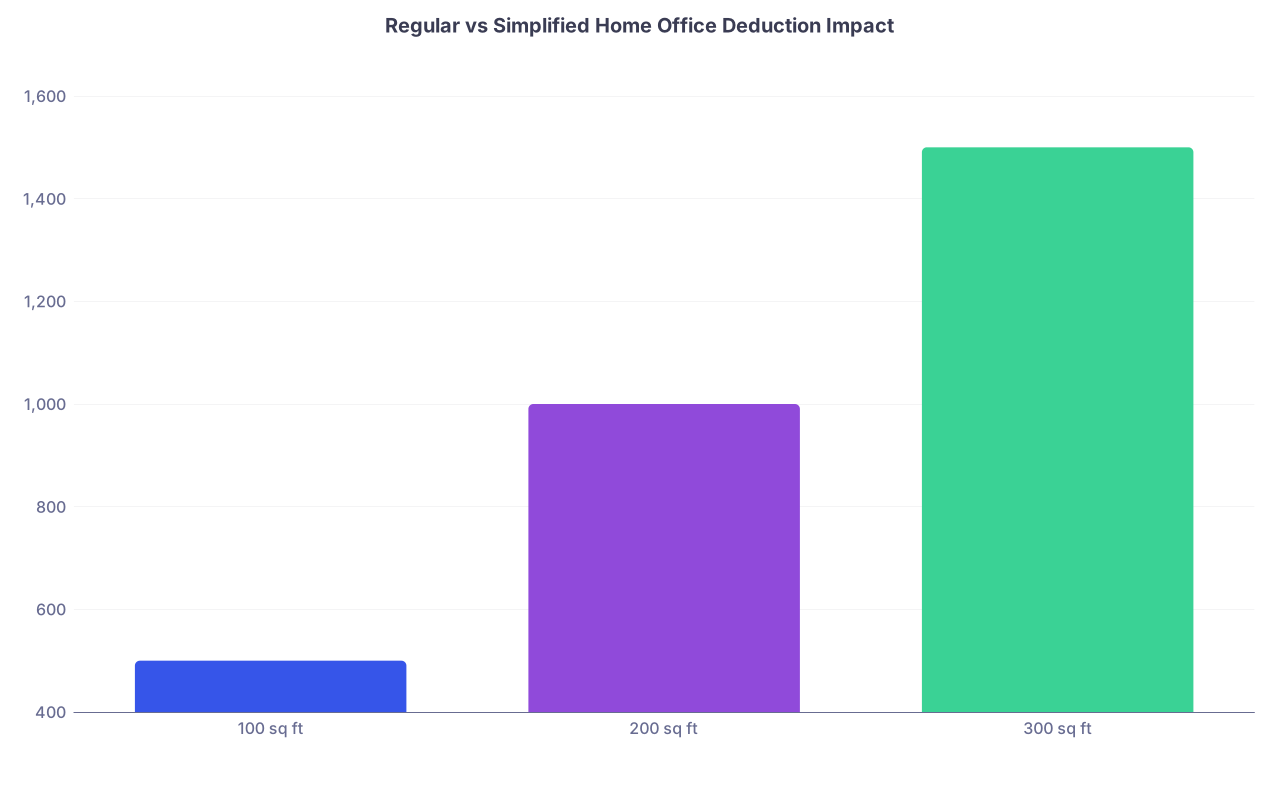
| Category | Value |
|---|---|
| 100 sq ft | 500 |
| 200 sq ft | 1000 |
| 300 sq ft | 1500 |
The unusual mistake physicians make? Chasing an extra $800–$1,200 deduction via the regular method while increasing documentation risk and audit exposure by a factor of ten.
For many higher‑earning physicians:
- Your marginal rate is high, yes.
- But your time and audit risk tolerance are also high‑value.
If your home office is modest and your 1099 income is not huge, the simplified method is often the smarter, safer option. Claiming a giant, highly-detailed deduction for a relatively small side business is exactly what makes an IRS computer flag your return.
The Residency Trap: Using Home Office to Create or Increase Losses
Here’s something I’ve seen blow up on early-career physicians and moonlighting residents.
Scenario:
- Resident with small moonlighting 1099 income
- $8,000–$12,000 of side income for the year
- Claims:
- Full Section 179 on equipment
- Large mileage deduction
- Aggressive home office deduction
- Result: Schedule C shows a loss
An occasional genuine loss is fine. But when the “business” is generating more deductions than revenue, the IRS starts asking:
- Is this a real business or a hobby?
- Are expenses properly allocated?
- Are these personal costs disguised as business?
Home office deductions that help turn your Schedule C or entity into a loss year after year? That’s a red flag. Especially for physicians with robust W‑2 income and conveniently loss‑making “businesses” on the side.
Do not use the home office deduction as a blunt tool to “wipe out” 1099 income. That’s the kind of pattern that triggers questions.
Documentation – Or What Saves You When the Letter Arrives
Most doctors think “I gave everything to my CPA; they’ll handle it.” That’s not how this works.
If the IRS questions your home office deduction, you are on the hook, not your CPA. You need documentation that looks like it was assembled by a serious professional, not scribbled during a shift change.
Here’s what I recommend you have ready to survive scrutiny:
1. Proof of square footage and layout
- Home floor plan, appraisal, or listing showing total square footage
- Simple sketch of your home with:
- Office identified
- Office dimensions written down
- Calculation:
- Office sq ft / Total sq ft = percentage
If you’re using the number‑of‑rooms method (less common but allowed when rooms are roughly equal), document that logic too.
2. Proof of regular and exclusive use
You won’t have “evidence” of exclusivity in the form of a certificate, but you can build a reasonable narrative:
- Photos of the office space:
- Desk
- Computer
- Files
- Medical/business books
- No bed, no TV, no kids’ toys
- A short written description:
- What business is conducted there
- How frequently you use it
- Confirmation that no personal use occurs
3. Expenses and allocations (for the regular method)
- Utility bills, insurance, tax statements, etc.
- A simple spreadsheet:
- Total amount
- Percentage applied (e.g., 10%)
- Calculated deduction
- Clear labeling of:
- Direct office expenses (100% deductible)
- Indirect home expenses (pro‑rated)
If that sounds tedious, that’s exactly why the simplified method exists.
Entity Structure Pitfalls: S‑Corps, Partnerships, and “Reimbursements”
Another nuanced mistake physicians make: getting fancy with entities and screwing up the mechanics of the home office deduction.
Common structure problems:
- S‑Corp but still deducting the home office on Schedule C or Schedule A
If your practice income flows through an S‑Corp:- You typically do not take a home office deduction directly on your 1040 for that activity.
- Instead, you set up an accountable plan and have the corporation reimburse you for legitimate home office use.
- The corp gets the deduction; you don’t report income for the reimbursement if the accountable-plan rules are followed.
Skipping the accountable plan and just “winging it” on your personal return? That’s a mess.
- Partnership/Group practice ignoring the available structure
In some groups, partners are told, “Just deduct your home office on your own return.”
That may be allowed for some setups, but:- If partners are actually W‑2 with K‑1s that don’t reflect a real self‑employed status, you can’t just make up a home office deduction on Schedule C.
- You need an actual business activity that uses that office.
Whenever the K‑1, W‑2, and home office story don’t match, an experienced IRS agent will smell it immediately.
How IRS Systems Actually Flag You
No, there isn’t a special “physician with home office” list at the IRS. But certain patterns are algorithm bait:
- High income + disproportionately large home office deduction
- New business with small revenue + big home office + big vehicle write‑off
- W‑2 physician with no 1099 but still showing home office anywhere on the return
- Multi‑year pattern of business losses cushioned by home office expenses
- Changing portions year to year with no explanation (10% one year, 30% next year)
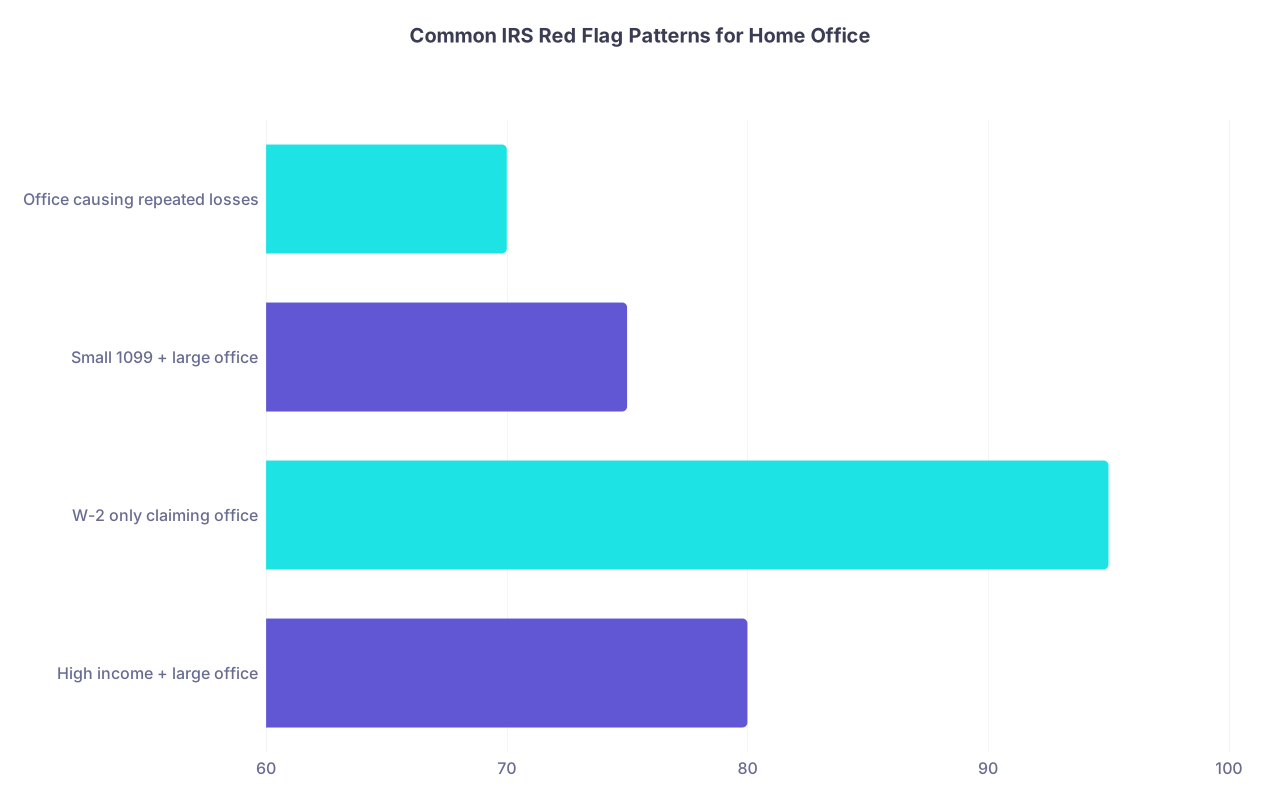
| Category | Value |
|---|---|
| High income + large office | 80 |
| W-2 only claiming office | 95 |
| Small 1099 + large office | 75 |
| Office causing repeated losses | 70 |
Are these a guaranteed audit? No. But if you’re stacking two or three of these together, you’re playing a dangerous game with very little upside.
A Safer Way to Use the Home Office Deduction as a Physician
Let me be practical for a minute, because the goal isn’t to scare you out of legitimate savings—it’s to stop you from doing dumb, risky stuff.
If you want to claim a home office without painting a target on your back:
Be brutally honest about eligibility
- W‑2 only? Forget it. Move on.
- 1099 or entity income? Great, now apply the tests properly for that activity only.
Use a reasonable, defendable square footage
- Measure the room.
- Don’t inflate it.
- Keep photos and basic documentation.
Strongly consider the simplified method
- If your office is 100–300 sq ft and your income is strong, $500–$1,500 of clean, low-risk deduction may be smarter than $3,000 of high-friction deduction.
Do not let the home office create or exaggerate business losses
- If your side business barely makes money, resist the urge to zero it out with home office.
- Use conservative assumptions; stay above water if at all realistic.
Coordinate entity structure and tax reporting
- If you’re using an S‑Corp or partnership, talk to someone who actually understands accountable plans and physician groups.
- Don’t rely on “my buddy in anesthesia does this.”

| Step | Description |
|---|---|
| Step 1 | Physician |
| Step 2 | Do not claim home office |
| Step 3 | Measure office and total home |
| Step 4 | Use $5 per sq ft up to 300 |
| Step 5 | Track expenses and allocate carefully |
| Step 6 | Check deduction vs income for reasonableness |
| Step 7 | Document everything and file |
| Step 8 | Any 1099 or entity income? |
| Step 9 | Regular and exclusive use? |
| Step 10 | Principal place for that business? |
| Step 11 | Simplified or regular? |
FAQ (Exactly 3 Questions)
1. I’m a full-time W‑2 hospitalist but do some unpaid admin work at home for my department. Can I claim a home office deduction?
No. Unreimbursed employee expenses, including home office for W‑2 work, are effectively gone under current law. If the hospital wants you to work from home, your path is to push for an accountable reimbursement arrangement with them, not to take a home office deduction on your own return.
2. I have a small 1099 telemedicine side gig and do 100% of that work from my home office. Is it safer to skip the deduction to avoid risk?
What’s risky is taking a deduction you can’t defend. If you truly use a clearly defined, exclusive space for that telemed work and it’s your only location for that activity, you’re squarely within the rules. I wouldn’t skip a legitimate, reasonably sized deduction out of fear—but I would keep it proportional to your 1099 income and seriously consider the simplified method.
3. My CPA suggested claiming 25% of my 4,000 sq ft house as home office because I “do a lot of work from home.” Is that realistic?
For almost any physician, 1,000 sq ft of home office is absurd. That kind of number invites questions. If a CPA is throwing out big round percentages without actually measuring your space or talking through the exclusive-use rules, that’s a red flag about their judgment, not the tax code. Push back, measure the actual office, and insist the deduction reflect reality.
Key takeaways:
- If you’re W‑2 only, stop trying to force a home office deduction. It’s not allowed and it’s not clever.
- If you have 1099 or entity income, keep the deduction modest, well-documented, and tied only to that business.
- When in doubt, use the simplified method and treat the home office as a tool—not a weapon—to save a bit of tax without inviting an audit.


