

It is your first real attending paycheck.
You open the direct deposit notification on your phone between cases. The gross number looks huge compared with residency. But the net? Not nearly as exciting. You shrug, tell yourself, “You pay more taxes when you make more money,” and move on.
Six months later, you are on call when your CPA emails: “Your 2025 tax liability is significantly underpaid; we should talk about an estimated payment.” You ignore it for a week because you are post-nights and exhausted. Then April hits.
Now you are sitting at your kitchen table, staring at a tax bill that looks like a luxury car down payment. You thought your employer withholding “handled all that.” It did not. You under-withheld, you did no planning, and the IRS does not care that you just finished training or that you still have $350,000 of loans.
I have watched this exact transition—from resident to attending—wreck people’s first two financial years. Not because they are reckless. Because no one bothered to tell them where the landmines are.
Let me walk you through the big residency‑to‑attending tax trap and how to avoid being the cautionary story everyone whispers about in the OR lounge.
The Core Trap: You Did Not Really Understand Your New Tax Reality
You were conditioned in residency: low-ish pay, simple W‑2, maybe a standard deduction, maybe a small refund. You file on TurboTax at 11 PM after a shift. Boring but manageable.
Then your life changes in three crucial ways—often in the same 12‑ to 18‑month window:
- Income jumps. Sometimes 2x–5x.
- Withholding no longer matches reality (especially if you do moonlighting or 1099 work).
- Deductions and credits you quietly benefited from as a “poor trainee” evaporate.
If you keep behaving like a resident from a tax standpoint while earning like an attending, you walk straight into the trap.
Here is the ugly part: the trap is not just “you owe more.” It is:
- Big surprise balances due in April
- IRS underpayment penalties
- State tax messes (often worse than federal)
- Cash-flow chaos just when you thought life would get easier
I will break down the common failure points so you can avoid each one deliberately.
Mistake #1: Assuming Your Employer Withholding “Takes Care of Taxes”
This is the number one misconception new attendings repeat while getting absolutely hammered.
Your thought process: “I am W‑2. I filled out a W‑4. Payroll is withholding taxes. Done.”
No. Not done.
Your employer is using a generic formula. It does not know:
- Your spouse’s income
- Your moonlighting income
- Your outside 1099 consulting, locums, medical-legal work
- Your side LLC
- Your investment income
- Your state residency quirks
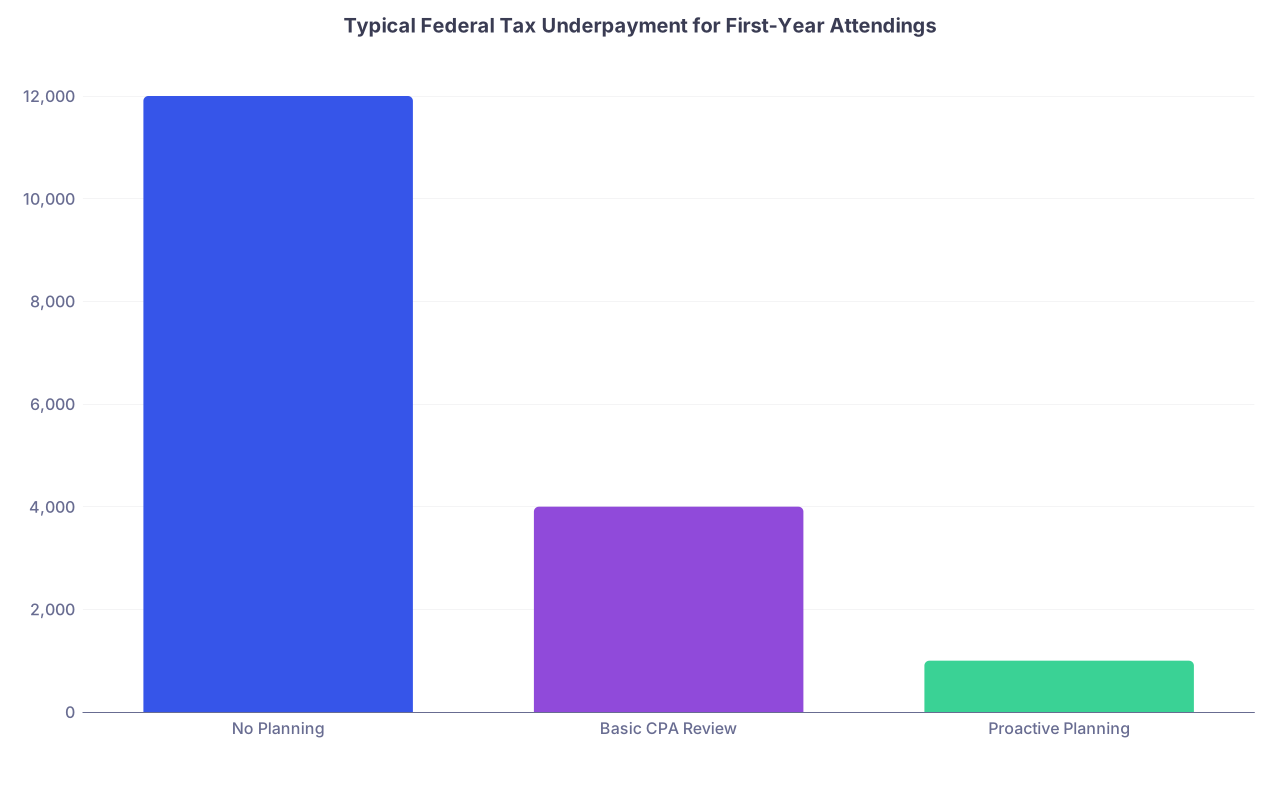
Result: The system under-withholds for high earners with multiple income sources. Every time.
| Category | Value |
|---|---|
| No Planning | 12000 |
| Basic CPA Review | 4000 |
| Proactive Planning | 1000 |
I routinely see first‑year attendings under-withheld by $10,000–$25,000 federally, plus several thousand at the state level. They realize it in March. At that point, you can write a big check or negotiate with the IRS. Neither feels like “finally finished training” energy.
How to avoid this mistake:
Within 30–60 days of starting your attending job:
- Pull a real pay stub and calculate your effective withholding rate:
(Federal tax withheld) ÷ (Gross pay) = your current withholding percentage. - Compare that to a ballpark of where you will end up. For many new attendings, total effective tax (federal, state, payroll) is in the 30–40% range. Not marginal, effective.
- If you are sitting at 18–22% total withheld and your projected combined rate is closer to 35%, you are on track for pain.
Then you adjust your W‑4 upward, deliberately. Or you make quarterly estimated payments. Or both.
Do not wait for “tax season” to find out you were off by five figures.
Mistake #2: Ignoring the Self-Employment Side Hustle Tax Bomb
During residency, you might have picked up some moonlighting. Often paid as 1099. It felt amazing: “They are paying me $140/hour!”
Later, as an attending, a few more things sneak in:
- Locums gigs
- Expert witness or chart review work
- Telemedicine contracts
- Small consulting for startups
All of these are frequently 1099 income. Which means:
- No tax withheld
- You owe both the employee and employer side of Social Security and Medicare (self-employment tax)
- You owe federal and possibly state income tax on top of that
I have seen residents and new attendings earn $40,000–$60,000 in 1099 income and think, “I will worry about the taxes later.” Later becomes a $15,000–$25,000 surprise plus penalties.
| Income Type | Withholding? | Payroll Tax | Estimated Payments Needed? |
|---|---|---|---|
| W-2 Salary | Yes | Shared by employer | Usually not, if adjusted |
| Moonlighting W-2 | Yes (often minimal) | Shared by employer | Sometimes |
| 1099 Locums | No | Full self-employment tax | Almost always |
| Telemedicine 1099 | No | Full self-employment tax | Almost always |
Red flags you are walking into a 1099 tax trap:
- You get a large check deposited directly with no stub, no withholdings listed.
- You are told, “We do not do benefits; it is an independent contractor role.”
- They say, “You will get a 1099 at the end of the year.”
If those words appear, you do not get to pretend it is “extra money.” A chunk of that belongs, from day one, to the IRS and your state.
Damage control:
- Immediately set aside 30–40% of every 1099 payment into a separate high-yield savings account labeled “Tax.”
- Hire someone or learn to file quarterly estimated taxes. If your 1099 income crosses about $10,000–$15,000 in a year, you have no business winging it.
Mistake #3: Forgetting You Just Lost Resident-Level Tax Breaks
You quietly depended on your low income for years without realizing it. As a resident or fellow, you may have:
- Qualified for income-based repayment (IBR, PAYE, SAVE) at artificially low payments
- Received the American Opportunity Tax Credit or Lifetime Learning Credit (if taking courses)
- Qualified for Roth IRA contributions regardless of income
- Had a real shot at certain state or local credits for lower earners
Then, your income jumps. Suddenly:
- Student loan payments pivot higher when your income recertifies
- You phase out of Roth IRA direct contributions (starts around $146k–$161k MAGI single / $230k–$240k married filing jointly for 2024; these move over time)
- Some credits simply vanish because your AGI is “too high”
Your tax software does not gently warn you, “By the way, that nice student-loan-interest deduction? Gone.” It just silently removes it.
Result: your tax bill inflates at both ends—more income, fewer breaks. That double punch is what shocks people.
Mistake #4: Botching the First Partial-Year as an Attending
The “transitional” year is the messiest. Example:
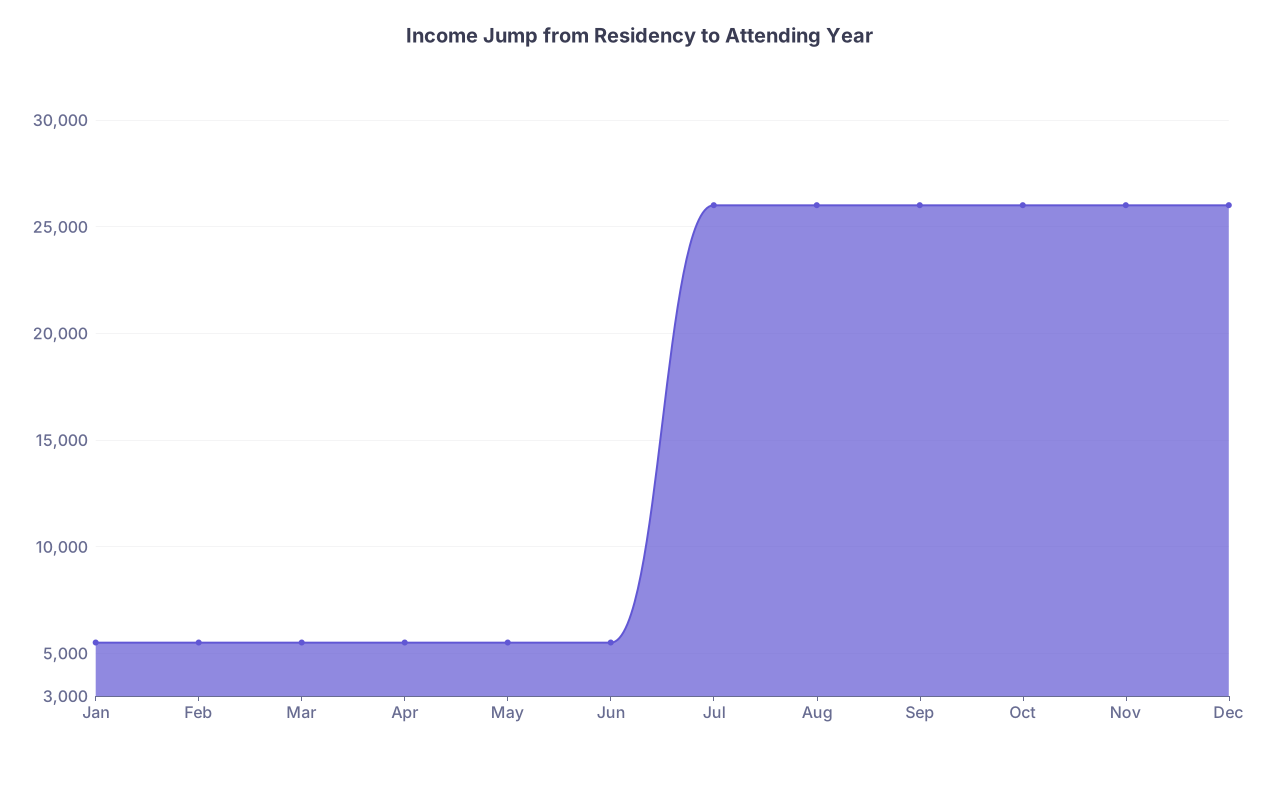
- Jan–Jun: PGY‑3 / PGY‑5, earning $65,000
- Jul–Dec: New attending, earning $320,000 annualized (so about $160,000 for that half year)
- Mix in: some moonlighting, maybe a sign-on bonus, relocation reimbursement, and a new state.
You now have:
- Two states to file in (old residency state vs new attending state)
- Two or three employers
- A sign-on bonus that maybe was badly withheld
- Multiple W‑2s, a 1099, and a confused tax software flow
| Category | Value |
|---|---|
| Jan | 5500 |
| Feb | 5500 |
| Mar | 5500 |
| Apr | 5500 |
| May | 5500 |
| Jun | 5500 |
| Jul | 26000 |
| Aug | 26000 |
| Sep | 26000 |
| Oct | 26000 |
| Nov | 26000 |
| Dec | 26000 |
The mistake: assuming that because part of the year was “low income,” your total tax outcome will somehow be moderate. It is not. The IRS looks at your total annual income and applies progressive brackets. You do not get a “resident half price” for the first six months.
There is another subtle trap: nonresident vs part-year resident state rules. I have seen new attendings:
- Pay tax twice on the same income because they did not file correctly in their relocation year
- Miss credits for taxes paid to another state
- Ignore state estimated payment rules and pick up penalties there, too
If you changed states in your transition year, do not wing the state returns. That is where the mistakes and penalties hide.
Mistake #5: Spending the Raise Before You Know What Is Actually Yours
This is not a “budgeting” article, but ignoring cash flow is a tax trap too.
Common story:
- You sign an attending contract at $350,000.
- You multiply by some rule-of-thumb and assume you “take home” ~$18,000+ a month.
- You lease a luxury car, upgrade your apartment, book a big vacation, and start “making up for lost time.”
- Then your real net hits, plus a big tax bill for last year’s under-withheld mess.
Now you are an attending living a resident-level panic, except with bigger numbers.
The IRS does not care that your rent is high. Or that your car payment eats into your check. It already watched you spend money that should have been withheld.
This is why I tell new attendings: do not fully upgrade your life until you have seen at least 3–4 months of actual net pay and run a tax projection for the year.
Mistake #6: Letting Student Loans and Taxes Collide Unplanned
From a pure tax perspective, your student loans matter, especially:
- If you are on SAVE/IBR/PAYE and in or considering PSLF
- If your loans are private vs federal
- If you are consolidating or refinancing right around graduation
Here is the unspoken trap:
- Under old rules, forgiven loan balances could be taxable. Under current temporary law (through 2025), much federal forgiveness is not taxed federally, but state rules differ.
- Changing your filing status (married filing separately vs jointly) to manipulate loan payments changes your tax bill in ways most residents do not model out.
- Refinancing to private loans for a lower rate just before understanding your true tax bracket is a classic irreversible mistake.
I have watched couples get “advised” into married filing separately to keep PSLF payments low, then lose credits, pay higher net tax, and not actually come out ahead.
Loan strategy is not separate from tax strategy. Treating it as a silo is how you overpay in both domains.
Mistake #7: Treating Yourself as a “Normal Employee” When You Are Not
Most W‑2 workers have simple returns. They:
- Take the standard deduction
- Have no significant side income
- Do not itemize
- Do not set up entities
- Do not think about retirement beyond whatever HR gives them
You, as a physician, especially after training, are a different animal:
- Your income is high enough that small percentage mistakes become five-figure dollars.
- You often have multiple streams of income (W‑2, 1099, investments).
- You may have legitimate business deductions if you are doing independent work the right way (entity structure, accountable plans, etc.).
- Every employer retirement plan, backdoor Roth, HSA, or defined benefit plan choice has tax implications.
Yet, I see new attendings treat their tax situation like a retail store manager’s: plug numbers into DIY software, hope for the best, repeat annually.
You do that at $350,000–$600,000 of income, with multiple states and side gigs, you will bleed money quietly.
What Smart Transition Planning Actually Looks Like
Let me show you the opposite of the tax trap.
A cautious but smart PGY‑3 matched into cardiology fellowship, then attending, does this:
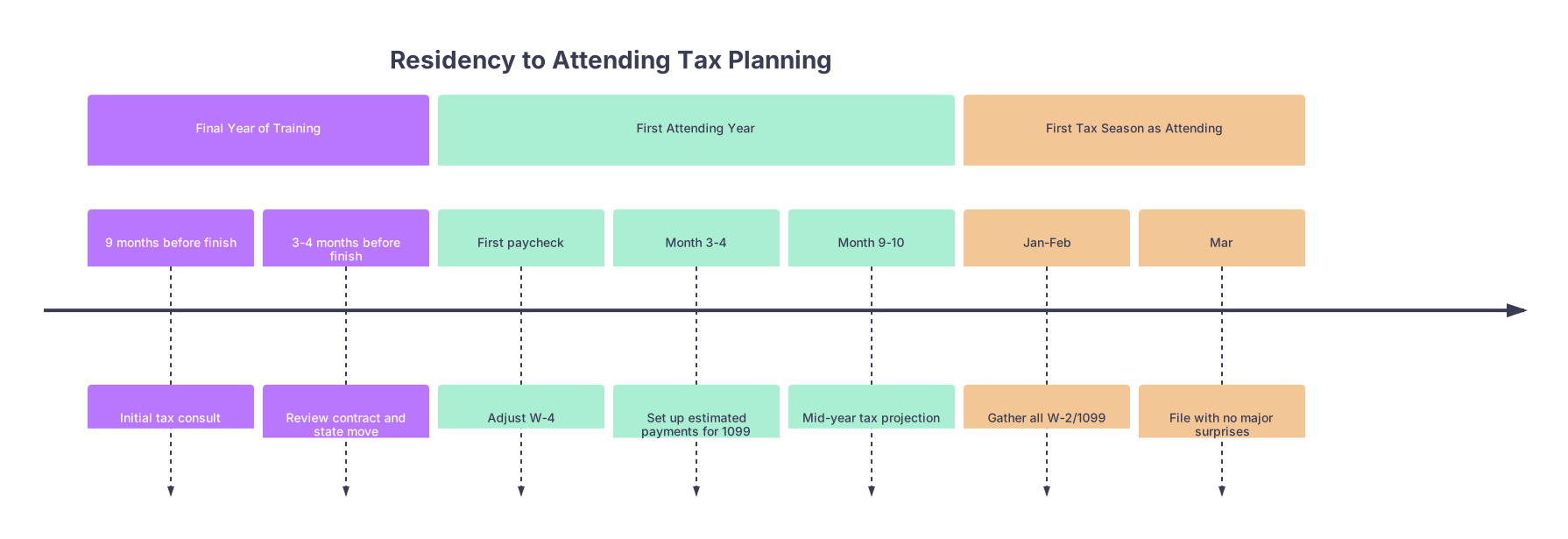
6–9 months before finishing training:
- Has a brief paid session with a physician-centric CPA or planner.
- Reviews likely attending income, state move, and any planned moonlighting or locums.
- Asks explicitly: “What should I do in my transition year to avoid underpayment penalties or surprises?”
At contract signing / first attending pay period:
- Submits a W‑4 that deliberately over-withholds federal and state for the first year.
- If 1099 work is on the horizon, opens a separate business checking account and “tax savings” account from day one.
First fall as an attending (around October):
- Sends last pay stub(s), any 1099 income so far, and spouse income info to CPA.
- Has a mid-year projection done: “If nothing changes, where will my total tax end this year?”
- Makes an additional estimated payment or adjusts W‑4 if needed.
| Period | Event |
|---|---|
| Final Year of Training - 9 months before finish | Initial tax consult |
| Final Year of Training - 3-4 months before finish | Review contract and state move |
| First Attending Year - First paycheck | Adjust W-4 |
| First Attending Year - Month 3-4 | Set up estimated payments for 1099 |
| First Attending Year - Month 9-10 | Mid-year tax projection |
| First Tax Season as Attending - Jan-Feb | Gather all W-2/1099 |
| First Tax Season as Attending - Mar | File with no major surprises |
Result: Their first “big tax year” is…boring. No meltdown, no emergency credit-card payment for the IRS, no frantic “can I get on a payment plan” calls. Just a known bill they already pre‑funded.
You are not less intelligent than that cardiologist. You just have not been told to think this way.
Quick Reality Check: How Much Tax Are You Actually Talking About?
Let us anchor this with a rough, simple example. Say:
- Single physician
- No kids
- Training in a no-income-tax state, then moves to a high-tax state for attending job
- 2024 income (numbers approximate for illustration, not a precise projection):
Resident half-year:
- $65,000 annual salary → $32,500 for 6 months
Attending half-year:
- $360,000 annual salary → $180,000 for 6 months
Moonlighting / telemed 1099:
- $25,000
Total income: roughly $237,500.
Depending on the specific brackets and state, you are realistically looking at:
- Federal income tax: high $40k–$50k range
- State income tax (high-tax state): $10k–$18k
- Payroll / self-employment: thousands more, especially on 1099 slice
If your employer withholds like you are “just” making $180,000 a year, and your moonlighting withholds nothing, you can easily be under by $15,000–$25,000.
You can either see that coming. Or you can pretend it will “work out” and then act shocked in April.
The Red Flags You Are Walking Into the Residency-to-Attending Tax Trap
If any of these sound like you right now, you are on the path to an ugly first attending tax year:
- You have not looked at your pay stub beyond “net pay.”
- You are doing 1099 work, and no one has said the words “quarterly estimated payments” to you.
- You started a big lease / mortgage before seeing 3–4 months of true net pay.
- You switched states and have no idea how that affects your taxes.
- You are still filing your return on the cheapest DIY software, clicking “standard deduction” and praying.
- You have not done a single projection or tax conversation since before residency.
You cannot claim surprise if you saw these flags and did nothing. The IRS will not care that you were on nights.
How to Protect Yourself: Concrete Steps
You want tactics, not theory. Here is what I would tell a PGY‑4 or new attending in clinic between patients.
Print your last pay stub. Today.
Find:- Year-to-date gross pay
- Federal tax withheld
- State tax withheld
Calculate rough withholding rate. If you are under 28–30% total (federal + state) and your salary is north of $250,000, that is a warning sign.
List your side income.
- Anything where taxes were not clearly taken out?
- Anything that will generate a 1099?
That income needs its own tax plan. Not vibes.
Set up a separate “tax” savings account.
You do not commingle this with your travel fund or wedding fund. Every 1099 check? Immediately send 30–40% to this account.Book a one-hour meeting with a CPA who actually works with physicians.
Not your uncle’s real estate accountant. Someone who has seen hundreds of residency-to-attending transitions and can say, “You are about to owe $X if you change nothing.”Stop lifestyle expansion until you see at least a basic projection.
Your future self will not thank you for the extra square footage if you are financing last year’s tax bill at 22% interest.Make one estimated payment if you are clearly behind.
Even a mid-year lump sum can reduce penalties and psychological stress. You do not have to be perfect; you need to not be reckless.
One Specific Step You Can Take Today
Open your latest pay stub and your bank account in two browser tabs.
On the pay stub, calculate your current federal + state withholding percentage. On the bank side, total up how much 1099 or “extra” income you have received this year with no taxes withheld.
If the numbers make you flinch, do not close the tabs and go back to rounds.
Send an email today—before you forget—to a CPA or planner who understands physicians and write:
“I am in my first year transitioning from residency/fellowship to attending, with both W‑2 and some 1099 income. I want to avoid an ugly surprise tax bill. Can we do a tax projection for this year and adjust my withholding/estimates?”
That one email, sent right now, is how you sidestep the big residency‑to‑attending tax trap everyone else quietly falls into.


