

The worst financial mistakes physicians make with side‑gig income do not show up until years later—when the IRS letter arrives.
You can absolutely mix W‑2 and 1099 income safely. Many physicians do it. The problem is doing it casually, without understanding the traps that come specifically from that mix. That is how you end up overpaying taxes, missing deductions, or triggering an audit you never saw coming.
Let me walk you through the mistakes I see over and over again and how to sidestep them before they cost you tens of thousands of dollars.
1. Treating 1099 Income Like “Extra Paycheck” Money
Here is the first big mistake: treating your 1099 side‑gig like it is just another shift on your W‑2 job.
It is not.
W‑2 income:
Your employer withholds federal income tax, state tax, Social Security, Medicare, maybe retirement contributions. You get a clean, mostly “handled for you” paystub.
1099 income:
No withholding. No automatic Social Security or Medicare. No retirement contributions unless you set them up. To the IRS, you are a self‑employed business.
The dangerous behaviors I see:
- Spending all 1099 money as if it were net pay.
- Waiting until April to “see what I owe.”
- Assuming your W‑2 withholding will somehow cover your side‑gig taxes.
That is how a $60,000 locums year becomes a surprise $20,000+ tax bill. With penalties. And interest.
If you have even $10,000 in 1099 income, you must:
- Treat it as business revenue, not free cash.
- Immediately set aside a percentage (often 30–40%, depending on your state and situation).
- Start thinking: quarterly estimates, not once‑a‑year tax panic.
If your first response to 1099 income is “Nice, this will cover the new car,” you are already in the danger zone.
2. Ignoring Quarterly Estimated Taxes (Until the Penalties Hit)
W‑2 world trains you to think taxes are automatic. The 1099 world punishes that mindset.
If your side‑gig income is 1099, the IRS expects you to pay as you go via estimated payments. Miss that, and you risk underpayment penalties—even if you pay everything by April 15.
Common physician mistake:
“I will just pay at tax time when I see what I owe.”
That is how you break the “safe harbor” rules.
Here is the basic framework you must not ignore:
| Rule Type | Requirement |
|---|---|
| 90% Current Year Tax | Pay at least 90% of this year’s tax |
| 100% Prior Year Tax | Or 100% of last year’s tax (AGI ≤150k) |
| 110% Prior Year Tax | Or 110% if AGI >150k |
If your primary job is W‑2 and you add a $50,000 1099 consulting gig, your withholding is almost never enough by default. That gap is where penalties creep in.
There are two ways to avoid this mistake:
Increase W‑2 withholding intentionally
Go to HR/payroll and change your W‑4 so they take out more each paycheck. Run the math with your CPA or tax software to make sure the total paid in meets safe harbor.Make quarterly estimated payments for the 1099 income
Use Form 1040‑ES. Schedule payments for April 15, June 15, September 15, and January 15.
The hybrid mistake I see a lot: physicians boost withholding a bit and “sort of” do quarterly payments but fail to hit safe harbor numbers. Half‑measures do not impress the IRS system. Numbers do.
If you mix W‑2 and 1099, you must actively plan where each dollar of tax payment comes from. Hoping your employer withheld “enough” is pure wishful thinking.
3. Using the Wrong Business Structure (Or None At All)
The single most overcomplicated topic in physician tax circles: entity structure.
The big mistake on one side:
Doing nothing. Staying as a default sole proprietor for substantial 1099 income and never considering whether an S‑Corp or PLLC could save you real money.
The big mistake on the other side:
Forming a fancy S‑Corp or LLC because “my colleague did it” or “the locums recruiter said I should,” with zero understanding of costs, compliance, or whether it even fits your numbers.
Here is the rough truth:
Below a certain 1099 income level (often ~$50k/year, though it depends), the complexity of an S‑Corp is usually not worth it. Above certain levels, staying a sole proprietor can cost you many thousands in extra self‑employment tax.
The red flags:
- You are making $150k in 1099 income.
- You report it all on Schedule C.
- You have never once discussed S‑Corp status with a tax professional.
- Your explanation: “My accountant never brought it up.”
That combination is dangerous. Not always wrong, but suspicious.
A basic comparison:
| Structure | Typical Use Level | Admin Burden | Potential Tax Savings |
|---|---|---|---|
| Sole Proprietor | Small/occasional 1099 | Low | Minimal |
| Single‑Member LLC | Liability/legal wrapper | Low–Medium | Taxed like sole prop |
| LLC taxed as S‑Corp | Sustained higher 1099 | Medium–High | Self‑employment tax |
Key mistake: adopting a structure purely for “tax savings” without understanding:
- Payroll requirements (you must pay yourself “reasonable” salary in an S‑Corp).
- Separate books, separate bank accounts, corporate minutes where required.
- Extra state fees and filing requirements.
I have seen physicians open an LLC, never open a separate bank account, mix personal and business expenses, and then be confused when their “structure” gives them no real protection and creates a mess at tax time.
Do not chase structure just because of fear of missing out. But do not ignore it when your 1099 income becomes real, recurring business revenue.
4. Failing to Separate Business and Personal Money
This one is boring. It is also where many audits become ugly.
If you mix W‑2 and 1099, you already have dual roles: employee and business owner. When you treat your 1099 money like random extra income in the same checking account as everything else, you make three big mistakes at once:
- You lose track of what you actually earn from your side gig.
- You miss legitimate deductions because they are buried in noise.
- You look sloppy if you ever get audited.
Bare minimum for 1099 side‑gig income:
- One dedicated business checking account.
- One dedicated business credit card (even if it is just a second personal card used solely for business).
All business revenue goes into that account. All business expenses come out of that account. You then pay yourself transfers as “owner draws” or payroll (if S‑Corp).
If a charge shows up at Best Buy and you cannot clearly explain whether that monitor was for your home office or family gaming setup, do not be surprised when an IRS agent treats it as personal. Clean separation is your first line of defense.
5. Sloppy or Nonexistent Tracking of Deductions
Side‑gig 1099 income has one major advantage over W‑2: you get business deductions.
The tragic mistake: physicians earning six‑figure 1099 income while deducting almost nothing because “I do not want to raise any red flags.”
You know what raises more red flags? Reporting $200,000 of locums income with $800 in expenses. That looks fake.
Common deductible categories for physicians with 1099 income:
- CME tied to your 1099 work.
- Licensing, DEA, board fees (when required for that work).
- Malpractice premiums you pay directly.
- Home office (if there is a clear, dedicated space used regularly and exclusively for admin related to your 1099 work).
- Equipment: laptop, tablet, stethoscopes, white coats, printer, scanner.
- Business mileage or vehicle expenses for travel to non‑primary work sites (where not reimbursed).
- Professional services: legal, accounting, tax planning.
- Subscriptions and software: UpToDate, Lexicomp, billing software, telehealth platforms.
The mistake is not just failing to deduct. It is failing to document.
If all you hand your CPA in March is a random pile of statements and “just write off whatever seems reasonable,” you are asking for missed opportunities and weak audit support.
Simple, effective system:
- Use your business account and business card only for 1099‑related expenses.
- Use a basic bookkeeping tool or even a well‑structured spreadsheet.
- Add brief notes to ambiguous expenses at the time of purchase.
You do not need perfection. You do need enough clarity that, two years later, you can answer, “What was this $437 charge?” without guessing.
6. Confusing Employer‑Provided Benefits With Self‑Employed Rights
This mistake hits physicians who are used to rich W‑2 benefit packages and then add side gigs.
You are wearing two hats:
- W‑2 hat: employee with benefits.
- 1099 hat: business owner with deduction and retirement plan options.
Problems happen when you assume the rules from one world apply to the other.
Common issues:
- Believing your W‑2 employer’s malpractice or tail covers your 1099 work (often false).
- Assuming your W‑2 401(k) limits stop you from opening a solo 401(k) for 1099 income (they do not; the employee deferral is shared, but the employer contribution side can still be available).
- Thinking you can deduct expenses on Schedule C that your W‑2 employer actually reimbursed or should have reimbursed.
If you are on call for your W‑2 hospital and working telemedicine on a 1099 basis at the same time, there is also risk overlap in coverage, licensing, and hospital policies that you cannot ignore.
This is where a good physician‑specific CPA and an attorney save you from yourself. Do not guess based on something you heard in the surgeons’ lounge.
7. Wrecking Retirement Strategy With Disorganized Plan Overlap
Mixing W‑2 and 1099 can be powerful for retirement savings. It can also lead to complete chaos if you do not understand the limits.
I see two recurring mistakes:
- Under‑saving because you assume “I already maxed my 401(k) at work; I am done.”
- Over‑contributing across different plans and creating messy excess contribution problems.
If your W‑2 job offers a 401(k)/403(b) and your 1099 side gig allows you to set up a solo 401(k) or SEP‑IRA, the rules are not intuitive.
High‑level:
- Employee deferral limit is shared across all 401(k)/403(b) plans (e.g., $23,000 under 50 in 2024).
- Employer contributions are per business and based on that business’s net self‑employment income (up to a separate overall cap).
- SEP‑IRA contributions can wreck your ability to do backdoor Roth IRAs by causing pro‑rata issues.
I have watched physicians make max “employer” contributions in a solo 401(k) based on incorrect calculations, then get a nasty correction letter years later.
If your 1099 income is significant and you like saving aggressively, you cannot afford to “wing it” here. Run the numbers with someone who does this routinely. The penalties and cleanup for excess contributions are not fun.
8. Misunderstanding Self‑Employment Tax and Double Social Security
Your W‑2 employer pays half your Social Security and Medicare taxes. You pay the other half via withholding.
On 1099 income, there is no employer. You are both sides. That is what self‑employment tax is: both halves of FICA rolled together.
Physicians often see a Schedule C showing:
- $80,000 in net profit.
- A large “self‑employment tax” line and think, “I am being double‑taxed. This cannot be right.”
The mistake is not understanding:
- Self‑employment tax covers Social Security and Medicare.
- Half of that tax is deductible as an adjustment to income.
- Social Security tax has a wage base cap; Medicare does not.
When you mix W‑2 and 1099, things get even trickier:
If your W‑2 wages already exceed the Social Security wage base (which many attending salaries do), then your 1099 income will only be subject to the Medicare portion, not Social Security. But if you are below the wage base on W‑2, there may be real additional Social Security tax due on the 1099 income.
I have seen CPAs miscalculate this, especially when there are multiple W‑2s plus 1099 income in the same year (think job changes plus locums).
You must not:
- Assume your 1099 income “escapes” these taxes.
- Assume you are being double‑charged without actually reviewing the math.
If the numbers feel off, ask direct questions. Demand a walkthrough of the self‑employment tax calculation. Do not just stare at the line item in silence.
9. Contract and Legal Pitfalls in Mixed W‑2/1099 Work
Taxes are not the only problem. Legal mistakes with mixed income can blow up your entire setup.
Big recurring issues:
- Violating non‑compete or non‑solicitation clauses when taking nearby 1099 gigs.
- Failing to disclose side‑gig work when your W‑2 contract explicitly requires it.
- Taking 1099 work that, in reality, should be classified as W‑2 based on control and schedule.
That last one matters more than people think. If the “1099” job:
- Sets your hours.
- Tells you how and where to work.
- Provides tools and infrastructure.
- Prohibits you from working elsewhere.
The IRS might view you as a misclassified employee. The risk usually falls more on the employer, but you get caught in the fallout.
You also need to watch out for:
- Lack of malpractice coverage on 1099 contracts (or inadequate limits).
- No tail coverage for certain types of radiology/telemed work.
- Missing indemnification or unreasonable clauses shifting risk to you.
Too many physicians sign 1099 agreements because “the money looked good” and then call a lawyer only after something goes wrong. That is backward.
10. Flying Blind Without Professional Help (Or Using the Wrong Kind)
There is a specific pattern that leads to preventable tax and legal disasters:
- Complex income (W‑2 + multiple 1099s + maybe K‑1s).
- Fast‑growing side gig.
- No coordinated team: maybe a generic tax preparer, no planning, no legal review.
The common defense: “My CPA said it was fine.”
When I dig deeper, “CPA” turns out to be a strip‑mall tax preparer who sees mostly W‑2 workers and small sole proprietors, not physicians with seven‑figure combined income.
You absolutely do not need the fanciest firm in Manhattan. But you cannot treat your situation like a simple TurboTax W‑2 filing when:
- You have material 1099 income.
- You are thinking about entities.
- You are layering retirement plans.
- You have non‑standard contracts.
You want, at minimum:
- A CPA or EA who works with physicians or similar high‑income professionals regularly.
- A business/healthcare attorney to review 1099 contracts and entity structure.
- A basic annual tax planning meeting before year‑end, not just April compliance filing.
Side gigs often start small. A few moonlighting shifts. A little telemed. Then they grow. The mistake is keeping the same casual level of tax and legal attention once the dollars become serious.
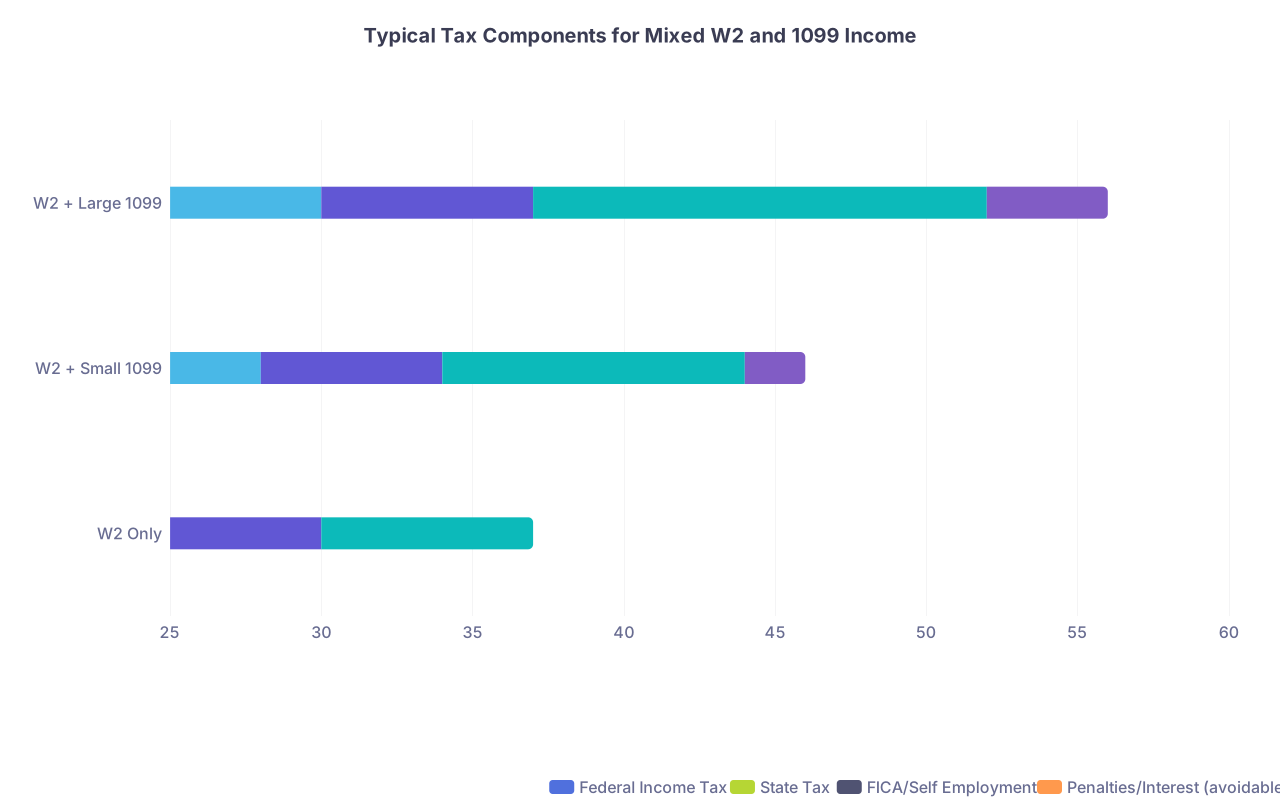
| Category | Federal Income Tax | State Tax | FICA/Self Employment | Penalties/Interest (avoidable) |
|---|---|---|---|---|
| W2 Only | 25 | 5 | 7 | 0 |
| W2 + Small 1099 | 28 | 6 | 10 | 2 |
| W2 + Large 1099 | 30 | 7 | 15 | 4 |

| Step | Description |
|---|---|
| Step 1 | Start 1099 Work |
| Step 2 | Use separate account and basic tracking |
| Step 3 | Consult CPA on entity and estimates |
| Step 4 | Sole prop or LLC likely enough |
| Step 5 | Model S Corp savings vs costs |
| Step 6 | Adjust W2 withholding or pay estimates |
| Step 7 | Review contracts and malpractice |
| Step 8 | Total 1099 > 20k? |
| Step 9 | Total 1099 > 75k? |
FAQs
1. If I already pay a lot of tax through my W‑2 job, do I really need to make estimated payments for my 1099 side gig?
Yes, unless your W‑2 withholding is intentionally increased enough to cover the additional liability and meet safe harbor rules. Hoping your existing withholding is “probably enough” is how underpayment penalties happen. You either boost W‑2 withholding based on real numbers or make quarterly estimated payments. Guessing is the mistake.
2. At what point does it make sense to consider an S‑Corp for my 1099 physician income?
The answer depends on your state, your malpractice and insurance needs, and how stable your 1099 income is. As a rough pattern, once you are consistently above maybe $75,000–$100,000 in net 1099 income, you should at least run a comparison with a CPA. Below that, the administrative burden often outweighs the tax savings. The big mistake is hitting $200,000+ in 1099 income and never having the conversation.
3. Can I deduct home office expenses for my 1099 work if I also have a W‑2 hospital job?
Yes, if you legitimately have a dedicated space used regularly and exclusively for admin activities tied to your 1099 business: charting, billing, telemedicine, business management. Your W‑2 job is irrelevant for this test. The mistake is either claiming an obviously questionable “office” (the kitchen table) or being too scared to claim a completely legitimate one.
4. How do multiple retirement plans work if I have a W‑2 job and 1099 side income?
You have one combined employee deferral limit across all 401(k)/403(b) plans, but employer contributions are calculated separately for your side‑gig business based on its profit. That means you can often have both a W‑2 401(k) and a solo 401(k) for 1099 income, but you cannot double‑count the employee deferral. Overcontributing is a common, messy mistake. Get the math done by someone who actually understands these limits.
5. My side gig pays me as 1099 but treats me like an employee. Is that a problem for me?
It can be. Misclassification risk is usually on the payer, but you are not immune to consequences. You might be missing out on benefits you should legally receive, while also bearing self‑employment tax and business risk. If the job controls your hours, location, and work methods and prohibits outside work, you should at least have a conversation with an attorney or qualified advisor. Blindly accepting “1099” status just because the recruiter said so is a mistake that can haunt you later.
Keep this simple:
- Your W‑2 life and your 1099 life follow different rulebooks; mixing them carelessly is how penalties and missed opportunities pile up.
- Once your 1099 income is real money—not a few odd shifts—you must treat it like a business: separate accounts, documented expenses, intentional tax planning.
- Do not wait for an IRS notice or a malpractice scare to get professional help. You avoid the worst mistakes by planning before the dollars and risks get big, not after.


