

State income tax planning is the most ignored six-figure decision in a physician’s career. The data shows it clearly: two doctors with identical salaries can see after‑tax differences of $40,000–$80,000 per year just by practicing in different states.
You do not feel that gap in the signing bonus. You feel it 10 years later when your colleague in Texas has an extra $500,000 in taxable investment accounts and you do not.
I am going to quantify that gap.
Below, I compare net pay (with a clean, conservative model) for physicians across 10 states with very different tax regimes. Then I will show you how much this compounds, where people make predictable mistakes, and how to think about this when evaluating jobs.
The Assumptions: Lock Them In Before You Argue the Results
If you change the inputs, the outputs change. Fine. Let us set a baseline so the comparisons are apples to apples.
Profile modeled
- Attending physician, W‑2 employee (no 1099, no K‑1)
- Filing status: Single
- Salary scenarios: $250,000, $400,000, and $600,000
- Standard deduction only, no itemizing
- Retirement: Contributes $22,500 to a pre‑tax 401(k) (2024 level, rounded)
- No HSA, no FSA, no other above‑the‑line deductions
- No local city income taxes (e.g., ignoring New York City, Philly, etc.) — this favors high‑tax states slightly
Tax environment
- Federal brackets: 2024 structure, rounded for clarity
- State tax rates: Approximate current top marginal rates and structures:
- Texas (TX) – 0% state income tax
- Florida (FL) – 0%
- Washington (WA) – 0% wage tax (ignoring capital gains tax)
- Nevada (NV) – 0%
- Tennessee (TN) – 0% wage tax
- Arizona (AZ) – flat ~2.5%
- Illinois (IL) – flat ~4.95%
- Pennsylvania (PA) – flat ~3.07%
- California (CA) – progressive, top bracket ~13.3%, but we model effective rates
- New York (NY) – progressive, top bracket ~10.9% (state only; ignoring NYC)
The key: all physicians compared are identical except for geography.
Step 1: How Much Does State Income Tax Really Take?
Let us look at approximate state tax paid at three salary levels. These are simplified but directionally accurate for a W‑2 physician.
| State | Tax System | $250k Salary | $400k Salary | $600k Salary |
|---|---|---|---|---|
| TX | 0% | $0 | $0 | $0 |
| FL | 0% | $0 | $0 | $0 |
| WA | 0% | $0 | $0 | $0 |
| NV | 0% | $0 | $0 | $0 |
| TN | 0% | $0 | $0 | $0 |
| AZ | Flat ~2.5% | ~$6,250 | ~$10,000 | ~$15,000 |
| PA | Flat 3.07% | ~$7,675 | ~$12,280 | ~$18,420 |
| IL | Flat 4.95% | ~$12,375 | ~$19,800 | ~$29,700 |
| NY | Progressive | ~$12,000 | ~$24,000 | ~$40,000 |
| CA | Progressive | ~$15,000 | ~$32,000 | ~$55,000 |
These are rounded, but they capture the central reality:
- At $400,000 salary, moving from Texas to California costs you on the order of $30,000+ per year in state tax alone.
- At $600,000 salary, that delta rises to $50,000–$60,000 per year.
Physicians routinely obsess over a $10,000 difference in base pay between two offers and then ignore a $40,000 annual tax difference embedded in the move.
Let’s visualize the penalty for choosing a high‑tax state versus a no‑tax state at $400,000 salary.
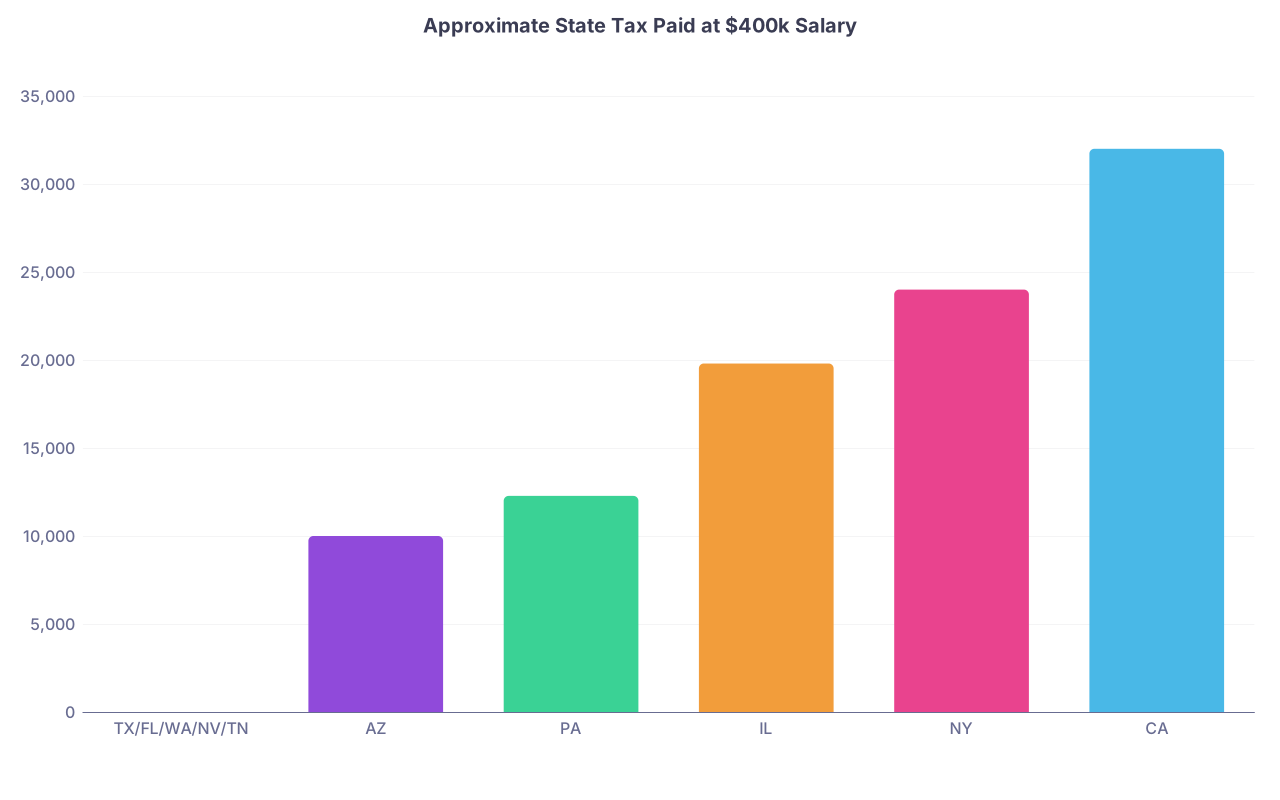
| Category | Value |
|---|---|
| TX/FL/WA/NV/TN | 0 |
| AZ | 10000 |
| PA | 12280 |
| IL | 19800 |
| NY | 24000 |
| CA | 32000 |
The spread is not theoretical. It is cash leaving your checking account every year.
Step 2: Net Pay Comparison at $400,000 – Where Most Attendings Land
Now we make this concrete. Assume:
- Salary: $400,000
- 401(k) contribution: $22,500 (pre‑tax)
- Taxable income before federal standard deduction: $377,500
- Standard deduction (single): ~$14,600 (approximate)
- Federal taxable income: ~$362,900
Using 2024 federal brackets, that puts you in the 35% marginal bracket. The effective federal rate on that income is roughly 26–27%. Quick estimate:
- Federal income tax: ≈ $96,000 (simplified but reasonable)
- FICA (Social Security + Medicare on W‑2):
- Social Security: 6.2% on first $168,600 ≈ $10,459
- Medicare: 1.45% on all W‑2 income ≈ $5,800
- Additional Medicare surtax (0.9% over $200k) ≈ $1,800
- Total FICA ≈ $18,000
So at $400,000 in any state, you are losing roughly:
- Federal income tax: ~$96,000
- FICA: ~$18,000
- Total federal + payroll: ~$114,000
This does not change with state. What changes is the state overlay.
Let us compute approximate take‑home pay (after federal income tax, payroll tax, and state income tax; before benefits, health insurance, etc.) for several states.
| State Group | State Tax | Total Tax (Fed+FICA+State) | Approx Net Pay |
|---|---|---|---|
| TX / FL / WA / NV / TN | $0 | ~$114,000 | ~$286,000 |
| AZ | ~$10,000 | ~$124,000 | ~$276,000 |
| PA | ~$12,280 | ~$126,280 | ~$273,720 |
| IL | ~$19,800 | ~$133,800 | ~$266,200 |
| NY (no NYC) | ~$24,000 | ~$138,000 | ~$262,000 |
| CA | ~$32,000 | ~$146,000 | ~$254,000 |
Now the actual punchline:
Going from Texas to California at $400,000 salary reduces annual take‑home pay by roughly $32,000. That is more than $2,600 per month. Every month. For as long as you work there.
If you stay in that situation for 15 years and invest the difference at a reasonable 5–7% after‑inflation return, the opportunity cost lands easily in the $800,000–$1,200,000 range.
You can get more precise. But the direction does not change.
Step 3: Scale It Up – High‑Earning Specialists at $600,000
Many procedural specialists and dual‑income physician households are far north of $400,000. That is where high‑tax states get truly punishing.
Run the same logic at $600,000:
Assume:
- Salary: $600,000
- 401(k): $22,500 → pre‑tax income $577,500
- Federal taxable after deduction: ~$562,900
- You are solidly in the 37% bracket; effective federal rate now pushes closer to 29–30%.
Approximate federal:
- Federal income tax: ≈ $165,000 (ballpark)
- FICA:
- Social Security: still capped at ~$10,459
- Medicare 1.45% of $600,000 = $8,700
- Additional Medicare 0.9% on $400,000 above $200k = $3,600
- Total FICA ≈ $22,800
So:
- Federal + payroll ≈ $187,800
Now overlay state tax estimates from earlier:
| State Group | State Tax | Total Tax (Fed+FICA+State) | Approx Net Pay |
|---|---|---|---|
| TX / FL / WA / NV / TN | $0 | ~$187,800 | ~$412,200 |
| AZ | ~$15,000 | ~$202,800 | ~$397,200 |
| PA | ~$18,420 | ~$206,220 | ~$393,780 |
| IL | ~$29,700 | ~$217,500 | ~$382,500 |
| NY (no NYC) | ~$40,000 | ~$227,800 | ~$372,200 |
| CA | ~$55,000 | ~$242,800 | ~$357,200 |
Net pay difference Texas vs California at $600,000:
≈ $412,200 – $357,200 = $55,000 per year.
You would need:
- A CA employer to pay you about $55,000 more just to match the same after‑tax pay you could get in a no‑tax state at the same federal tax bracket.
- If the offers are “$600,000 in Texas” vs “$650,000 in California,” that top‑line bump is partially illusion. A large share of the $50,000 bump is clawed back by higher state tax.
Let’s visualize that net pay spread.
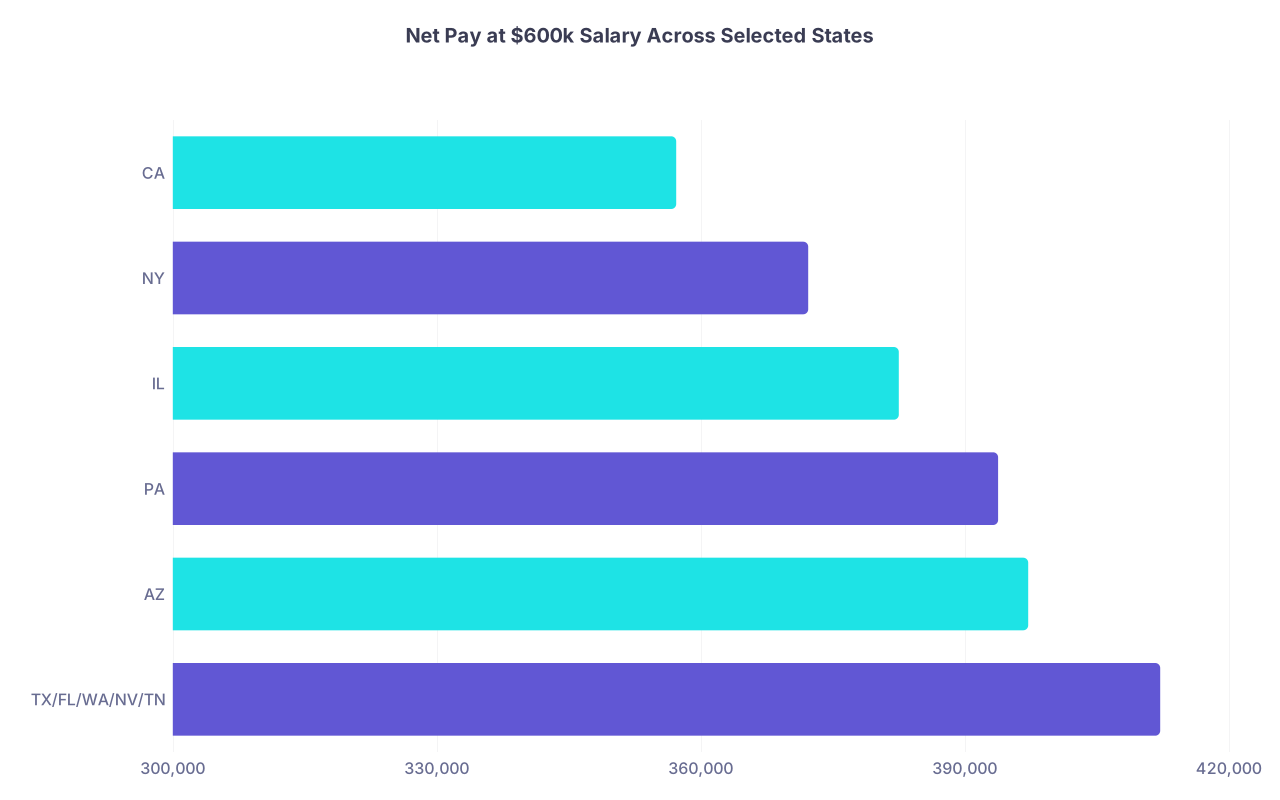
| Category | Value |
|---|---|
| TX/FL/WA/NV/TN | 412200 |
| AZ | 397200 |
| PA | 393780 |
| IL | 382500 |
| NY | 372200 |
| CA | 357200 |
This is where I see a lot of regret. Physicians take “prestige jobs” in high‑tax, high‑cost states in their early 30s, then hit 40, do the math, and realize they effectively worked an extra day every week for the state.
Step 4: The “No Tax State” Myth – It Is Not That Simple, But The Direction Holds
Someone will say: “Cost of living in Texas is exploding, and housing in Florida is up 60%.” True. And relevant. But the data still favors no‑tax states heavily when salaries are similar.
The key drivers you actually need to model:
- State income tax – what we are focusing on here.
- Cost of living – especially housing and childcare.
- Effective federal rate does not change by state, but state tax can be deductible for itemizers (though capped by SALT limit, currently $10,000).
Most high‑earning physicians hit the SALT cap quickly. That means:
- Extra state tax above $10,000 per year buys you no federal deduction benefit.
- The difference between paying $10,000 and $40,000 in state tax is basically fully after‑tax money burned.
I have built plenty of spreadsheets for attendings comparing, for example:
- $450k job in California
- $400k job in Texas
Even with a $50k higher top‑line salary in CA, you often end up with similar or worse net pay after state tax and city cost of living.
Where high‑tax states sometimes “win”:
- Academic positions with lower salary but very strong non‑financial goals.
- Extremely niche specialties where the only high‑volume centers are in NY/CA/MA.
- Short‑term stints (1–3 years) where you prioritize experience over wealth building.
But from a pure numbers standpoint, the default is simple: if two jobs pay the same gross, the lower‑tax state almost always wins by an enormous margin over a 20‑year horizon.
Step 5: Accumulated Gap Over a 20‑Year Career
Annual differences do not scare people enough. Cumulative wealth does.
Let us do a simple compounding example for a physician earning $400,000, comparing:
- Scenario A: Lives in Texas (no state income tax)
- Scenario B: Lives in California (state income tax ≈ $32,000 at this income)
Assume:
- Each year, the Texas physician invests the state tax savings: $32,000.
- Real after‑tax annual return: 5% (fair for a mixed stock/bond portfolio).
- Time horizon: 20 years.
Use the standard future value of an annual contribution:
FV ≈ Contribution × [((1 + r)^n − 1) / r]
Here:
- Contribution = $32,000
- r = 0.05
- n = 20
The factor [((1.05)^20 − 1) / 0.05] ≈ 33.066.
So:
- FV ≈ $32,000 × 33.066 ≈ $1,058,000
That is a rough $1.0 million advantage purely from investing the difference in state tax between TX and CA at $400k salary.
If we re‑run at $600,000 salary with a $55,000 annual tax delta, same math:
- FV ≈ $55,000 × 33.066 ≈ $1.82 million
You do not need heroic returns. You just need to not send that money to Sacramento or Albany in the first place.
Step 6: How Much Higher Must a High‑Tax Offer Be To Compete?
This is the question physicians almost never ask recruiters:
“How high does your offer have to be to match the after‑tax pay of a comparable job in a no‑tax state?”
Let us quantify a simple rule of thumb.
Target salary in no‑tax state: $400,000
From our earlier table, take‑home:
- Texas net ≈ $286,000
What gross salary does a California job need to offer to also produce ≈ $286,000 net?
We know:
- At $400k CA salary, net ≈ $254,000
- At $600k CA salary, net ≈ $357,200
We can interpolate roughly linearly (not perfect, but close enough for planning). The marginal combined tax rate (federal + payroll + state) on the $200k bump from $400k to $600k is:
- Net increase: $357,200 − $254,000 = $103,200
- So of the extra $200,000 gross, you keep ≈ $103,200 → about 51.6% take‑home marginally, 48.4% marginal tax.
You need an extra:
- $286,000 − $254,000 = $32,000 of net pay to match Texas.
At ~52% take‑home, that means CA needs to increase gross by:
- Extra gross ≈ $32,000 / 0.516 ≈ $62,000
So a very rough equivalence:
- $400k in Texas ≈ $462k in California on an after‑tax basis.
Same logic for New York (state only, no NYC). Using earlier gaps:
- TX net ≈ $286,000 at $400k
- NY net ≈ $262,000 at $400k
- Gap: $24,000
- At similar marginal effective rate (~47–50%), NY needs roughly $48,000–$52,000 more gross to match TX net.
Rule of thumb for attendings around the $400k mark:
- To compensate for high state tax:
- CA usually needs $60k+ more gross than a no‑tax state.
- NY (state only) needs $45k–$55k more gross than a no‑tax state.
- Flat‑tax states like IL, PA, AZ need $15k–$30k more, depending on the state.
Most offers do not include that spread. Some do. But you should measure it, not guess.
Step 7: Legal and Strategic Levers Physicians Forget They Have
You cannot legally “pretend” to move to Texas and keep working full‑time in California. States are aggressive, and you will lose that fight.
You can, however, structure your career with tax consequences in mind.
Here are the levers that actually matter:
True domicile moves
- Move your primary residence to a no‑tax state and work there physically.
- Avoid maintaining conflicting “ties” (voter registration, driver’s license, kids’ school) in high‑tax states.
- For telemedicine or remote work, states still often tax based on where the work is performed and where you reside. Get real legal advice if you are crossing lines.
Partial career in high‑tax states
- Do residency and early attending years in NY/CA if needed.
- Plan an intentional move to lower‑tax states once you hit peak earning years.
- The earnings curve is back‑loaded; moving at 35–40 years old matters more than at 28.
Choice of entity and contract structure
- Employed W‑2 physicians have fewer levers. The state taxes your wages where you work.
- Independent contractors (1099), multi‑state locums, and partners in group practices have more planning options:
- Allocate income to states with lower rates, where legally justified.
- Use pass‑through entities to capture state‑level credits or workarounds (where available and compliant).
- But this gets complex quickly; do not improvise this without a CPA who actually deals with physicians in multi‑state setups.
Exit planning
- Retiring or downshifting from a high‑tax state to a low‑tax state before large IRA/401(k) distributions, Roth conversions, or taxable account liquidations can save six figures.
- Many coastal physicians finish their career in CA/NY, then retire to WA, NV, FL, or TX and suddenly discover their tax bill collapses. You can plan that earlier.
Step 8: Common Misconceptions I See in Physician Tax Planning
I see the same flawed arguments again and again.
“The hospital pays so much more in California, it offsets the tax.”
Maybe. Sometimes. But the math often fails when you run actual net numbers. A $25,000 bump in base pay does not offset a $30,000+ annual state tax penalty.
“I will just do it for a few years; it will not matter.”
Three years at a $40,000 tax difference is $120,000+. Invested over 25 years, that can be $400,000–$500,000 in retirement. “A few years” is not free.
“I want to live where I am happy; money is secondary.”
Valid. But vague. The data point you actually want: “How much am I willing to pay, annually and cumulatively, for that lifestyle difference?” Put a dollar tag on it. You may still choose CA or NY and be satisfied. Or you may decide the price is too high.
“State tax is deductible; it all comes out in the wash.”
Wrong for high earners. The SALT deduction is capped at $10,000. If you pay $35,000 in state income tax, $25,000 of that is basically fully non‑deductible at the federal level.
How to Use This as a Physician Making Real Decisions
You do not need a PhD in tax. You need a spreadsheet with about 10 inputs:
- Gross salary for each offer.
- Filing status and basic deductions.
- Federal bracket estimates.
- State tax rate (effective, not just marginal top bracket).
- Simple FICA calculations.
- Net take‑home for each state.
- Annual difference in net pay between options.
- Investment return assumption (5–7% real is a good planning range).
- Time horizon: how long you realistically expect to stay in that job/state.
- Future value of the annual difference.
Run it. Look at the 10‑, 15‑, and 20‑year cumulative gap.
Then ask a simple question:
Is this job, city, or prestige worth giving up $800,000 of future wealth?
Sometimes the answer is yes. Often it is not.
Key Takeaways
- State income tax can easily create $30,000–$60,000 per year differences in physician net pay at common attending salary levels.
- Over a 20‑year career, choosing a no‑tax state over a high‑tax state can translate into $1–2 million of additional invested wealth, assuming you invest the difference.
- Any job comparison across states that ignores state income tax is incomplete at best and financially reckless at worst. Quantify the gap before you sign.


