

Charitable bunching is not a “nice-to-have” gimmick. For many physicians, the data show it is the difference between getting zero tax benefit from your giving and capturing thousands in annual deductions.
Most high-earning doctors write big checks to charity every year. Most also overestimate the tax benefit they actually receive. Once the standard deduction jumped in 2018, the math changed. Quietly but dramatically. Many physicians who “itemize every year” stopped itemizing and did not realize it.
Let’s fix that with numbers, not vibes.
This article models and compares charitable bunching versus steady annual giving for physicians, using realistic income, SALT, and mortgage assumptions, and shows precisely when bunching wins, by how much, and what structures make it work best.
1. The Baseline: Why Many Physicians Get Little or No Tax Benefit from Annual Giving
The core issue is simple: your itemized deductions must exceed the standard deduction before any charitable contribution generates incremental tax savings.
For 2024 (married filing jointly):
- Standard deduction ≈ $29,200
- High-income physician household with:
- State/local taxes (SALT) capped at $10,000
- Mortgage interest ≈ $12,000–$18,000 (common on $600k–$900k mortgages at today’s rates)
- Routine annual charitable giving: say $10,000–$25,000
You do not get additional benefit from giving until the total of SALT + mortgage interest + charitable contributions exceeds $29,200.
Let’s anchor with a typical scenario.
Scenario A – “Good income, typical deductions”
- Household: two-physician couple, MFJ
- Income: $650,000 W-2 (combined)
- SALT paid: $35,000, but capped at $10,000
- Mortgage interest: $14,000
- Annual charitable giving: $10,000
- Other itemized deductions: assume $0 for simplicity
Itemized vs standard:
- SALT: $10,000
- Mortgage interest: $14,000
- Charity: $10,000
- Total itemized: $34,000
Excess over standard deduction:
- $34,000 – $29,200 = $4,800
That $4,800 is the only “incremental” deduction beyond what you would have received with no itemizing at all.
At a combined marginal rate around 37% federal + 5% state (varies, but this is common in high-tax states or at higher incomes):
- Effective marginal rate ≈ 40–42%
- Tax savings from incremental itemizing: $4,800 × 40% ≈ $1,920
So a $10,000 charitable gift produces about $1,920 in tax savings.
Effective after-tax cost of giving = $10,000 – $1,920 = $8,080.
Not bad, but notice something: you gave $10,000, and the first $5,800 of itemized (34k – 29.2k) was needed just to beat the standard deduction threshold. The tax code is diluting the benefit.
Now watch what happens if your mortgage is paid off.
Scenario B – Same income, no mortgage interest
- SALT: $10,000
- Mortgage: $0
- Charity: $10,000
- Total itemized: $20,000
Standard deduction: $29,200
You would take the standard deduction because it is larger.
Tax outcome:
- With $10,000 charity: deduction = $29,200 (standard)
- With $0 charity: deduction = $29,200 (standard)
Incremental tax deduction from that $10,000 gift: $0.
Tax savings: $0.
The after-tax cost of giving = full $10,000.
This is the reality for a surprising number of mid/late-career physicians who are debt-free and capped on SALT. They think “charity is tax-deductible,” but their tax return disagrees.
This is where charitable bunching becomes financially meaningful, not just conceptually clever.
2. How Charitable Bunching Actually Works (With Real Numbers)
Charitable bunching compresses multiple years of planned giving into a single tax year to force itemization in that year, and then uses the standard deduction in the off years.
You keep your overall charitable support level the same on average. You just change when you get the tax deduction.
Mechanically, bunching is almost always implemented using a donor-advised fund (DAF):
- In Year 1, you contribute multiple years’ worth of giving to a DAF (for example, three years of a $10k plan = $30k).
- You get a full charitable deduction in Year 1 for the $30k.
- The DAF then distributes grants to charities over the following 3 years, at your direction, at roughly $10k/year.
- In Year 1, you itemize. In Years 2 and 3, you take the standard deduction because you will likely not have enough deductions to beat it.
The charities receive money on the same annual timeline. The tax code, however, treats you very differently.
Let’s model a straightforward 3-year cycle.
Baseline: Give $10k each year, do not bunch
Assumptions:
- Married filing jointly
- SALT = $10,000 every year (capped)
- Mortgage interest = $0 (home paid off)
- Planned giving: $10,000 per year
- Other itemized: $0
Then:
Year 1:
- SALT: 10,000
- Charity: 10,000
- Total itemized: 20,000
- Standard: 29,200 → use standard
Years 2 and 3: identical.
Over 3 years:
- Total charitable contributions: $30,000
- Total deductions actually used: 3 × 29,200 = $87,600
- Incremental deduction from charity: $0
(you would have had $87,600 of standard deduction even with no giving)
Tax benefit of $30,000 given: $0. All charity is out-of-pocket from a tax perspective.
Now bunch the same $30,000.
Bunched Strategy: Give $30k in Year 1 (via DAF), $0 in Years 2 and 3
Year 1:
- SALT: 10,000
- Charity (DAF contribution): 30,000
- Total itemized: 40,000 > 29,200 → you itemize
Incremental deduction in Year 1 vs standard: 40,000 – 29,200 = 10,800
Years 2 and 3:
- SALT only: 10,000
- No charity
- You take the standard deduction each year: 29,200
Now compare 3-year totals with bunching:
- Total deductions:
- Year 1: 40,000
- Years 2–3: 29,200 + 29,200 = 58,400
- 3-year total: 98,400
Without bunching (just annual giving, but no tax benefit from it):
- Total deductions: 3 × 29,200 = 87,600
Incremental 3-year deduction from bunching = 98,400 – 87,600 = 10,800
At a 40% marginal tax rate, that produces:
- 10,800 × 40% = $4,320 of extra tax savings over 3 years
- Effective tax savings per year (averaged) ≈ $1,440
Put differently:
- You planned to give $30,000 anyway.
- Without bunching: tax benefit = $0.
- With bunching: tax benefit ≈ $4,320, for doing the same charitable support on a 3-year timeline.
That is a 14.4% “rebate” on your giving, just for sequence optimization.
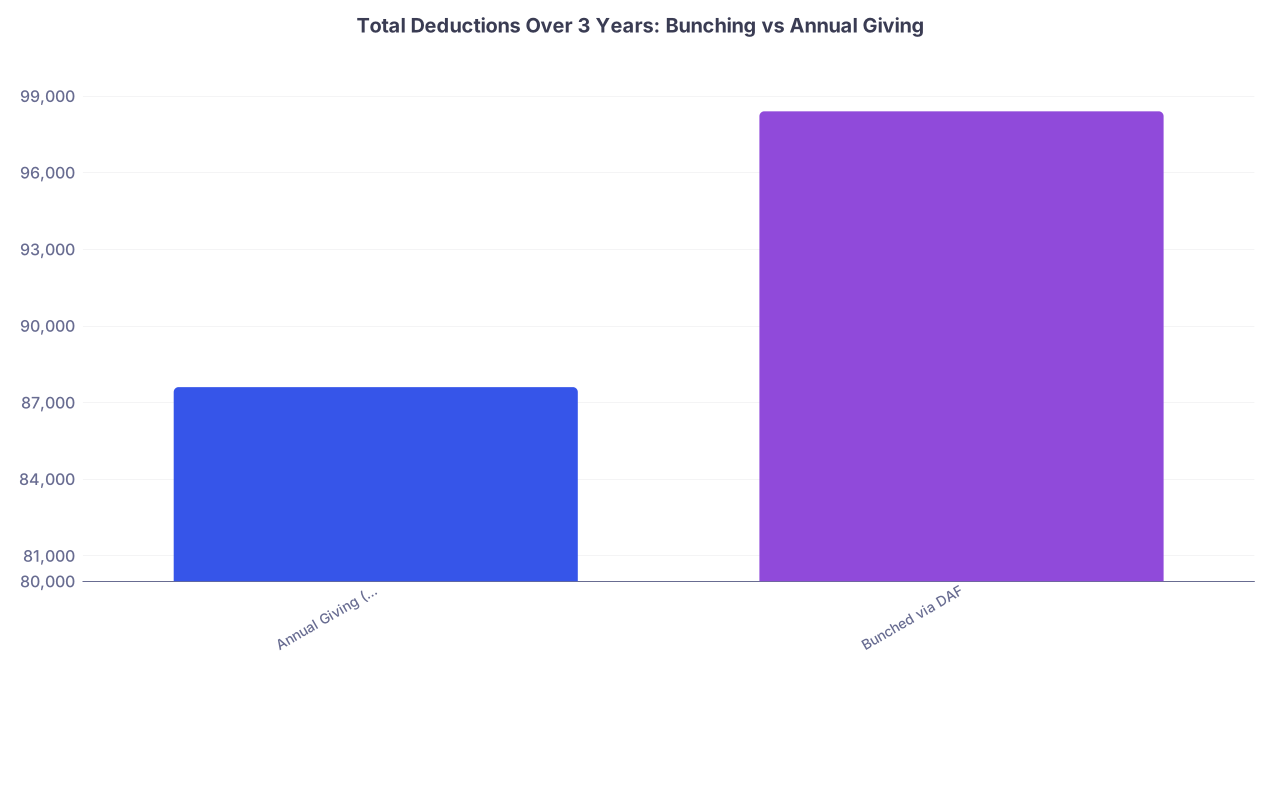
| Category | Value |
|---|---|
| Annual Giving (No Bunch) | 87600 |
| Bunched via DAF | 98400 |
3. Modeled Outcomes Across Common Physician Profiles
To move beyond anecdotes, let’s run multiple scenarios. The patterns are robust.
We will model:
- Filing: Married filing jointly
- Deduction: 2024 standard deduction ≈ $29,200
- SALT: capped at $10,000 in each scenario
- Mortgage interest: varies
- Marginal tax rate: approximate combined (federal + state) of 35% and 42% to show a range.
- Time horizon: 3 years
- Giving: $10k/year or $20k/year, annual vs 3-year bunch.
Profile 1 – Late-career physician, no mortgage
- Income: $500k
- SALT: 10,000
- Mortgage interest: 0
- Planned giving: $10,000/year → $30,000 over 3 years
- Marginal rate: 40%
We already computed this above. Summary:
- Annual (no bunch): extra deduction from charity = $0
- Bunch 3 years into 1 (30k): extra deduction = $10,800
- Extra tax savings ≈ $4,320 over 3 years
Effective tax rebate on giving: 4,320 / 30,000 ≈ 14.4%
Profile 2 – Mid-career, moderate mortgage, $10k/year giving
- Income: $650k
- SALT: 10,000
- Mortgage interest: 12,000/year
- Charity: 10,000/year
- Marginal rate: 40%
Annual giving
Each year:
- SALT: 10,000
- Mortgage: 12,000
- Charity: 10,000
- Total itemized: 32,000
Excess over standard = 32,000 – 29,200 = 2,800
Incremental deduction from charity each year is not all 10,000, but just the portion above the threshold.
To see the charity effect, compare to no charity:
If charity were $0:
- SALT + mortgage = 22,000
- You would take standard 29,200 instead of 22,000.
So with no charity, your deduction is 29,200. With 10k of charity, your deduction is 32,000. Incremental: 32,000 – 29,200 = 2,800. So the effective deductible portion of your $10k gift is 2,800, not 10,000.
Tax savings per year = 2,800 × 40% = $1,120
Over 3 years = $3,360
Bunched giving (30k in Year 1, $0 in Years 2–3)
Year 1:
- SALT: 10,000
- Mortgage: 12,000
- Charity: 30,000
- Total itemized: 52,000
If no charity in Year 1, you would have chosen standard 29,200 (because 10k + 12k = 22,000). Actual with charity: 52,000. Incremental deduction from bunch = 52,000 – 29,200 = 22,800
Years 2–3:
- SALT 10,000 + mortgage 12,000 = 22,000 → still below standard
- You take 29,200 each year
Compare 3-year totals:
With bunch:
- Y1: 52,000
- Y2–3: 29,200 × 2 = 58,400
- Total = 110,400
Without charity at all:
- Standard each year: 29,200 × 3 = 87,600
Incremental 3-year deduction due to the 30k gift = 110,400 – 87,600 = 22,800
Compare to annual strategy where incremental 3-year deduction was 3,360 / 0.40 = 8,400. So:
- Annual giving: incremental deduction = 8,400 → tax savings ≈ $3,360
- Bunched: incremental deduction = 22,800 → tax savings ≈ $9,120
Extra savings from choosing bunching vs annual: 9,120 – 3,360 = $5,760 over 3 years.
On $30,000 total giving, that is 19.2% more efficient vs your baseline annual approach.
Profile 3 – High charitable intent, $20k/year
Now consider a physician couple that is intentionally generous.
- Income: $800k
- SALT: 10,000
- Mortgage interest: 12,000
- Charity: $20,000/year (60k over 3 years)
- Marginal rate: 42%
Annual giving
Each year:
- SALT: 10,000
- Mortgage: 12,000
- Charity: 20,000
- Total itemized: 42,000
Compare to no charity:
Without charity, you would claim standard deduction of 29,200 (since 10k + 12k = 22,000).
Incremental deduction from $20k gift each year: 42,000 – 29,200 = 12,800
Tax savings per year: 12,800 × 42% ≈ $5,376
Over 3 years: 3 × 5,376 ≈ $16,128
Bunch 3 years of giving (60k) into Year 1
Year 1:
- SALT: 10,000
- Mortgage: 12,000
- Charity: 60,000
- Total itemized: 82,000
Without charity in Year 1, deduction = 29,200. With charity, 82,000. Incremental = 52,800
Years 2–3:
- Same pattern as before: SALT + mortgage = 22,000 < 29,200, so you take standard = 29,200 each year.
3-year totals:
- With bunching: 82,000 + 29,200 + 29,200 = 140,400
- With no charity: 29,200 × 3 = 87,600
Incremental deduction due to 60k of charity: 140,400 – 87,600 = 52,800
Tax savings from bunching: 52,800 × 42% ≈ $22,176
Compare:
- Annual giving tax savings: ≈ $16,128
- Bunching savings: ≈ $22,176
Extra efficiency from bunching: 22,176 – 16,128 = $6,048 over 3 years.
You gave the same total 60k. Bunching delivered an additional ~10% “return” on your giving in tax savings.
To summarize these profiles:
| Profile | 3-Year Giving | Annual Strategy Tax Savings | Bunched Strategy Tax Savings | Extra Savings from Bunching |
|---|---|---|---|---|
| 1: No mortgage, $10k/yr | $30,000 | $0 | $4,320 | $4,320 |
| 2: $12k mortgage, $10k/yr | $30,000 | $3,360 | $9,120 | $5,760 |
| 3: $12k mortgage, $20k/yr | $60,000 | $16,128 | $22,176 | $6,048 |
The recurring pattern: bunching consistently outperforms annual giving in tax efficiency, especially when SALT is capped and mortgages are low or paid off.
4. When Charitable Bunching Makes Sense for Doctors (And When It Does Not)
I am not interested in “it depends.” The math is clear enough to state strong rules.
Bunching makes strong sense if:
- You are SALT-capped at $10,000.
- Your mortgage interest + SALT is below or just moderately above the standard deduction.
- Your planned annual charitable giving is at least $7,500–$10,000.
- Your marginal tax rate is above roughly 32%.
Under those conditions, your annual giving is very likely “wasted” against the standard deduction. Bunching recovers thousands.
Bunching is less compelling if:
Your regular itemized deductions (SALT + mortgage + other) already exceed the standard deduction by a large margin without charity.
- Example: $10k SALT + $25k mortgage + $15k other = 50k before charity. In that world, every additional charitable dollar is fully deductible already.
- Bunching yields little incremental value here.
You are in a low marginal tax bracket (resident, fellows, or physicians temporarily with unusually low income).
- If you are in the 12% bracket in one year and expect 32–37% in future years, then you might even want to delay bunching into higher-income years.
You do not have the cash-flow or liquidity to front-load multiple years of giving.
- Bunching forces you to “prepay” your charitable plan.
5. Practical Implementation: Donor-Advised Funds and Timing
Structurally, the donor-advised fund (DAF) is the workhorse for charitable bunching.
You get:
- An immediate charitable deduction for the year of contribution.
- Administrative simplicity (single receipt from the DAF).
- Ability to support multiple charities over time from one “pool”.
- Option to donate appreciated securities instead of cash, which compounds tax benefits by avoiding capital gains.
Example: Combining bunching with appreciated stock
Take Profile 2 again, but assume you also have $50,000 of appreciated mutual fund shares with a $20,000 basis (unrealized gain = $30,000).
If you sell those shares:
- Capital gains tax (assuming 20% federal + 5% state) ≈ 25% × 30,000 = $7,500
Instead:
- You contribute those shares directly to a DAF.
- You avoid the $7,500 capital gains tax entirely.
- You still get the full fair-market-value deduction (subject to AGI limits)—for simplicity say equal to $50,000.
Now your bunching move is stacking two tax benefits:
- Incremental ordinary-income deduction (as analyzed earlier).
- Avoidance of capital gains tax.
On a combined basis, the “effective” cost of a large multi-year charitable move can sometimes fall below 50–60 cents on the dollar once you model both layers.
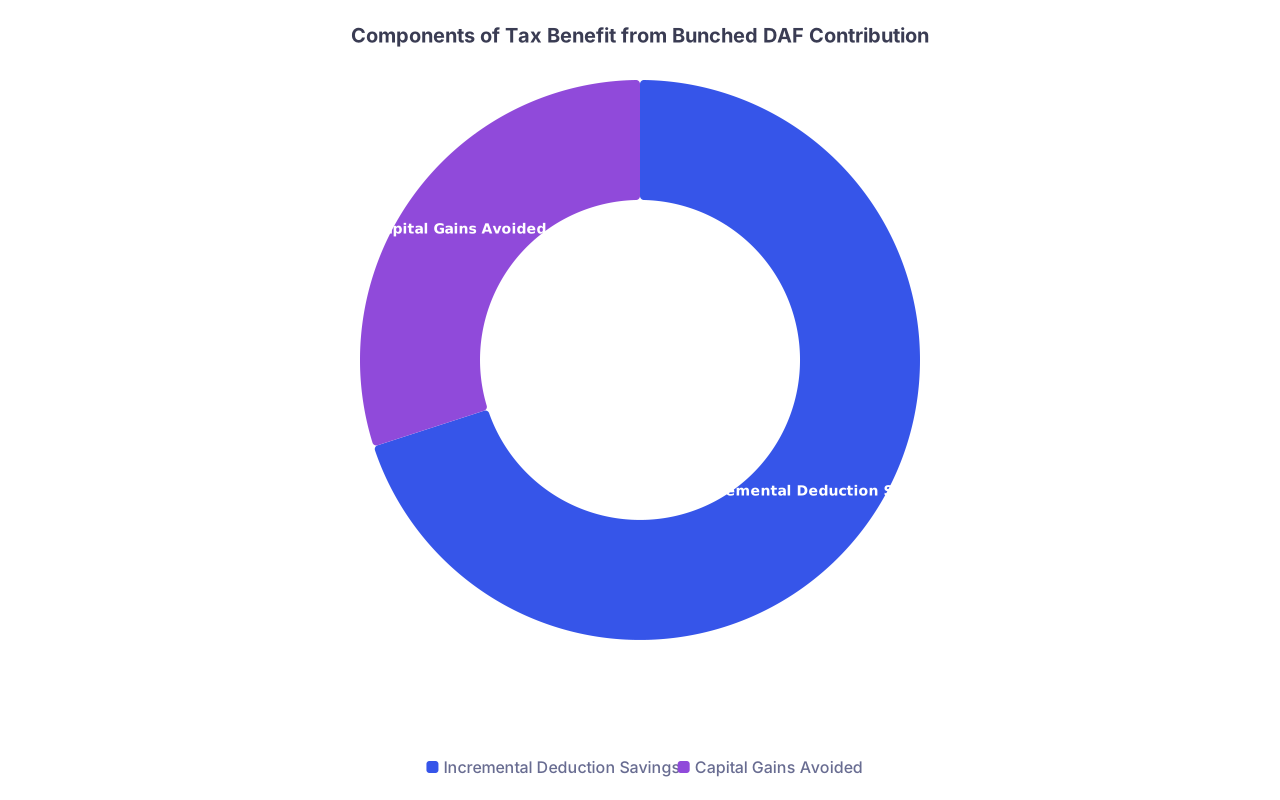
| Category | Value |
|---|---|
| Incremental Deduction Savings | 70 |
| Capital Gains Avoided | 30 |
(The exact split varies, but the chart illustrates that the capital gains piece can be a meaningful minority share of the total benefit.)
Timing and year-to-year planning
The smartest physicians I have worked with treat charitable bunching as a tool to smooth their tax profile across abnormal years:
Big bonus year?
Bunch 3–5 years of giving into that year to offset the spike.Year with large Roth conversions or realization of business/practice sale gains?
Use a DAF contribution as part of the same calendar-year tax plan.
This is not a religious commitment to a specific cadence (every 3 years forever). It is opportunistic: you bunch when your income is unusually high, or when non-recurring events would otherwise push you into higher brackets or phaseouts.
6. Annual Giving vs Bunching: Behavioral and Practical Trade-offs
Numbers alone say: bunching usually wins for physicians in the SALT-cap era. But real humans have preferences and habits.
A few non-tax factors I have actually seen derail otherwise great tax plans:
Charities expecting annual checks.
If the nonprofit relies on predictable cashflows, bunching might feel disruptive. The DAF solves this: you still grant out annually from the DAF, even though you deducted in a prior year.Psychological comfort with big one-time contributions.
Some physicians simply dislike making a single $30k or $60k gift, even if it is “for three years.” That is not irrational, just human. A DAF helps because it feels more like “funding a charitable account” than “giving it all away at once.”Record-keeping and compliance.
A DAF dramatically simplifies record-keeping. Instead of 10–15 separate receipts from different nonprofits, you have one per contribution to the DAF. For a high-income household with complex returns, this matters.AGI percentage limits.
Very high givers (those contributing 30–60% of AGI in certain years) need careful modeling around the IRS percentage caps on charitable deductions. This does not kill bunching, but it sets upper bounds on deductibility in a single year, with carryforwards.
7. Pulling It Together: How to Decide Your Strategy
Here is the short, data-driven decision approach I actually use when sanity-checking plans.
Project your deductions without charity
Add:- SALT (capped at 10k)
- Mortgage interest
- Other itemized (large medical, etc.)
Compare to standard deduction (29,200 MFJ).
Ask: If I gave nothing to charity, would I still itemize?
- If yes, and by more than ~$10–15k, bunching offers limited extra benefit.
- If no, or if you just barely exceed the standard, bunching is probably valuable.
Quantify incremental deduction with and without bunching
- Compute 3-year total deductions under:
- Strategy A: steady annual giving.
- Strategy B: 3-year bunch via DAF once, then standard deduction otherwise.
- Difference × marginal rate = dollar impact.
- Compute 3-year total deductions under:
Overlay behavioral reality
- Will you actually commit to pre-funding several years’ giving?
- Do you use a DAF already or are you willing to start?
Once you run the numbers even once, the pattern becomes painfully obvious. Many physicians are already de facto on Strategy A (annual, low-efficiency giving) without consciously choosing it.
8. Key Takeaways for Physician Tax Planning
The combination of the standard deduction and SALT cap means a large share of physicians get little or zero tax benefit from routine annual giving, especially if they are mortgage-free.
Charitable bunching via a donor-advised fund converts those same dollars into significantly higher, often double-digit percentage tax savings over multi-year windows, without disrupting how charities receive funds.
The “right” strategy is not philosophical. It is numerical. Run a 3-year projection with and without bunching; if your total deductions and resulting tax differ by thousands, you have your answer.


