
The usual W‑2 vs 1099 advice for physicians is dangerously oversimplified. The data shows that tax outcomes flip direction depending on income level, benefits, and how aggressively you actually use the tools available to you.
You cannot answer “Should I be W‑2 or 1099?” without running the numbers. So I am going to run them for you.
Below, I will walk through modeled tax outcomes for W‑2 vs 1099 physicians from roughly $200,000 to $1,000,000 in income, under realistic (not fantasy) assumptions: 2024 federal rules, married filing jointly, typical benefit structures, and common small‑practice setups. The point is not to hit exact dollar precision for your specific situation, but to give you an analytic framework and credible ballpark differences.
1. Core Tax Mechanics: W‑2 vs 1099 for Physicians
Let me be direct: the difference is not “W‑2 vs 1099.” The difference is:
- Employee (W‑2) with limited planning levers
versus - Business owner (1099, typically S‑corp) with more planning levers
The code favors business owners. But only if they actually behave like business owners.
What changes when you go from W‑2 to 1099?
Mechanically:
W‑2 physician:
- Earns wages.
- Employer pays half of Social Security and Medicare (7.65% on first $168,600 for 2024; 1.45% Medicare above that, plus 0.9% additional Medicare at high incomes paid by you).
- Limited deductions: essentially retirement contributions, HSA, FSA, some itemized deductions, charitable giving.
- Potential for 401(k)/403(b)/457(b), health insurance partly subsidized.
1099 physician (modeled as S‑corp, which is what most high‑earning contractors end up using to optimize):
- Revenues come in as business income.
- You pay yourself:
- “Reasonable” W‑2 salary: subject to payroll taxes.
- Distributions: not subject to Social Security/Medicare.
- Business can deduct:
- Employer half of payroll taxes.
- Employer retirement contributions (e.g., solo 401(k) profit share).
- Health insurance premiums.
- CME, licensing, equipment, home office, legal/accounting, etc.
- Potential 20% QBI deduction on business profit (phase‑outs apply).
So the 1099 physician has more knobs to turn:
- Adjust salary vs distributions.
- Increase deductible business expenses.
- Increase retirement plan contributions.
But there are trade‑offs: no employer‑subsidized health insurance, no “free” match, usually no paid time off, and more complexity and risk if you play too aggressive with “reasonable compensation.”
2. Modeling Assumptions
To keep this grounded, I will use the following baseline assumptions. These are not the only valid setups, but they are realistic, not fantasy.
Filing status: Married filing jointly, no dependents.
State tax: Ignored for comparability (assume same state and rate either way).
Year: 2024‑style federal brackets and payroll taxes (conceptual, not literal line‑by‑line recreation).
Retirement behavior: Reasonably aggressive but not “max everything to the theoretical limit” unless clearly stated.
Benefits: Modeled realistic employer benefits for W‑2; realistic out‑of‑pocket for 1099.
Baseline W‑2 package (typical hospital employed)
- Salary: varies by scenario ($250k, $400k, $600k, $1M).
- Employee 401(k): $23,000 deferral.
- Employer match: 4% of salary.
- Health insurance: Employer pays $15,000 of premiums; employee’s after‑tax share ignored here for simplicity.
- No 457(b) in base model (that is hospital‑dependent).
Baseline 1099 package (S‑corp contractor)
- Total 1099 revenue = same as comparable W‑2 salary, to keep apples‑to‑apples on “top line.”
- S‑corp structure.
- “Reasonable salary”: 50–60% of total compensation in most examples (varies by income level).
- Employer side of retirement: up to 20–25% of W‑2 salary as profit‑sharing in solo 401(k).
- Health insurance: $20,000 per year, fully deductible by business.
- Business expenses (CME, licensing, phone, etc.): modeled at $15,000 per year for most scenarios.
I am not designing an idealized, optimized unicorn plan. I am modeling what a well‑advised, but still busy, physician tends to do in real life.
3. Modeled Outcomes by Income Level
Now to the part you actually care about: numbers.
All figures below are rounded and approximate. The directionality and magnitude matter more than the last dollar.
Scenario 1: $250,000 Income – Early Attending or Lower‑Paid Specialty
At this level, the W‑2 vs 1099 gap is there, but not seismic.
W‑2 Physician at $250,000
Key pieces:
- Gross salary: $250,000
- Employee 401(k): $23,000
- Employer match (4%): $10,000
- Taxable wages after employee deferral: $227,000
Rough payroll taxes (employee side):
- Social Security: 6.2% of $168,600 ≈ $10,449
- Medicare: 1.45% of $250,000 ≈ $3,625
- No additional 0.9% Medicare (threshold is $250k MFJ; borderline, but ignore for simplicity)
Employee FICA ≈ $14,000.
Federal income tax on $227,000 taxable wages (after standard deduction, say $29,200 for MFJ):
Taxable income ≈ $197,800. That lives largely in the 22% and 24% brackets, some at 32%. Rough federal income tax ≈ $36,000–$40,000 depending on exact bracket mechanics.
To keep it clean, call:
- Federal income tax: $38,000
- Employee FICA: $14,000
Total personal taxes ≈ $52,000.
Net cash to household (ignoring withholdings timing) ≈ $250,000 – $23,000 (401k) – $52,000 = $175,000
Plus the $10,000 employer 401(k) match and ~$15,000 of health premiums paid by employer as “hidden comp.”
Effective economic value ≈ $175,000 cash + $33,000 benefits = $208,000.
1099 Physician at $250,000 (S‑corp)
Assumptions:
- 1099 revenue: $250,000
- Reasonable salary: $150,000
- S‑corp distribution: $100,000
- Business expenses (CME, etc.): $15,000
- Health insurance: $20,000 (deducted by business)
Business P&L:
- Revenue: $250,000
- Expenses: $150,000 salary + $11,475 employer payroll tax (7.65% of $150k) + $15,000 other + $20,000 health = $196,475
- Profit: ≈ $53,525 (paid out as distribution)
Retirement:
- Employee 401(k) deferral on salary: $23,000
- Employer profit‑sharing: say 20% of salary → $30,000
Total retirement: $53,000 (versus $33,000 for W‑2 in this band).
Payroll taxes:
- On salary (both halves are effectively borne by you, but employer side is deductible):
- Social Security 12.4% of $150,000 (capped at $168,600): $18,600
- Medicare 2.9% of $150,000: $4,350
Total ≈ $22,950 before deductibility.
After accounting for deductibility of the employer half, effective incremental burden is slightly less, but not dramatically.
Federal income tax base:
- Salary: $150,000
- Distribution (business profit): $53,525
- Total income before retirement: $203,525
- Less employee 401(k) deferral: $23,000
- Adjusted gross income ≈ $180,525
- Less standard deduction ≈ $29,200 → taxable ≈ $151,325
Federal income tax on $151k taxable: roughly $26,000–$28,000.
To keep the model consistent:
- Federal income tax: ≈ $27,000
- Self‑employment/payroll tax net burden (after deduction of employer half): effective ≈ $18,000–$19,000
Total taxes ≈ $45,000–$46,000.
Net cash to household:
- Cash received = $150,000 salary + $53,525 distribution = $203,525
- Less employee 401(k): $23,000
- Less personal taxes ≈ $46,000
Take‑home ≈ $134,500.
But we must include the value of:
- Employer retirement contribution: $30,000
- Health insurance paid by business: $20,000
- Business perks (CME, device, phone, etc.) embedded in the $15,000 expense.
Effective economic value ≈ $134,500 cash + $50,000+ benefits/retirement = ~$185,000–$190,000.
Comparison at $250,000
- W‑2 economic value ≈ $208,000
- 1099 economic value ≈ $185,000–$190,000
At $250,000, with a decent employer plan, W‑2 usually wins or is at least slightly ahead. The 1099 advantage in flexibility does not yet compensate for lost employer match + subsidized health coverage, once you factor in payroll tax on your own salary.
The idea that “1099 always wins” is simply wrong at this income level with a solid W‑2 benefits package.
4. Mid‑Career Income: $400,000–$600,000
This is where things start shifting. The Social Security wage base caps out; the additional Medicare tax kicks in; and business‑owner tools become more powerful.
Scenario 2: $400,000 Income – Common for Hospitalists, Anesthesia, Many Subspecialties
W‑2 at $400,000
Assume:
- Salary: $400,000
- Employee 401(k): $23,000
- Employer match (4%): $16,000
- Taxable wages after employee deferral: $377,000
Payroll taxes (employee share):
- Social Security: 6.2% of $168,600 = $10,449
- Medicare: 1.45% of $400,000 = $5,800
- Additional 0.9% Medicare on wages above $250k MFJ: 0.9% of $150,000 = $1,350
Total employee payroll ≈ $17,600.
Federal income tax:
Taxable wages ≈ $377,000
AGI after standard deduction: $377,000 – $29,200 ≈ $347,800
This lives deep in the 32% and partly 35% brackets. Reasonable estimate for federal income tax: ~$75,000–$80,000.
Use:
- Federal income tax: $78,000
- Employee payroll: $17,600
Total ≈ $95,600.
Net cash:
- Gross: $400,000
- Less 401(k): $23,000
- Less taxes ≈ $95,600
Take‑home ≈ $281,400.
Add:
- Employer 401(k) match: $16,000
- Health benefits: $15,000
Economic value ≈ $312,000.
1099 at $400,000 (S‑corp)
Assume:
- 1099 revenue: $400,000
- Reasonable salary: $220,000
- Business expenses: $20,000 (more CME, more activities at this income)
- Health insurance: $20,000
- Employer retirement contribution: 25% of salary up to limits (25% of $220k = $55,000, but total employer + employee capped at $69,000 for 2024 style; we will cap total appropriately).
First, compute the P&L without retirement:
- Revenue: $400,000
- Expenses:
- Salary: $220,000
- Employer payroll tax (7.65% of $220k): ≈ $16,830
- Business expenses: $20,000
- Health: $20,000
Total pre‑retirement: $276,830
Profit before retirement: $123,170.
Now retirement:
- Employee 401(k) deferral: $23,000
- Employer profit‑sharing: we want to use the room up to $69,000 total. If we use the full $46,000 of employer contribution (to reach $69k total), that reduces business profit by $46,000.
Revised profit:
- $123,170 – $46,000 = $77,170 (paid as S‑corp distribution).
Income components:
- Salary: $220,000
- Distribution: $77,170
- Total income before deferrals: $297,170
AGI:
- Subtract employee deferral: $23,000 → $274,170
- Health insurance is already deducted at business level.
Standard deduction: $29,200 → taxable ≈ $244,970.
Federal income tax on ~245k taxable: roughly mid‑32% zone: ≈ $53,000–$56,000. Take $55,000.
Payroll taxes (on salary, both halves, but employer half deductible):
- Social Security: capped at $168,600 → 12.4% of $168,600 = $20,906
- Medicare: 2.9% of $220,000 = $6,380 Total gross payroll = $27,286, but employer half reduces taxable income, so effective burden slightly lower. For quick modeling, call the net hit ≈ $24,000.
Total taxes:
- Federal income: ≈ $55,000
- Net payroll: ≈ $24,000
Total ≈ $79,000.
Net cash:
- Cash received = salary $220,000 + distribution $77,170 = $297,170
- Less employee 401(k): $23,000
- Less taxes ≈ $79,000
Take‑home ≈ $195,000.
But add:
- Employer retirement: $46,000
- Health insurance: $20,000
- Business‑funded expenses: $20,000
Economic value ≈ $195,000 + $86,000 = $281,000.
Comparison at $400,000
- W‑2 economic value ≈ $312,000
- 1099 economic value ≈ $281,000
Conclusion: at $400k, a strong W‑2 package can still outperform a typical contractor setup, if the employer match and health subsidy are solid. The 1099 starts narrowing the gap but does not obviously win unless:
- The W‑2 benefits are weak, or
- The 1099 physician pushes even harder on deductions (e.g., defined benefit plan, larger legitimate expenses).
This is exactly where the simplistic “1099 is way better” narrative leads people astray. The margin is nowhere near as big as advertised, and it can even go the other way.
Scenario 3: $600,000 Income – High‑Paid Specialist, Busy Procedures, or Heavy Moonlighting
At higher incomes, the game changes. Social Security is fully maxed. Medicare and the 0.9% surtax matter more. Retirement space and strategic use of entities can move tens of thousands per year.
To keep this tractable, I will slightly simplify retirement caps and focus on order of magnitude.
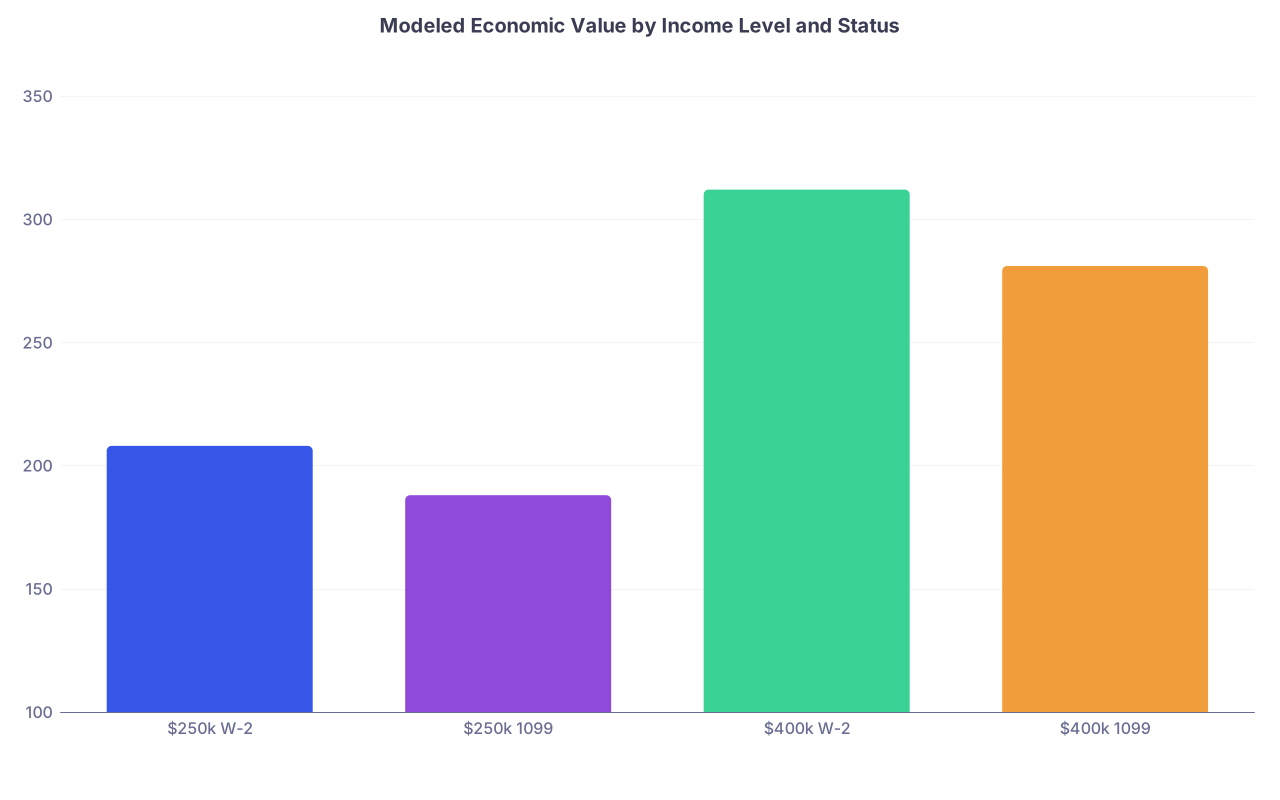
| Category | Value |
|---|---|
| $250k W-2 | 208 |
| $250k 1099 | 188 |
| $400k W-2 | 312 |
| $400k 1099 | 281 |
W‑2 at $600,000
Assume:
- Salary: $600,000
- Employee 401(k): $23,000
- Employer match (4%): $24,000
- Taxable wages after employee deferral: $577,000
Payroll taxes (employee portion):
- Social Security: $10,449 (max)
- Medicare: 1.45% of $600,000 = $8,700
- Additional 0.9% Medicare on $350,000 above $250k: 0.9% of $350k = $3,150
Total employee FICA ≈ $22,300.
Federal income tax:
Taxable wages ≈ $577,000
AGI after standard deduction ≈ $547,800
This puts a large portion in the 35% bracket, with some still in 32%. Reasonable federal tax ≈ $140,000–$150,000. Use $145,000.
Total taxes ≈ $167,000.
Net cash:
- Gross: $600,000
- Less 401(k): $23,000
- Less tax ≈ $167,000
Take‑home ≈ $410,000.
Add:
- Employer match: $24,000
- Health benefits: $15,000
Economic value ≈ $449,000.
1099 at $600,000 (aggressively but credibly optimized S‑corp)
Assume:
- Revenue: $600,000
- Salary: $260,000 (still defensible for many specialties with high productivity)
- Business expenses: $30,000
- Health insurance: $20,000
- Employer retirement: target high but capped by qualified plan limits and reasonableness
P&L without retirement:
- Revenue: $600,000
- Expenses:
- Salary: $260,000
- Employer payroll (7.65% of $260k): ≈ $19,890
- Biz expenses: $30,000
- Health: $20,000
Total: $329,890
Profit before retirement: $270,110.
Retirement:
- Employee deferral: $23,000
- Employer profit‑sharing: up to ~25% of salary (25% of $260k = $65,000), but again we hit the total annual additions limit (roughly $69,000). So approximate:
- Employer = $46,000 (to hit ~$69k total contributions).
New profit:
- $270,110 – $46,000 = $224,110 (distribution).
Income components:
- Salary: $260,000
- Distribution: $224,110
Total coming to you pre‑deferral = $484,110.
AGI:
- Less employee 401(k): $23,000 → $461,110
- Standard deduction: $29,200 → taxable ≈ $431,910
Federal income tax:
At this level, more in 35% bracket, some near 37% threshold. Approximate tax ≈ $115,000–$120,000. Use $118,000.
Payroll taxes on salary (both halves):
- Social Security: 12.4% of $168,600 = $20,906 (cap hit)
- Medicare: 2.9% of $260,000 = $7,540
- Additional 0.9% Medicare on wages over $250k: 0.9% of $10,000 = $90
Total ≈ $28,536 before employer deduction. Effective net ≈ $25,000–$26,000. Use $25,000.
Total taxes ≈ $143,000.
Net cash:
- Cash received = salary $260,000 + distribution $224,110 = $484,110
- Less employee 401(k): $23,000
- Less taxes ≈ $143,000
Take‑home ≈ $318,000.
Then add:
- Employer retirement: $46,000
- Health: $20,000
- Business expenses: $30,000
Economic value ≈ $318,000 + $96,000 = $414,000.
Comparison at $600,000
- W‑2 economic value ≈ $449,000
- 1099 economic value ≈ $414,000
Even here, with a fairly aggressive (yet plausible) S‑corp split, a strong W‑2 package is still ahead in this modeled case.
So where is the big 1099 win everyone swears exists?
Answer: when the W‑2 benefits are weak, or when the 1099 physician truly maximizes multiple advanced strategies: defined benefit/cash balance plans, multiple entity structures, potentially multiple 401(k)s through unrelated employers, and more aggressive business expense planning.
5. Where 1099 Actually Starts to Win: Weak W‑2 or Very High Income
Let me sketch the scenario where the 1099 clearly dominates: high income, poor employer benefits, motivated to plan.
Imagine a $600,000 W‑2 role with:
- No 457(b)
- No match (yes, this exists)
- Mediocre health subsidy
- No other meaningful fringe benefits
Versus a 1099 setup where:
- You run an S‑corp.
- You add a cash balance / defined benefit plan contributing, say, another $80,000–$120,000 per year pre‑tax.
- You fully load the solo 401(k) (employee + employer up to limits).
- You legitimately push business expenses to, say, $40,000 per year.
Now the modeling changes:
- Your current‑year taxable income can drop by $150,000+ relative to gross receipts.
- The extra payroll tax on a moderate salary becomes a smaller slice of the pie.
- The implicit “match” from a W‑2 role disappears, so you are no longer comparing against a highly subsidized baseline.
In those settings, it is absolutely feasible for a 1099 physician at $600k–$1M gross to:
- Cut current federal tax by $30,000–$80,000 per year compared with an equivalent “bare‑bones benefits” W‑2 role.
- Stack hundreds of thousands of dollars in additional tax‑deferred or tax‑favored retirement space over a decade.
That is where the real leverage is. Not at $250k with a generous hospital 403(b).
6. Side‑by‑Side Snapshot
To make the pattern explicit, here is a pared‑down comparison using the earlier modeled numbers.
| Income Level | Status | Approx. Take-Home Cash | Retirement / Benefits Value | Total Economic Value |
|---|---|---|---|---|
| $250,000 | W-2 | $175,000 | $33,000 | $208,000 |
| $250,000 | 1099 | $135,000–$140,000 | $50,000+ | ~$185,000–$190,000 |
| $400,000 | W-2 | $281,000 | $31,000 | $312,000 |
| $400,000 | 1099 | ~$195,000 | ~$86,000 | ~$281,000 |
| $600,000 | W-2 | ~$410,000 | ~$39,000 | ~$449,000 |
| $600,000 | 1099 | ~$318,000 | ~$96,000 | ~$414,000 |
The data pattern is blunt:
- Strong W‑2 benefits are extremely valuable in the $250k–$600k range.
- 1099 only starts to mathematically dominate after you strip away W‑2 benefits or push harder on advanced strategies.
7. Beyond the Taxes: Risk, Admin, and Reality
I have stayed in the math so far. But you and I both know this is not purely a spreadsheet decision.
A few real‑world data points from physician clients and colleagues:
- A surprising percentage of 1099 docs do not actually open a solo 401(k) for years. They “plan to” then never get around to it.
- Many pay themselves too low a salary, red‑flagging “reasonable compensation” for the IRS and taking on audit risk to save a few thousand dollars.
- Health insurance from the exchange can run $20,000–$30,000 per year for a family with decent coverage. That wipes out the theoretical “extra” take‑home if your employer was heavily subsidizing it before.
- Bookkeeping, payroll, and tax prep for a small S‑corp are not free. Call it $2,000–$5,000 per year for quality support. That cost must be in your mental model.
So the decision is not W‑2 vs 1099. It is:
- Are you going to run a small business properly, with the discipline to actually capture the tax benefits?
- Or are you effectively going to replicate a W‑2 job with more hassle and fewer benefits, while leaving the planning tools underused?
8. Practical Framework: How to Decide for Yourself
You should not copy my example numbers; you should copy the process.
Here is the analytic framework I use when I sit down with a physician evaluating a 1099 offer.

| Step | Description |
|---|---|
| Step 1 | Start - Compare Offers |
| Step 2 | Quantify W-2 Benefits |
| Step 3 | Model 1099 Revenue and Costs |
| Step 4 | Estimate W-2 After Tax and Benefits |
| Step 5 | Set Reasonable S-corp Salary |
| Step 6 | Estimate 1099 Taxes and Retirement Space |
| Step 7 | Compare Economic Value |
| Step 8 | Consider 1099 with CPA support |
| Step 9 | Prefer W-2 or renegotiate |
| Step 10 | Difference > $25k and aligns with lifestyle? |
Stepwise, in plain English:
Quantify the W‑2 package.
- Salary.
- Employer retirement contributions.
- Health insurance subsidy.
- Other fringe benefits (disability, CME, etc. paid by employer).
Put a dollar value on these. Do not hand‑wave. If the hospital is paying $18,000 of your health insurance, that is real money.
For a proposed 1099 role:
- Start with gross expected 1099 receipts.
- Estimate business expenses (CME, licenses, phone, etc.).
- Price your own health insurance.
- Choose a defensible S‑corp salary (look at MGMA or similar for comparable salary for your specialty).
Model:
- Payroll taxes (employer + employee).
- Federal income tax with and without advanced retirement strategies.
- Realistic retirement contributions you will actually make, not just “could” make.
Add up:
- Net take‑home cash.
- Employer‑side retirement / DB plan contributions.
- Value of health premiums and other benefits.
Only then compare W‑2 vs 1099.
If the 1099 path does not beat the W‑2 economic value by at least $20,000–$30,000 per year, consistently, I usually call it a wash financially and shift the conversation to lifestyle, schedule, autonomy, and long‑term career strategy. The marginal tax savings alone are not worth major instability for most physicians.
9. Visualizing the Trade‑off
To give you a feel for the shape of the curve, here is a simplified conceptual chart of after‑tax economic value for a physician as income rises with:
- Solid W‑2 benefits
- Moderately optimized 1099 structure
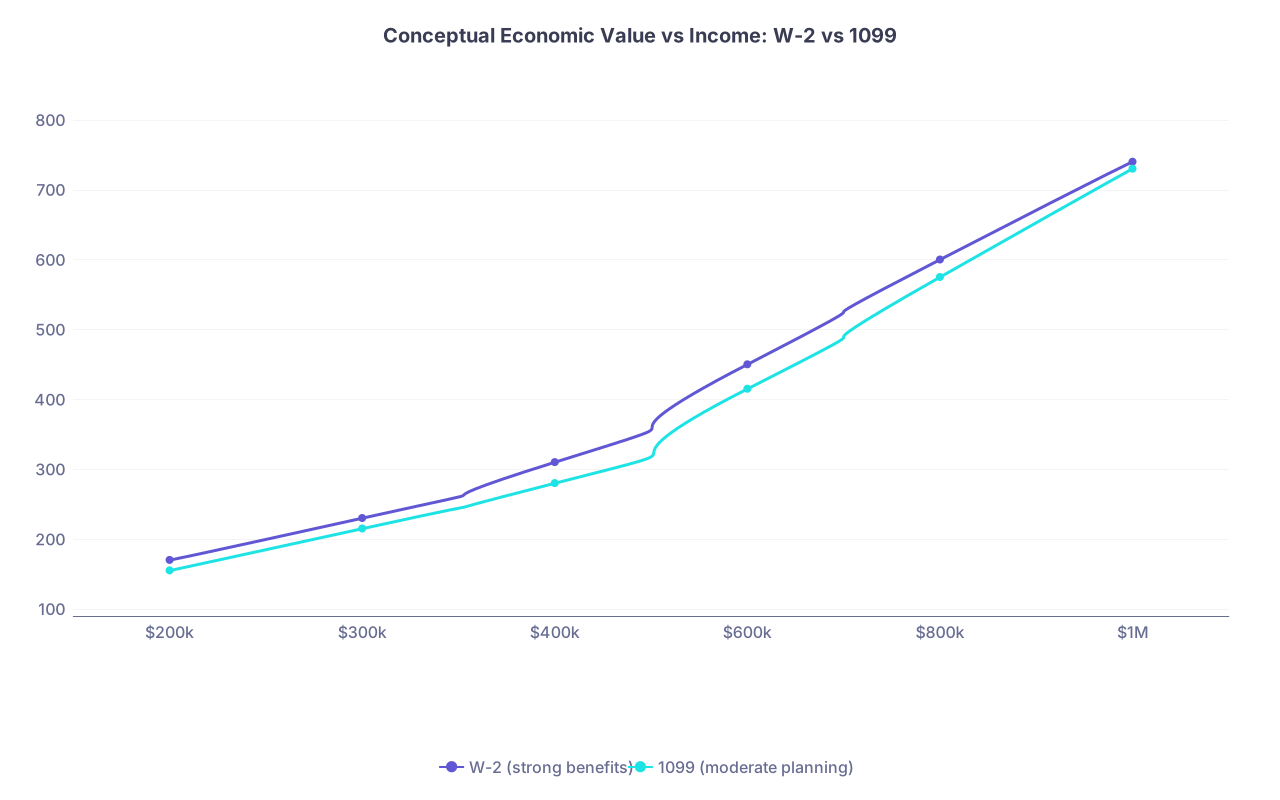
| Category | W-2 (strong benefits) | 1099 (moderate planning) |
|---|---|---|
| $200k | 170 | 155 |
| $300k | 230 | 215 |
| $400k | 310 | 280 |
| $600k | 450 | 415 |
| $800k | 600 | 575 |
| $1M | 740 | 730 |
The lines are close. In the mid‑range, the W‑2 with strong benefits usually wins. At very high incomes, the curves converge and can cross if you unlock advanced tools on the 1099 side.
10. The Bottom Line
Here is the distilled reality from the numbers:

Below roughly $300k–$350k, a good W‑2 package almost always beats 1099 purely on economic value. Employer match + subsidized health + employer‑paid payroll taxes are hard to outperform.
In the $350k–$600k band, W‑2 vs 1099 is close. A strong W‑2 usually still wins unless:
- The W‑2 benefits are weak, or
- You aggressively exploit 1099 tools (high retirement contributions, serious business deductions, possibly a cash balance plan).
At very high incomes ($600k–$1M+), the tax code leans more toward business owners. If you are willing to run a sophisticated structure, 1099 can produce significantly better tax outcomes than a bare‑bones W‑2 role. But the advantage is earned, not automatic.
If you remember nothing else: do not make a six‑figure career decision based on back‑of‑the‑napkin tax myths. Run the modeled numbers, line by line, W‑2 package vs 1099 structure. Then decide.