

The popular narrative that “doctors get audited more than everyone else” is lazy and usually wrong. The data shows something more precise: very high income self‑employed professionals, including many physicians, attract disproportionately high audit scrutiny compared with W‑2 employees in other fields. The IRS is not targeting white coats. It is targeting large, complex income with lots of judgment calls and deduction opportunities.
If you are a high‑earning physician, your audit risk does not look like the average American’s. It also does not look like a Fortune 500 CEO’s. It sits in an uncomfortable, data‑dense middle zone that most physicians seriously underestimate.
Let us walk through what the numbers actually say.
1. What the IRS Data Actually Shows
The best public window into audit risk is the IRS Data Book and occasional deep dives by the Treasury Inspector General and GAO. They do not break out “physician” as a category. So you have to infer risk from:
- Income level
- Entity type (W‑2 vs Schedule C vs S‑corp/partnership)
- Use of specific “high‑audit” forms (Schedule C, E, F, Form 2555, etc.)
This is exactly the profile of many high‑income physicians: S‑corp or partnership K‑1s from a group practice, pass‑through income from surgery centers or imaging centers, sometimes rental real estate, plus a high W‑2 or guaranteed payment component.
Audit probabilities by income band
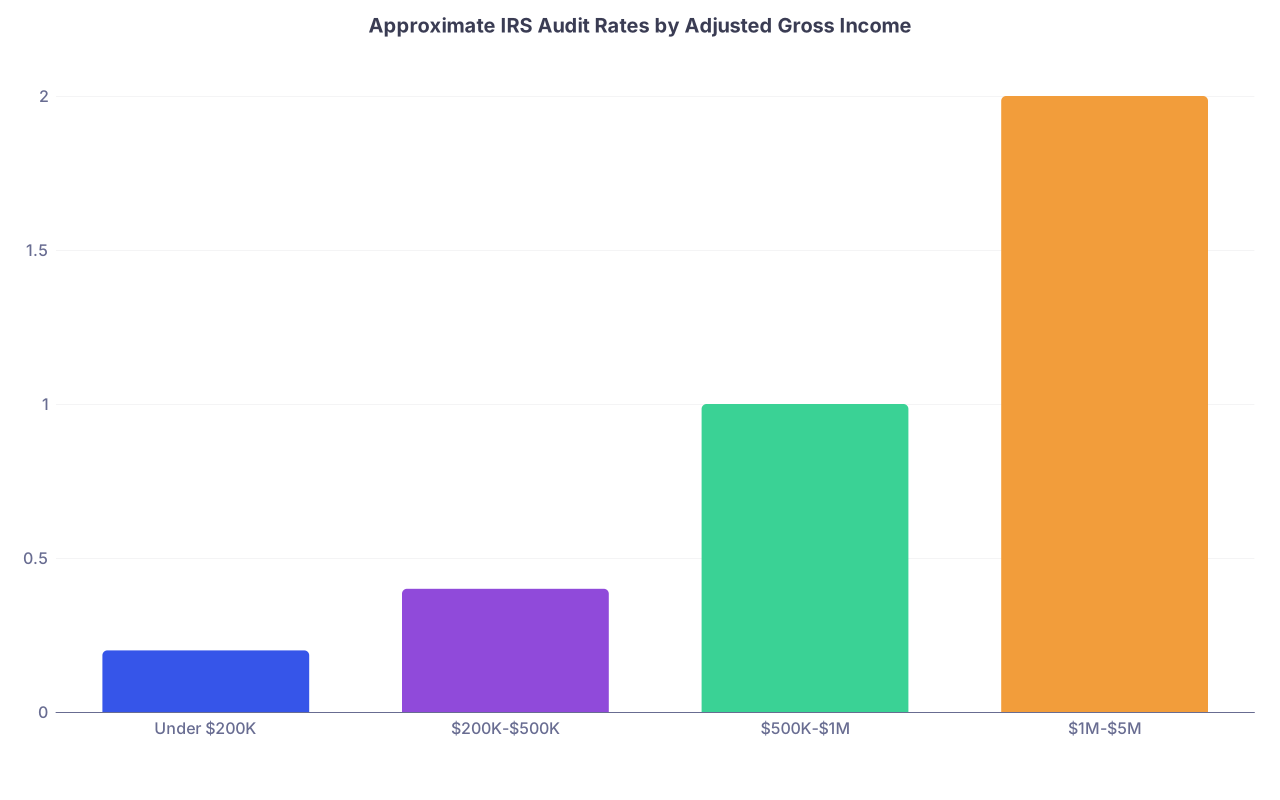
Pulling from recent IRS data (aggregated across all occupations), the pattern is clear: income drives audit risk.
| Category | Value |
|---|---|
| Under $200K | 0.2 |
| $200K-$500K | 0.4 |
| $500K-$1M | 1 |
| $1M-$5M | 2 |
These are rounded, approximate field + correspondence examination rates in recent years:
- Under $200,000 AGI: about 0.2% audited per year
- $200,000–$500,000 AGI: roughly 0.3–0.4%
- $500,000–$1,000,000 AGI: around 0.8–1.0%
- $1,000,000–$5,000,000 AGI: 1.5–2.0%+
Now overlay physicians:
- Median attending doctor: total compensation often $300,000–$450,000
- Subspecialists (ortho, neurosurg, interventional cardiology, GI with ownership stakes): easily $700,000–$1,500,000+
- Practice owners with ancillary income (ASC, imaging, labs, real estate): commonly $1,000,000+ including pass‑through profits
Conclusion: a large fraction of experienced physicians live in the 0.4–2.0% audit‑rate bands, versus 0.2% for the “average taxpayer.”
So yes, high‑income physicians face 2–10x the audit probability of the general population solely based on income level.
2. Physicians vs Other High‑Income Professionals
Income alone is not the full story. How that income is reported matters more than most doctors realize.
W‑2 executives vs physician practice owners
Compare two people with the same $900,000 of total income:
- A Fortune 500 VP with a $900,000 W‑2 and basic 401(k)
- A surgical subspecialist with:
- $500,000 W‑2 from the group
- $300,000 K‑1 from an S‑corp or partnership
- $100,000 K‑1 or Schedule E from an ASC/investment LLC
These two taxpayers do not face the same audit profile, even at the same income.
| Profile | Key Forms | Relative Audit Exposure* |
|---|---|---|
| W‑2 executive | W‑2, Schedule A | Low |
| Employed hospitalist physician | W‑2, Schedule A | Low‑moderate |
| Physician partner (group) | W‑2, K‑1, Schedule E | Moderate |
| Multi‑entity physician owner | W‑2, K‑1s, 199A, E | High |
| Self‑employed 1099 physician | 1099‑NEC, C, SE, 199A | High |
*Relative to taxpayers with similar income but fewer complex schedules.
The IRS audit selection algorithms (DIF scores and related systems) put much more attention on:
- Schedule C (non‑employee compensation, self‑employment)
- Schedule E (rental and pass‑through entities)
- K‑1 income from partnerships and S‑corps
- Significant “other deductions” not tied to third‑party reporting
Many large‑firm attorneys, partners in consulting firms, and high‑end real estate brokers look similar to physician practice owners on paper. The risk profile is comparable: 1–3% in many income buckets, sometimes higher where the returns show aggressive patterns.
So the question “Are high‑income physicians audited more than other professions?” is sloppy. You need to ask:
- Are high‑income, entity‑heavy physicians audited more than W‑2 tech executives? Yes.
- Are they audited more than law firm or accounting firm partners with similar income structures? Generally no; they sit in the same risk band.
The IRS is watching the structure, not the specialty.
3. Where Physicians Diverge From Other Professions
Even inside the high‑income bucket, physicians have a specific pattern the IRS sees over and over. That pattern carries its own triggers.
3.1 The 1099 / Schedule C problem
Hospitalists, anesthesiologists, radiologists, EM docs, and locums physicians often receive large 1099‑NEC payments instead of W‑2 wages. These often hit Schedule C, especially for solo‑practicing physicians.
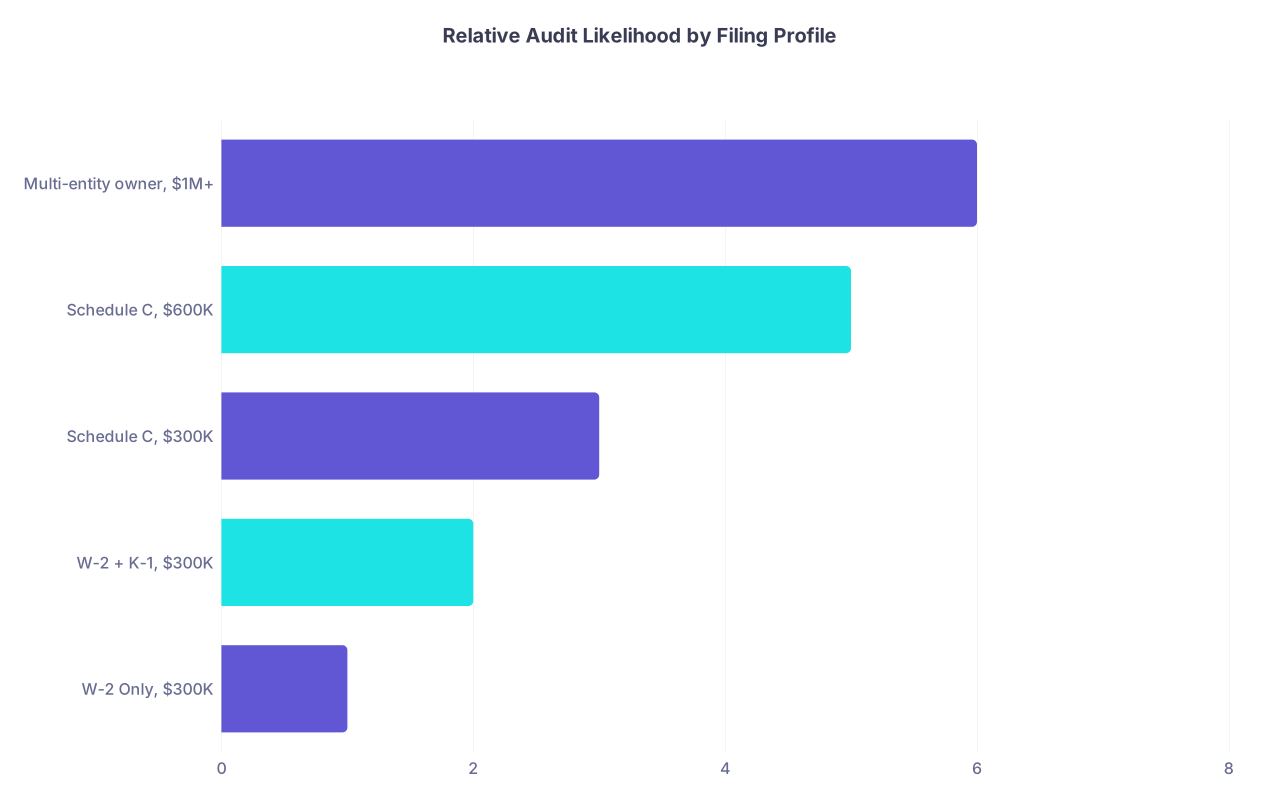
The data shows Schedule C filers have a significantly higher audit rate than W‑2‑only taxpayers at the same income level, particularly when:
- Gross receipts exceed roughly $200,000
- Net profit margin looks “too clean” (e.g., 90%+ profit with minimal expenses)
- Expense ratios do not align with peer norms in IRS data
| Category | Value |
|---|---|
| W-2 Only, $300K | 1 |
| W-2 + K-1, $300K | 2 |
| Schedule C, $300K | 3 |
| Schedule C, $600K | 5 |
| Multi-entity owner, $1M+ | 6 |
Indexing W‑2‑only at 1x risk, the relative pattern is roughly:
- W‑2 only: baseline
- W‑2 + modest K‑1: ~2x
- Schedule C $300,000: ~3x
- Schedule C $600,000: ~5x
- Multi‑entity owner at $1M+: 5–6x or more
This pattern applies across professions. But physicians have a high concentration in the Schedule C + K‑1 buckets, so they feel this more than, say, software engineers.
3.2 Common physician‑specific red flags
From actual audits I have seen, these items recur in physician files:
Excessive CME and conference write‑offs
- Multiple “conferences” in resort locations
- Family travel included in business expenses
- Weak documentation connecting conference to active clinical practice
Home office deductions
- Claimed by employed physicians who do nearly all work in hospital or clinic
- Floor plans and usage rarely documented
- Deducting large portions of rent, utilities, or even home remodels
Vehicle expenses
- Large SUV “100% business use” for commuting between home and a single hospital
- Mileage logs reconstructed after the fact, if at all
Medical equipment and supplies
- Laptops, iPads, high‑end monitors “for EMR access,” often dual‑use
- Scrubs, shoes, and similar items that are arguably personal clothing
Each of these is not unique to physicians, but the pattern is distinctive enough that busy local IRS agents will literally say, “This looks like every doctor’s return I see.” That is not a compliment.
Contrast this with a salaried CFO or software VP who has:
- W‑2 income
- Basic charitable, mortgage, and SALT deductions
- Maybe some RSUs and stock sales on 1099‑B
Their return is mostly third‑party‑reported. Very little room (or temptation) for “creativity.” Audit algorithms favor this simplicity.
4. High‑Income Physicians vs Other Fields: A Direct Comparison
Let me stack up typical profiles around the same income levels to make this concrete.
At ~$350,000 of total income
Employed orthopedic surgeon at a hospital system
- W‑2: $350,000
- Deductions: 401(k), HSA, maybe itemized mortgage/SALT
- Audit risk: not far from a high W‑2 engineer or executive; modestly above average, but low in absolute terms
Senior software engineer at a FAANG company
- W‑2 + RSUs: $350,000
- Mostly all reported by third parties
- Audit risk: similar to above; the IRS has nothing to argue about except basis tracking on stock
Contract anesthesiologist (1099)
- 1099‑NEC gross: $350,000
- Schedule C: large business deductions, maybe spouse on payroll
- Self‑employment tax and 199A interactions
- Audit risk: meaningfully higher; the return is more complex, with more subjective elements
Same dollar income. Very different audit profile.
At ~$900,000 of total income
Big‑law partner
- K‑1 income from partnership: $900,000
- Large state and local tax burden, often limited by SALT cap
- Complex partnership allocations, but the law firm’s return is usually meticulous
- Audit risk: high but mostly at the entity level; individual often targeted only if there is a partnership issue
Multi‑entity cardiologist owner
- W‑2: $450,000
- K‑1 from group practice: $250,000
- K‑1 from ASC and imaging center: $200,000
- Passive vs non‑passive classification, 199A, possibly real estate
- Audit risk: similar band to big‑law partner, but in practice, physicians often have weaker entity and documentation discipline than large law firms
Corporate VP at a public company
- W‑2 + vested RSUs: $900,000
- Mostly third‑party‑reported; some complexity around equity comp
- Audit risk: significantly lower than the physician owner and law partner, even with the same income
So where do physicians land relative to other professions?
- Higher risk than high‑income W‑2‑only professionals at similar incomes
- Comparable risk to other high‑earning partners and self‑employed professionals (law, consulting, accounting, real estate)
- Risk concentrated in specific return patterns: Schedule C, multiple K‑1s, large deductions with weak third‑party reporting
5. How Physicians Actually Get Selected for Audit
The IRS does not have a “physician” flag. It has math. Here is how that math tends to punish doctors.
5.1 DIF scores and peer norms
The IRS uses a Discriminant Function System (DIF) to score how “abnormal” a return looks compared to peers with similar:
- Income level
- Filing status
- Business or occupation codes
- Types of income and deductions
The data shows that outliers in:
- Business expense ratio to gross receipts
- Schedule C profit margin
- Charitable giving as a percent of income
- Unreimbursed business expenses (where still applicable)
get singled out. Many physicians are outliers because they:
- Earn high wages but also have relatively high living and consumption costs
- Try to “run” some of their lifestyle through the business (travel, vehicle, gadgets)
- Combine multiple revenue streams in ways the IRS system flags as complex
5.2 Document mismatch
Physicians also get caught in lower‑level “correspondence audits” triggered by mismatch:
- 1099‑NEC or 1099‑K issued by a group or locums agency that is not properly reported
- 1099‑INT or 1099‑DIV from brokerage accounts overlooked
- Early distribution penalties on retirement accounts missed
These are common in other high‑income professions too. The difference is that physicians juggling shifts at three hospitals plus a side LLC tend to accumulate more 1099s than, say, a single‑employer VP.

| Step | Description |
|---|---|
| Step 1 | File Tax Return |
| Step 2 | Income Level Check |
| Step 3 | Low Priority Pool |
| Step 4 | Complexity Scan |
| Step 5 | Standard DIF Score |
| Step 6 | Enhanced DIF Score |
| Step 7 | No Audit |
| Step 8 | Human Review |
| Step 9 | Audit Selected |
| Step 10 | Schedules C/E/K-1? |
| Step 11 | Score Above Threshold? |
| Step 12 | High Yield? |
This is simplistic, but directionally accurate. Physicians with multiple entities live in that “Enhanced DIF Score” box.
6. What the Data Suggests for Physician Tax Planning
If you accept that high‑income physicians are structurally higher‑risk than the average taxpayer, you adapt. You do not hide. You build returns that survive scrutiny.
6.1 Use complexity only where the numbers justify it
I see physicians at $300,000 of total income tangled in:
- S‑corp structures
- Management companies
- Family partnerships
to save maybe $5,000–$10,000 per year in tax, at the cost of doubling their audit visibility.
By contrast, a physician at $1.5M of total income should be using entities and advanced planning. The savings are six figures over a few years, and the incremental audit risk is a rational tradeoff if the documentation is solid.
The data‑driven rule:
- Below ~$400,000–$500,000 and mostly W‑2? Keep it simple.
- Above ~$500,000 with growing non‑W‑2 income? Complexity is justified, but you must treat the tax structure like part of your practice infrastructure, not an afterthought.
6.2 Run “audit‑ready” books, not just tax‑ready
The most painful audits I have seen were not about fraud. They were about sloppiness:
- No mileage logs
- No receipts for large travel expenses
- CME “conferences” with no agenda or proof of attendance
- “Medical consulting” arrangements with family members as employees with no time records
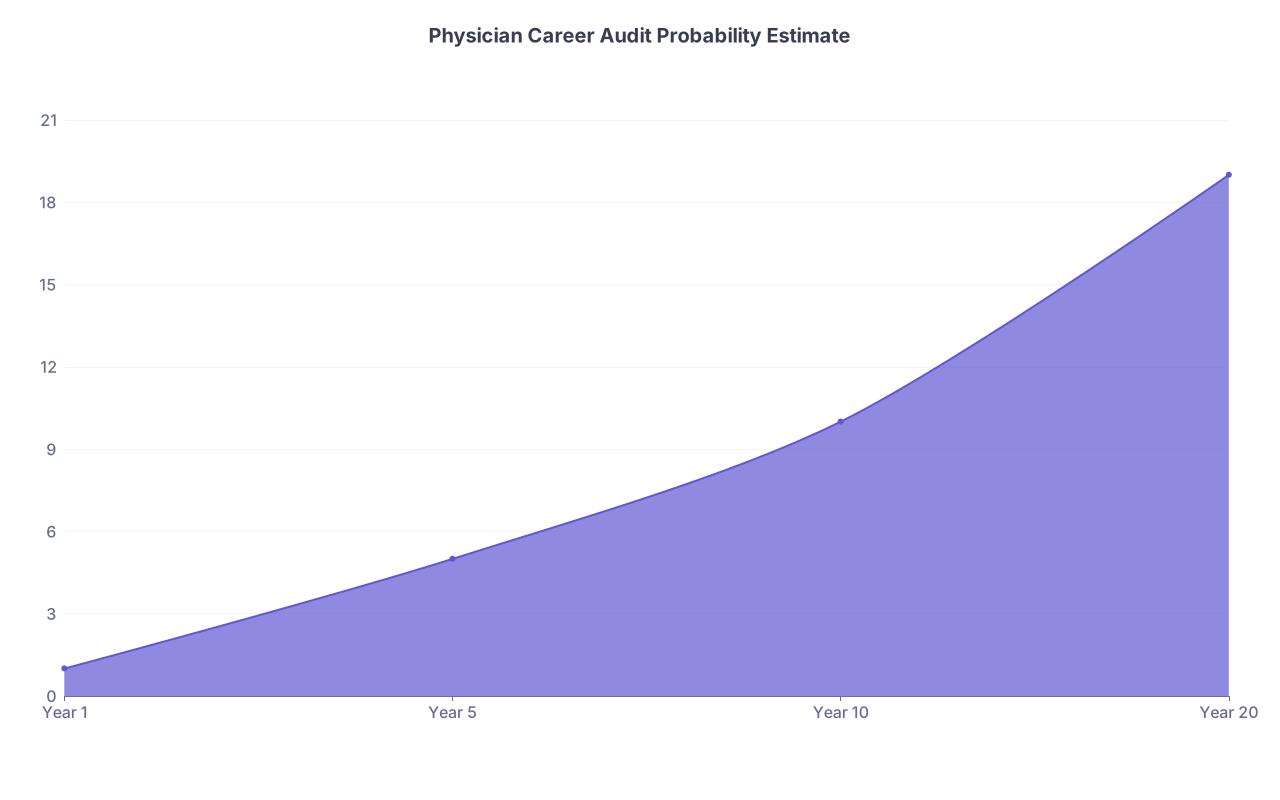
From a probability standpoint, your risk as a high‑income physician might be 1–3% per year. Over a 20‑year career, that is a non‑trivial cumulative probability of at least one exam.
So you build systems:
- Separate business and personal bank/credit accounts
- Real‑time expense tracking categorized clearly
- Digital storage of receipts >$75 and anything that looks “luxury”
- Contemporaneous mileage or vehicle use logs
Not because you expect an audit this year. Because the base rate over your career says there is a decent chance you will face one at least once.
6.3 Choose tax advisors who understand physician risk profiles
The worst combination is:
- High‑income, entity‑heavy physician
- Plus a “tax reduction guru” selling aggressive strategies based on edge‑case interpretations
The IRS has seen most of these games already: management companies that do nothing, sham leases with family, “consulting fees” to kids, or medical practices trying to squeeze personal consumption into business deductions.
You want a CPA or EA who:
- Works routinely with 1099 physicians, group practice partners, and physician owners
- Will quantify risk: “This saves you $X, but raises audit visibility by Y; here is why I am or am not comfortable with it”
- Designs documentation up front, instead of improvising after an audit notice arrives
| Category | Value |
|---|---|
| Year 1 | 1 |
| Year 5 | 5 |
| Year 10 | 10 |
| Year 20 | 19 |
If your annual audit chance averages ~1% over a long career, cumulative probability of at least one audit over 20 years is roughly 18–20%. That is not rare. It is a scenario you plan for.
7. The Bottom Line: How High‑Income Physicians Really Compare
Condensing the data into blunt statements:
- High‑income physicians are not uniquely targeted as a profession.
- They are overrepresented in high‑audit‑risk filing patterns: large Schedule C, multiple K‑1s, and complex pass‑through structures.
- Compared with W‑2 executives or engineers at the same income, physicians with significant self‑employment or ownership income face noticeably higher audit exposure.
- Compared with law partners, consulting partners, and other self‑employed high earners, physicians’ audit risk is similar, sometimes worse when their entity and record‑keeping hygiene is weaker.
- Good planning is not about avoiding IRS attention completely. It is about ensuring that, if scrutinized, your return looks boringly consistent with the data on your peer group.
You cannot change that you earn a high income. You can change whether your return looks like a clean, well‑documented business or a chaotic side hustle.
That is the real lever.
You are in the “Financial and Legal” phase of your planning now. The next logical move is to tie this audit‑risk understanding into a full tax strategy: entity selection, compensation design, retirement and defined benefit stacking, and practice sale planning. That is a longer conversation—but the audit data you have now should drive how aggressively (or conservatively) you play that game.


