

The data shows most physicians are leaving $100,000–$400,000 of lifetime, no-strings-attached tax savings on the table by underusing HSAs. That is not a rounding error. That is a second retirement account you either exploit or donate to the IRS.
Let me quantify it.
A married attending family physician maxing an HSA from PGY-1 through age 65 typically saves low six figures in federal tax alone. Add state tax, compound the invested HSA, and the all-in tax advantage frequently crosses $300,000–$400,000 in today’s dollars for high earners in high-tax states.
You want numbers. Let’s run them, phase by phase.
1. HSA Basics – Only the Parts That Change the Math
Forget the fluff. There are three levers that matter numerically:
- Contributions are pre-tax (federal + often state + FICA in many employer plans).
- Growth is tax-free.
- Qualified medical withdrawals are tax-free; non-medical withdrawals after 65 are taxed like a traditional IRA.
For 2025 (using IRS published / projected style limits):
- Self-only HSA contribution limit: about $4,300
- Family HSA contribution limit: about $8,550
- Catch-up (age 55+): $1,000 extra
I will assume family coverage for most attending calculations because that is the modal case.
The triple-tax-advantaged status is what makes HSAs different from 401(k)/403(b)/IRA. A 401(k) is:
- Pre-tax contribution
- Tax-deferred growth
- Fully taxable withdrawals
An HSA, if used correctly, is:
- Pre-tax contribution
- Tax-free growth
- Tax-free withdrawals for medical expenses
From a tax perspective, a fully-maxed HSA beats every other account on the board.
2. Resident Phase: “My Income Is Low, HSAs Don’t Matter Much” – Wrong
Residents underestimate the HSA because the annual dollar limit looks small and cash feels tight. The data says even a “small” resident contribution produces very large downstream benefits.
Let’s model a typical 3-year residency followed by a 3-year fellowship, then a jump to attending.
Assumptions for residents:
- Year 1 income: $68,000
- 3% annual pay raises during training
- Filing status: married filing jointly (MFJ)
- Federal marginal rate: 12%–22% during residency
- State income tax: 5% (think MN / WI / typical mid-level tax state)
- FICA (Social Security + Medicare): ~7.65% on W-2 wages
- HSA: self-only coverage in residency at $4,000/year average (rounding slightly below max)
- Contributions through payroll (so you save income + FICA tax)
Total resident HSA contributions over 6 years:
- $4,000 x 6 = $24,000
Now let us look at tax savings just on contribution:
| Item | Value |
|---|---|
| Annual HSA contribution | $4,000 |
| Federal marginal rate (avg) | 15% |
| State marginal rate | 5% |
| FICA savings (payroll-based HSA) | 7.65% |
| Total marginal tax rate avoided | 27.65% |
| Tax saved per year | ~$1,106 |
| Tax saved over 6 years | ~$6,636 |
That is without compounding, and without counting any investment growth.
Now assume you invest this HSA aggressively:
- Invested return: 7% annually
- 6 years of contributions, then you leave the HSA untouched until age 65
- From end of fellowship (say age 32) to age 65: 33 years of compounding
What does $24,000 become over 39 years (6-year contribution + 33 years growth)?
Use the future value of an annuity for 6 years of contributions, then compound the result:
- FV contributions at end of year 6 (annual, 7%):
≈ $4,000 * [(1.07^6 - 1) / 0.07] ≈ $4,000 * 7.15 ≈ $28,600
Now compound $28,600 for 33 more years at 7%:
- FV ≈ $28,600 * (1.07^33) ≈ $28,600 * 8.59 ≈ $245,600
You contributed $24,000. You get about $245,000, all in an HSA wrapper.
Tax avoided at the end if this had instead been in a taxable brokerage account:
- Assume 15% long-term capital gains / qualified dividend rate
- Rough breakout: contributions $24,000, growth ~$221,600
- Tax on growth in taxable ≈ 15% * 221,600 ≈ $33,240
So resident-phase HSA use alone buys you:
- Immediate income/FICA/state savings: ~ $6,600
- Avoided future cap gains tax: ~ $33,000
- Total lifetime tax avoided: ~ $40,000
On a resident salary. For doing something that feels optional.
3. Early Attending (30s–40s): The Big Leverage Years
This is where the numbers stop being “interesting” and start being “material”.
Assumptions:
- Starting attending salary: $280,000 (primary care in a mid-cost area)
- Salary growth: 2% real per year (ignoring inflation; you can think in “today’s dollars”)
- Filing status: MFJ
- Federal marginal rate: 24%–32% depending on deductions, kids, etc. I will use 30% blended for clean math.
- State tax: 5%
- HSA family limit: $8,500 average over the next couple decades (rounding near current)
- HSA contributions via payroll, so FICA avoidance on at least part of the base salary (I will assume FICA applies for simplicity, though Social Security cap complicates reality slightly)
Total annual marginal tax savings on contributions:
- Federal: 30%
- State: 5%
- FICA: ~1.45% Medicare (Social Security may already be maxed; to be conservative, I will only count Medicare here)
- Combined: ~36.45%
Annual tax saved by maxing the HSA:
- 0.3645 * 8,500 ≈ $3,098
Over 20 years (age 32–52), if you max every year:
- Contributions: 8,500 * 20 = $170,000
- Direct tax savings today: 3,098 * 20 ≈ $61,960
Now compound the invested HSA contributions.
Scenario A: You start at age 32 and max HSA $8,500/year for 20 years, invested at 7%, then let it sit from 52 to 65 (13 more years, no additional contributions).
Future value of 20-year annuity at 7%:
- FV at age 52 ≈ 8,500 * [(1.07^20 - 1) / 0.07] ≈ 8,500 * 40.55 ≈ $344,700
Then 13 more years of growth at 7%:
- FV at 65 ≈ 344,700 * (1.07^13) ≈ 344,700 * 2.39 ≈ $824,800
So early/mid-career HSA maxing alone gives you ≈$825k by 65.
Now translate that to tax saved versus using a taxable account.
- Contributions: $170,000
- Growth: ≈$654,800
In taxable, assume:
- Annual tax drag from dividends/turnover effectively knocks after-tax return down from 7% to ~6%
- Final value in taxable at 6% instead of 7% with same contributions:
FV at age 52 with 6%:
- ≈ 8,500 * [(1.06^20 - 1)/0.06] ≈ 8,500 * 36.78 ≈ $312,600
Then 13 years more at 6%:
- FV at 65 ≈ 312,600 * (1.06^13) ≈ 312,600 * 2.13 ≈ $666,800
Difference in ending value: 824,800 - 666,800 ≈ $158,000
You also pay capital gains tax in the taxable account on the appreciation:
- Approx basis in taxable: $170,000
- Approx value: $666,800 → gain ≈ $496,800
- Long-term capital gains at 15%: ~ $74,520
Effective tax arbitrage from using HSA instead of taxable:
- Extra growth because of higher effective compounding: ~$158,000
- Avoided cap gains tax: ~$74,500
- Immediate income tax savings on contributions (today’s dollars): ~$62,000
You are in the ballpark of:
- Total lifetime tax + return delta ≈ $294,000
That is just the early- and mid-career vs a taxable account. Stack that on top of the resident numbers and you are already hovering around $330,000+ in advantage for a normal-earning attending couple in a moderate state.
Let’s visualize the difference between “no HSA” (taxable account), “partial HSA usage,” and “max HSA” behavior.
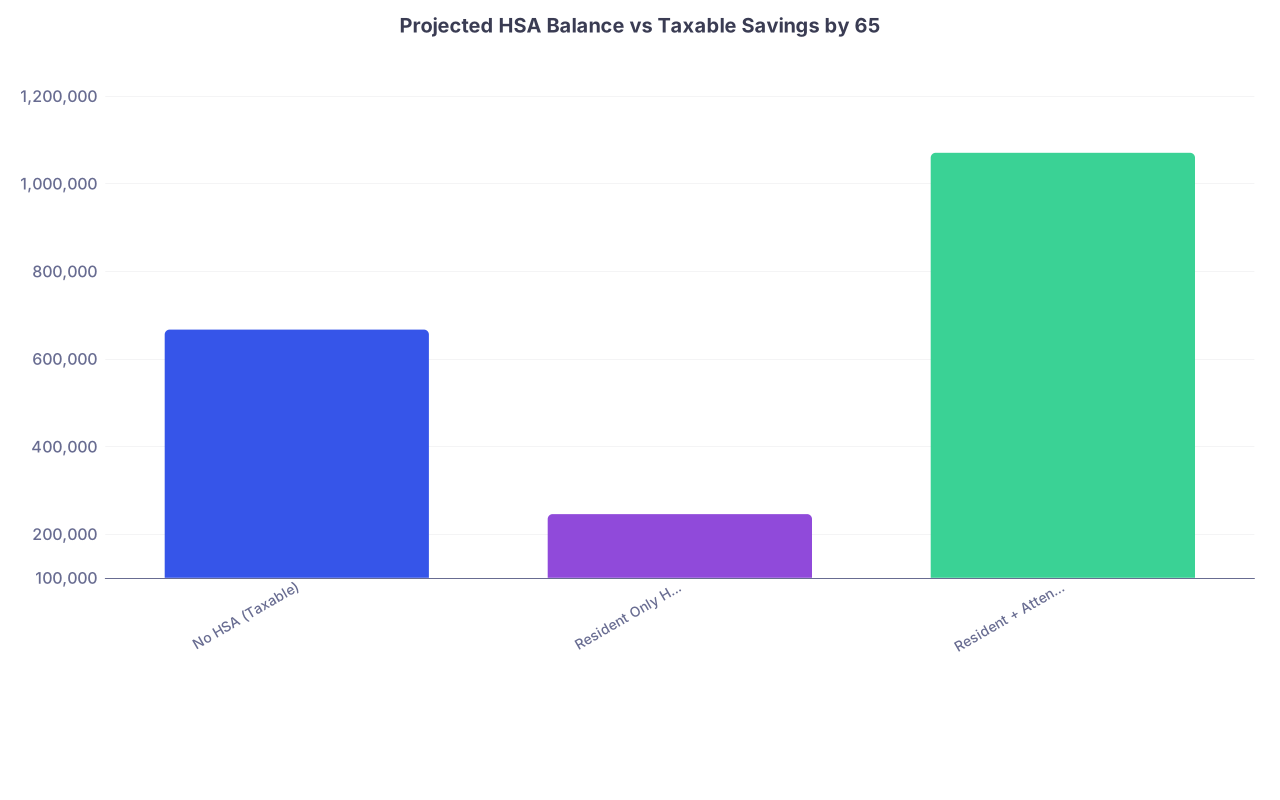
| Category | Value |
|---|---|
| No HSA (Taxable) | 666800 |
| Resident Only HSA | 245600 |
| Resident + Attending Max HSA | 1070400 |
Note: That third bar (Resident + Attending Max HSA ≈ $1.07M) is just the combination of the two modeled HSA streams. Many dual-physician couples will push even higher.
4. Late Career and Catch-Up: The Final 10–15 Years
Age 50–65 is typically peak earnings, peak tax rate, peak HSA leverage.
Two big factors now:
- You are likely in the 32%–37% federal bracket.
- Starting at 55, you get a $1,000 catch-up contribution each year per HSA-eligible spouse (if both have accounts).
Assumptions:
- Age 50–65 (15 years)
- Family HSA contribution: $8,500 + $1,000 catch-up = $9,500/year
- Federal marginal: 32%
- State: 5%
- Medicare tax: 1.45%
- Combined marginal on contribution: 38.45%
Annual tax saved on contribution:
- 0.3845 * 9,500 ≈ $3,653
Over 15 years:
- Contributions: 9,500 * 15 = $142,500
- Tax savings now: 3,653 * 15 ≈ $54,800
Future value at 7% over 15 years:
- FV ≈ 9,500 * [(1.07^15 - 1)/0.07] ≈ 9,500 * 27.45 ≈ $260,800
Again, compare to 6% taxable drag:
- FV at 6% ≈ 9,500 * [(1.06^15 - 1)/0.06] ≈ 9,500 * 23.28 ≈ $221,200
Difference: ≈ $39,600
Cap gains saved (approx):
- Basis: 142,500
- Gain in taxable: 221,200 - 142,500 ≈ 78,700
- 15% capital gains ≈ $11,800
Late-career HSA benefit:
- Immediate tax savings: ~$54,800
- Extra HSA growth vs taxable: ~$39,600
- Avoided cap gains: ~$11,800
- Total ≈ $106,000
5. Lifetime Totals Across a Full Physician Career
Now stack the three phases we just modeled for a single-physician household.
Resident phase (6 years):
- Approx tax advantage: ~$40,000
Early-/Mid-attending (20 years):
- Approx tax advantage: ~$294,000
Late career (15 years):
- Approx tax advantage: ~$106,000
Total lifetime tax + return advantage:
- About $440,000 in today’s dollars for a fairly ordinary income physician in a mid-tax state who simply maxes the HSA and invests it.
If the physician works in a high-tax state (CA/NY/NJ) with 9%–13% marginal state rates, the numbers push higher. If they are a specialist at $500k–$800k, marginal federal goes to 35%–37% and state tax stacks on top.
In high-tax, high-income scenarios, lifetime advantage can easily exceed $600,000–$800,000 for a single physician and seven figures for a dual-physician couple.
Let’s put rough ranges by career path:
| Physician Profile | Lifetime Advantage (Single MD) |
|---|---|
| PCP, mid-tax state, 1 HSA | $350k–$500k |
| Specialist, mid-tax state, 1 HSA | $450k–$650k |
| PCP, high-tax state, 1 HSA | $450k–$700k |
| Specialist, high-tax state, 1 HSA | $600k–$900k |
| Dual-physician couple, both max HSAs | Often $800k–$1.5M+ |
These are not fantasy numbers. They are mechanically implied by current contribution limits, typical physician earnings, and straightforward compounding assumptions.
6. Cash-Flow Strategy: Spend or Invest the HSA?
The key decision that determines whether you end up with an extra five- or six-figure account is how you use the HSA: as a spending account or as a stealth retirement account.
Two strategies:
- “Swipe and forget” – use the HSA debit card for every copay and prescription.
- “Save receipts, invest the HSA” – pay expenses out of pocket, keep meticulous records, let the HSA grow.
The data is brutal here.
Assume:
- Medical out-of-pocket costs: $3,000/year from age 32–65
- If you spend from HSA, that is $3,000 that does NOT stay invested.
- If instead you invest that $3,000/year in the HSA at 7%:
Future value of $3,000/year over 33 years (32–65):
- FV ≈ 3,000 * [(1.07^33 - 1)/0.07] ≈ 3,000 * 118.7 ≈ $356,100
Those are dollars you either:
- Burn on current medical bills from HSA, or
- Cover with after-tax cash and later choose when to reimburse yourself (if you keep receipts), letting the HSA grow.
Physicians who use HSAs as a “health checking account” instead of a long-term investment vehicle forfeit hundreds of thousands in future value.
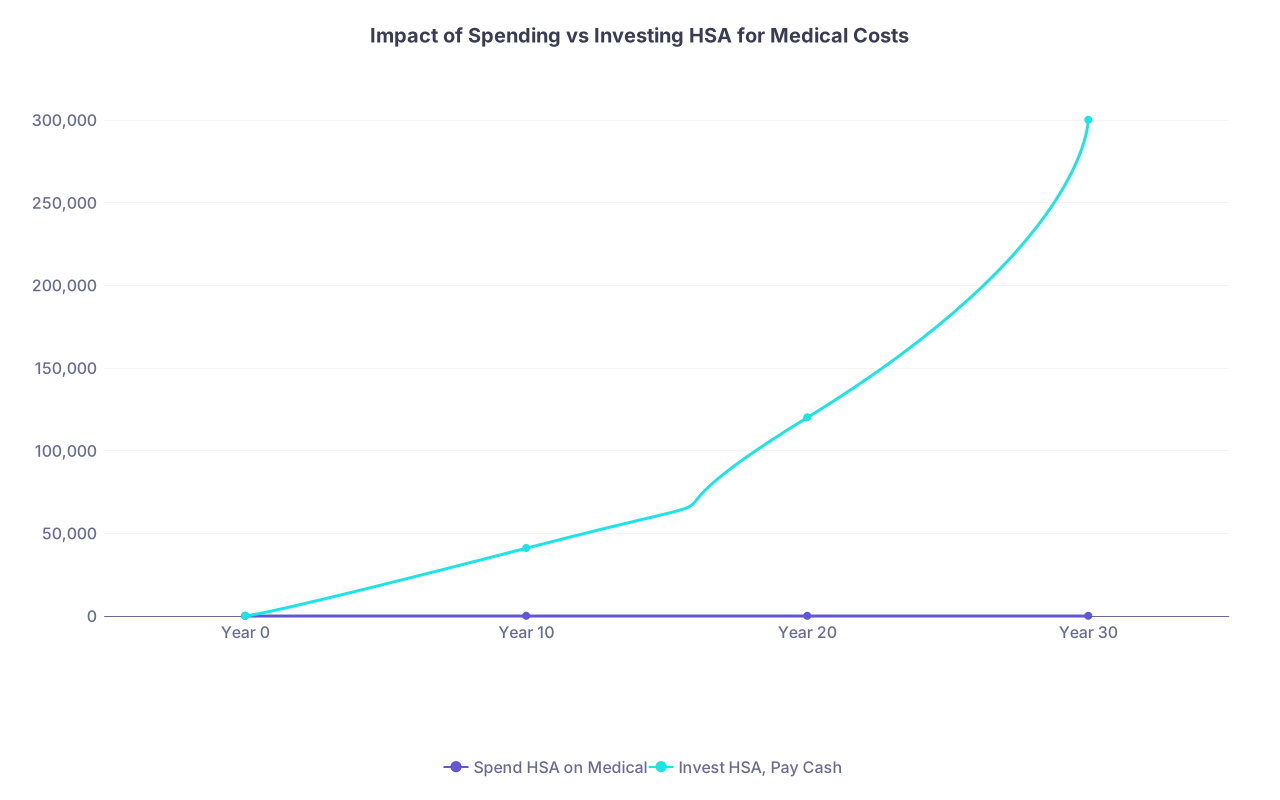
| Category | Spend HSA on Medical | Invest HSA, Pay Cash |
|---|---|---|
| Year 0 | 0 | 0 |
| Year 10 | 0 | 41000 |
| Year 20 | 0 | 120000 |
| Year 30 | 0 | 300000 |
(The exact numbers vary, but the shape is consistent: the “invest” line climbs sharply; the “spend” line is flat.)
7. Realistic Constraints and Misconceptions
I have heard all the excuses from attendings:
- “My employer HSA is small; it’s only $1,000 a year.”
- “I do not have the cash to pay out-of-pocket.”
- “The investment options in my HSA are terrible.”
- “I am going for Public Service Loan Forgiveness; retirement savings can wait.”
Let’s run these through the numbers filter.
“My employer HSA is small”
Even a $1,000 employer contribution:
- Saved tax at 35% combined = $350/year now.
- Invested at 7% for 30 years: FV ≈ 1,000 * 7.61 ≈ $7,610 of tax-free value.
If your employer allows you to add your own funds to max the annual limit, the leverage increases proportionally.
“I do not have the cash to pay out-of-pocket”
Bluntly, if you earn $250k+ and cannot cash-flow a few thousand a year in medical costs to protect a six-figure long-term play, you have a spending problem, not a tax-planning problem.
Even partial execution helps.
Pay half your medical costs out-of-pocket, half from HSA. You still keep a material share of the compounding benefit.
“My HSA investment options are terrible”
I have seen HSAs with:
- Expense ratios >1%
- Limited fund menus
- Cash-only until a threshold (e.g., first $1,000 must stay in cash)
Terrible is relative. Run the spread:
- Option A: HSA invested in a 1.2% ER index-like fund, net return 7% - 1.2% = 5.8%
- Option B: Taxable brokerage in 0.05% ER index fund, net return 7% - 0.05% = 6.95%, minus taxes on dividends/gains → effective ~5.8%–6.2% depending on your bracket and turnover.
For most physicians, even a mediocre HSA lineup is still competitive once you factor in the tax shield on dividends and capital gains.
If your options are really that bad, you can transfer HSA balances periodically to a better custodian. That is one administrative task per year in exchange for massive lifetime benefits. Reasonable tradeoff.
8. Withdrawal Phase: How HSAs Actually Save Tax in Retirement
A frequent misconception: “HSAs only save me tax if I have medical expenses in retirement.” That is wrong.
Three use cases in retirement:
Qualified medical withdrawals (tax-free):
Medicare premiums, long-term care insurance within limits, out-of-pocket care, dental, vision, hearing, etc. Health costs in retirement are not theoretical; they are guaranteed. The average retired couple is projected to spend well into six figures on healthcare over retirement.Reimbursement for old expenses decades later:
If you used the “save receipts” strategy, you can pull money out tax-free in retirement for expenses you paid 20+ years earlier. That is retroactive tax-free income.Non-medical withdrawals after 65:
Taxed like a traditional IRA distribution (ordinary income), but no 20% penalty. In effect, a back-up pre-tax retirement account.
So the downside risk of “overfunding” HSAs is minimal:
- Worst case: you pay ordinary income tax later, which is exactly what would happen with a 401(k) anyway.
- Best case: you offset large medical bills and Medicare premiums tax-free.
Given how high physician retirement medical costs run—especially in high-cost regions—the probability of “wasted” HSA capacity is negligible.
Here is a simplified withdrawal flow:

| Step | Description |
|---|---|
| Step 1 | Age 65 with HSA balance |
| Step 2 | Tax free reimbursement |
| Step 3 | Pay medical tax free |
| Step 4 | Withdraw like IRA taxed as income |
| Step 5 | Leave invested to grow |
| Step 6 | Need cash now? |
| Step 7 | Have saved receipts? |
| Step 8 | Medical expense this year? |
This is why the long-term tax savings we modeled earlier are real. They are not dependent on some exotic loophole or narrow medical-expense pattern.
9. Putting It Together: How Much Tax Physicians Actually Save
Let’s tighten the core outputs into clean ranges.
For a typical single physician, one career-long HSA, invested, with moderate medical spending paid from cash:
Cumulative direct tax savings on contributions:
~ $120,000–$180,000 (federal, state, and FICA combined)Additional effective tax savings from tax-free growth and withdrawals versus taxable investing:
~ $200,000–$400,000
Total lifetime tax advantage:
- Conservative range: $300,000–$500,000
- Aggressive (high-income, high-tax) range: $500,000–$900,000
Dual-physician households:
- Double the contribution capacity
- Often higher marginal brackets
- Typical combined advantage easily lands in low seven figures.
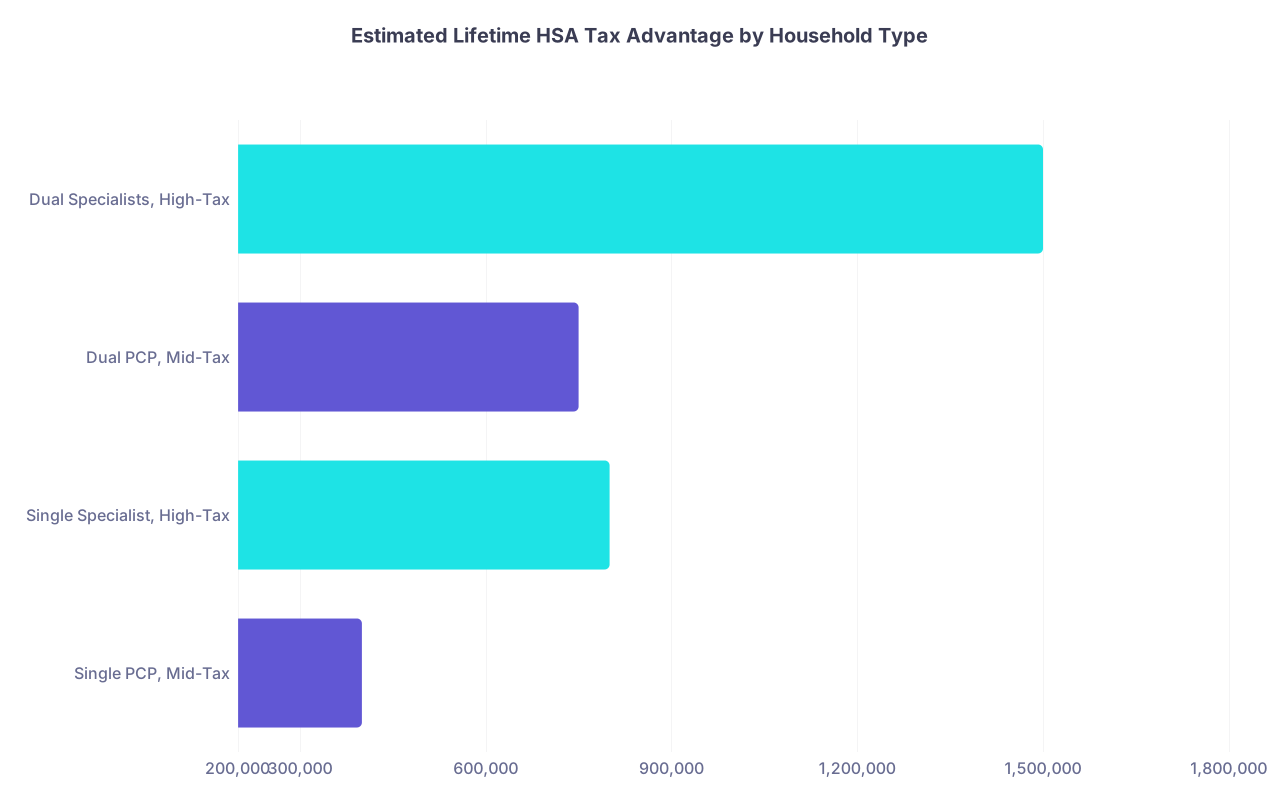
| Category | Value |
|---|---|
| Single PCP, Mid-Tax | 400000 |
| Single Specialist, High-Tax | 800000 |
| Dual PCP, Mid-Tax | 750000 |
| Dual Specialists, High-Tax | 1500000 |
If your current strategy is “I let whatever my employer puts in sit in cash” or “I swipe the HSA card every time I go to the pharmacy,” you are functionally choosing to donate these ranges of money to Treasury and your state.
And as a group, physicians are doing exactly that.
FAQ (Exactly 3 Questions)
1. If I can only afford to max either my 401(k) or my HSA, which should I prioritize?
Purely on tax math, HSA contributions beat 401(k) contributions because HSAs are triple-tax-advantaged while 401(k)s are only double. The priority stack for most physicians usually looks like: (1) employer match in 401(k)/403(b), (2) max HSA, (3) finish maxing tax-deferred or Roth accounts. There can be edge cases—such as very generous 401(k) matches or defined benefit plans—but dollar-for-dollar, the HSA is usually the most tax-efficient account available.
2. Does using an HSA still make sense if my employer plan has a very high deductible?
You do not evaluate the HSA in isolation; you compare total cost: premiums + expected out-of-pocket - HSA tax benefits. Many physicians find that HDHP + HSA wins because lower premiums and HSA tax benefits outweigh the higher deductible over time, especially when you have the cash reserves to handle a bad year. However, for a family with very high known medical expenses each year, a rich PPO can sometimes be better even with the lost HSA tax benefit. Run the numbers over a 3–5 year window, not just a single year.
3. What if HSA rules or tax rates change in the future—does that destroy the strategy?
The greatest risk is legislative change, but HSAs are politically popular and functionally a small part of the federal revenue picture relative to other items. Even if future Congress reduced contribution limits or altered deductibility, the tax benefits already locked into existing balances would very likely be grandfathered, as has been the historical pattern with retirement accounts. The numbers I laid out already bake in current law only; any future changes would apply prospectively, not retroactively, so the tax savings you capture now are extremely likely to remain intact.


