

Defined benefit plans are the most underused tax shelter available to high‑earning physicians. The data is not subtle about this.
For senior doctors in peak earning years, a defined benefit (DB) or cash balance plan layered on top of a 401(k) can produce six‑figure annual tax deferrals, while the 401(k) by itself often caps out at a relatively modest shelter. The reason is simple: contribution limits for DB plans scale with age, income, and actuarial assumptions, not with a flat IRS dollar cap like a 401(k).
Let me walk through the numbers, not the sales pitch.
1. The Structural Difference That Drives the Tax Math
A 401(k) is a defined contribution plan. The IRS tells you the maximum input. You control the risk and returns. The annual employee + employer limit in 2024 is $69,000 (plus $7,500 catch‑up if applicable, for salary deferral only).
A defined benefit plan flips the logic. It promises a future benefit (for example, “$X per year from age 62”), then an actuary backs into how much must be contributed each year to fund that promise, constrained by IRS rules. For older physicians with high incomes, that “required” contribution can easily exceed $200,000–$300,000 per year.
The key driver: the time horizon to retirement. A 60‑year‑old has 5–10 years to fund a promised benefit. A 40‑year‑old has 20–25 years. Less time → larger annual contribution.
The data point most physicians miss: The DB plan contribution limit is not one number. It is a function of:
- Age
- Compensation
- Years to retirement age defined in the plan
- Interest rate assumptions and mortality tables (actuarial inputs)
That is why generic “maximum contribution” tables you see online are usually wrong for a specific doctor. You need a plan design. But we can still model typical ranges and tax savings.
2. Modeled Tax Savings: 401(k) Only vs 401(k) + Defined Benefit
Let us build a clean scenario for a senior physician in private practice.
- Age: 60
- Filing: Married filing jointly
- Practice structure: S‑corp or partnership with flexibility for employer contributions
- W‑2/guaranteed payments from practice: $500,000
- State: High‑tax state (call it 9% marginal state tax)
- Federal marginal bracket: 37%
Assume 2024 limits and keep the modeling simple.
2.1 Baseline: 401(k) Only
At age 60, the physician can do:
- Employee deferral: $23,000 + $7,500 catch‑up = $30,500
- Employer contribution (profit sharing) to reach total $69,000 limit
So maximum 401(k) / profit sharing = $69,000 tax‑deferred.
Tax savings on that contribution:
- Federal: 37% × $69,000 = $25,530
- State: 9% × $69,000 = $6,210
Total modeled tax savings: $31,740 per year.
Useful. But not transformative for a doctor earning $500,000+.
2.2 401(k) + Defined Benefit (Cash Balance) Plan
Now layer in a well‑designed cash balance/DB plan.
For a 60‑year‑old physician, typical maximum deductible DB/cash balance contributions (solo or with well‑structured staff allocations) often range $200,000–$300,000+ annually. I have seen actuarial designs north of $350,000 for late‑60s owners.
Let us model three age points with conservative contribution ranges.
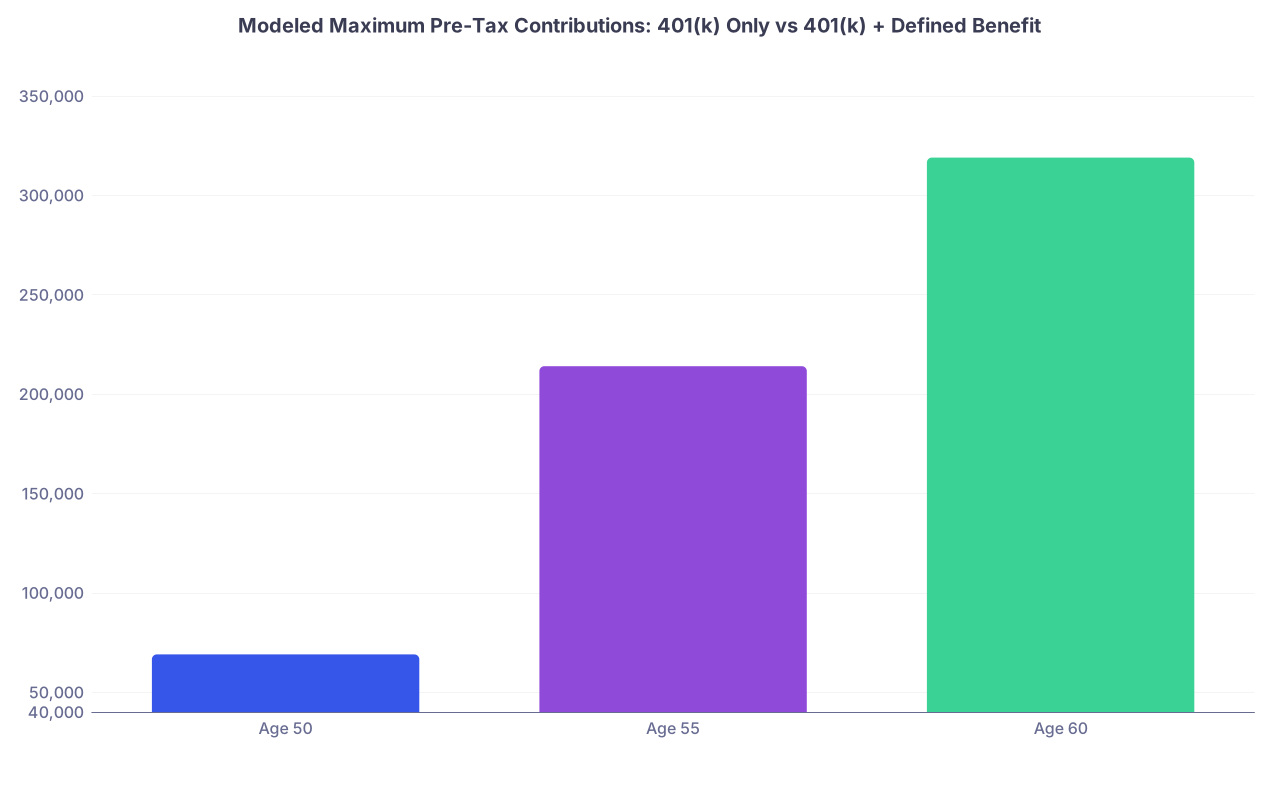
| Category | Value |
|---|---|
| Age 50 | 69000 |
| Age 55 | 214000 |
| Age 60 | 319000 |
Assumptions behind those totals:
- 401(k)/profit sharing: $69,000 at each age
- DB plan modeled contributions:
- Age 50: $145,000
- Age 55: $200,000
- Age 60: $250,000
So combined total pre‑tax retirement contributions:
- Age 50: $69,000 + $145,000 = $214,000
- Age 55: $69,000 + $200,000 = $269,000
- Age 60: $69,000 + $250,000 = $319,000
Now, compare annual tax savings.
Let us assume the same 37% federal + 9% state = 46% marginal rate.
Modeled annual tax savings:
Age 50 (401(k) only vs combo)
- 401(k) only: 46% × 69,000 = $31,740
- 401(k) + DB: 46% × 214,000 = $98,440
- Incremental tax savings from DB: $66,700 per year
Age 55
- 401(k) only: $31,740
- 401(k) + DB: 46% × 269,000 = $123,740
- Incremental: $92,000 per year
Age 60
- 401(k) only: $31,740
- 401(k) + DB: 46% × 319,000 = $146,740
- Incremental: $115,000 per year
Now look at this as a 7–10 year runway before retirement.
At age 60, if you run the plan for only 7 years:
- Extra annual tax savings: ≈ $115,000
- Over 7 years: $805,000 in total tax deferral, before any investment growth on the sheltered dollars.
That is the difference between walking into retirement with a comfortable portfolio and walking in with several million more in tax‑deferred assets.
3. Multi‑Year Modeling: What the Numbers Look Like Over Time
One‑year tax savings are helpful. Multi‑year cumulative impact is where DB plans really separate from a 401(k)‑only strategy.
Let us model a 60‑year‑old physician who:
- Keeps income steady at $500,000
- Runs a 401(k) + DB combo for 7 years
- Uses the age 60 modeled contribution: $319,000/year pre‑tax
- Applies a 46% marginal tax rate
- Assumes 5% annual investment growth, tax‑deferred
- Compares to 401(k) only with $69,000/year contributions and same growth rate
We will track two things:
- Cumulative tax deferral
- Ending pre‑tax retirement account balances
3.1 Cumulative Tax Deferral
Annual tax deferral:
- 401(k) only: $31,740
- 401(k) + DB: $146,740
Seven‑year totals (ignoring bracket creep and law changes, deliberately simple):
- 401(k) only: $31,740 × 7 = $222,180
- 401(k) + DB: $146,740 × 7 = $1,027,180
- Incremental benefit: ≈ $805,000 deferred
3.2 Ending Account Balances
Run the compounding on contributions for 7 years at 5% annual return.
Use the standard future value of an annuity formula:
FV = C × [((1+r)^n − 1) / r]
Where:
- C = annual contribution
- r = 0.05
- n = 7
Factor: ((1.05^7 − 1) / 0.05) ≈ 8.14
401(k) only:
- C = 69,000
- FV ≈ 69,000 × 8.14 ≈ $561,660
401(k) + DB:
- C = 319,000
- FV ≈ 319,000 × 8.14 ≈ $2,597,660
Incremental retirement capital: ≈ $2.0 million more in tax‑deferred assets, driven largely by the DB plan.
To make the contrast explicit:
| Scenario | Annual Contribution | 7-Year Tax Deferral | 7-Year Ending Balance (5% return) |
|---|---|---|---|
| 401(k) only | $69,000 | $222,180 | ~$562,000 |
| 401(k) + DB plan | $319,000 | $1,027,180 | ~$2,598,000 |
You are not going to get that kind of leverage from “adding a backdoor Roth” or “tax‑loss harvesting.” This is big‑lever planning.
4. Solo vs Group Practice: How Staff Costs Change the Math
Everything I have shown so far implicitly treats the doctor as the primary participant. In a group practice with staff, you must pay attention to the required contributions for employees. That is the most common reason doctors walk away from DB plans: not the IRS, not the complexity, but the staff cost.
The right way to think about it is as a yield problem:
For every dollar you are required to contribute for staff, how many dollars can you put away for the owners?
For a well‑designed plan in a typical small practice (1–3 doctors, 5–15 staff), efficient ratios often look like:
- $1 to staff → $3 to $8 for owners
Let us put some structure around that with a simple scenario:
- 2 physician partners, each age 58
- Combined compensation: $900,000
- 8 staff members, average age 40, average salary $60,000
Assume an actuary designs a combo 401(k) + cash balance plan:
- Total owner contributions: $500,000
- Total required staff contributions: $80,000
Owner:staff contribution ratio: 6.25:1
At a combined 46% tax rate, the owners defer:
- 46% × $500,000 = $230,000 in tax per year
The $80,000 to staff is a real cash cost, but it is:
- Deductible to the practice
- A recruiting/retention tool
- Still leaves a net owner benefit far in excess of the cost
This is where many physicians miscalculate. They see the $80,000 and ignore the $230,000 in tax they are not paying. That is a bad trade.
To visualize the leverage:
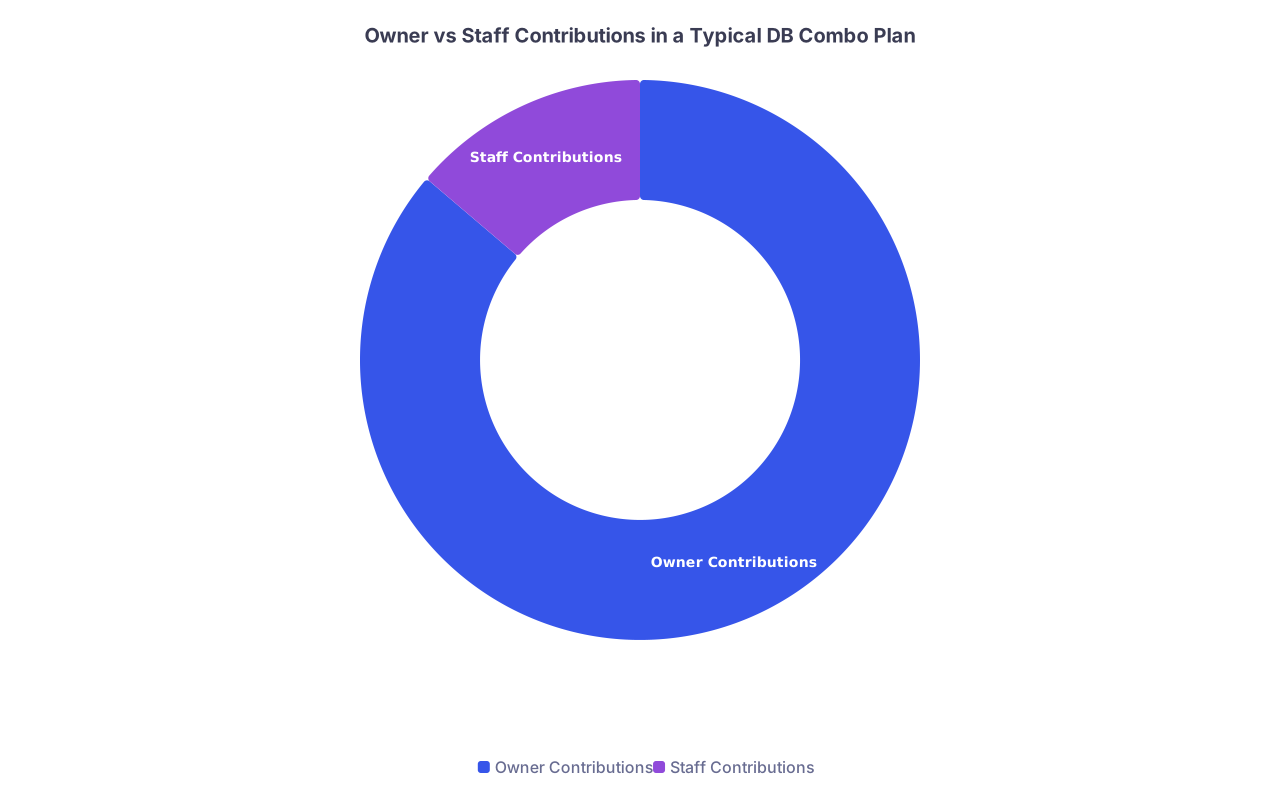
| Category | Value |
|---|---|
| Owner Contributions | 500000 |
| Staff Contributions | 80000 |
If your staff ratio looks more like 2:1 or 1.5:1, the plan may still be viable but the after‑tax benefit shrinks. That is exactly why you run the numbers instead of working off rules of thumb.
5. Tax Rate Arbitrage: Why Deferral Still Works for Senior Physicians
Sophisticated doctors sometimes push back: “I’m already in a high bracket now, and RMDs later will be taxed at high rates too. Is this just kicking the can?”
No. Not if you structure withdrawals intelligently and use the usual planning tools (Roth conversions, staggered distributions, charitable strategies). The data on lifetime tax burdens usually breaks in favor of deferral, especially when you stack:
- High current marginal rate (often 40–50% combined)
- Lower effective retirement rate across multiple brackets
- Years of tax‑deferred compounding
Let us run a simple arbitrage model for the 60‑year‑old:
- Current combined marginal rate: 46%
- Retirement effective rate on withdrawals: 28% (blended across brackets, Social Security interactions, etc.)
- Extra retirement assets from DB combo vs 401(k) only at 67: about $2.0 million (from earlier model)
Immediate tax avoided by using the DB plan:
- $1,027,180 over seven years, as modeled
Tax paid later when withdrawing that $2.0 million at 28% effective:
- $2,000,000 × 28% = $560,000
Net lifetime tax savings from arbitrage on those incremental DB contributions alone:
- $1,027,180 avoided now − $560,000 future = ≈$467,000
This ignores:
- The time‑value benefit of paying $560,000 decades later instead of $1,027,180 over the next 7 years
- Any partial Roth conversion strategy during lower‑income years
- Charitable remainder trusts, donor‑advised funds, or QCDs that might zero out some RMDs
The simplification still makes the point: DB plans do not merely smooth taxes. They can reduce lifetime taxes in absolute dollars, not just shift the timing.
6. Risk, Flexibility, and “What If I Can’t Keep Funding It?”
Now the uncomfortable part. DB plans are not toys. You cannot casually turn them on and off without consequences.
Key constraints:
Funding obligations
The plan commits to a benefit formula. That creates a range of required contributions annually. In a bad investment year, the contribution may need to be higher. In a strong year, it may be lower. You are targeting a promised benefit, not a fixed deposit.Plan termination
You can terminate a DB plan, but it is a formal process with an actuary and, for some plans, PBGC implications. You cannot simply “skip a few years” because revenue dipped without plan redesign.Investment risk
Low returns or portfolio losses increase required future contributions to reach the same benefit. That said, you control the investment policy. Many physician DB plans run with conservative allocations (40/60 or 50/50 equity/bond) to manage volatility because the real win is the tax shelter, not aggressive alpha.
In practice, what I have seen with physicians:
- Best candidates are 50–65, with stable or predictable income
- They have 5–10 years of runway where they can commit to funding at relatively high levels
- They are often 3–8 years “behind” on retirement savings relative to their income
For those doctors, the combination of:
- Large contributions
- Strong current tax savings
- Short remaining work horizon
…makes DB plans extremely powerful.
For a 38‑year‑old attending with variable income and a lot of lifestyle inflation? Usually not a fit. The contribution obligations are likely too long‑term and inconsistent with future uncertainty.
Here’s how the risk “feels” to a practice owner:

| Step | Description |
|---|---|
| Step 1 | High Income Doctor 50 plus |
| Step 2 | Avoid DB Plan or Keep Small |
| Step 3 | Model DB Plan With Actuary |
| Step 4 | Compare Multi Year Tax Savings vs Staff Cost and Flex Risk |
| Step 5 | Implement If Ratios and Risk Acceptable |
| Step 6 | Income Stable 5 to 10 years |
| Step 7 | Staff Headcount and Costs Reasonable |
| Step 8 | Comfort With 100k plus Annual Contributions |
If you land on F and the numbers do not show at least a 3:1 owner:staff contribution ratio and six‑figure annual tax savings, I usually tell physicians to walk away. Not worth the complexity.
7. Distribution, Exit, and Coordination with Other Strategies
One last layer: a DB plan is not a standalone universe. It must coordinate with:
- Existing 401(k)/profit sharing
- Backdoor Roth IRAs (watch pro‑rata rules with any pre‑tax IRAs from rollovers)
- Practice entity structure and compensation strategy
- Estate and charitable planning
For senior doctors approaching retirement, the question is always: What does the exit look like?
Typical pattern I see:
Age 60–67: High contribution phase
- Max DB + 401(k) combo
- Possibly add cash balance credits that ramp down near retirement
Plan termination around retirement age
- Lump sum rolled into an IRA, or
- Annuity purchase, depending on design and goals
Early retirement years (say 67–75)
- Partial Roth conversions in lower‑income years, using standard tax bracket management
- Charitable strategies for those inclined to reduce future RMDs
RMD phase
- Coordinated distributions to fill desired brackets, integrate with Social Security and other income
The tactical point: DB + 401(k) simply gives you more tax‑deferred volume to shape later. You are not locked into high taxes forever. You get more chess pieces on the board.
To visualize the changing contribution pattern over time (simplified):
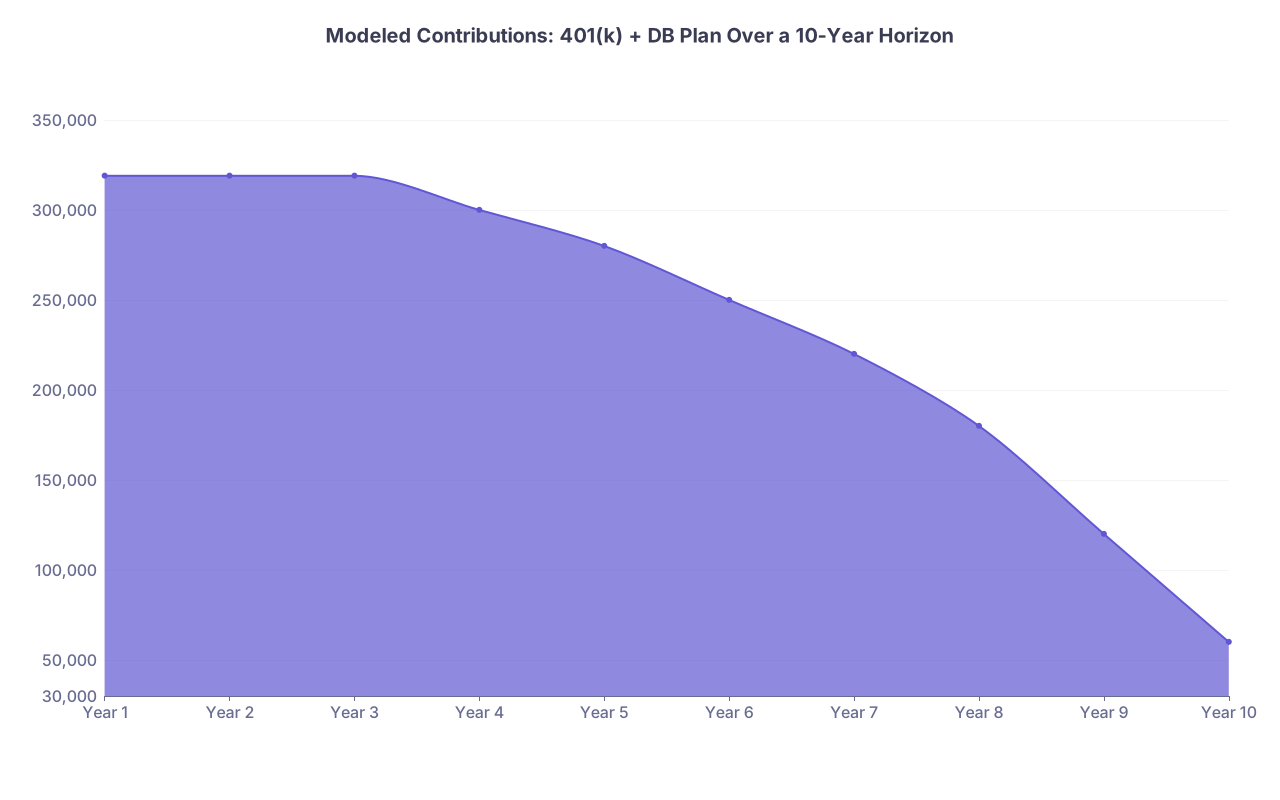
| Category | Value |
|---|---|
| Year 1 | 319000 |
| Year 2 | 319000 |
| Year 3 | 319000 |
| Year 4 | 300000 |
| Year 5 | 280000 |
| Year 6 | 250000 |
| Year 7 | 220000 |
| Year 8 | 180000 |
| Year 9 | 120000 |
| Year 10 | 60000 |
Actual plan designs will rely on actuarial rules, but the pattern holds: high contributions early, tapering as you approach the benefit cap or retirement.
8. When a Defined Benefit Plan Clearly Wins—and When It Does Not
Let me be blunt.
A DB or cash balance plan is usually a clear win for a physician when:
- Age 50+
- Consistent income above ~$400,000
- Practice can support $150,000+ total annual retirement contributions
- Staff contributions produce at least a 3:1 or 4:1 owner:staff ratio
- Physician has < $3–4 million already saved and wants to “catch up”
It usually does not make sense when:
- Age < 45 with uncertain income or practice stability
- Owner is unwilling to commit to large, recurring contributions
- Staff costs swamp owner benefit (ratios near 1:1 or 2:1)
- Physician is already oversaved, expects very high retirement tax brackets, and prefers Roth‑heavy planning
The data across hundreds of plans is consistent: for senior physicians with high, stable income, the tax and accumulation benefits are overwhelming compared to 401(k) only.
You just must prove it with your numbers: age, income, staff census, and contribution targets. Not rules of thumb.
Core Takeaways
The modeled tax savings from a 401(k) + defined benefit plan for a senior physician typically ranges from $80,000 to $150,000 per year beyond a 401(k)‑only strategy, with multi‑year tax deferral easily crossing $500,000–$1,000,000.
Over a 7–10 year window for a 60‑year‑old doctor, combining a DB plan with a 401(k) can reasonably add $1.5–$2.5 million in tax‑deferred assets versus 401(k) only, even with conservative return assumptions.
The plan only makes sense if the practice economics work: stable income, acceptable staff cost ratios, and a physician willing to commit to six‑figure annual contributions for a defined runway. When those conditions are met, the data strongly favors the DB + 401(k) combo over 401(k) only.


