

Real Estate Professional Status (REPS) is either a powerful tax lever for physicians or an overhyped loophole sold by aggressive promoters. The data shows both stories are true, depending on how you run the numbers.
Let me strip out the marketing and walk through what actually happens on a physician tax return when REPS is in play. With math. Not vibes.
1. The Core Tax Problem REPS Tries To Solve
REPS matters only because physicians often sit in a very specific tax profile:
- High W‑2 income
- High marginal tax rate
- Growing interest in real estate as a diversification and tax strategy
For a typical attending:
- W‑2 income: $350,000–$600,000
- Effective federal rate: 24–30%
- Marginal federal rate: 35–37%
- State: 0–10%
Real estate offers two big tax levers:
- Depreciation (especially bonus depreciation / cost segregation)
- Ability to use paper losses from depreciation to offset other income
The IRS basically says:
“You can have your depreciation, but if you are a high‑income W‑2 earner, your rental losses are passive. They usually cannot offset your W‑2 income.”
That’s the wall REPS tries to break.
Passive Loss Limitation: The Real Constraint
For high‑income physicians without REPS, here’s the rule that bites:
- Rental real estate is generally passive
- Passive losses can only offset passive income, not W‑2 or active business income
- The $25,000 special allowance for active participants in rentals phases out and is gone by AGI of $150,000
So if you earn $400,000 as a hospital employee and your rentals generate a $100,000 tax loss (mostly depreciation), in most cases:
- That $100,000 does NOT reduce your W‑2 income this year
- It becomes a “suspended passive loss” that carries forward until:
- You have passive income, or
- You sell the property (or portfolio, depending on grouping elections)
Result: big paper losses, but no current tax benefit.
That is why the REPS pitch is so seductive: “Turn those losses into offsets against your W‑2 income.”
2. What REPS Actually Requires – By The Numbers
REPS is not a checkbox. It is a test. With thresholds and time.
The law has two main prongs:
- More than 50% of your personal services must be in real property trades or businesses in which you materially participate
- At least 750 hours per year in those real property trades or businesses, with material participation
Both must be true. Each year.
The 750‑Hour Threshold in Plain Numbers
750 hours per year = roughly:
- 62.5 hours per month
- About 14.4 hours per week
- ~2 hours per day, every day
That does not sound bad until you put it next to actual physician hours.
Take a conservative attending schedule:
- 50 hours/week clinical
- 48 working weeks/year
- Total: 2,400 hours/year
For REPS, more than 50% of your personal service time must be in real estate. That means:
- Real estate hours > physician hours
- Real estate hours > 2,400 in this example
That is impossible for a full‑time physician. The math does not care about enthusiasm.
This is why, in reality, REPS for physicians most often looks like:
- One spouse is the physician (high income, W‑2)
- The other spouse qualifies as the real estate professional (meets >750 hours and >50% of their work time in RE, plus material participation)
The IRS looks at REPS status at the taxpayer level. For a married couple filing jointly, if one spouse qualifies, the rental activities can be non‑passive for the return.
So the “physician uses REPS” story is usually “physician’s spouse uses REPS and they file jointly.”
3. The Tax Impact: How Much Does REPS Actually Save?
Now to the part nobody should hand‐wave: the actual dollar effects.
Example 1: High‑Income Physician, No REPS
Assumptions:
- Filing status: Married filing jointly
- Physician W‑2 income: $500,000
- Non‑physician spouse: no earned income
- Federal marginal rate: 37%
- State income tax: 5%
- Real estate:
- 3 rental properties
- Net cash flow before depreciation: $30,000
- Depreciation (after cost segregation): $120,000 per year
- Interest, taxes, repairs, etc. are already baked into the $30,000 net cash flow
Tax result without REPS:
- Rental income (cash basis): +$30,000
- Depreciation: –$120,000
- Net rental loss: –$90,000
Because of passive loss rules and high income:
- That $90,000 loss is passive
- Passive loss allowed to offset non‑passive income: $0
- $90,000 is suspended and carried forward
Taxable W‑2 income impact: no reduction
Current year tax savings from real estate losses: $0
You still enjoy the economic benefit of depreciation later (fewer taxes on sale or on passive income years), but not now when your marginal rate is highest.
Example 2: Same Physician, Spouse Qualifies for REPS
Same assumptions, but now the spouse:
- Documents 900 hours/year in qualifying real estate activities
- Has no other job, so >50% of personal services in real estate
- Materially participates in each rental (or they are properly grouped)
Tax result with REPS:
- Rental activities become non‑passive for the return
- Net rental loss: –$90,000
- This can offset non‑passive W‑2 income
So:
- Taxable W‑2 income effectively reduced: $500,000 – $90,000 = $410,000
Tax savings:
- Federal: 37% × $90,000 = $33,300
- State: 5% × $90,000 = $4,500
- Total Year 1 tax savings: $37,800
Same properties. Same economics. Just different classification. That is the core REPS value.
Sensitivity: How Much Loss Do You Need For REPS To Be Worth It?
This is where the data cuts through the hype.
Let us hold the same marginal tax rates and look at varying loss levels:
| Allowed Loss (via REPS) | Federal @ 37% | State @ 5% | Total Tax Saved |
|---|---|---|---|
| $25,000 | $9,250 | $1,250 | $10,500 |
| $50,000 | $18,500 | $2,500 | $21,000 |
| $75,000 | $27,750 | $3,750 | $31,500 |
| $100,000 | $37,000 | $5,000 | $42,000 |
| $150,000 | $55,500 | $7,500 | $63,000 |
Now overlay costs and hassle:
- Proper bookkeeping and REPS documentation
- CPA or tax attorney with RE specialization (often $3,000–$10,000/year for complex returns)
- Cost segregation studies ($3,000–$10,000 per property)
- Real risk of audit
If your annual loss is only $25,000 and you save ~$10,500 per year, the after‑cost and after‑risk benefit is modest. When your losses cross $75,000–$100,000, the leverage starts to look meaningful.
In practice, REPS becomes compelling when:
- You can consistently generate $75,000+ in annual depreciation‑driven losses
- You are in a 32–37% federal bracket plus state
- You intend to hold or roll properties for a long period, not flip in 1–2 years
4. Where The Real Estate Losses Actually Come From
People toss around “$100k in losses” like it is trivial. The data says otherwise.
Those losses are usually non‑cash and come from:
- Straight‑line depreciation (27.5 years for residential, 39 for commercial)
- Bonus depreciation front‑loading through cost segregation
- Sometimes high interest and repair costs in early years
Cost Segregation and Bonus Depreciation
Before 2018, bonus depreciation was less generous. Under the Tax Cuts and Jobs Act (TCJA):
- 2018–2022: 100% bonus depreciation on qualifying property
- 2023: 80%
- 2024: 60%
- 2025: 40%
- 2026: 20%
- 2027: 0% (scheduled, unless rules change)
This matters because most of the flashy REPS case studies you see online rely on 100% bonus depreciation. That window is already closing.
Illustrative example:
- You buy a $1,000,000 small multifamily (80% building, 20% land)
- Depreciable basis: $800,000
- Cost seg study identifies 25% as 5‑, 7‑, and 15‑year property: $200,000
Under 100% bonus depreciation (2018–2022):
- You could deduct the full $200,000 in Year 1
Under 60% bonus depreciation (2024):
- You can bonus 60% of that $200,000 = $120,000 in Year 1
- The remaining 40% of that chunk is depreciated over 5–15 years
So the immediate loss potential is shrinking over time under current law.
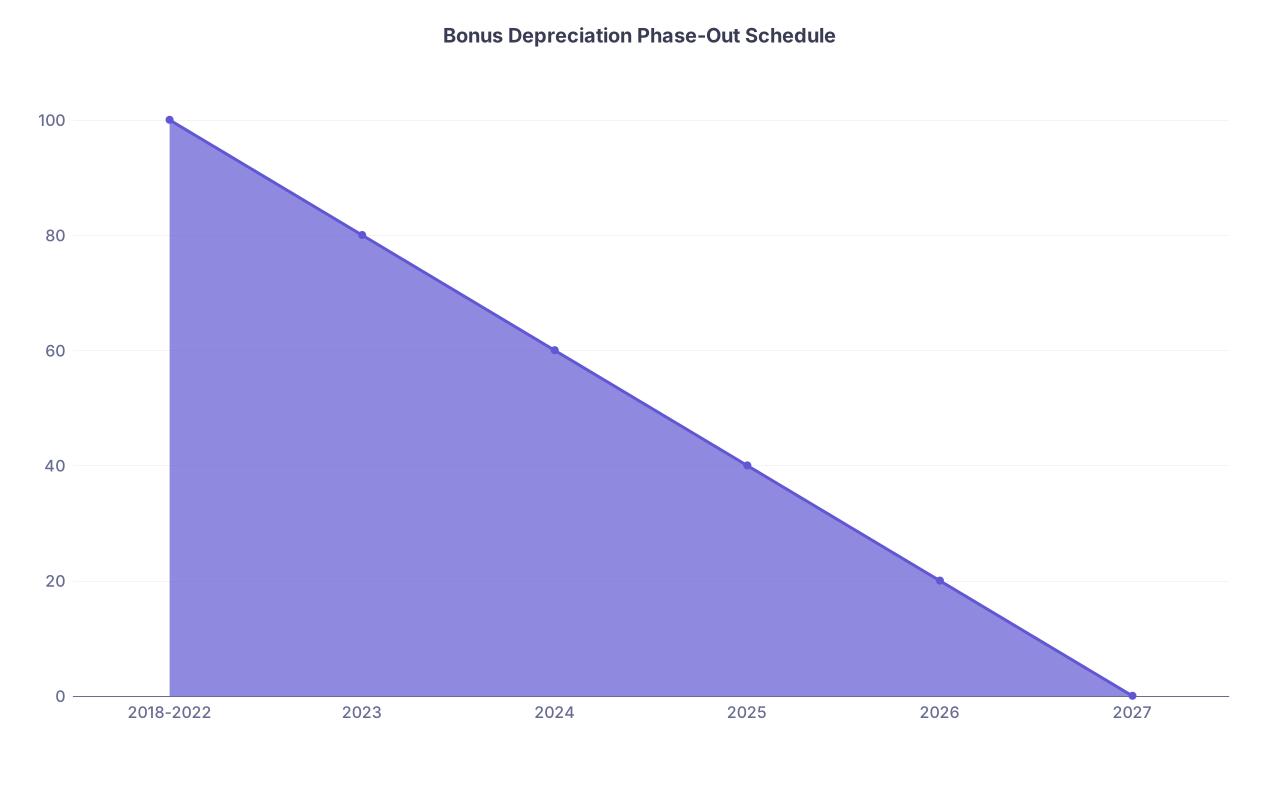
| Category | Value |
|---|---|
| 2018-2022 | 100 |
| 2023 | 80 |
| 2024 | 60 |
| 2025 | 40 |
| 2026 | 20 |
| 2027 | 0 |
The equity you need grows with property cost. That is the hidden denominator in all these “I wiped out my income” posts.
5. How Often Do Physicians Actually Qualify For REPS?
The IRS does not publish “REPS by profession” stats. But we can triangulate.
We know:
- REPS claims are a small share of all returns, but heavily concentrated in higher incomes
- The IRS has challenged REPS aggressively in audits, often successfully when documentation is weak
- Court cases show a recurring pattern: professionals with full‑time jobs lost REPS when they could not prove hours
In my experience looking at physician households:
- Full‑time attending + full‑time physician spouse: REPS is basically dead
- Full‑time attending + part‑time spouse genuinely running rentals: REPS is viable
- Locums / part‑time physician reducing clinical hours to build a RE portfolio: possible but closely scrutinized
The key quantitative constraint is the “more than 50% of services in real estate” test. For a spouse who does not work outside real estate, that is easy. For a physician trying to claim REPS personally, the math usually destroys the story.
6. Risk Profile: What The Data Says About IRS Enforcement
REPS is not illegal. It is in the statute. The issue is abuse and poor documentation.
Audit selection is data driven. A few factors push you toward the front of the line:
- High AGI with large Schedule E losses offsetting W‑2 income
- REPS claimed with obvious full‑time job in a non‑real estate field
- Big bonus depreciation spikes from cost seg in year 1
- Prior‑year patterns with no REPS, then sudden REPS and massive losses
If your return shows:
- W‑2: $650,000
- Schedule E: –$300,000
- “Real Estate Professional” box checked
You are not invisible.
On audit, the IRS laser focuses on:
- Contemporaneous time logs: dates, activities, hours
- Material participation in each activity (or proper grouping election)
- Actual role: managing vs. truly passive investor
The most common failure mode I see:
- Taxpayers create calendars retroactively
- Hours are padded with vague entries (“reviewed market,” “researched properties”)
- Activities that do not count (education, investor calls, casual browsing Zillow) are lumped in
If you cannot credibly document 750+ hours and more than 50% of your working time in RE for the year, those losses get reclassified as passive. Then you owe back taxes, penalties, and interest.
7. When REPS Is Rational For Physicians – And When It Is Not
Let’s rank the scenarios by data‑backed attractiveness.
Strong REPS Candidates (Physician Households)
You see the math work well when:
- One spouse has high W‑2 / 1099 physician income (e.g., $350k–$800k)
- The other spouse:
- Has no or very minimal W‑2 income elsewhere
- Genuinely runs a rental / short‑term rental / small development business
- Can document 750+ hours and real material participation
And:
- There is enough depreciable basis coming online (new acquisitions or heavy rehabs) to create $75k–$200k+ in annual losses
- They use cost segregation strategically over several years, not all in one shot
- They accept that bonus depreciation is phasing down and build that into projections
In those cases, I have seen:
- Effective federal + state savings of $40,000–$150,000 per year
- 3‑ to 5‑year windows where taxes drop dramatically, then normalize as bonus depreciation fades and portfolios stabilize
Weak or Bad REPS Candidates
The data looks ugly when:
- Both spouses have demanding full‑time jobs outside real estate
- You own 1–2 small rentals with limited depreciation potential
- You are in a moderate tax bracket (say $150k–$250k income, 22–24% federal)
- You are buying turnkey properties with little opportunity for value‑add or cost seg benefit
In those cases, REPS usually fails 3 ways:
- You actually do not qualify, so the strategy is imaginary
- You spend serious money on advisors and cost seg for modest benefit
- You take on unnecessary audit risk for very little upside
The math just does not justify the effort.
8. Economics Beyond Taxes: Do Not Ignore the Investment Side
Too many REPS conversations fixate on taxes and ignore the base question:
Are these actually good real estate investments?
A perfectly designed tax shelter around a mediocre property is still a mediocre decision.
Basic metrics matter:
- Cash‑on‑cash return
- Debt service coverage ratio (DSCR)
- Vacancy assumptions
- Capital expenditure reserves
If you overpay for a property because someone is dangling a “$100k paper loss” in front of you, you are just pre‑spending your tax savings.
Quantitative example:
Option A – Safer investment, no REPS:
- Invest $300,000 in low‑cost index funds in a taxable account
- Long‑term expected after‑tax annual return: ~6–7%
- No audit risk, no complexity
Option B – Aggressive REPS play:
- Use $300,000 as 25% down payment on $1.2M property
- Generate $120,000 depreciation in year 1
- Tax savings at 42% combined rate: ~$50,400
- But property has:
- 3–4% cap rate
- High leverage
- Concentration risk in one market
You might “win” $50,000 this year and lose multiples of that over 5–10 years if the underlying deal is weak.
Tax planning should follow sound investment decisions, not lead them.
9. How To Quantify REPS For Your Situation: A Simple Framework
You do not need a 50‑page plan to see if REPS is even in the right zip code for you. You need 5 numbers:
- Marginal tax rate (federal + state)
- Expected annual real estate losses (from depreciation, not cash burn)
- Years you can realistically generate those losses (given bonus depreciation rules and your acquisition pace)
- Cost of implementation (CPA, legal, cost segs, bookkeeping)
- Probability you genuinely qualify (be honest)
High‑level break‑even:
Annual tax savings ≈ (Losses × marginal rate) – annualized implementation cost
If:
- Losses: $100,000
- Combined marginal: 42%
- Annual implementation cost: $10,000
Expected savings: $42,000 – $10,000 = $32,000 per year
Then ask:
- Can we sustain similar losses for 3–5 years?
- Are we comfortable defending REPS in an audit with real time logs?
- Are the underlying properties solid even if laws change?
If the answer is weak on any of those, REPS may be more sizzle than steak for you.

| Step | Description |
|---|---|
| Step 1 | Physician Household |
| Step 2 | REPS Low Value |
| Step 3 | Physician REPS Unlikely |
| Step 4 | High Audit Risk |
| Step 5 | REPS Potentially Strong |
| Step 6 | High Marginal Rate? |
| Step 7 | Spouse Available for REPS? |
| Step 8 | Sufficient Depreciation Losses? |
| Step 9 | Can Document 750 Hours? |
10. The Bottom Line: Does REPS Truly Cut Physician Taxes?
The data is pretty clear if you strip out anecdotes.
- REPS can reduce taxes for high‑income physician households by tens of thousands per year when one spouse legitimately qualifies and there is substantial depreciation to deploy.
- For full‑time physicians trying to personally claim REPS while working 40–60 clinical hours per week, the time math almost always fails. Audit risk is real, not theoretical.
- The shrinking bonus depreciation schedule makes the “wipe out my taxes” examples less repeatable going forward. You need more properties and more capital to generate the same losses each year.
In three bullets:
- REPS is a powerful but narrow tool: it works extremely well for a specific slice of physician households, and poorly or dangerously outside that slice.
- The only numbers that matter are your marginal rate and the size and duration of real, defensible depreciation losses. Everything else is sales talk.
- If the investment would not make sense without the tax angle, it is usually a bad trade even if the REPS math technically “works.”


