

Most physicians are using their LLC about 20% as well as they could. The rest is just a glorified checking account. That is a waste.
You can turn that same LLC into a serious tax and asset protection tool in roughly 12 months. But it will not happen by accident, and your CPA will not magically do it for you while you send them a shoebox of 1099s in March.
I am going to walk you through a one‑year, step‑by‑step build‑out. By the end, your medical LLC will stop being “where my locums checks land” and start functioning like a professionally run practice, even if you are a solo moonlighter.
Step 0: Confirm Your Foundation (Month 0–1)
Before you start layering in tax strategies, you need the legal and structural basics nailed down. Otherwise you are optimizing on top of sand.
1. Get the entity type right
You do not get tax benefits from the letters “LLC” alone. The tax magic is in how that LLC is taxed.
For a physician practice / side income LLC, your real choices:
- Single‑member LLC, disregarded entity (default)
- Multi‑member LLC, taxed as partnership
- LLC taxed as S‑corporation (via Form 2553)
- LLC taxed as C‑corporation (almost never right for most individual physicians)
For most 1099 physicians, the usual progression looks like this:
- Income < ~$120k 1099:
Default LLC taxation (sole prop or partnership) is usually fine. Keep it simple. - Income ~$150k–$500k 1099 from active services:
S‑corp election often makes sense to reduce self‑employment taxes, if done correctly. - Income mainly from owning multiple practices, passive ventures, or complex ownership structures:
You may mix partnership and S‑corp entities, but that is advanced planning with a tax attorney.
You do not need to guess. Here is a quick comparison to anchor the decision:
| Option | Best When Income | Payroll Required | Admin Burden | Typical Benefit |
|---|---|---|---|---|
| Disregarded (sole) | < $120k | No | Low | Simplicity |
| Partnership | Multi-owners | Maybe | Medium | Splits, flex |
| S-Corp Election | $150k–$500k+ | Yes | Higher | SE tax savings |
| C-Corp Election | Rarely optimal | Yes | High | Niche uses |
If you already have an LLC, confirm with your CPA:
- How is it taxed right now? (Sole prop, partnership, S‑corp, C‑corp?)
- When (if ever) did you file Form 2553 (S‑corp election)?
- What is your approximate net income from the LLC in the last 12 months?
If your CPA cannot clearly explain why your current status is best for your situation, that is a red flag.
Step 1: Separate “Doctor You” From “Business You” (Month 1–2)
If your LLC is currently just a separate bank account where your checks land and you occasionally pay yourself, you are not running a business. You are running a glorified piggy bank.
You need simple but enforced separation.
1. Set up the core financial structure
You need three accounts at minimum:
- Business checking (LLC name)
- Business savings (LLC name)
- Personal checking (your name)
Fine to add a business credit card if you can be disciplined.
Then implement a simple money flow:
- All 1099 / practice revenue → LLC checking
- Operating costs, malpractice, CME, subscriptions → paid from LLC checking
- Taxes and retained profit → move to LLC savings
- Owner pay (salary or draw) → transfer from LLC checking to personal checking
Do not pay personal groceries from your LLC debit card “because it is easier.” That is how audits and pierce‑the‑veil arguments start.
2. Clean up your contracts and payors
You want all income tied properly to your entity:
- Update W‑9s with:
- LLC legal name
- EIN
- Address that is not your home if possible (registered agent, office, or virtual office)
- For hospital/locums contracts, ensure:
- The contracting party is your LLC, not you personally where possible
- The payee name on checks / ACH is your LLC
If you already have contracts in your personal name, you do not have to panic. Just fix them as they renew.
Step 2: Build a Basic Tax‑Savvy Bookkeeping System (Month 2–3)
This is where most physicians either overcomplicate with 15 spreadsheets or completely abdicate and dump everything on a CPA in February.
You need something in the middle. Minimalistic, but structured.
1. Choose a bookkeeping method
You have three viable paths:
- Spreadsheet, thoughtfully structured – Fine up to ~$100k–$150k revenue
- Cloud bookkeeping software (QuickBooks Online, Xero) – Recommended for most
- Bookkeeper – When you are too busy or above ~$300k revenue
The key is consistency, not the specific tool.
If using software, spend 2–3 focused hours with your CPA or a bookkeeper to set up:
- Chart of accounts tailored to physicians
- Bank feeds from your business checking and credit card
- Rules to auto‑categorize common transactions
Here is a reasonable minimal chart of accounts for a small physician LLC:
- Income
- Clinical services
- Telemedicine
- Consulting / expert witness
- Medical directorship
- Expenses
- Malpractice insurance
- Licenses / DEA / board fees
- CME / conferences
- Subscriptions (UpToDate, journals, EMR)
- Professional fees (CPA, attorney)
- Office supplies
- Home office (if tracked)
- Travel (CME / business)
- Phone / internet
- Health insurance (if paid through entity)
- Retirement plan contributions (employer side)
2. Design a simple monthly ritual
Non‑negotiable: you must touch your books once a month.
Your monthly checklist:
- Reconcile bank accounts (match transactions to categories)
- Tag anything unclear with a note
Example: “CME – ACEP conference Oct 2025” - Run two reports:
- Profit & Loss (month and year‑to‑date)
- Balance Sheet
- Record estimated taxes set‑aside (we will get to this)
You can do this in 45–60 minutes per month once the system is set.
Step 3: Estimate and Pre‑Fund Your Taxes (Month 3–4)
If you are surprised by your tax bill each April, you are doing this wrong. Your LLC should be a tax smoothing machine, not a tax anxiety machine.
1. Calculate a simple tax set‑aside percentage
Work with your CPA to approximate your effective tax rate on LLC income. Or use this rough framework (for federal + SE, ignoring state variation):
- 24% federal bracket, no major other income:
Set aside 25–30% of net LLC income. - 32–37% bracket (typical attending with W‑2 base + 1099 moonlighting):
Set aside 35–40% of net LLC income.
Do not overcomplicate. This is for cash management, not final calculation.
2. Automate your tax buckets
Every month (or after each large deposit):
- Take net revenue for the period (collections minus direct costs).
- Transfer your chosen % to LLC savings – Tax Bucket.
- When quarterly estimates are due (Form 1040‑ES), pay from that tax bucket.
This single move—systematic tax set‑asides—turns your LLC from chaos into control.
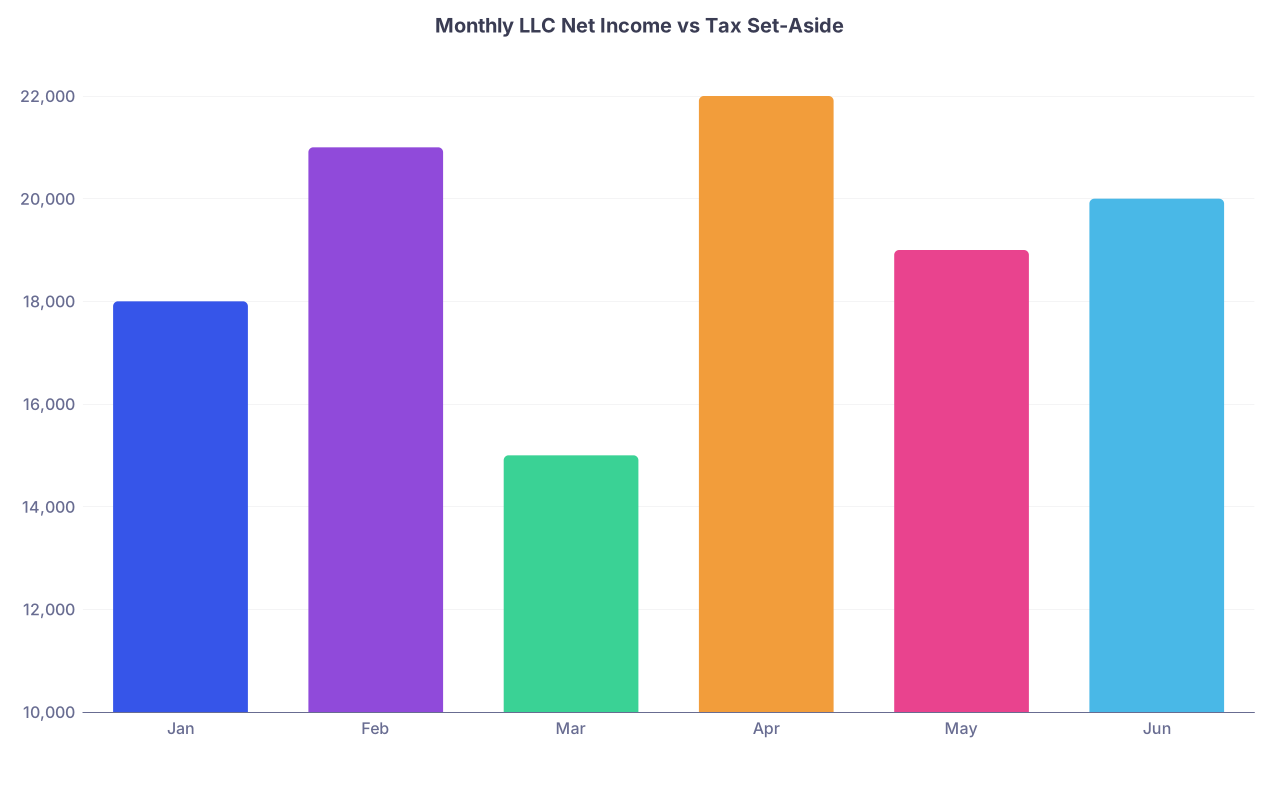
Here is what this looks like over a year for a hypothetical moonlighter:
| Category | Value |
|---|---|
| Jan | 18000 |
| Feb | 21000 |
| Mar | 15000 |
| Apr | 22000 |
| May | 19000 |
| Jun | 20000 |
If you set aside 35%, those numbers become automatic transfers. No drama in April.
Step 4: Decide If and When to Add an S‑Corp Layer (Month 4–6)
Now we talk about the big one: using your LLC as an S‑corp to reduce self‑employment tax.
Handled well, it is powerful. Handled poorly, it is an audit magnet.
1. The S‑corp logic in one paragraph
As a sole prop or default LLC, 100% of your net income is subject to self‑employment tax (Social Security + Medicare).
As an S‑corp:
- You pay yourself a “reasonable salary” via payroll → subject to payroll taxes.
- Extra profit above that salary is a distribution, not subject to employment tax (still subject to income tax).
The spread between reasonable salary and total net income is where the savings live.
Example:
- Net income: $300,000
- Reasonable salary: $200,000
- S‑corp distribution: $100,000
→ Self‑employment / payroll tax avoided on that $100,000. Significant.
2. Deciding if it is worth it
S‑corp overhead:
- Payroll setup and fees
- Extra tax return (Form 1120‑S)
- More bookkeeping precision
- Stricter record‑keeping
In real life, it typically becomes attractive around $150k+ of consistent net income from services.
Below that, the admin cost and complexity often eat up the benefit.
3. Implement S‑corp correctly (not halfway)
If you and your CPA decide to elect S‑corp status:
- File Form 2553 with the IRS (timing matters; talk to your CPA about current‑year vs next‑year election).
- Choose a reasonable salary based on:
- Specialty
- Region
- Hours
- Comparable W‑2 offers for similar work
- Set up actual payroll:
- Withhold income and payroll taxes
- Issue W‑2 at year end
- Pay yourself:
- Regular paycheck (biweekly or monthly) as W‑2
- Periodic distributions for remaining profit (quarterly works well)
If you call it an S‑corp but never run payroll, the IRS calls that a problem.
Step 5: Layer On Smart, Legitimate Deductions (Month 6–9)
Once your bookkeeping is clean and your entity structure is set, you start weaponizing the LLC for deductions you were either missing or underusing.
These are not gimmicks. These are completely standard if documented and structured correctly.
1. Home office (yes, physicians can actually use it)
If:
- You use a specific area of your home regularly and exclusively for LLC work
(charting for your 1099 telemed work, scheduling, admin, peer review, etc.) - The home office is your principal place of business for that LLC
Then you can typically deduct:
- Portion of rent or mortgage interest
- Utilities
- Property taxes
- Homeowners insurance
- Repairs (pro‑rated)
You can use the simplified method (square footage x IRS rate) or actual expense method. Your CPA will run the numbers. The key is to:
- Measure the space
- Document with photos and a simple layout
- Keep annual records of home expenses
2. Health insurance and HSAs
If you are self‑employed through your LLC and not covered by a spouse’s employer plan:
- Your self‑employed health insurance premiums can often be deducted, potentially more efficiently through the entity structure.
- If you use a high‑deductible health plan, you can make HSA contributions (pre‑tax, tax‑free growth, tax‑free withdrawal for medical).
3. Retirement plans: solo 401(k) or SEP‑IRA
This is where physicians leave massive money on the table.
Through your LLC, you can create:
- Solo 401(k) (best flexibility if it is just you or you + spouse)
- SEP‑IRA (simpler, but less flexible and can complicate backdoor Roth IRAs)
You can make:
- Employee deferrals (up to IRS limit, shared across all employers)
- Employer contributions (percentage of net earnings from self‑employment)
For many 1099 physicians, a solo 401(k) allows:
- Meaningful employer contributions on top of what you do in a hospital W‑2 plan, if structured properly.
Get a CPA and preferably a retirement plan custodian who understands physician multi‑plan coordination. I have seen solo 401(k)s underused or misused because someone at the brokerage read off a generic script.
Step 6: Turn the LLC Into a Risk and Asset Protection Tool (Month 9–11)
You are not only planning for taxes. You are also hardening your financial life against bad outcomes. Lawsuits. Contract disputes. Billing errors. Credentialing nightmares.
Your LLC can help if you actually respect corporate formalities.
1. Maintain the corporate veil
An LLC will not protect you if:
- You constantly co‑mingle funds
(e.g., paying your kid’s orthodontist directly from the LLC card) - You do not keep basic minutes or records for major decisions
- You ignore state annual filing requirements and let the entity go inactive
Simple protocol:
- Use the LLC name consistently on contracts, invoices, letterheads.
- Sign as:
Your Name, Managing Member, [LLC Name] - Avoid paying personal expenses directly from the LLC.
- If you use personal funds for business, record it as capital contribution or loan to business.
2. Check and correct your liability coverage map
Match your LLC structure to your coverage:
- Professional liability (malpractice):
Ensure policies are aware of your 1099 / LLC work, not just your employed role. - General liability and cyber:
If you run a small practice, telemed, or store any PHI, you likely need something beyond malpractice. - Umbrella policy (personal):
Does not replace business coverage but is a cheap way to add an extra layer.
Your LLC is not a force field against malpractice. That is fantasy. It is primarily helpful for business liabilities, contracts, leases, and non‑clinical risk.
Step 7: Implement a 12‑Month Operating Rhythm (Month 11–12)
By now you have structure, books, tax planning, and entity optimization. The final step is to lock this into a repeatable system.
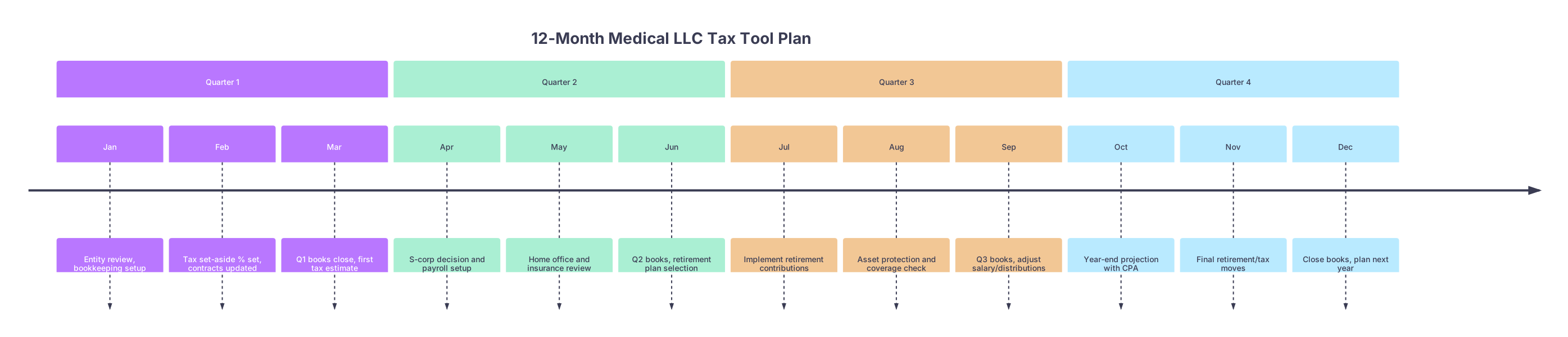
1. Create a simple annual calendar
Map out what happens when. Something like this:
| Period | Event |
|---|---|
| Quarter 1 - Jan | Entity review, bookkeeping setup |
| Quarter 1 - Feb | Tax set-aside % set, contracts updated |
| Quarter 1 - Mar | Q1 books close, first tax estimate |
| Quarter 2 - Apr | S-corp decision and payroll setup |
| Quarter 2 - May | Home office and insurance review |
| Quarter 2 - Jun | Q2 books, retirement plan selection |
| Quarter 3 - Jul | Implement retirement contributions |
| Quarter 3 - Aug | Asset protection and coverage check |
| Quarter 3 - Sep | Q3 books, adjust salary/distributions |
| Quarter 4 - Oct | Year-end projection with CPA |
| Quarter 4 - Nov | Final retirement/tax moves |
| Quarter 4 - Dec | Close books, plan next year |
You can tweak months, but the point is: do not cram everything into tax season. Spread the work.
2. Have two serious CPA meetings per year
Stop treating your CPA as a tax historian. Use them as a planner.
Mid‑year meeting (around June/July):
- Review YTD income and expenses
- Check if salary/distributions are on target (if S‑corp)
- Adjust estimated tax payments
- Decide on retirement contribution targets
Year‑end meeting (around Oct/Nov):
- Run a projection for the full year
- Lock in final retirement contribution plan
- Check for any year‑end moves:
- Equipment purchases
- Prepaying certain expenses (when appropriate)
- Deferring or accelerating income
If your CPA never proactively talks about timing of income/expenses, reasonable S‑corp salary, coordination with hospital W‑2, or multiple states, you either need to push them harder or upgrade.
Example: 12‑Month Transformation in Real Numbers
Let me walk you through a simplified scenario so you can see the end GAME.
Dr. A: Hospitalist, W‑2 base, plus 1099 telemed and occasional locums.
- W‑2 salary: $330,000
- 1099 income (last year): $220,000 (net after direct costs)
- Current LLC: single‑member, no S‑corp, basic bank account, no retirement plan
Starting point problems
- No tax set‑asides. April brings a $50k+ surprise bill.
- No solo 401(k); only contributing to hospital 403(b) up to match.
- No home office deduction, despite spending 3–4 hours most days charting from a dedicated room.
- Malpractice for telemed technically in place but not fully aligned with LLC structure.
Year 1 system build
Quarter 1:
- Cleanly separates finances; sets up LLC checking + tax savings.
- Starts monthly bookkeeping with QuickBooks Online.
- Sets federal/state combined tax set‑aside at 38% of net LLC income.
Quarter 2:
- Elects S‑corp for the LLC (effective Jan 1 of this year).
- Sets reasonable salary at $180,000 (based on comparable telemed/locums hospitalist offers).
- Runs actual payroll, issues paychecks monthly.
- Sets up home office documentation (120 sq ft of 2,000 sq ft home → 6%).
Quarter 3:
- Opens a solo 401(k) for the LLC.
- Coordinates with CPA to:
- Max employee deferral across hospital 403(b) and solo 401(k).
- Add employer contributions from LLC profit.
- Aligns malpractice and telemed contracts with the LLC as the contracting party.
Quarter 4:
- Year‑end projection shows:
- LLC net income: $220,000
- W‑2 salary from LLC: $180,000
- S‑corp distributions: $40,000
- Taxes:
- Payroll/self‑employment tax only on $180,000, not $220,000.
- Employer side contributions to solo 401(k) on top of employee deferrals.
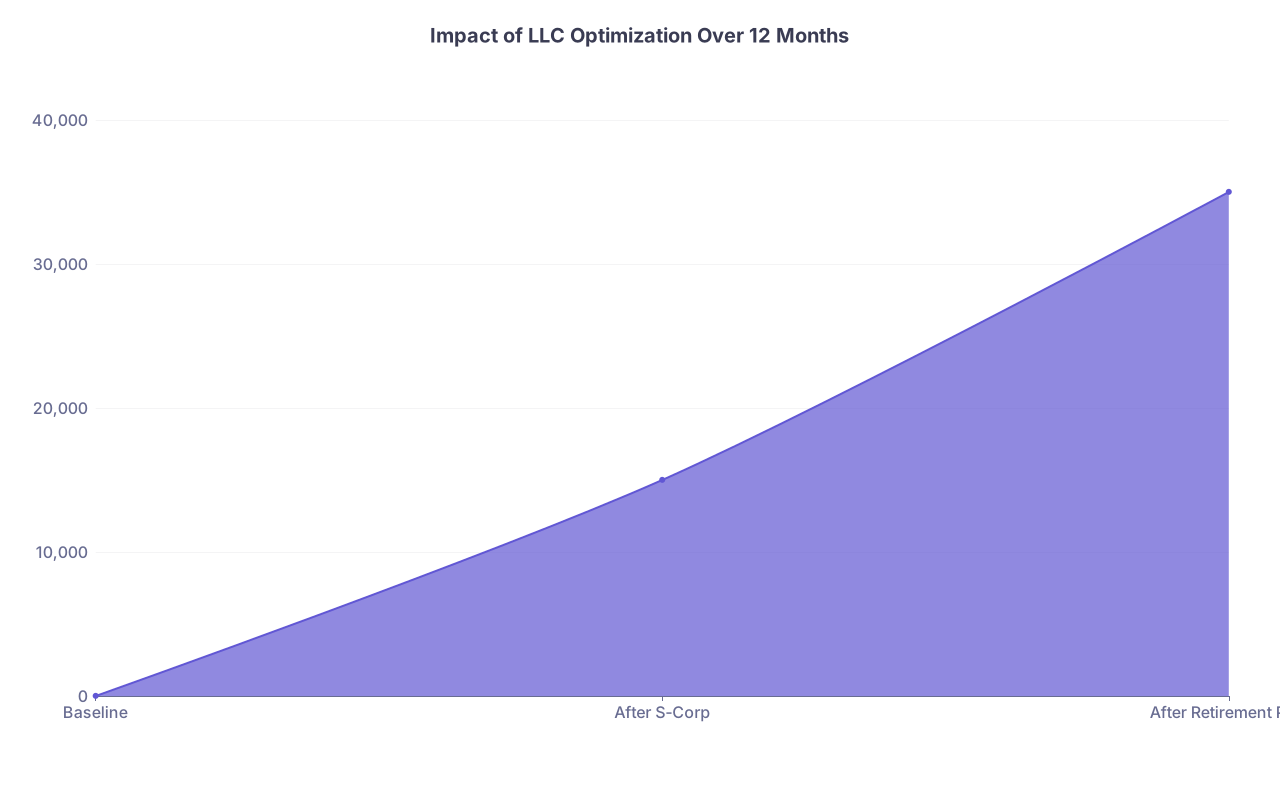
A rough illustration of how Dr. A’s picture improves:
| Category | Value |
|---|---|
| Baseline | 0 |
| After S-Corp | 15000 |
| After Retirement Plan | 35000 |
Interpretation (approximate):
- $15,000–$20,000 in self‑employment tax reduction via S‑corp structure.
- $20,000+ in extra pre‑tax retirement contributions that were not being made before.
- Home office, better expense tracking, and insurance structuring add several thousand more in deductions and better risk management.
No exotic tricks. Just running the LLC like a real business.
Common Mistakes That Kill the Benefits
I have seen smart physicians neutralize all their good planning by doing a few dumb things. Avoid these.
Treating S‑corp salary as a joke
Paying yourself $40k on $400k of net income invites IRS trouble. “Reasonable” is not arbitrary.Co‑mingling funds casually
Paying your kid’s private school from LLC, then trying to call some of it “marketing.” You are not fooling anyone.Garbage documentation for home office and travel
If you cannot cleanly show:- Where you went
- Why it was business
- What you did
then do not expect that deduction to survive scrutiny.
Ignoring multi‑state issues
Telemed across state lines, different locums states, living in a no‑income‑tax state but working in high‑tax states: this gets complex fast. You need a CPA who understands allocation and credits.Never adjusting as income changes
You set a “reasonable salary” once and keep it static for 7 years while your income doubles. That is lazy and risky.
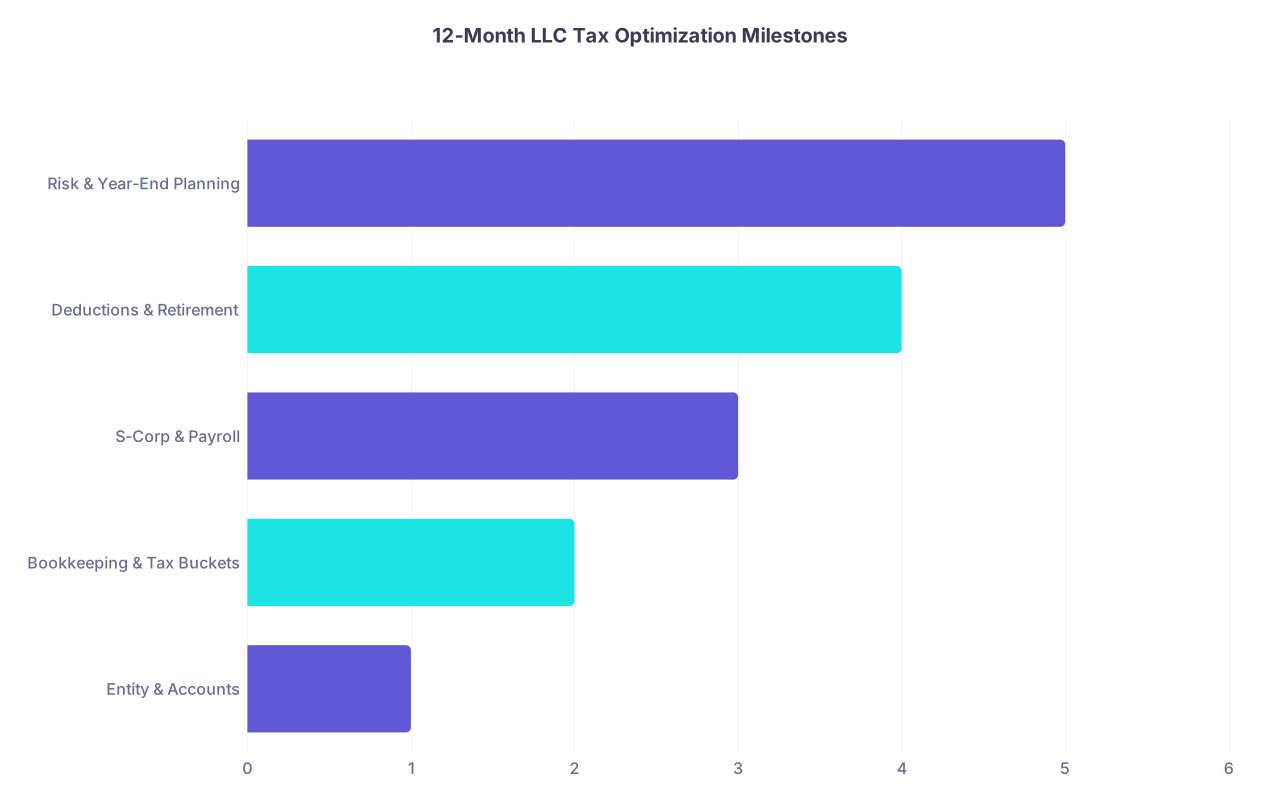
Putting It All Together: Your 12‑Month Playbook
Here is a condensed, realistic sequence you can follow:
| Category | Value |
|---|---|
| Entity & Accounts | 1 |
| Bookkeeping & Tax Buckets | 2 |
| S-Corp & Payroll | 3 |
| Deductions & Retirement | 4 |
| Risk & Year-End Planning | 5 |
Month‑by‑month outline:
Month 1–2:
- Confirm entity and tax status
- Fix contracts and W‑9s
- Open proper business and tax accounts
Month 2–3:
- Set up bookkeeping system
- Start monthly books review
- Build your chart of accounts
Month 3–4:
- Establish tax set‑aside percentage
- Begin monthly or per‑deposit transfers to tax savings
- First serious meeting with CPA (planning, not just compliance)
Month 4–6:
- Decide on S‑corp election if income justifies it
- Implement payroll with a defensible salary
- Separate W‑2 and distribution flows to personal accounts
Month 6–9:
- Document and implement home office if appropriate
- Review and deduct legitimate business expenses you were missing
- Open and fund a solo 401(k) or SEP‑IRA as appropriate
Month 9–11:
- Clean up liability coverage and corporate formalities
- Tighten contracts, signatures, and sign‑offs under the LLC
- Schedule year‑end tax projection and optimization meeting
Month 11–12:
- Execute year‑end moves
- Close your books cleanly
- Set next year’s salary, distribution target, and retirement contribution plan
What You Should Do Today
Open your last 12 months of 1099 income and answer three questions on paper:
- How much net income did you earn through your LLC or side work?
- What tax status is your LLC currently using (sole prop, partnership, S‑corp)?
- How much did you actually set aside for taxes from that LLC income?
Then, email your CPA and schedule a planning call with this exact subject line:
“I want to turn my medical LLC into a tax and asset protection tool over the next 12 months – here are my numbers.”
Bring your answers to those three questions and this article’s 12‑month outline. That single move will start the shift from “just a bank account” to a real, leveraged physician business.
You can keep winging it and writing checks in April. Or you can run your LLC like the six‑figure professional entity it already is on paper. Your call—but the clock is ticking on another tax year.


