

The default tax advice physicians get when they marry a non‑physician is lazy. “Just file jointly, you’ll save more.” Sometimes that is right. Sometimes it is very wrong. If your household has one W‑2 high‑earning doctor and one non‑physician with different income, benefits, and businesses, you need a coordinated strategy, not blanket rules.
Let me show you how to actually fix this.
Step 1: Get Clear On Your “Household Tax Profile”
Before you touch deductions, retirement accounts, or entity structures, you need a clear picture of what you and your spouse are working with. And you do this every year. Jobs change. Benefits change. Tax law changes.
Here is the minimum data you should have in front of you:
Income types for each spouse
- Physician:
- W‑2 employee? 1099 independent contractor? Practice owner (K‑1)?
- Non‑physician:
- W‑2? 1099? Small business (Schedule C)? S‑corp or partnership (K‑1)? Rental income?
- Physician:
Benefits available to each spouse
- Physician:
- 401(k) / 403(b) / 457(b)
- Defined benefit / cash balance plan
- HSA‑eligible plan or FSA
- Non‑physician:
- 401(k) / SIMPLE / SEP
- HSA vs FSA
- Stock options / RSUs
- Physician:
Key household factors
- Children and childcare costs
- Student loans (type and repayment plan)
- State of residence (CA/NY vs TX/FL is not a small detail)
- Expected practice ownership or side gigs in the next 2–3 years
Create a one‑page summary. Not a spreadsheet monster you never update. One page, both spouses on it.
| Category | Physician Spouse | Non-Physician Spouse |
|---|---|---|
| Income Type | W-2 hospitalist | W-2 tech project manager |
| 2024 Gross Income | $320,000 | $95,000 |
| Retirement Plan | 403(b) + 457(b) | 401(k) |
| Health Plan | HSA-eligible family plan | Opts out |
| Student Loans | $260,000 (PAYE) | None |
If you cannot fill this out cleanly, you are not ready to “optimize taxes.” You are guessing.
Step 2: Joint vs Separate – Run the Numbers, Do Not Rely On Rules of Thumb
“Married filing jointly is always better” is a myth. For high‑earning physicians with complex households, you must calculate the difference, especially if:
- One of you has income‑driven student loan repayment (PAYE, REPAYE, SAVE).
- One of you has high medical, miscellaneous, or casualty/theft itemized deductions.
- One of you has significant liability risk (malpractice, business lawsuits, etc.).
- You live in a high‑tax state with nasty “marriage penalties.”
How to actually compare MFJ vs MFS
You do not need to be a CPA to do a first pass.
1. Prepare three mock returns:
- Your return alone (single, with only your income and deductions).
- Your spouse’s return alone (same).
- Married Filing Jointly (combined).
Then:
- Use tax prep software that allows “what if” scenarios.
- Or sit down with a CPA who understands both physician compensation and student loans.
2. Specifically check these areas:
- Total federal tax (obvious).
- Total state tax (often forgotten and can swing the answer).
- Student loan payment impact (if any loans are on IDR).
- Child tax credits and other credits that phase out at higher AGIs.
- Deduction eligibility you may lose when filing separately:
- IRA deductions
- Student loan interest deduction
- Certain education credits
Then you look at net effect:
- Tax savings / cost of MFJ vs MFS
PLUS - Student loan payment changes (annual cost difference)
PLUS - Any legal/asset‑protection reason you might want separation.
Only then decide. Not before.
Step 3: Coordinate Retirement Contributions, Do Not Duplicate Them
When you marry someone outside medicine, their benefits are almost never optimized for a high‑income household. HR tells them to pick 5% for the match, maybe open a Roth IRA, and move on. That is not enough when the other spouse is sitting on $300k+ of W‑2 or 1099 income.
You want to design retirement contributions as a household strategy, not two separate independent plans.
Priority framework that actually works
Here is the order I use when I sit with physician couples:
Grab every employer match – both spouses
- This is non‑negotiable. 100% ROI on the match.
- Example: Physician gets 4% match on 403(b), spouse gets 5% match on 401(k). You both hit those minimums first.
Max pre‑tax where the tax bracket is highest
- If the physician is in the 32–37% bracket and the non‑physician in effect is in the 24% range, every pre‑tax dollar from the physician is more valuable.
- Max the physician’s 401(k)/403(b)/457(b) before shoving huge pre‑tax amounts into a spouse’s plan with worse investment options or higher fees.
Use backdoor Roth IRAs correctly
- If either of you has pre‑tax money in traditional IRAs, SEP IRAs, or SIMPLE IRAs, you can blow up the backdoor Roth and generate a big tax bill.
- Solve it:
- Roll pre‑tax IRA balances into an employer plan (401(k)/403(b)) if available.
- Then do clean $6,000–$7,000 (depending on year and age) non‑deductible traditional IRA contributions and convert to Roth.
- Both spouses can do backdoor Roths if each has no pre‑tax IRA money on 12/31.
Layer on extras once the basics are maxed
- Physician:
- 457(b)
- Cash balance or defined benefit plan (if in a group that offers it)
- Non‑physician:
- Employee stock purchase plans (if discounted)
- Mega backdoor Roth (if their 401(k) allows after‑tax contributions and in‑plan conversions)
- Physician:
Here is what a coordinated plan might look like:
| Account | Physician | Non-Physician |
|---|---|---|
| 403(b) Pre-tax | $23,000 | — |
| 457(b) Pre-tax | $23,000 | — |
| Employer 403(b) Match | $10,000 | — |
| Spouse 401(k) Pre-tax | — | $10,000 |
| Spouse 401(k) Employer Match | — | $5,000 |
| Backdoor Roth IRA | $7,000 | $7,000 |
Notice something: you are not automatically maxing both 401(k)/403(b)s in year one if cash flow is tight. You are prioritizing where the tax impact and the benefit design are strongest.
Step 4: Student Loans – Where Tax Strategy and Marriage Collide
If one spouse is a physician with large federal loans and income‑driven repayment, marriage is a tax decision as much as a life decision. I have seen couples accidentally add $1,500–$2,000 per month to payments because they casually checked “married filing jointly” without running the math.
Key rules that matter
- Some IDR plans (like PAYE, SAVE) may allow payments based on separate income if you file taxes separately.
- Others always count spousal income, joint or separate filing.
So your process is:
Confirm exact loan type and repayment plan.
- Example: Direct Unsubsidized, PAYE, seeking PSLF.
Run payment simulations:
- Payment if single with only physician income.
- Payment if MFJ with combined income.
- Payment if MFS where only the physician’s income is counted.
Compare:
- Extra taxes paid from filing separately vs
- Reduced student loan payments plus extra PSLF forgiveness.
Sometimes filing separately for years is worth it. Sometimes it is not. But you must measure it, not guess.
Step 5: Health Insurance, HSA, FSA – Choose One Master Plan, Not Two Mediocre Ones
The non‑physician spouse often has “decent benefits” through their employer. The physician has another set of options through the hospital or group. Households routinely waste thousands here.
You want to pick one primary health strategy as a couple.
The hierarchy
Decide whose plan you will actually use for the family.
- Compare:
- Premiums (employee and employer share)
- Deductibles and out‑of‑pocket max
- Network and typical utilization (OB, pediatrics, mental health, fertility, etc.)
- Often, the physician’s plan has better networks for complex care; the non‑physician’s plan may have cheaper premiums. You must actually compare.
- Compare:
If you pick a high‑deductible HSA‑eligible plan:
- Contribute to only one family HSA per year, but either spouse can own it.
- Often makes sense for the higher‑income spouse to own the HSA for long‑term tax planning.
- Treat the HSA like a stealth retirement account:
- Pay current medical costs from cash.
- Keep receipts.
- Let the HSA grow invested.
Avoid FSA/HSA conflicts.
- General‑purpose FSA can disqualify you from HSA eligibility.
- If one of you has a family HSA plan, the other spouse should not have a general‑purpose FSA that covers medical expenses. Limited‑purpose FSA (dental/vision) is usually fine.
Use dependent care FSA strategically.
- If you have kids and pay for daycare, after‑school, etc., the dependent care FSA can be valuable.
- Contribute up to the legal cap (varies by year) if you know you will spend it.
You are trying to avoid the classic mess: both spouses casually picking their employer “default” options and ending up with overlapping plans, wasted FSAs, and a half‑used HSA.
Step 6: If One of You Has a Business or Side Gig, Coordinate Entity and Income Splits
This is where physician–non‑physician couples either do very well or very poorly. A typical scenario:
- Physician is W‑2 only, high income, very little tax flexibility.
- Non‑physician spouse runs:
- Consulting / coaching
- Real estate business
- Online business
- Part‑time 1099 professional work
If the non‑physician spouse has any meaningful 1099 income and is not just parking it on a simple Schedule C with almost no planning, you are leaving money on the table.
Key levers you can pull
Entity choice: Sole prop vs S‑corp vs partnership / LLC
- Under ~ $40–60k profit, often fine as Schedule C.
- Above that, S‑corp can make sense to reduce self‑employment tax.
- If both spouses work in the business, you may consider a partnership or LLC taxed as partnership and deliberately manage income allocation.
Use the non‑physician’s business for household retirement strategy.
- Solo 401(k) for the non‑physician can:
- Create extra tax-advantaged space beyond the physician’s employed plan.
- Allow large pre‑tax or Roth contributions depending on your plan.
- Example:
- Non‑physician makes $120k net in an S‑corp.
- Reasonable salary, say $70k.
- Employer side 401(k) contribution up to ~20–25% of comp.
- Employee 401(k) deferral if they do not already max at a W‑2 job.
- Solo 401(k) for the non‑physician can:
Income shifting (when legitimate).
- If the non‑physician spouse is in a lower effective marginal bracket and truly works in the business:
- Pay them reasonable W‑2 wages from the business.
- Shift income away from the physician’s individual bracket.
- Do not invent fake jobs or fake hours. The IRS is not stupid. But document real work with a payroll and job description.
- If the non‑physician spouse is in a lower effective marginal bracket and truly works in the business:
Health insurance through the business (advanced move).
- In some settings, you can have the business pay for health insurance as an employee benefit for the non‑physician spouse, which then covers the family. Complex, but sometimes beneficial when structured correctly.
This is the area where a CPA who actually understands small businesses is non‑negotiable. Not the “we see a lot of physicians” firm that still files everything on Schedule C year after year for convenience.
Step 7: State Taxes and Marriage Penalties – Stop Ignoring Your ZIP Code
A physician in Texas married to a graphic designer has a very different tax reality than a physician in California married to an attorney.
The usual problems:
- States with high marginal rates and narrow brackets.
- States that piggyback on federal AGI but do not offer the same deductions or credits.
- Community property states vs common law states.
Action steps
Check exact state rules for MFJ vs MFS.
- Some states do not even allow MFS in the same way the federal government does, or they force ridiculous adjustments.
- In community property states, income may be split 50/50 by law for tax purposes regardless of who earned it.
Run state‑level projections, not just federal.
- I have seen California couples where MFJ vs MFS saved or cost thousands at the state level, erasing any federal advantage.
Plan moves or practice changes with state taxes in mind.
- If you are considering changing jobs or moving states, include:
- Combined household income.
- Property tax.
- State income tax.
- Local tax.
- If you are considering changing jobs or moving states, include:
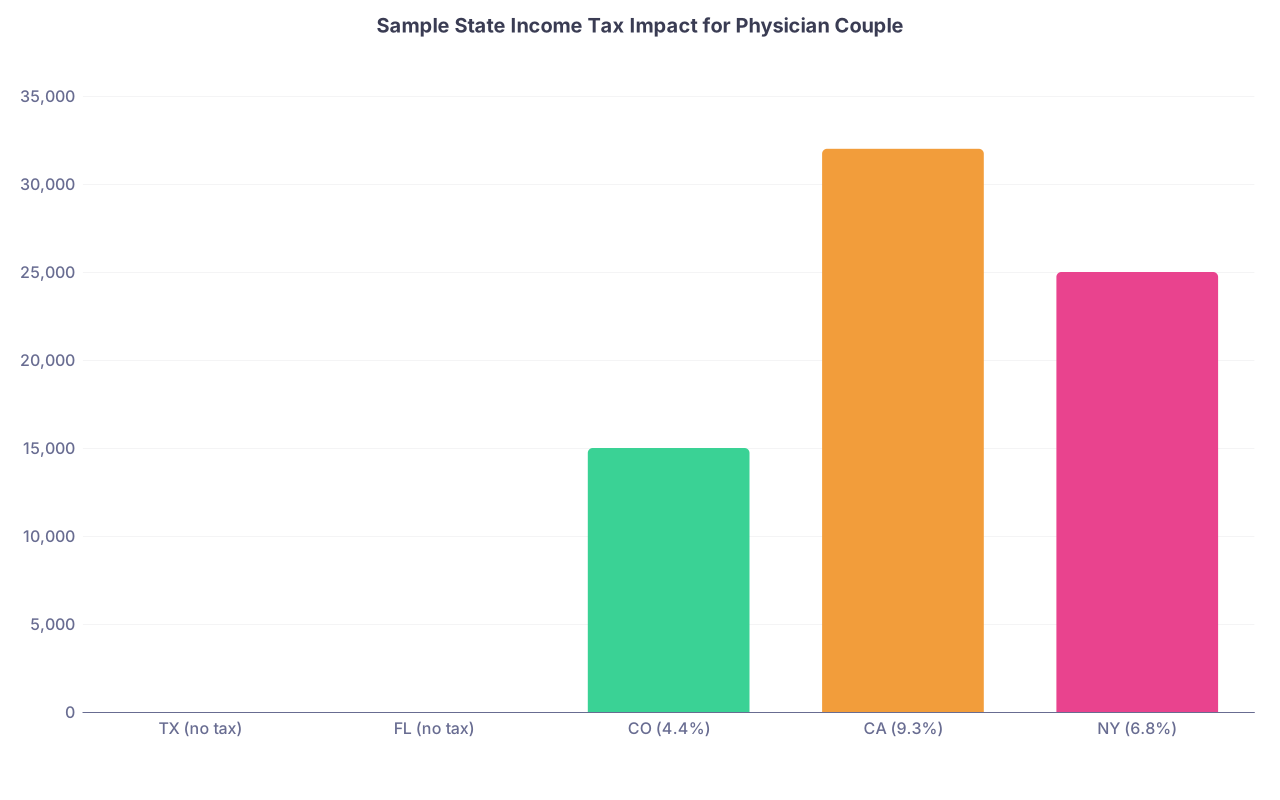
| Category | Value |
|---|---|
| TX (no tax) | 0 |
| FL (no tax) | 0 |
| CO (4.4%) | 15000 |
| CA (9.3%) | 32000 |
| NY (6.8%) | 25000 |
Those numbers are illustrative, not exact. But the magnitude is real.
Step 8: Asset Protection and Liability – Why “Who Owns What” Matters
Physicians carry more lawsuit risk, period. It is not paranoia. It is math. When you marry someone who is not in a high‑risk profession, you have the option to strategically decide who holds what.
Principles that work in the real world
Max out protected accounts first.
- Retirement accounts (ERISA plans like 401(k)/403(b)) are strongly protected in most states.
- HSAs and some IRAs have varying protection by state.
- Make sure both spouses are using these buckets effectively.
Title high‑risk assets away from the physician when appropriate.
- If the non‑physician spouse has minimal professional liability:
- Consider titling certain non‑retirement assets in their name alone (subject to your state’s marital property rules and your comfort level).
- This can include:
- Brokerage accounts
- Some real estate
- This is nuanced. You do not do this randomly. You do it deliberately with an attorney who understands your state’s asset protection laws.
- If the non‑physician spouse has minimal professional liability:
Use appropriate insurance layers.
- Physician:
- Malpractice with adequate limits.
- Household:
- Umbrella liability (usually $1–5 million).
- Make the non‑physician spouse the primary titled owner and named insured on certain assets when it makes legal sense.
- Physician:
The goal is simple: if something goes wrong professionally for the physician, you do not want every single non‑retirement dollar in the household directly attached to them.
Step 9: Set an Annual Tax Strategy Meeting – Like a Mini Board Meeting For Your Marriage
The couples who are consistently ahead treat their household like a small business. They do not “remember” tax things in April. They schedule one 60–90 minute meeting every year, ideally:
- Q4 (October–December) so there is time to act.
Your agenda looks like this:
Income review
- Actual year‑to‑date pay for each spouse.
- Expected year‑end bonuses, call pay, moonlighting, business profits.
Retirement contributions status
- Are you on pace to hit your planned 401(k)/403(b)/457(b) numbers?
- Do you need to adjust contributions for the final pay periods?
Student loans check‑in
- Confirm current plan eligibility.
- Project next year’s payments based on this year’s AGI.
- Decide if MFJ or MFS still makes sense for next year.
Insurance and benefits
- Open enrollment decisions for both spouses.
- HSA / FSA elections for next year.
Business and side gigs
- Profit projections.
- Open or modify solo 401(k).
- Evaluate S‑corp or other entity changes if income has grown.
Draft a simple one‑page “Tax Action Plan” for next year
- Filing status target (MFJ vs MFS).
- Contribution targets.
- Planned backdoor Roths, HSA funding, etc.
- Any entity or titling changes to consider with your attorney/CPA.
Capture decisions. Not in your head. In writing.
To make this practical, you can even sketch the flow of your annual process:

| Step | Description |
|---|---|
| Step 1 | Q4 Household Meeting |
| Step 2 | Review Income and Benefits |
| Step 3 | Decide MFJ vs MFS Target |
| Step 4 | Set Retirement Contribution Levels |
| Step 5 | Choose Health Plan and HSA FSA |
| Step 6 | Plan Student Loan Strategy |
| Step 7 | Update CPA and Financial Advisor |
| Step 8 | Implement Changes Before Year End |
Step 10: Stop Delegating Strategy to People Who Only See Half the Picture
Biggest mistake I see physician–non‑physician couples make? Each spouse uses their HR, their benefits rep, their random online tax advice, and nobody is looking at the household.
That is how you end up with:
- Redundant FSAs.
- Suboptimal 401(k)/403(b) contribution mix.
- Blown backdoor Roths.
- Avoidable student loan mistakes.
- Asset titling that ignores malpractice risk.
You do not need a 15‑person advisory team. You need:
- One tax‑literate financial planner (fee‑only, fiduciary) who understands physicians, student loans, and small business.
- One proactive CPA who is not just a form‑filler but actually runs projections.
- One attorney for entity, asset protection, and estate documents, ideally with physician clients.
Your job is not to become a tax expert. Your job is to:
- Show up with clear data.
- Ask direct questions.
- Insist on seeing before/after projections when you change something.
Your Next Step (Do This Today)
Print or open a blank sheet and create your Household Tax Profile Snapshot:
- List each spouse.
- Income type and expected amount.
- Available retirement plans.
- Health plan + HSA/FSA options.
- Student loans and repayment plan.
- State of residence.
Then write one question at the bottom:
“Should we file jointly or separately next year, and what is the real dollar difference?”
That is your trigger for a serious conversation—with your spouse, and then with your CPA. Do not wait for tax season.


