

You are sitting at your kitchen table on a Sunday morning, coffee going cold, staring at last year’s tax return.
You just had a “fun” conversation with a colleague who casually mentioned their $32,000 in deductions for CME, mileage, home office, and 1099 side work. You pull your own return. Your Schedule C is tiny. Your itemized deductions are minimal. Half the stuff they deduct? You never even thought about it.
And then it hits you:
You have been leaving money on the table for years.
Now you are doing the math in your head:
If you have been overpaying by $10k–$30k per year for several years, that is not a rounding error. That is a down payment. A year of college. A chunk of your retirement.
But you are also not stupid. You have heard the stories: amended returns “trigger audits,” “the IRS will come after you,” “you are better off not touching old returns.” The fear is real.
So here is the job:
Fix years of unclaimed deductions.
Get back what you are legally owed.
Do it in a way that does not wave a red flag in front of the IRS.
That is what I am going to walk you through.
Step 1: Get Clear On What You Actually Missed
Before worrying about audits, you need to know whether there is even enough money at stake to justify the effort.
You are going to do a quick, physician-specific diagnostic.
1. Pull the right documents
Gather for each year you want to review (start with the last 3–4 years):
- Filed tax returns (federal and state), all pages:
- Form 1040
- Schedule A (itemized deductions)
- Schedule C (if you had 1099 income)
- Schedule E (rentals, K‑1s)
- Schedule SE (self-employment tax)
- W‑2s and 1099s (clinical work, consulting, expert witness, locums, telemedicine)
- Loan statements (student loans, practice loans)
- Practice or locums bookkeeping records, if any (QuickBooks, spreadsheets, etc.)
2. Make a checklist of common physician deductions
Here is where most physicians screw this up: they assume W‑2 employees get “no deductions” after 2018. That is wrong. The rule changed, but planning did not disappear.
You want to look for:
- For 1099 / independent contractor / side work:
- CME, conferences, board exam fees, licensing fees
- Medical society dues, journal subscriptions
- Malpractice premiums (if you pay your own)
- Office expenses, laptop, iPad, EMR add‑ons
- Scrubs, white coats (if not reimbursed), stethoscope, medical equipment
- Home office (if used regularly and exclusively for 1099 work)
- Mileage or actual vehicle expenses for business travel (locums sites, hospitals, clinics)
- Phone and internet portion used for work
- Telemedicine equipment, software subscriptions
- Legal and tax prep fees tied to the business
- For practice owners / partners:
- All of the above, plus:
- Staff wages, benefits
- Rent, utilities, equipment leases
- Retirement plan contributions (profit sharing, defined benefit)
- Health insurance premiums
- For W‑2 only physicians:
- Student loan interest (up to IRS limits and income phaseouts)
- HSA contributions
- Retirement contributions (401(k)/403(b), 457)
- State, local, and property taxes (up to the SALT cap)
- Charitable contributions
- Investment advisory fees paid from outside accounts (indirectly, via tax‑efficient structures)
- Medical expenses above AGI thresholds, in some cases
Now, most of the “missed” opportunity is on the 1099 / Schedule C side. That is where you can fix the most.
3. Estimate how big the miss is
Do a rough back‑of‑the‑envelope calculation for one year:
- Find a year where you know you did substantial 1099 or side work.
- Ask: what did I actually deduct on Schedule C that year?
- If Schedule C “Expenses” is under $5,000 while you were actively doing locums or telemedicine, assume you are missing a lot.
- Now estimate:
- CME + conferences: maybe $3k–$10k
- Licensing, DEA, boards: $1k–$3k
- Travel + mileage: often $2k–$10k
- Home office + phone/internet: easily $2k–$5k
- Equipment and subscriptions: $2k–$10k
A typical attending with ongoing 1099 work can legitimately have $15k–$40k in expenses. Many have more.
Multiply your “miss” by your marginal tax rate (federal + state, say 35–45%). That is your overpayment.
If you are looking at $1,500 of tax savings per year, maybe do not bother with five amended returns. If you are seeing $8k–$25k per year, now we are talking.
Step 2: Learn the Statute of Limitations Game
Next question: how many years back can you fix?
The IRS has very specific windows. You need to know them cold.
| Action | Time Limit | Typical Use |
|---|---|---|
| Claim a refund (amend return) | 3 years from original filing date or 2 years from date tax was paid, whichever is later | Amended returns for missed deductions |
| IRS standard audit window | 3 years from filing | Normal exam period |
| IRS extended audit window (large understatement) | 6 years | Underreported income > 25% |
| No limit (fraud or nonfiling) | None | Not your goal |
You care most about the first row: refund claim.
How many years can you realistically fix?
- You generally can amend:
- The last 3 tax years, sometimes 4 depending on timing
- Example:
- You filed your 2021 return on April 10, 2022
- You have until April 10, 2025 to file Form 1040‑X for 2021
So, if you are analyzing this in early 2026:
- 2025, 2024, 2023, and maybe 2022 are your prime targets, depending on filing dates.
Do not waste time reconstructing 2016 in detail if you cannot claim a refund. You can still want clean records for your own sanity, but that is a separate project.
Step 3: Decide Your Strategy—Amend vs Adjust Forward
This is where people get paralyzed. You have two main levers:
- Amended returns (1040‑X) for years within the refund window
- Accounting method changes and “catch‑up” deductions that flow through the current year (Form 3115 for serious situations)
1. Amending returns: when you should and when you should not
You should amend when:
- The missed deductions are:
- Clear‑cut legitimate business expenses
- Well‑documented or reconstructable
- Substantial enough to justify the hassle
- There is no fraud, no obvious underreported income, and no “gray area” games
You should think twice when:
- You already have an open IRS issue for that year
- You are planning aggressive, borderline deductions
- You cannot reasonably reconstruct documentation (no bank records, no calendar, no receipts, nothing)
2. Adjusting forward—without amending
Some things do not require amended returns:
- Depreciation corrections through Form 3115 (change in accounting method)
- Fixing future handling of CME, mileage, home office etc., even if you missed them in past years
- Implementing new entity structures (PC, S corp, partnership) going forward
This is the calmer path:
Maximize deductions this year and beyond, and only amend where the numbers scream that you should.
Step 4: Reconstruct Deductions Carefully (Without Sloppiness)
If you are going to amend, especially for multiple years, your internal standard should be higher than “good enough.” The IRS does not require perfection, but they hate made‑up numbers.
Build a defensible reconstruction process
For each year you want to fix, do the following from your actual records:
- Pull bank and credit card statements
- Both personal and business cards if you used them for professional expenses.
- Export Amazon, Apple, and other purchase histories
- A lot of equipment, books, and subscriptions live there.
- Use your calendar and email
- Conferences, CME trips, locums dates, interviews, board exams—your calendar is your friend.
- Get vendor statements
- CME platforms, medical societies, licensing boards often allow you to reprint receipts or statements.
Then build a simple spreadsheet by year:
- Date
- Vendor
- Description
- Category (CME, travel, license, etc.)
- Amount
- Business use percent (for mixed-use items)
Mileage and travel: how to fix without lying
Mileage is where a lot of physicians either leave money on the table or get stupid and fabricate logs.
Here is how you fix this correctly:
- Look at your schedule and calendar:
- Locums in two hospitals 45 miles apart, three days per week? That is real mileage.
- Use:
- Old EMR login locations
- Call schedules
- Email confirmations for locums shifts
- Reconstruct:
- Typical weekly pattern
- Distances (Google Maps is fine)
- Apply conservative assumptions, not “every day was maximum distance”
You do not need perfect daily logs from three years ago. You do need a reasonable, consistent method you could explain to an auditor without sweating.
If you cannot reconstruct mileage reasonably, do not claim it. Focus on other deductions.
Home office: do it right or do not do it
Home office is powerful but abused. For physicians, it is often legitimate for:
- Telemedicine done from home
- Charting, telehealth follow‑up, or 1099 admin done regularly in a dedicated space
- Non‑clinical consulting or expert witness work
You must be able to answer “yes” to:
- Is there a specific area used regularly and exclusively for this work?
- Could you show a floor plan and photos if asked?
Calculate:
- Square footage of office / total home square footage = business use %
- Apply that to:
- Rent or mortgage interest
- Utilities
- Home insurance
- Certain repairs
Again, conservative is safer. Do not claim your entire living room because you bring the laptop there sometimes.
Step 5: File Amended Returns the Smart Way
Now you have your numbers. Time to fix the returns—without turning it into an audit magnet.
Use Form 1040‑X properly
For each year:
- Start with a copy of the originally filed return.
- Update:
- Schedule C with the corrected expense amounts
- Any impacted forms (Schedule SE for self‑employment tax, Schedule A, credits, etc.)
- Transfer the differences to Form 1040‑X:
- Column A: Original numbers
- Column C: Correct numbers
- Column B: Changes (C minus A)
Write a clear, boring explanation
There is a section on 1040‑X for explanations. This is where people sabotage themselves by oversharing or sounding sketchy. Keep it dry and factual.
Example language that works:
“Taxpayer had 1099 income as an independent contractor physician in 2022. During preparation of the 2024 return, taxpayer and preparer identified that certain ordinary and necessary business expenses (CME, license fees, professional dues, and business mileage) were not fully reported on the original 2022 Schedule C.
This amendment corrects Schedule C to include these substantiated expenses based on contemporaneous bank and credit card records and calendar documentation. Resulting changes flow through to Schedule SE and Form 1040.”
That is it. No drama. No “I just learned about this new trick from a podcast.”
Be consistent year-to-year
If you are amending multiple years, the pattern of expenses needs to make sense:
- Similar type of work → similar categories of expenses
- Some natural variation is fine; wild swings are not
- Example: three years of 1099 telemedicine and CME-heavy work should not show:
- 2022: $1,200 in expenses
- 2023: $38,000 in expenses
- 2024: $900 in expenses
If a year is an outlier (big conference year, board recertification, major equipment purchase), be prepared to document why.
Step 6: Reduce Audit Risk While You Fix Things
You cannot reduce audit risk to zero. That is not the goal. The goal is “if they do look, I am fine.”
Here is how you avoid waving a flag:
1. Stay within normal ranges for your situation
Think in terms of ratios:
- Schedule C expenses as a percentage of Schedule C gross income:
- A physician with 1099 telemedicine income of $60k and $25k of expenses might be fine.
- A physician with $60k of income and $55k of expenses will attract more scrutiny.
If your expense ratio is unusually high, you had better have unusually good records.
2. Do not “catch up” ten years of depreciation in one year without guidance
Big method changes (like fixing depreciation on a home office or equipment going back many years) can be done via Form 3115. That form is an audit magnet if misused.
If you are even considering a Form 3115, this is where you get a CPA who:
- Works with physicians
- Has actually filed Form 3115 before
- Knows how to write a proper Section 481(a) adjustment
Do not wing that one.
3. Avoid obviously aggressive positions
Examples of what not to do:
- Deduct 100% of your personal vehicle as business because “I am always on call.”
- Claim every family trip as “CME” because you went to one lunch talk.
- Deduct your entire house as a home office because you read some contractor did it on TikTok.
The IRS is under-resourced but not dumb. They know patterns. Do not be the obvious outlier.
Step 7: Use a Pro Strategically (Not Blindly)
There are two kinds of tax pros for physicians:
- The conservative generalist who misses half your deductions because “doctors make a lot, the IRS will look at you”
- The “aggressive specialist” who wants to write off your boat as a “consulting space”
You want neither.
You want someone who:
- Works with multiple physicians and physician groups
- Understands W‑2, 1099, and practice ownership structures
- Has experience with:
- Multi‑year amendments
- Home office
- Mileage and travel for physicians
- Accounting method changes (if you are in deep)
Where a good CPA/EA is worth the money:
- Reviewing your reconstructed expense spreadsheets
- Testing the reasonableness of your numbers
- Preparing and filing 1040‑X, 3115 if needed
- Advising on what to fix vs what to leave alone
If a preparer never pushes back on your assumptions, be suspicious. If they balk at every deduction and want you to be a W‑2 robot with no Schedule C, also be suspicious.
Step 8: Build a Clean System So You Never Do This Again
Fixing the past is only half the job. If you keep the same habits, you will be right back here in five years.
You need a simple, physician‑friendly structure going forward.
1. Separate your lives: business vs personal
If you earn any 1099 income:
- Open:
- A separate checking account for 1099 income and expenses
- A separate credit card used only for business spending
- Route all:
- Locums, consulting, telemedicine payments into that account
- CME, travel, equipment, license, and subscription costs onto that card
This is the single biggest “audit defense” step you can take. Clean books.
2. Use basic, not fancy, bookkeeping
You do not need a PhD in QuickBooks. But you do need:
- A monthly habit:
- Categorize your expenses into a handful of buckets:
- CME
- Travel
- Licensing and dues
- Equipment and supplies
- Home office (if applicable)
- Phone/internet
- Categorize your expenses into a handful of buckets:
- A mileage tracking app (if you drive for work):
- MileIQ, Everlance, or any decent app that logs trips
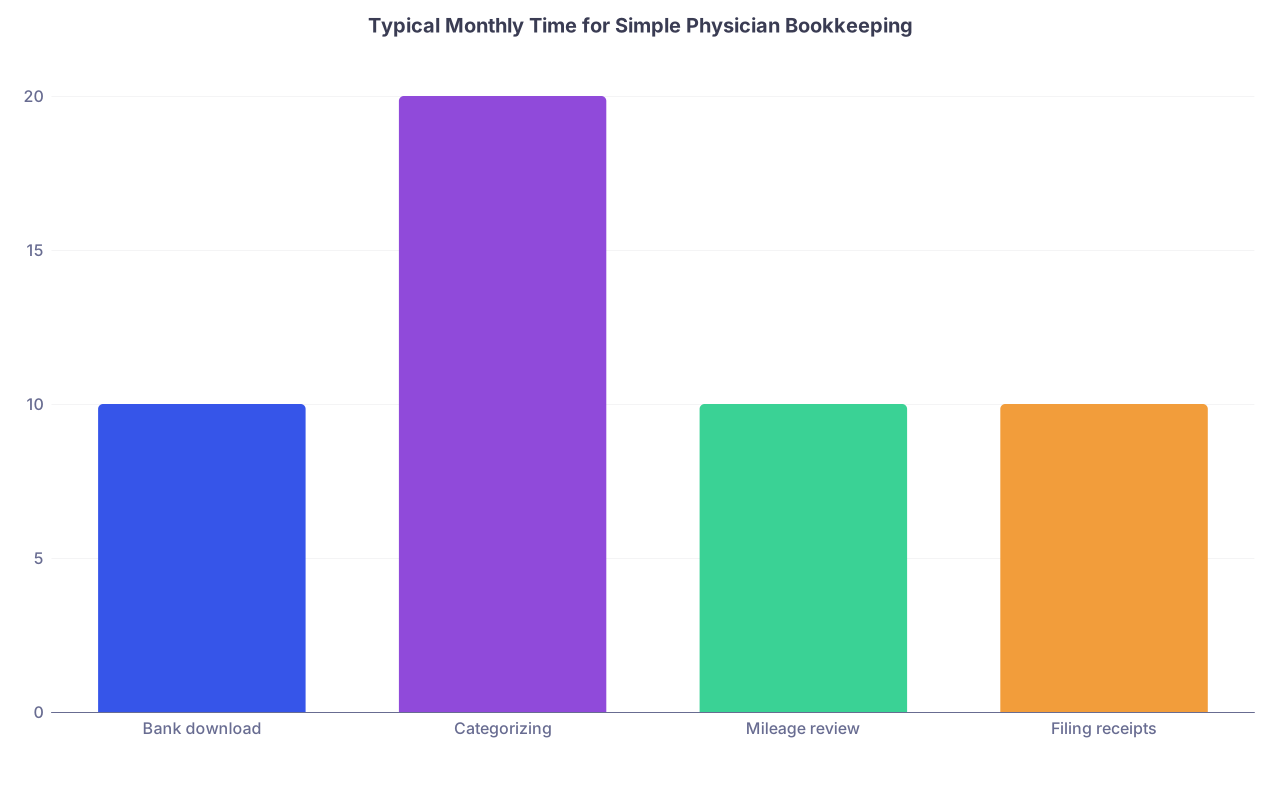
| Category | Value |
|---|---|
| Bank download | 10 |
| Categorizing | 20 |
| Mileage review | 10 |
| Filing receipts | 10 |
Forty to fifty minutes a month. That is what keeps you out of this mess.
3. Document home office properly
- Take:
- Photos of your office setup
- Measure and note the square footage
- Keep:
- Utility bills, rent/mortgage statements in a digital folder
- Once a year:
- Recalculate the percentages if you move or remodel
4. Do a mid‑year tax review annually
Stop making tax a once‑a‑year emergency.
Twice per year (say June and November), sit with your CPA or, if you insist on DIY, at least with your books and:
- Project:
- Your total W‑2 and 1099 income
- Your current deductions year‑to‑date
- Adjust:
- Quarterly estimates if needed
- Retirement plan contributions
- HSA contributions
This is when you catch “hey, you are on track for $30k of 1099 profit with almost no tracked deductions” before you file a bad return.
Step 9: How to Respond If the IRS Actually Does Ask Questions
You fix old years. You file amended returns. Most of the time, the IRS cashes your check or sends you a refund and that is the end of it.
Sometimes, they send a letter.
Common scenarios
CP‑series notices
- Mismatches, math checks, or clarification requests
- Often auto‑generated, resolved by mailing supporting documentation
Correspondence audit (mail‑in audit)
- They ask for proof of certain deductions (often Schedule C categories)
Office or field audit
- Less common, more comprehensive
How to handle it like an adult
- Do not:
- Call and start free‑talking without reviewing your file
- Send random piles of paper with no organization
- Do:
- Pull:
- Copy of the amended return
- Your reconstruction spreadsheets
- Source documents (PDFs of receipts, statements, etc.)
- Draft:
- A clean summary cover letter matching their request:
- “Enclosed please find documentation supporting Schedule C travel and CME expenses for 2023, as requested in your letter dated [date].”
- A clean summary cover letter matching their request:
- Pull:
If they are asking about your 1099 mileage:
- Provide:
- Your reconstruction method summary
- Sample calendar pages
- Mileage logs or app exports
- Relevant shift records
If you built your reconstruction honestly, you will not panic here. It will just be annoying, not terrifying.
This is also the time when having that CPA who knew about your amendments pays off—they can represent you.

A Practical, Step‑By‑Step Game Plan
You want a clear sequence. Here is how I would run this if you were sitting in my office.
Phase 1: Triage (1–2 weeks)
- Pull last 4–5 years of returns and income documents.
- Identify years with significant:
- 1099/independent work
- Practice ownership activity
- Rough‑estimate missed deductions per year.
- Map against refund windows to see which years are actionable.
Phase 2: Reconstruction (2–6 weeks)
- For each actionable year:
- Download bank/credit card statements
- Export online receipts and calendars
- Build a year‑by‑year expense spreadsheet:
- Separate tabs per year
- Clear categories
- Notes for any reconstructed estimates

Phase 3: Professional Review (optional but smart)
- Engage a physician‑savvy CPA/EA for:
- Reasonableness check on each year’s expenses
- Advice on which years to amend and which to leave
- Identification of any accounting method issues (depreciation etc.)
Phase 4: Amend and File (1–4 weeks)
- Prepare 1040‑X forms and updated schedules for each selected year.
- Write short, factual explanations for each amendment.
- File via certified mail with return receipt or e‑file if allowed for that year.
- Track expected refunds vs what is received.
Phase 5: Build the New System (ongoing)
- Open dedicated business accounts for 1099 activity.
- Implement monthly bookkeeping and mileage tracking.
- Set a recurring calendar reminder for mid‑year and late‑year tax reviews.
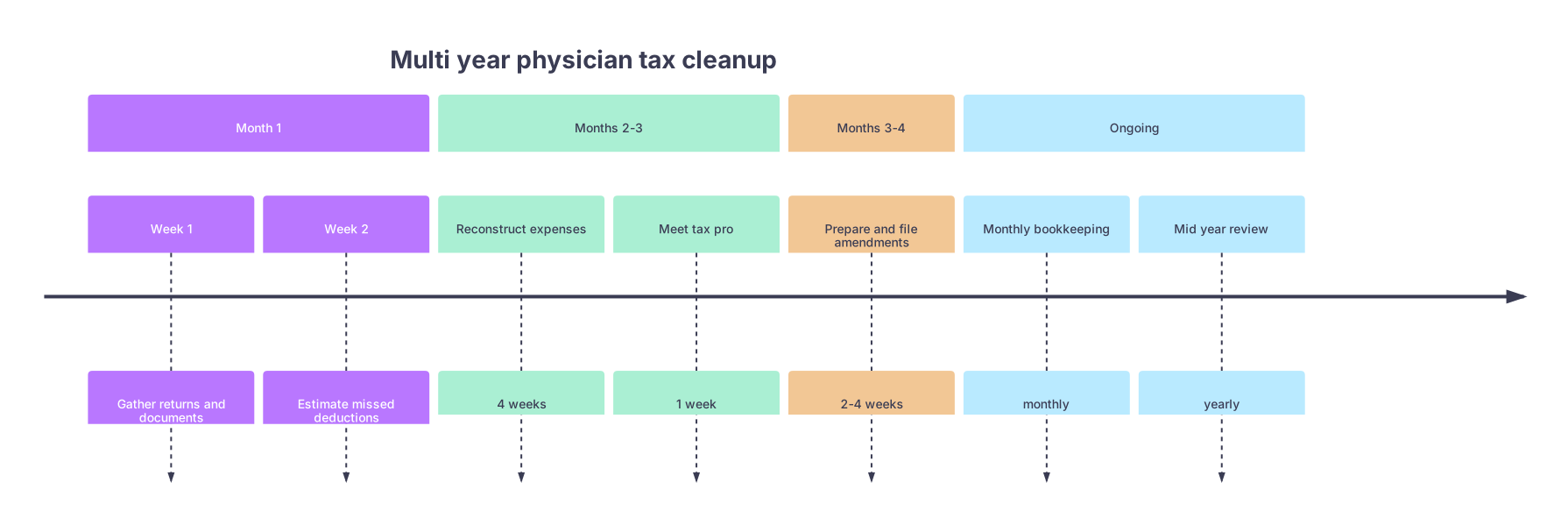
| Period | Event |
|---|---|
| Month 1 - Week 1 | Gather returns and documents |
| Month 1 - Week 2 | Estimate missed deductions |
| Months 2-3 - Reconstruct expenses | 4 weeks |
| Months 2-3 - Meet tax pro | 1 week |
| Months 3-4 - Prepare and file amendments | 2-4 weeks |
| Ongoing - Monthly bookkeeping | monthly |
| Ongoing - Mid year review | yearly |
The Bottom Line
Three core points and you are done:
You can fix this, and you can do it safely.
Amended returns are not automatic audit triggers. Sloppy, inflated, undocumented amendments are. Build your case from real records and stay in the realm of reasonable.Focus on the years that matter.
Work within the refund window. Target the years with the biggest 1099 income and the thinnest deductions. Do not waste hours rebuilding ancient history that will never generate a refund.Change your system so you never have to do this again.
Separate accounts, simple monthly bookkeeping, and one or two targeted check‑ins with a competent tax pro each year will preserve far more money, with far less stress, than any one‑time “rescue mission” ever will.


