

The way most physicians structure their income is bleeding money in taxes. You are not “paying your fair share”; you are tipping the IRS.
You do not fix that with another index fund or a new budgeting app. You fix it by changing how your income is earned and who earns it.
This is the playbook.
Step 1: Map How Your Income Actually Flows Today
Before you touch entities or elections, you need a clear picture of where you stand. Most physicians skip this and then wonder why their CPA looks irritated every March.
Break your income down into buckets:
Employment vs. independent income
- W-2 from hospital / group
- 1099 from locums, telehealth, moonlighting, consulting
- K-1 from existing partnerships (surgery center, imaging, practice)
By source type
- Clinical work (W-2 or 1099)
- Call pay / stipends
- Medical director fees
- Speaking / expert witness / consulting
- Ownership distributions (ASC, imaging, practice)
- Passive income (rentals, investments, royalties)
By tax treatment
- Ordinary income, subject to:
- Federal income tax
- State income tax (if applicable)
- Payroll taxes: Social Security, Medicare, Additional Medicare
- Qualified dividends / long-term capital gains
- Rental income (often passive)
- Return of capital / basis distributions
- Ordinary income, subject to:
Create a one-page snapshot. No excuses.
- Gross W-2 income
- Gross 1099 income (by payer if multiple)
- K-1 and rental income
- Current retirement contributions (401(k), 403(b), 457, SEP, solo 401(k))
- Current entity list (LLC, PLLC, S-corp, C-corp, partnership)
If your 1099 work is over roughly $30,000–$40,000 per year and you are just cashing checks personally, you are probably giving away 5–10k+ annually in avoidable taxes.
Step 2: Choose the Right Entity Structure (And Stop Mixing Everything in Your Personal Name)
The core move in physician tax planning is simple:
Shift income that does not need to be W-2 into a business structure that gives you control over:
- Payroll taxes
- Retirement plan design
- Deductions
- Legal risk
The three main tools

You will see the same building blocks over and over:
Single-member LLC (or PLLC)
- Liability shield (subject to state rules and malpractice carve-outs)
- Default tax: disregarded entity (income flows to Schedule C)
- Easy to set up and maintain
- Good starter for modest 1099 (under ~40k/year) or when you want simplicity
-
- Legal entity is usually an LLC/PLLC
- You file Form 2553 to elect S-corp status
- You pay yourself:
- A “reasonable salary” (W-2, subject to payroll taxes)
- Distributions (not subject to Social Security/Medicare payroll taxes)
- More admin, more forms, but real payroll tax savings when income is high enough
Partnership / multi-member LLC
- Used when you co-own something: practice, imaging, ASC, group venture
- You receive a K-1
- Allows income to flow as:
- Guaranteed payments (like salary)
- Profit distributions
- Rental income (if structured correctly with a separate property entity)
Quick comparison
| Structure | Best For | Complexity | Main Tax Benefit |
|---|---|---|---|
| Sole Prop (no LLC) | Small 1099 side work | Low | None beyond basic write-offs |
| Single-member LLC | Modest 1099, liability focus | Low | Clean separation, basic deductions |
| LLC taxed as S-corp | 1099 > ~$40–60k | Medium | Reduced payroll taxes |
| Partnership LLC | Group ventures, practice | Medium-High | Flexible profit splitting |
If you are an employed physician with any material 1099 income, at least an LLC is mandatory. If your 1099 is six figures, an S-corp is usually a no-brainer if structured and run correctly.
Step 3: Use an S-Corp Wisely (Not Stupidly)
This is where many physicians either leave money on the table or get themselves in trouble.
The basic S-corp play
Here is the core mechanism:
- Create an LLC/PLLC in your state (physician professional entity if required).
- Obtain an EIN.
- Elect S-corp status with Form 2553 (time-sensitive).
- Your 1099 payers now pay the entity, not you personally.
- The S-corp:
- Pays you a salary on payroll (W-2)
- Pays you distributions as the owner
Payroll taxes (Social Security + Medicare) apply on the salary portion, not on distributions. That is the tax arbitrage.
Example with numbers
You earn 250k a year doing independent telemedicine and locums (no benefits from any employer).
Option A: Sole proprietor
- 250k net income on Schedule C
- You pay:
- Federal + state income tax on 250k
- Self-employment tax (Social Security up to the wage base, Medicare on all)
Option B: S-corp
Assume:
- Reasonable salary: 150k
- Distributions: 100k
You pay:
- Income tax on full 250k (no change there)
- Payroll/Self-employment taxes only on 150k salary
- Medicare tax savings on 100k, plus some Social Security structure benefits depending on other wages
For a high-income physician, this is often in the 7–15k per year range in savings, sometimes more.
“Reasonable salary” is not a joke
This is where the IRS hammers people.
- If you earn 500k and pay yourself 40k in salary and 460k in distributions, that is not “smart”; that is an audit magnet.
- Reasonable salary must reflect:
- Specialty
- Market rate for someone doing what you do
- Time spent
- Geography
For many specialists, the “reasonable” number is six figures. Yes, that is less charming for tax savings. It is also what keeps this strategy legitimate.
Have your CPA:
- Document the salary analysis (MGMA data, job postings, market surveys).
- Update it when your income changes materially.
- Keep records in your corporate minutes file.
If your CPA just shrugs and asks “what salary do you want,” get a better CPA.
Step 4: Split Your Income Intelligently – W-2 vs. 1099 vs. K-1
You cannot usually change W-2 from your hospital job into 1099. Trying to “convert” employment to contractor income for pure tax reasons is asking for worker classification trouble.
But you can:
- Route new side work (locums, telehealth, consulting) through your entity.
- Re-negotiate some add-ons as separate contracts:
- Medical director work
- Administrative stipends
- Quality bonuses tied to additional duties
- Speaking / educational activities
The goal is not to fake contractor status. The goal is to structure real separate work under separate contracts that can legitimately be paid to your business.
Better income mix: a practical example
Current structure:
- 400k W-2 hospitalist
- 80k extra locums as 1099 paid to you personally
Restructured:
- 400k W-2 hospitalist (unchanged)
- Form “YourName Medical, PLLC” taxed as S-corp
- All locums / telemed contracts pay the PLLC
- You:
- Draw a 50–60k salary from the S-corp
- Take 20–30k as distributions
- Use the S-corp to:
- Fund a solo 401(k) if you have room beyond your W-2 plan
- Deduct expenses (CME, licensing, mileage, home office if truly used)
That one move can:
- Cut payroll tax on the distribution portion
- Increase your tax-deferred space
- Cleanly separate liability and accounting
Step 5: Layer Retirement Plans the Right Way
Most physicians underuse one of the strongest tax tools they have: employer-sponsored and self-sponsored retirement plans.
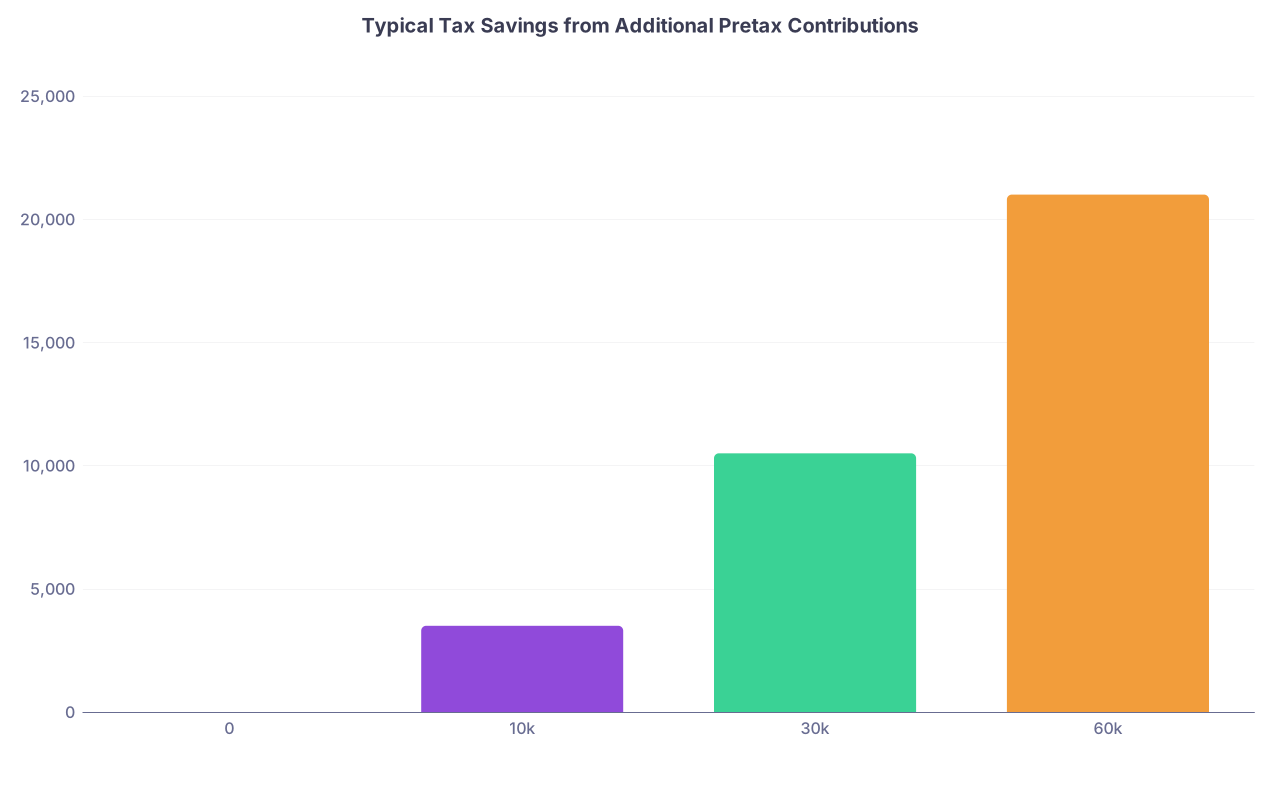
| Category | Value |
|---|---|
| 0 | 0 |
| 10k | 3500 |
| 30k | 10500 |
| 60k | 21000 |
Assuming a rough 35% combined marginal rate, every pre-tax dollar saves you about 35 cents in tax today.
Common scenarios
Employed physician with 401(k)/403(b) and 457(b)
- You can contribute:
- Employee deferral: up to 23k (2024, under 50) across all 401(k)/403(b) plans
- Employer contributions (match, non-elective)
- 457(b) if offered (separate 23k bucket under many governmental plans)
- If you also have an S-corp for 1099 work:
- You can open a solo 401(k), but:
- Your employee deferral limit (23k) is shared across all 401(k)/403(b) plans.
- Employer contribution (profit-sharing) is tied to your S-corp salary, often up to ~25% of W-2 from the S-corp.
- You can open a solo 401(k), but:
- Solution:
- Max employee deferral at the best plan (often hospital with match).
- Use S-corp mostly for employer contribution space.
- Coordinate with a CPA who actually understands multiple-plan rules. Many do not.
- You can contribute:
Pure independent contractor (no W-2 job)
- S-corp or sole proprietor:
- Solo 401(k) with:
- Employee deferral up to 23k
- Employer contribution up to 20–25% of net business earnings / W-2 from S-corp
- Solo 401(k) with:
- High-income physicians can often hit the combined 69k+ limit (2024) quickly.
- S-corp or sole proprietor:
Practice owner with defined benefit / cash balance plan
- If you own a group or run your own practice:
- Consider a cash balance plan layered on top of a 401(k).
- This lets you potentially contribute 100k–300k+ per year pre-tax, depending on age and income.
- Cost: mandatory contributions for employees, actuarial expenses.
- If your group has not at least explored this with a qualified actuary, you are probably burning tax savings.
- If you own a group or run your own practice:
Step 6: Turn Ordinary Income into Better-Taxed Income Where Possible
You will never turn W-2 salary into long-term capital gains. That fantasy dies now.
But you can:
- Channel new business earnings into structures that can generate:
- Qualified dividends
- Long-term capital gains
- Rental income
- Return of capital
Common physician plays

Own your practice building
- Separate “OpCo” (operating practice) and “PropCo” (property company):
- The practice pays rent to your property LLC.
- Practice rent is deductible to the practice.
- Rental income goes to PropCo, often taxed more favorably and potentially eligible for 199A/QBI.
- Done right, you shift some active income into a different, often more flexible, bucket.
- Separate “OpCo” (operating practice) and “PropCo” (property company):
Ambulatory surgery center or imaging ownership
- ASC ownership usually pays:
- K-1 distributions
- Often capital distributions when deals are restructured or sold
- These structures can blend:
- Ordinary income
- Portfolio income
- Capital gains on sale
- The tax efficiency is not automatic. Contract terms and entity design matter.
- ASC ownership usually pays:
Tax-efficient investing
- In taxable accounts, favor:
- Broad market index funds with low turnover
- Municipal bonds in high-tax states (if rates justify it)
- Real estate with depreciation shielding.
- Do not keep high-turnover active funds in taxable accounts if you are already in the top bracket.
- In taxable accounts, favor:
Step 7: Exploit Legitimate Deductions You Are Probably Missing
There is nothing heroic about paying tax on stuff that should have been deductible.
Core business deductions for physicians with 1099/S-corp income:
- CME, boards, conferences
- Licensing, DEA fees, credentialing
- Malpractice premiums (if not covered by employer)
- Telemedicine equipment, EHR costs, tech tools
- Professional subscriptions, journals, specialty societies
- Billing services, accounting, legal fees
- Staff or contractor help (scribe, admin)
Two controversial but usable areas if done correctly:
Home office
- Must be:
- Regular and exclusive use.
- Principal place of business for that income stream.
- For many telemedicine or consulting physicians, this is legitimate.
- For someone who occasionally reads charts at the kitchen table, it is not.
- Must be:
Travel / conferences
- Commuting to your main job is not deductible. Stop trying.
- Travel clearly tied to your independent business can be:
- Flights, hotel, 50% of meals
- Mileage for visiting clients or locums sites
- Adding a day of vacation around a conference does not kill the deduction, but keep records and be reasonable.
Document everything.
The IRS does not need to like your deduction; you just need to be able to prove it.
Step 8: Coordinate Entity, Income, and Family Planning
Here is where it gets more nuanced. You do not restructure income in a vacuum. You structure it around your life.

| Category | W-2 Salary | 1099/S-corp | K-1/Passive |
|---|---|---|---|
| Residency | 70 | 0 | 0 |
| Early Attending | 300 | 40 | 10 |
| Mid Career | 350 | 120 | 80 |
| Late Career | 250 | 80 | 200 |
A few advanced levers:
Spousal employment in your entity
- Pay a spouse a real salary for real work:
- Bookkeeping
- Admin
- Office management
- Why?
- Shift income to a lower-bracket spouse
- Qualify spouse for retirement plan contributions and Social Security credits
- Do it sloppily (fake job, no documentation, inflated pay), and you have a problem.
- Pay a spouse a real salary for real work:
Kids on payroll (narrow use-case)
- Works better for sole proprietor / partnership than S-corp because of FICA rules.
- Only if your kids do legitimate work at a market-appropriate wage.
- You are not paying your 7-year-old 30k to “model” on your website. That is how you end up in an audit story.
Income timing
- Late in the calendar year, if you control timing of bonuses or distributions:
- Delay or accelerate income depending on expected bracket next year.
- Coordinate with:
- RSU/stock vesting if you have corporate side gigs
- Practice buy-in or buy-out timing
- Late in the calendar year, if you control timing of bonuses or distributions:
Step 9: Use a Simple Process – Not Chaos – To Implement All This
You need a process. Not a yearly panic.

| Step | Description |
|---|---|
| Step 1 | January - Set Income Targets |
| Step 2 | March - Meet With CPA |
| Step 3 | June - Midyear Tax Check |
| Step 4 | September - Adjust Salary and Contributions |
| Step 5 | November - Year End Strategy Meeting |
| Step 6 | January - File and Review Results |
Here is a practical protocol that I have seen work well:
Initial setup (once)
- Hire:
- A tax-focused CPA who actually understands physicians.
- An attorney to set up LLC/PLLC and review contracts.
- Form the right entity (LLC or PLLC, elect S-corp if appropriate).
- Open:
- Business checking account
- Business credit card
- Solo 401(k) / practice plan if needed
- Switch 1099 contracts to pay the entity.
- Hire:
Quarterly rhythm
- Q1:
- Review last year’s return with CPA.
- Adjust S-corp salary for expected income.
- Q2:
- Check bookkeeping.
- Pay quarterly estimates.
- Q3:
- Midyear projection: confirm that salary/distributions split still makes sense.
- Q4:
- Finalize contributions (401(k), HSA, DB plan).
- Make any timing decisions on income and big expenses.
- Q1:
Record-keeping
- Use a basic accounting tool (QuickBooks, Xero) or a bookkeeper.
- Keep:
- Separate business and personal accounts. No commingling.
- Receipts (digital is fine) organized by category.
- Corporate minutes / resolutions, especially salary decisions.
Common Mistakes That Kill Tax Efficiency

I see the same errors repeatedly:
- Doing six-figure 1099 work as a sole proprietor with no entity and no retirement plan.
- Electing S-corp status with 20k in net income because “someone on Facebook recommended it.”
- Paying an obviously unreasonable salary (either too low or absurdly high) from the S-corp.
- Having multiple 401(k)s with conflicting contribution rules and no plan coordination.
- Mixing personal and business expenses in one checking account.
- Ignoring state-specific rules about professional entities, franchise taxes, and filing requirements.
- Only talking to a CPA in March, after all the good planning windows have closed.
Avoid these and you are already ahead of most physicians.
When You Need Professional Help (And How to Choose It)
You should not DIY all of this if:
- Your 1099 or practice income is >100k.
- You own part of a surgery center, imaging center, or multi-physician practice.
- You are considering a defined benefit or cash balance plan.
- You are in a high-tax state (CA, NY, NJ, etc.) and are above 400k total income.
What you want:
A CPA who:
- Can explain S-corp salary reasoning without staring at the ceiling.
- Has other physician or professional service clients.
- Talks about planning, not just compliance.
An attorney who:
- Works with professional entities and medical groups.
- Understands anti-kickback, Stark, and state law on physician ownership where relevant.
Ask direct questions:
- “How many physicians do you work with?”
- “How do you typically structure 1099 physician income?”
- “What is your approach to S-corp reasonable compensation?”
If the answers are vague, move on.
Two or Three Moves You Can Make This Quarter
If you want an immediate checklist, this is it:
If you have 30k+ 1099 and no entity:
- Form an LLC/PLLC.
- Open business banking.
- Route new 1099 through it.
- Talk to a CPA about S-corp election timing.
If you already have an S-corp:
- Confirm your salary level is documented and defensible.
- Make sure you are actually running payroll (not just taking draws).
- Check that your retirement contributions are maximized correctly.
If you are a practice owner:
- Ask an actuary about adding or optimizing a cash balance plan.
- Review whether your practice is paying rent to an entity you own (properly structured).
- Get a projection of your 3–5 year tax savings from restructuring.


