

You are four months into attending life.
Your paycheck is finally “real” money. The biweekly deposits look fantastic compared with residency. But something is bothering you.
Last year as a PGY-3 you got a fat refund. You remember the smug little rush when the IRS dropped a few thousand into your checking account. You had been overwithholding for years and never thought about it.
Now your co-attendings are telling you: “Yeah, I owed like $18k last year.”
You open your new paystub. No state withholding (you moved). Federal withholding looks…tiny compared with your gross. You plug some numbers into a free tax calculator and it spits out: “Estimated balance due: $22,000.”
You realize you are living in the classic physician pattern:
- Overwithheld as a resident (big refunds, felt “safe”)
- Underpaying as an attending (creeping toward a big tax bill and maybe penalties)
Here is how you fix it. Systematically.
Step 1: Understand What Actually Happened
Before you change anything, you need a clean mental model.
As a resident:
- You had 1–2 W‑2 jobs.
- Your income was modest relative to physician norms.
- HR usually defaulted you to “safe” withholding, sometimes treating you like a single person with no deductions.
- You had minimal side income and few complicated deductions.
Result: Too much tax was withheld. Big refunds. You thought that meant you were “good with taxes.” It really just meant you gave the government a free loan.
As an attending:
- Your W‑2 income jumped – sometimes doubled or tripled.
- You might have:
- Sign‑on bonuses
- Relocation benefits
- Moonlighting
- 1099 locums or telemedicine work
- HR may have kept your old W‑4 assumptions (or you never updated them).
- Your effective tax rate climbed sharply, but withholding did not keep pace.
Result: Not enough tax withheld. Small or zero refund. Or a nasty surprise balance due.
Here is the core rule you need in your head now:
The IRS does not care whether tax is taken out of your paycheck or paid by you directly. They care that you have paid enough, early enough, during the year.
That is all we are managing.
Step 2: Diagnose Your Current Situation (Resident vs Attending)
You cannot repair what you have not measured. Do a quick diagnostic.
If you are still a resident or fellow
Pull:
- Your last year’s tax return (Form 1040)
- Your most recent paystub
Check:
Last year’s refund or amount owed
- Refund > $1,000? You were overwithheld.
- Owed > $1,000? You were underwithheld.
Effective tax rate
On your 1040:
- Line with “total tax” / AGI = effective tax rate
- Example: $8,000 total tax / $66,000 AGI ≈ 12%
Withholding rate on your paycheck
On your paystub:
- Add up federal income tax withheld for the year so far
- Divide by year‑to‑date gross income
- Example: $6,500 withheld / $50,000 YTD income ≈ 13%
If your withholding rate is significantly higher than your effective tax rate, you are building a refund again.
If you are now an attending (first 1–3 years)
Pull:
- Most recent paystub with YTD numbers
- Last year’s 1040 (if attending last year) or your final resident‑year return
- Any 1099/contract information or estimated income from side gigs
Then answer three questions:
What is your projected total income this year?
Be specific.
- W‑2 base salary (e.g., $320,000)
- Expected bonus (clinical productivity, quality, etc.)
- 1099 income (locums, telemed)
- Other income (spouse, rental, etc.)
How much federal tax has been paid so far?
- From paystub: “Federal income tax YTD”
- From any estimated payments made
- Add them up
Roughly what should your total federal tax be?
Use a physician-oriented calculator or even an online marginal tax bracket table. This does not need to be exact. You want to know if you are on track, or way off.
Once you have rough numbers, you can actually see the gap.
Step 3: Use Safe Harbor Rules so You Do Not Get Penalized
Now the unpleasant part: the IRS does not just want its money by April 15. It wants the money spread through the year.
If you underpay during the year, you may owe underpayment penalties, even if you pay the whole balance by April 15.
To avoid that, you “play the safe harbor game.”
Here are the safe harbor rules for most attendings:
You will avoid underpayment penalties if by the end of the year you have paid at least:
- 90% of your current year total tax, or
- 100% of your prior year total tax (if your AGI last year was <= $150,000), or
- 110% of your prior year total tax (if your AGI last year was > $150,000)
Hey, look – that prior-year safe harbor is your friend in attending transition years.
Example: Resident last year, now attending
- Last year (PGY-3):
- AGI: $68,000
- Total tax: $7,000
This year, as an attending:
- Projected tax might jump to $70,000+
- You can avoid underpayment penalties if by year‑end you have paid at least $7,000 in federal tax during the year.
That is an easy target. Most attendings hit that by March or April through paycheck withholding alone.
Example: Attending last year, still attending this year
- Last year AGI: $320,000
- Total tax: $68,000
This year:
- Prior year safe harbor you must hit: 110% × $68,000 = $74,800 of tax paid during the year
So if you make sure your withholding + estimated payments total at least $74,800 by December 31, you will not owe underpayment penalties. You may still owe extra tax in April if your income jumped, but no penalty.
That is the repair target.
Step 4: For Residents – Stop the Chronic Overwithholding
If you are still in training, your job now is:
- Avoid giving the IRS big interest‑free loans
- Avoid owing meaningful amounts when you become an attending
- Smooth your transition so you do not have to suddenly “learn taxes” in your first attending year
How to fix overwithholding as a resident
Run your numbers with the IRS Tax Withholding Estimator
- Go to IRS.gov and use their “Tax Withholding Estimator”
- Enter:
- Filing status (single, married, etc.)
- Number of jobs (you + spouse)
- Income for each job
- Typical deductions (standard, student loan interest, etc.)
- It will suggest how to adjust your W‑4
Update your W‑4 strategically
Your goal is not some mystical “perfect” withholding. It is to be within ±$1,000 at tax time.
Most residents can:
- Choose “Single” or “Married filing separately” status on W‑4 (more withholding) if they tend to owe
- Or “Married filing jointly” with correct dependents if they have been overwithheld
If you have always gotten $4,000–$6,000 refunds, lean toward less withholding. For example:
- Adjust the W‑4 so you claim appropriate dependents
- Use the estimator’s suggested extra credits
- Consider removing any extra flat amount you have been withholding each paycheck, unless you really want forced savings
Understand that a medium‑sized refund is fine; massive refunds are not
- Refund $500–$1,500 → You are basically on target
- Refund $5,000–$8,000 → You just gave the IRS an interest‑free loan
Set a simple rule: aim for a refund of no more than one paycheck.
Step 5: For New Attendings – Patch the Underpayment Before It Hurts
This is the critical part. You are no longer protected by the “I am a broke resident” excuse.
Your income has jumped. Your tax bill will too. You fix this in two layers:
- Get safe harbor locked in (to avoid penalties)
- Get as close as practical to your actual expected tax
Step 5A: Calculate your gap
Use this simple structure:
- Estimate total federal tax for this year
- Subtract tax already paid (withholding + estimates)
- Decide how much to adjust for the remaining months
Let’s walk a concrete example.
Example: First full attending year
- W‑2 base salary: $350,000
- Expected bonus: $30,000
- 1099 telemed side gig: $40,000 (no withholding)
- Married filing jointly, two kids
You run rough numbers through an online calculator:
- Estimated total federal tax: $90,000
You check your year‑to‑date:
- Federal tax withheld on W‑2 so far: $28,000
- No estimated payments yet
You are in September. 4 months left, 8 paychecks.
Gap:
- $90,000 – $28,000 = $62,000 left to pay this year
Now check safe harbor:
- Last year (PGY-3 + spouse resident): total tax: $12,000, AGI < $150,000
- Prior year safe harbor: 100% of $12,000 = $12,000
You already paid $28,000 via withholding. So safe harbor is satisfied; no underpayment penalty issue. That is good. You can exhale a bit.
But you will still owe ~$62,000 in April if you do nothing. That is the cash flow problem.
So your decision is purely: How much pain now vs. later?
Reasonable plan:
- Increase W‑2 withholding significantly for the rest of the year
- Start quarterly estimates for the 1099 income
- Accept that you might still owe $10k–$20k in April, but not $62k
Step 6: Change Withholding the Right Way (W‑2 Attending)
You repair withholding via Form W‑4 with your employer.
The IRS redesigned W‑4, which confused everyone. Ignore most of the noise. Here is the streamlined approach.
Quick W‑4 strategy for high‑income physicians
On your W‑4:
- Step 1: Fill name/address/filing status correctly
- Step 2: If you or spouse have multiple jobs, use the “multiple jobs” checkbox or online estimator. For most two‑physician couples, checking that box for both jobs is better than pretending it is one simple W‑2.
- Step 3: Dependents – fine to claim your kids; that reduces withholding
- Step 4: This is where you fix the real problem:
- 4(a): Other income (not from jobs) – you can enter your 1099 estimate here, but I find most physicians do better managing 1099 via estimated payments instead
- 4(b): Deductions – usually leave blank if you take the standard deduction
- 4(c): Extra withholding per paycheck – this is your cleanest control knob
So:
- Keep 4(a) and 4(b) simple or blank unless you know exactly what you are doing.
- Use 4(c) to add a fixed dollar amount of extra withholding from every paycheck.
Back to our example
You needed an extra $62,000 this year. Eight paychecks left.
- $62,000 / 8 = $7,750 extra per paycheck
That feels insane. You probably won’t do that. Maybe you:
- Boost withholding by $3,000–$4,000 per paycheck now
- Make an estimated payment or two with savings
- Accept a remaining balance in April
You are in control of the mix. The point is you stop drifting and choose a clear plan.
Step 7: Handle 1099 / Locums / Telemed Income Correctly
This is where I see the biggest disasters. Attending makes $280k W‑2 and adds “just” $50k of 1099 locums. No withholding. April arrives. Surprise $15k+ tax bill.
Here is the simple rule:
Every $1 of 1099 income should have 30–40 cents earmarked for taxes (federal + state + self-employment).
If you are in a high-tax state, lean closer to 40%. In low/no-tax states, 30–35% may be enough.
You have two tools:
- Quarterly estimates (Form 1040-ES)
- Over-withholding via your main W‑2 job
Option 1: Classic quarterly estimates
Quarterly deadlines (for calendar-year docs):
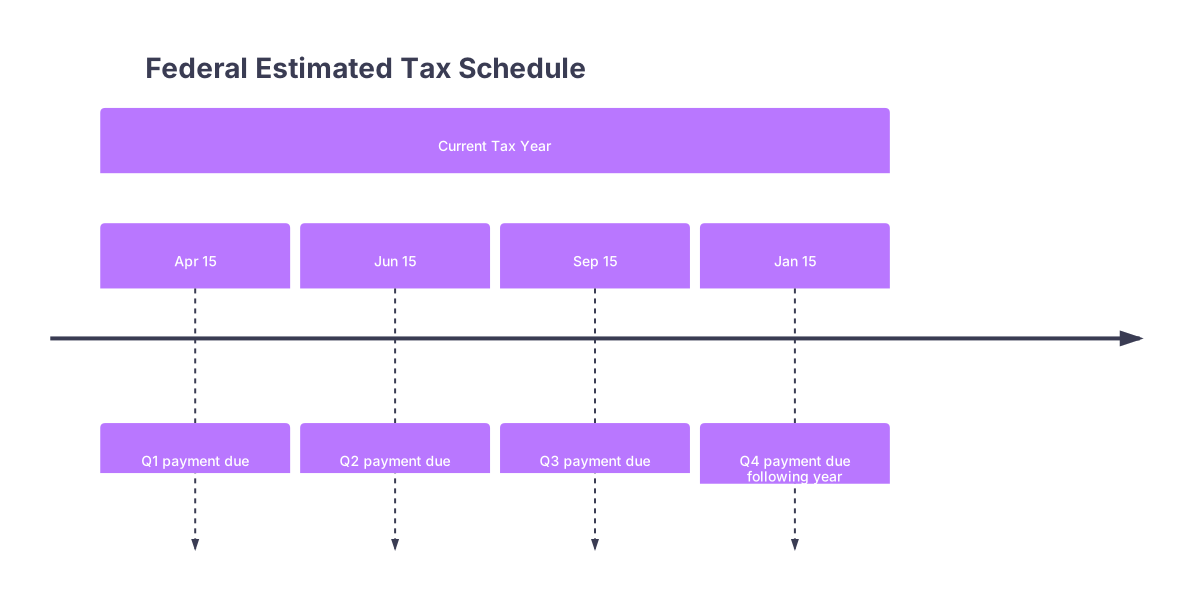
| Period | Event |
|---|---|
| Current Tax Year - Apr 15 | Q1 payment due |
| Current Tax Year - Jun 15 | Q2 payment due |
| Current Tax Year - Sep 15 | Q3 payment due |
| Current Tax Year - Jan 15 | Q4 payment due following year |
If you make 1099 money:
- After each quarter, total your net 1099 income (after expenses)
- Multiply by 30–40%
- Send that as an estimated payment
Rinse and repeat.
Option 2: Use W‑2 over-withholding to cover 1099
The IRS does not care whether tax comes from:
- Paycheck withholding
or - Estimated payments
Withholding is treated as if it were paid evenly over the year, even if it all happens late. That matters. It means you can:
- Skip quarterly estimates by heavily increasing W‑2 withholding in the back half of the year, and still avoid underpayment penalties.
This is incredibly useful for busy attendings who hate quarterly forms.
Example:
- Side 1099 income: $40,000
- Target tax rate on that: 35%
- Tax needed: $14,000
Method:
- Instead of filing 1040-ES four times:
- Increase W‑2 withholding by $1,167/month for 12 months
- Or by $583 per paycheck if paid twice monthly
You behave like the IRS is another monthly bill through payroll rather than a quarterly admin project.
Step 8: Fixing Past Underpayment – When You Already Owe
Sometimes you are reading this too late. You already got the bad news from your accountant:
“You owe $23,000. And $600 in underpayment penalties.”
This is repair, not prevention. Do three things.
1. Stop the bleeding going forward
Immediately:
- Submit a new W‑4 with substantial extra withholding
- If doing 1099 work, start either:
- Quarterly estimates, or
- Extra W‑2 withholding sufficient to cover that income
Set a simple target: do not be in this situation again next April.
2. Cleanly pay what you owe
Do not wait and hope for some miracle. Options:
- Pay from cash or savings
- If you do not have the funds:
- Use a short-term 0% promo balance transfer or personal loan only if you are extremely disciplined and can pay it off inside the promo window
- Otherwise, set up an IRS payment plan directly (they are usually cheaper than random high-interest credit cards and less annoying long-term)
But understand: using consumer debt to pay an IRS bill is a symptom. Your tax planning system is broken. You must fix the system, not just the current balance.
3. Autopsy what went wrong
Sit with your prior year return and:
- Look at total tax
- Look at withholding and estimated payments
- Identify the missing piece:
- Massive 1099 income with no estimates?
- Large bonus with inadequate withholding?
- Spouse’s job not on your radar?
Write this in one sentence you understand:
“I owed $23,000 because _______ was not covered by withholding or estimates.”
That sentence is your new rule for this year.
Step 9: Use Simple Tools and Structures (Not Just Hope)
This is physician tax planning, not rocket design. You do not need exotic strategies. You need a boring system.
Here is a straightforward structure that works for most attendings:
| Component | Purpose |
|---|---|
| Annual tax projection | Sets total tax target |
| Safe harbor check | Avoid penalties |
| W-4 extra withholding | Covers W-2 and some 1099 income |
| Quarterly review | Catch drift and income changes |
| Separate tax savings | Hold money for 1099/bonuses |
1. Annual projection (30–60 minutes once a year)
- In January or February, project:
- W‑2 income
- 1099 income
- Big changes (marriage, kids, home purchase, etc.)
- Use last year’s return as a template
- Or have a CPA do it once; then you just update numbers annually
2. Safe harbor target
- Ask your CPA or check last year’s 1040:
- What was my “total tax” last year?
- Is my AGI > or <= $150,000?
- Compute 100% or 110% safe harbor amount
You now know the “penalty-free amount” you must pay in during the year.
3. W‑4 with extra withholding
Use line 4(c):
- Decide how much extra per paycheck to withhold to:
- Hit safe harbor by year-end
- Get reasonably close to your actual tax
If your income changes mid-year (promotion, new job, spouse starts working), adjust again.
4. Quarterly 15-minute review
Put recurring reminders on your calendar for:
- April 1
- July 1
- October 1
- Early January
On each date:
- Pull latest paystub
- Check:
- YTD income
- YTD federal withholding
- Roughly re-project your total year tax and compare with where you are
If the gap is growing, increase withholding or schedule an estimated payment.
5. Separate “tax bucket” for 1099 income
Open a separate high-yield savings account:
- Every time you get 1099 money, immediately move 30–40% into that account
- Use that account for quarterly estimates or just let it sit and build your April tax payment cushion
This single habit prevents most 1099 horror stories.
Step 10: When to Involve a CPA (and How to Use Them Properly)
You can DIY a lot. But there are clear points where a CPA is not optional anymore. Not if you want to be efficient.
You should hire a tax pro when:
- You have both W‑2 and significant 1099 income
- You own a practice, ASC shares, real estate with partners, or multiple rentals
- You are crossing into high six-figure combined household income with kids, student loans, and business entities
Even if you hire a CPA, you still own the withholding and cash flow decisions. Most CPAs are backward-looking. They file what happened.
You need to force forward-looking conversations:
Here is exactly what to ask:
- “Based on this year’s projection, what is my estimated total federal tax?”
- “How much have I paid so far in withholding and estimates?”
- “What amount of additional tax payments do I need and by when, to be:
- Penalty free (safe harbor), and
- Close to zero in April?”
Then, translate their numbers into:
- A specific extra withholding amount on W‑4
and/or - Specific quarterly estimated payments with calendar reminders
Visual: Resident vs Attending Tax Pattern
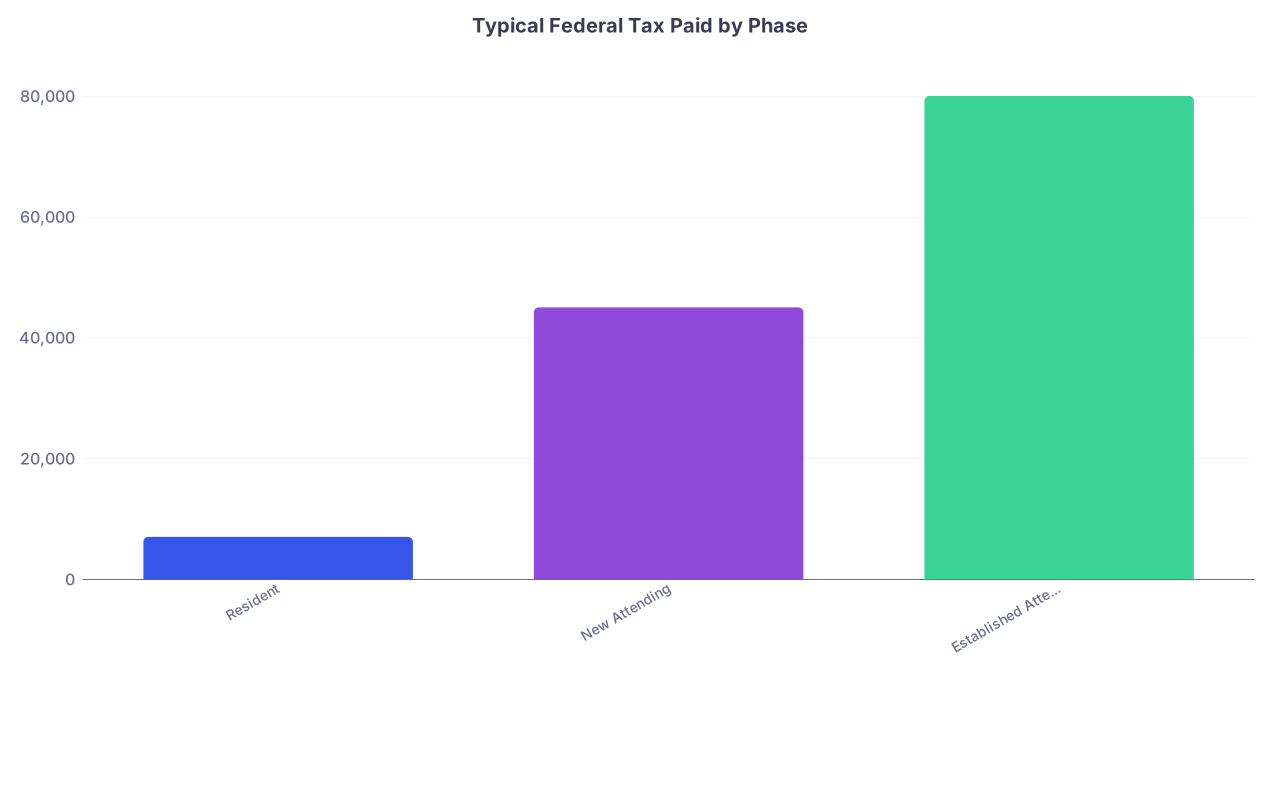
| Category | Value |
|---|---|
| Resident | 7000 |
| New Attending | 45000 |
| Established Attending | 80000 |
This is the pattern you are managing. The tax bill jumps hard. Your systems need to jump with it.
Quick Workflow Summary – Your Repair Plan
Let us put this into one clean flow:

| Step | Description |
|---|---|
| Step 1 | Pull Last Return and Paystub |
| Step 2 | Estimate This Year Income |
| Step 3 | Estimate Total Tax |
| Step 4 | Check Safe Harbor Target |
| Step 5 | Compare Withholding YTD vs Targets |
| Step 6 | Increase W-4 Extra Withholding |
| Step 7 | Schedule Estimated Payments |
| Step 8 | Quarterly Check Ins |
| Step 9 | Shortfall? |
Once you run this loop once or twice, it becomes routine.
The Bottom Line
You went from overwithholding as a resident (big refunds, low risk) to underpaying as an attending (big balances, possible penalties) because your systems never adapted to your income.
Fix it by:
- Knowing your targets – total yearly tax and safe harbor amount.
- Using W‑4 extra withholding and/or quarterly estimates to actually hit those targets.
- Building a simple, repeatable process so every year is boring and predictable, not a tax surprise roulette.


