

The biggest mistake hospital-employed doctors make with a new side LLC is assuming “my CPA will handle it.”
They won’t. Not correctly. Not without clear instructions from you. And the IRS absolutely does not care that this is your “first time doing this.”
Let’s walk through exactly what to do if you’re a W‑2 hospital-employed physician spinning up a side LLC—for consulting, telemedicine, expert witness work, locums, speaking, or any 1099 income.
I’ll treat you like what you are: smart, busy, and slightly allergic to paperwork.
Step 1: Get Clear On What Your Side LLC Is (And Is Not)
You’re already a W‑2 employee. Your hospital pays you a salary, withholds taxes, and issues a W‑2. That world is separate.
Your LLC is for everything outside that employment contract.
Typical side gigs I see doctors run through an LLC:
- Expert witness testimony
- Medical consulting (to startups, pharma, device companies)
- Telemedicine shifts as a 1099 contractor
- Locums work outside your main employer
- Speaking, teaching, or course creation
- Chart review / utilization review
- Coaching / advising
Do not assume it’s OK with your hospital just because “everyone does it.”
Before you touch the tax setup:
- Read your employment contract.
- Look for:
- “Outside activities” or “moonlighting”
- Non-compete / non-solicitation clauses
- Intellectual property language
- If there’s any doubt, get a short email from your employer (or legal) confirming you can do this.
You want your tax setup aligned with reality. If your contract says “no competing clinical work within 20 miles,” then your LLC should not be doing exactly that across the street.
Step 2: Form the LLC Properly (Keep It Simple)
LLCs are a legal structure, not a tax classification. That’s one of the most misunderstood points.
For most hospital-employed physicians starting a side business, the cleanest path:
- Single-member LLC
- In your home state
- Taxed by default as a “disregarded entity” (meaning: on your personal return, Schedule C)
If it’s just you and you’re under roughly $150k–$200k/year in net profit (not revenue) from the side gig, that default setup is usually fine at the beginning.
Do this:
- File the LLC with your state’s Secretary of State (or equivalent).
- Use a simple, boring name: “Smith Medical Consulting, LLC” is fine.
- Use your home address unless you have a legitimate business address.
- Get an Operating Agreement, even if the state doesn’t require it. (Your future self and your CPA will appreciate this.)
Then you’re not done. You’ve created a legal entity. Now you must wire it into the tax system.
Step 3: Get an EIN — Do Not Use Your SSN for the Business
Now you get an EIN (Employer Identification Number) from the IRS. It’s free. Don’t pay some online “service” $75 for five minutes of typing.
Go to the IRS EIN Assistant and:
- Choose “Limited Liability Company”
- One member
- Reason: “Started a new business”
- Responsible party: you
- Use your LLC legal name exactly as filed with the state
Then:
- Save the confirmation letter (CP 575). PDF it and back it up.
- Do not lose it; banks will ask for it. CPAs will ask for it.
Now your LLC exists in the IRS’s world, tied to you as the owner.
Step 4: Decide Your Tax Classification (For Now, Default Is Usually Right)
Right now your LLC, by default, is:
- A “disregarded entity” for federal tax purposes
- That means:
- Income/expenses go on Schedule C of your Form 1040
- You’ll pay:
- Income tax at your marginal rate
- Self-employment tax (Social Security + Medicare) on the net profit
For a hospital-employed doctor just starting a side LLC, this is usually correct at the start.
You’ll hear people say “make it an S‑corp immediately to save taxes.” That’s lazy advice.
Here’s the reality:
- S‑corp election starts to make sense when your net profit (after expenses) is consistently around $75k–$100k/year or more.
- Below that, the extra admin (payroll, separate returns, bookkeeping) often isn’t worth the savings.
If you’re just getting going:
- Use single-member LLC taxed as a sole proprietor (default).
- Revisit the S‑corp idea with a real CPA once your profit level is predictable.

| Category | Value |
|---|---|
| $25k | 0 |
| $50k | 500 |
| $75k | 3000 |
| $100k | 7000 |
| $150k | 12000 |
Those numbers are ballpark and depend heavily on your state, but the shape is right: negligible savings early, meaningful later.
Step 5: Open a Business Bank Account and Draw a Line in the Sand
If you skip this step, the rest of the article is basically wasted.
You need:
- A dedicated business checking account (in the LLC’s name, with the EIN)
- Ideally a separate business credit card (also in the LLC’s name)
Why? Because:
- Every dollar of side income goes into that account.
- Every business expense comes out of that account.
- Your bookkeeping becomes 80% easier.
- If you’re ever audited, this separation makes you look like a professional, not a hobbyist.
Walk into a bank (or open online) with:
- Your LLC approval from the state
- Your EIN letter
- Your driver’s license
Then:
- Link this business account to whatever system you use to receive payments:
- Stripe, PayPal Business, Zelle for Business, direct ACH, etc.
- Do not mix personal grocery, vacations, kid’s tuition out of this account.
You can absolutely pay yourself; just do it as an owner draw (transfer from business checking to your personal checking).
Step 6: Understand How You’ll Actually Be Taxed (No Surprises)
Here’s what will happen the first year you have meaningful 1099 income through your LLC.
You’ll get:
- W‑2 from your hospital (normal)
- One or more 1099-NEC or 1099-MISC forms sent to your LLC’s name/EIN (or sometimes to your SSN if the client is sloppy)
All of that 1099 income:
- Flows onto Schedule C (if single-member LLC, default classification)
- You subtract legitimate business expenses
- What’s left is net profit
- You pay:
- Income tax on that profit
- Self-employment tax (15.3% up to Social Security wage base, then 2.9% Medicare, plus possible 0.9% additional Medicare if you’re high income)
Here’s the part no one tells you: no one is withholding taxes on your 1099 income.
Your W‑2 job handles that for your salary. Your LLC income? Not so much.
So you must:
- Make quarterly estimated tax payments
OR - Increase withholding on your W‑2 job enough to cover your side tax
Doctors screw this up constantly. They roll into April with:
- $60k of side profit
- No estimated payments
- A $20k+ surprise tax bill and maybe penalties
Do not be that person.
Step 7: Set Up Estimated Taxes (Without Overcomplicating It)
If you expect to owe more than $1,000 in tax from your side gig (you will, if you’re doing any real work), you should be making estimated payments.
Simple approach:
- Roughly estimate your total side net profit for the year.
- Multiply by a “safe” blended tax rate. For most specialists in high-tax states, 35–45% isn’t crazy. For hospitalists/PCPs in moderate states, maybe 25–35%.
- Divide that number by four.
- Pay that amount each quarter as estimated tax.
You can do this two ways:
- Method A: IRS Direct Pay
- Go to IRS Direct Pay
- Pay from your personal bank (not the LLC account, to keep things clean)
- Type: “Estimated Tax”
- Apply to the current tax year
- Method B: Increase your W‑2 withholdings
- Ask HR/payroll to increase your federal withholding each paycheck
- This can cover your side income taxes, and IRS accepts it as “safe harbor” if enough is withheld by year-end
Doctors who hate quarterly payments often just crank their W‑2 withholding. That’s fine as long as the math works.

| Step | Description |
|---|---|
| Step 1 | Side LLC Earns Income |
| Step 2 | Deposited to Business Account |
| Step 3 | Track Expenses |
| Step 4 | Calculate Net Profit |
| Step 5 | Set Aside Tax % |
| Step 6 | Adjust Hospital Payroll |
| Step 7 | Pay IRS Quarterly |
| Step 8 | Year End Tax Return |
| Step 9 | No Big Surprises |
| Step 10 | How to Pay Tax |
Step 8: Track Expenses (Without Turning Into a Bookkeeper)
You don’t need to become a full-time accountant. But you do need a system that would make sense to an IRS agent or a CPA.
Bare minimum:
- One business checking account + one business credit card
- Download monthly statements as PDFs
- Maintain a simple spreadsheet or use basic accounting software (QuickBooks Simple Start, Wave, etc.)
Common fully or partially deductible expenses for side LLC doctors:
- Home office (if used regularly and exclusively)
- Part of cell phone and internet
- CME directly tied to your side work
- Licenses, DEA, state fees (if the LLC work uses them)
- Professional liability insurance (coverage for consulting/telemed/locums)
- Bookkeeping, tax prep, legal consults
- Travel for consulting / speaking (flights, hotels, meals)
- Software subscriptions: Zoom, EMR, Dropbox, productivity tools
Red flag to avoid: dumping obviously personal stuff into your LLC to “get a write-off.” The IRS isn’t stupid.
If you buy a laptop you use 90% for LLC work and 10% for personal, that’s reasonably defensible. Your Disney trip as a “marketing expense” because you answered two client emails from the hotel? No.
Step 9: Decide When (And If) To Elect S‑Corp Status
You don’t need this immediately. But you should understand when it becomes relevant.
Your LLC can elect to be taxed as an S‑corporation by filing Form 2553 with the IRS.
Why doctors do this for side gigs:
- Only the “salary” portion you pay yourself is subject to self-employment (payroll) taxes.
- The remaining profit (above your salary) flows out as a distribution—no payroll tax on that part.
- If you’re already maxed on Social Security wages from your W‑2 job, the main savings is on Medicare tax.
Rough rule of thumb:
- Net profit under $75k/year? Usually not worth the complexity.
- Net profit $75k–$150k? Worth modeling with a CPA.
- Net profit >$150k? You should be seriously evaluating S‑corp.
If/when you elect S‑corp:
- You must run payroll to yourself through the LLC/S‑corp.
- You need clean books.
- You’ll file an 1120‑S return for the S‑corp plus your personal 1040.
- You’ll issue yourself a W‑2 from your own company.
Do not DIY this unless you genuinely like tax law and payroll systems. Have a CPA set up the structure and target salary.
Step 10: Coordinate Everything With a CPA Who Actually Understands Physicians
There are CPAs who are great at restaurants. Great at dentists. Great at real estate investors.
You want someone who:
- Understands W‑2 + 1099 mix for physicians
- Understands state-level implications (especially CA, NY, NJ, etc.)
- Knows how to handle:
- 401(k) at the hospital job
- Solo 401(k) or SEP-IRA for the LLC
- Backdoor Roths if you’re high income
When you meet with them, here’s what you say, clearly:
- “I’m a W‑2 hospital-employed physician.”
- “I’m starting a side LLC for [type of work].”
- “I expect [estimate] in gross revenue and [estimate] in expenses this first year.”
- “I want a clean setup with:
- Proper tax classification
- Clear plan for estimated payments
- Advice on if/when S‑corp makes sense
- Guidance on retirement contributions through the LLC.”
You are not asking them, “What should I do?” in a vacuum. You’re giving them parameters and asking for structure.
| Decision Area | Early Stage (Year 1) | Later Stage (Growing) |
|---|---|---|
| Entity Type | Single-member LLC | Same LLC, possible S-corp |
| Tax Classification | Disregarded (Schedule C) | S-corp via Form 2553 |
| Banking | One biz checking, card | Add savings/tax subaccount |
| Tax Payments | Estimates or W-2 bump | Estimates + payroll system |
| Retirement | Maybe solo 401(k) | Solo 401(k) with higher deferrals |
Step 11: Set Up a Simple, Boring System You Can Actually Maintain
If your tax setup requires heroics every month, you will stop doing it. Then the penalties and chaos will show up later.
Here’s a sustainable baseline:
Monthly:
- Download and quickly review your business bank and credit card statements.
- Categorize transactions in your software or spreadsheet.
- Move a fixed percentage (say, 30–40%) of each income deposit into a separate savings account earmarked for taxes.
Quarterly:
- Update your profit estimate.
- Make adjusted estimated payments if needed.
- Review upcoming expenses (CME, conferences, gear) you might want to time within the tax year.
Annually:
- Meet with your CPA between October–December, before year-end.
- Discuss:
- Estimated full-year side profit
- Need for additional prepayments
- Whether next year is S‑corp territory
- Retirement plan optimizations
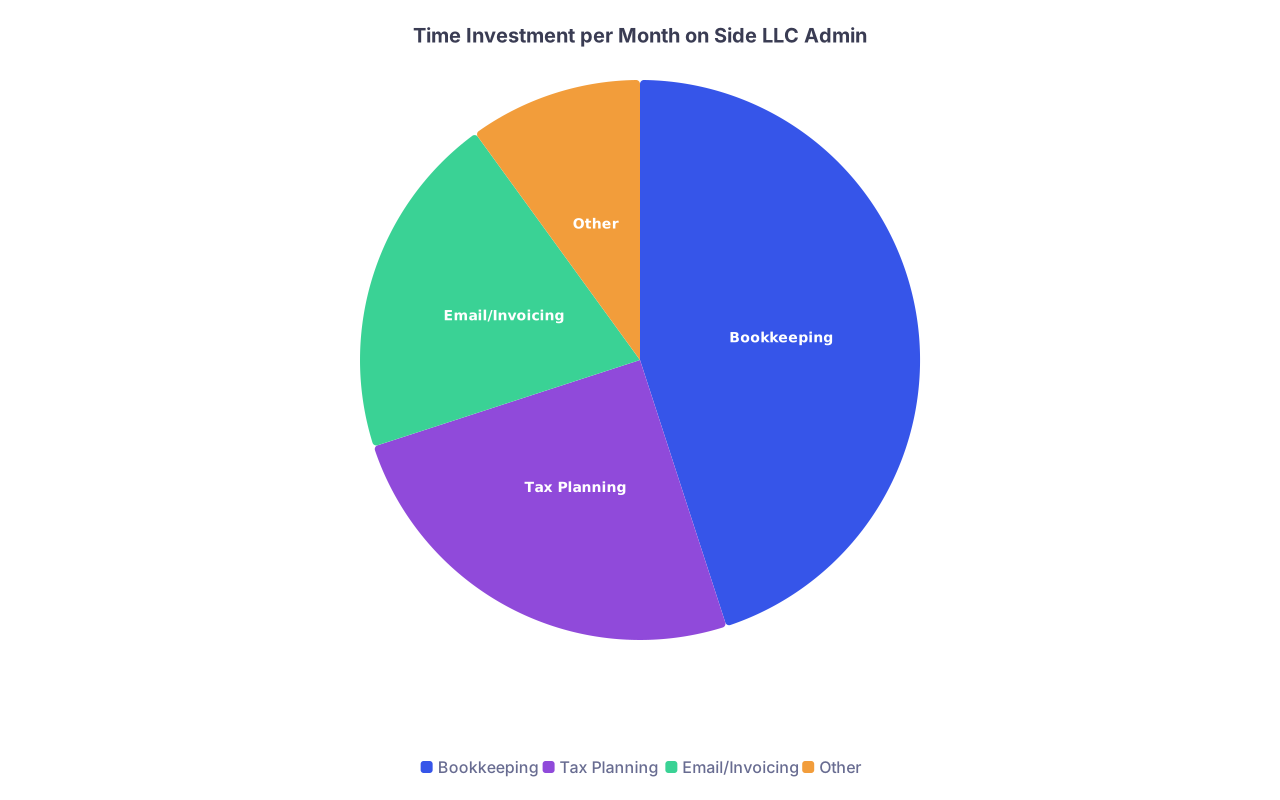
| Category | Value |
|---|---|
| Bookkeeping | 45 |
| Tax Planning | 25 |
| Email/Invoicing | 20 |
| Other | 10 |
If you’re spending more than 2–3 hours a month on admin for a moderate-size side gig, your system is probably overcomplicated.
Step 12: Don’t Ignore State and Local Nonsense
Federal is only half the game.
Check:
- State income tax on your side income (same rate as your other income in most states)
- State-specific LLC fees:
- California: $800 annual LLC fee plus gross receipts fee at higher levels
- New York: publication requirement for new LLCs
- City/local business licenses or taxes (common in some cities)
A 30-minute call with a CPA or local business attorney can save you from missing some obscure $50 license that later turns into a $500 headache.
Quick Recap for the “Just Tell Me What to Do” Crowd
If you’re a hospital-employed doctor starting a side LLC, your basic sequence is:
- Confirm your contract allows side work.
- Form a single-member LLC in your state.
- Get an EIN for the LLC.
- Open a business bank account and run all side income and expenses through it.
- Keep the default tax classification initially (Schedule C).
- Start making estimated tax payments or increase W‑2 withholding.
- Track expenses in a simple, consistent system.
- Talk to a physician-savvy CPA once your net profit gets close to $75k/year to evaluate S‑corp.
- Revisit the structure annually as the side business grows.
Do these and you’ll be ahead of 90% of your colleagues running side gigs out of their personal checking account and hoping TurboTax magically understands what they did.
FAQ (Exactly 5 Questions)
1. Do I really need an LLC, or can I just take 1099 income in my own name?
You can take 1099 income as an individual with no LLC. The IRS doesn’t require an LLC. But the LLC gives you legal separation, easier branding, cleaner banking, and a better foundation if you eventually elect S‑corp status. For most physicians doing ongoing side work, forming an LLC isn’t overkill—it’s the grown-up move.
2. I started my side gig mid-year without an LLC. Can I fix this retroactively?
You can’t retroactively make an LLC exist before you formed it with the state. What you can do is: form the LLC now, start routing all future work through it, and still deduct legitimate business expenses you incurred earlier in the year as a sole proprietor. Your CPA will allocate pre-LLC activity to a Schedule C under your name, and post-LLC activity through the disregarded entity. Messy, but fixable.
3. Can I hire my spouse or kids through my LLC for tax benefits?
You can, but doing this just to “shift income” without real work is how you end up in audit horror stories. If your spouse is truly doing admin work, marketing, bookkeeping, etc., and you document hours and pay a reasonable rate, it can make sense. Hiring minor kids is trickier and often not worth the drama for a small side gig. Don’t get cute here without a CPA’s blessing.
4. Can I contribute to a solo 401(k) if I already have a 401(k) through the hospital?
Yes, but with limits. The employee deferral limit (e.g., $23k under 50, $30.5k over 50 in recent years) is shared across all 401(k)s. You can’t double dip that. However, your LLC (as employer) can still make employer contributions based on your side business profit, up to the overall limit. This is very fact-specific—run the numbers with a CPA or retirement specialist who works with physicians.
5. What happens if I don’t make estimated payments the first year and just “see what I owe”?
You’ll probably owe a painful lump sum in April plus underpayment penalties, especially if your side income is significant. The IRS expects you to pay as you go—either through W‑2 withholding or estimates. If you’re already in that situation, fix it going forward: adjust your W‑2 withholding now and set up a quarterly estimate plan with your CPA so you’re not white-knuckling every April.
Key point 1: Your side LLC is a separate business life; treat it that way with its own bank account, EIN, and record-keeping.
Key point 2: Start simple (single-member LLC, Schedule C), then graduate to S‑corp and more advanced planning only when profits justify the complexity.
Key point 3: Do not ignore taxes until April—build a quarterly system now so the IRS doesn’t become your most stressful “payer.”


