

You get your first out‑of‑state telemedicine license approved on a Tuesday. By Thursday, you’re seeing patients in three different states from the same desk in your apartment. A month later, your accountant says, “We need to talk. You may owe tax in all of those states.” You stare at your laptop and think: “For video visits from my living room? Seriously?”
Yes. Seriously.
If you’re a physician building a multi‑state telemedicine practice, the clinical logistics are actually the easy part. The tax and legal structure is the landmine field. Let’s walk through what you’re actually up against and how to set this up like an adult, not like a side gig that accidentally triggers tax audits in five jurisdictions.
Step 1: Understand Where You “Exist” for Tax Purposes
First thing: for tax, your practice doesn’t just “exist on the internet.”
You exist in at least three ways:
- Your home/base state – Where you physically sit while you click “Start Visit.”
- Every state where your patients are – Because many states claim you’re “doing business” there if you treat their residents.
- States where your entity is formed or registered – Your LLC/PC/PLLC adds another layer.
Most physicians get the first one right and completely ignore the other two. That’s how you end up with ugly back tax notices.
Here’s the general rule of thumb:
- Your income is always taxable in your resident state (where you live).
- Your income is often taxable in each nonresident state where you maintain a license and actively see patients, if you cross that state’s “doing business / nexus” threshold.
- Your entity may also trigger separate state filing obligations (income tax, franchise tax, minimum fees).
If you plan to see patients in 2–3 states, this is manageable with planning. If you’re trying to be “national” out of the gate, expect complexity to explode.
Step 2: Nexus – When a New State Gets to Tax You
“Nexus” is the magic word. It means: when does a state get the legal right to tax your business?
For telemedicine, this usually comes down to:
- Are you licensed in that state?
- Are you regularly treating patients who are physically located there?
- Are you contracted with payers or platforms specifically for that state?
- Do you market to patients there (ads, website pages targeting that state)?
Most states treat you as “doing business” in their state if you’re repeatedly rendering medical services to their residents, even if you never step foot there. One or two one‑off consults isn’t what gets you. Ongoing panels of patients do.
Here’s a quick comparison snapshot:
| State | Typical Trigger for Filing | Extra Gotcha |
|---|---|---|
| California | Very low thresholds; often any consistent revenue from CA patients | Minimum franchise tax for entities |
| New York | Regular telemedicine to NY residents often creates nexus | Aggressive enforcement, complex rules |
| Texas | Franchise tax nexus if gross receipts sourced to TX exceed threshold | Margin tax even with no income tax |
| Florida | No individual income tax; still may have entity requirements | Telehealth registration rules separate from tax |
| Illinois | Regular services to IL patients → nonresident filing | City-level taxes in some locales |
This is not a substitute for your CPA looking up the exact rules. It’s just to make the point: you can’t assume “I’m not physically there, so no tax.”
Step 3: W‑2 vs 1099 vs Your Own Entity – Your Role Matters
Before you worry about 12 state returns, figure out how you’re actually being paid.
Scenario A: You’re a W‑2 telemedicine employee
Example: You work for Teladoc, Amwell, or a hospital system, receiving a W‑2.
- The employer controls most multi‑state tax obligations.
- They withhold state tax where they have decided you work and/or where they allocate your wages.
- Your risk:
- Under‑withholding for your resident state (e.g., you live in CA, they withhold in TX only).
- Unclear multi‑state reporting if they allocate wages across states in a way that doesn’t match your situation.
What you do:
- Confirm with HR/payroll:
- What state(s) are they reporting your wages to?
- Are they treating you as working solely in your home state or allocating by patient locations?
- Coordinate with a CPA in your resident state to check if:
- You owe additional tax because withholding is too low.
- You must file nonresident returns in any other state based on how the employer reports your income.
Scenario B: You’re a 1099 independent contractor
This is where most headaches live.
If you’re getting a 1099‑NEC from a telemedicine company, a group, or multiple payers:
- You are the business.
- You are responsible for:
- Federal income tax
- Self‑employment tax
- Quarterly estimated payments
- Multi‑state tax filings and registrations (if applicable)
If the 1099 shows you earning $200,000 and you’re seeing patients in 5 states, each state may claim a piece of that, depending on nexus rules and sourcing.
Scenario C: You formed an LLC/PLLC/PC/S‑Corp
Good news and bad news.
- Good: May lower federal tax via S‑Corp strategies, better deductions, separation from personal liability (to some extent).
- Bad: You now have entity‑level filing obligations in one or more states:
- State income tax or franchise tax
- Annual reports
- Registered agent fees
- Possible foreign entity registration in each state where you do business
Do not form entities in multiple states blindly “for asset protection” or “because some blog said Wyoming is best.” You’ll just pay more to accountants and states with zero real benefit.
Step 4: Sourcing Income – Which State Gets How Much?
You need a method to decide how much of your income belongs to each state. You don’t guess. You pick a rational, documented method.
For telemedicine, common approaches:
Patient‑location method
You allocate revenue to the state where the patient is physically located during the visit. This is usually the cleanest and most defensible for clinical work.Single‑state home office method
If you only see patients from one state but your visits technically include a few out‑of‑state scenarios, your CPA might keep it simple and treat everything as from your home state, unless there’s clear nexus elsewhere.Platform‑location confusion
Some telemedicine platforms route payments through multiple affiliates. If your 1099 comes from a corporate entity in a specific state, that doesn’t automatically mean your income is “from” that state, but it can complicate reporting.
If you’re serious about multi‑state telemedicine, you should be tracking:
- Number of visits per state
- Revenue per state (ideally)
- Time per state if that ever matters for apportionment
Use a spreadsheet if you have to. Better if your EMR or telehealth platform can pull reports by patient state.
Step 5: Compliance Checklist – Before You Add Another State
Before you add your third or fourth telemedicine state, stop and do this like a professional.
1. Define your resident state and base
Where do you actually live most of the year, where’s your main home, drivers license, voter registration? That’s your resident state. They get to tax all your income, period.
Everything else is layered on top of that.
2. Clarify how you’re paid
- W‑2?
- Get a year‑to‑date paystub and see what states are listed.
- 1099?
- Gather all contracts.
- Verify the payer entities and their states.
3. Map where your patients are
List each state where:
- You hold a medical license or telemedicine registration.
- You have actually seen patients in the last 6–12 months.
- You plan to expand in the next year.
Then rank them by volume. If 90% of your patients are in two states and 10% scattered across five, you plan differently than if it’s evenly spread.
Step 6: When You Actually Have to Register and File in Another State
This is where a telemedicine‑savvy CPA or attorney pays for themselves.
At a high level, for each additional state where you have real patient volume, you may need:
Nonresident individual income tax return
You file as a nonresident, report income sourced to that state, pay tax on that slice.Business/Entity registrations
- Foreign entity registration (if your LLC/PC is formed elsewhere but “doing business” in that state).
- State tax ID number.
- State payroll registrations if you pay yourself wages from an S‑Corp, or have staff there.
Franchise or margin tax returns Some non‑income‑tax states (like Texas) still have business taxes.
Why this matters: your home state will usually give you a credit for tax paid to other states on the same income. That avoids double taxation. But if you don’t file in those other states, your home state still taxes everything. Then later if another state comes knocking, you can get stuck.
Step 7: Practical Structures That Actually Work
Let’s walk through a few real‑world style setups.
Setup 1: Solo doc, 2‑state telemed, 1099, based in a high‑tax state
- You live in California.
- You see patients in CA and Arizona.
- You’re paid 1099 by a platform.
What I’d usually tell you:
- Form a PLLC/PC or LLC taxed as S‑Corp in CA (not in some other random state).
- Treat your income as:
- CA‑sourced for CA patients.
- AZ‑sourced for AZ patients.
- File:
- CA resident return (all income, minus credit for any AZ tax).
- AZ nonresident return for the AZ portion.
- CA entity return + CA minimum franchise tax.
- AZ entity filings only if your practice volume there is meaningful and you clearly have business nexus.
If AZ volume is tiny? Your CPA might reasonably decide to treat it all as CA‑sourced until you cross a meaningful threshold. Not perfect, but reality.
Setup 2: Doc in a no‑income‑tax state, multi‑state telemed
- You live in Florida or Texas.
- You’re licensed in 6–8 states.
- You see large volumes across multiple states.
You don’t get a free ride just because your home state has no income tax.
- You still owe nonresident returns in states where you have significant patient volume and nexus.
- But you don’t ever owe tax to Florida/Texas (for individual income), so there’s no home‑state credit to coordinate.
Your priority:
- Decide which states are “major” vs “minor.”
- Register the entity only where necessary; don’t blindly foreign‑register in all 8 states.
- Use good tracking to allocate revenue by patient state.
- Budget for several state returns each year; this is just part of the business model.
Setup 3: W‑2 telemed job plus your own 1099 telemed side gig
This is very common now.
- W‑2: employer handles most state allocations.
- 1099 side gig: you’re on the hook.
You should:
- Separate books and tracking for each.
- Make sure payroll withholding on your W‑2 job is enough to broadly cover your resident state tax and maybe some federal but do not let that blind you. Your 1099 income requires quarterly estimates.
- Your nonresident state filings may combine both W‑2 wages sourced there and 1099 income sourced there, depending on where you’re treating patients.
Step 8: Sales Tax, Use Tax, and Other Weird Stuff
Physicians generally don’t deal with sales tax on professional services. But with telemedicine, some odd edges show up:
If you sell devices, supplies, or digital products (e.g., DME, at‑home test kits, paid digital courses), you may trip:
- Sales tax in some states.
- Economic nexus thresholds based on revenue or transaction count.
Certain local jurisdictions (think New York City, some Ohio cities, some PA localities) might have local income or business taxes beyond the state.
You can avoid most of this by keeping your practice tight: clinical services only, no retail commerce, no “bonus” product lines until you’ve got the tax structure fully dialed in.
Step 9: Documentation That Will Save You Later
If you’re running multi‑state telemedicine, assume you’ll eventually have to prove what you did where. Don’t rely on memory.
You want:
- Telemedicine platform reports:
- Date, time, patient state, and charge for each visit.
- Separate revenue summaries by state each month.
- Copies of all telemedicine contracts, marked with:
- State coverage.
- Payment terms.
- Any mention of tax obligations.
- Written notes with your CPA or attorney:
- The allocation method you’re using.
- When you decided a state crossed the nexus threshold.
- When you registered or chose not to register in each state.
If a state later challenges your filing position, you want to show: “Here’s the consistent, reasonable methodology we used, and here’s the data.”
Step 10: When to Bring in Professional Help (and What to Ask)
If you’re serious about telemedicine across multiple states and expect >$100k from it, you need a tax pro who isn’t winging this.
Look for:
- A CPA or EA who:
- Works with physicians or healthcare entities.
- Has explicit multi‑state experience.
- A healthcare attorney for:
- Corporate practice of medicine rules.
- Proper entity structure (PC/PLLC/MSO, etc.).
Questions to ask your CPA:
- “Given my licenses and patient locations, which states do you think I clearly have nexus in right now?”
- “What’s your recommended method for allocating my income across states?”
- “At what volume or threshold should we register the entity as a foreign LLC/PC in another state?”
- “How many state returns do you realistically think I’ll need this year?”
- “Can you help build a simple tracking sheet or system I can maintain monthly?”
If the CPA says, “Telemedicine is just like any other remote work, we’ll just file in your home state,” and you’re actively seeing hundreds of patients in other states—find a different CPA. That’s lazy and it’s going to bite you.
A Quick Visual: Growth vs Complexity
Here’s what usually happens as telemedicine expands:
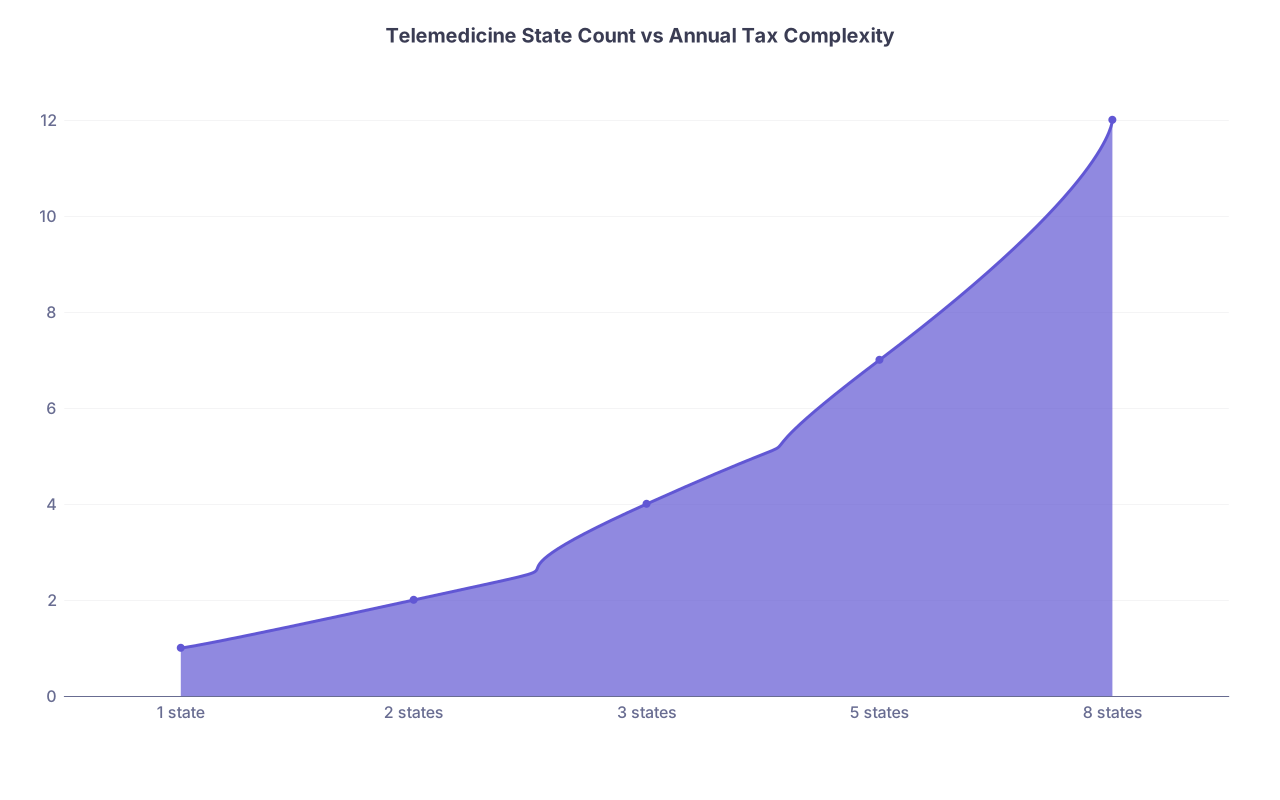
| Category | Value |
|---|---|
| 1 state | 1 |
| 2 states | 2 |
| 3 states | 4 |
| 5 states | 7 |
| 8 states | 12 |
Point is simple: each extra state increases complexity more than you think. Don’t scale your licensing faster than you scale your tax and legal structure.
Common Avoidable Mistakes
I see the same errors over and over:
- Assuming “no physical presence” means “no tax” – that ship sailed years ago.
- Forming an LLC in Wyoming/Delaware/Nevada “to save taxes” while living in a completely different high‑tax state and doing all work there. Useless.
- Never filing nonresident returns even when 30–40% of patients are in another state with clear nexus.
- Not making quarterly estimates for 1099 income and getting blasted with penalties.
- Mixing W‑2 and 1099 activity with no tracking by patient state.
- Waiting 3–4 years until a state notice shows up, at which point you owe multiple years of back tax, interest, and sometimes penalties.
You don’t need to be perfect. You do need to be intentional and consistent.
How to Phase This In Without Going Crazy
If you’re just starting:
Year 1: Keep it tight.
- One main state, maybe a second.
- Clean entity structure in your home state.
- Start tracking by patient state from day 1.
Year 2: Add 1–2 more states max.
- Only if the payer mix and reimbursement justify the added complexity.
- Have your CPA re‑evaluate nexus and filing requirements.
Year 3+: Consider an MSO or more advanced structure if you’re building a real multi‑state group practice.
- Different conversation.
- You’re managing other clinicians, not just your own panel.
Final Takeaways
Multi‑state telemedicine isn’t just “more licenses.” It’s more tax homes, whether you like it or not.
If you remember nothing else, remember this:
- Your resident state always taxes all your income; other states get a slice when you create nexus by treating their patients.
- Track your patient locations and revenue by state from the start; guessing later is a good way to lose money and sleep.
- Do not expand your telemedicine footprint faster than your tax and legal structure—and your CPA—increase their sophistication.


