

It’s June 30. You just finished med school across the country, stuffed your life into a Honda Civic, and drove to a new state for residency. Your badge is ready, your pager works, your EMR login is (sort of) set up.
Then you get an email from HR about tax withholding and “state residency declarations.” Your old landlord asks for a forwarding address. Your parents are asking if they can still claim you as a dependent. And you have this sinking feeling: my income is about to triple, I’m in a different state, and I have no idea what that means for my taxes.
This is that article. The “I just matched and moved states; what do I actually do about tax residency” article.
Let’s walk through what you’re actually up against and how to avoid dumb, expensive mistakes.
Step 1: Understand What “Tax Residency” Actually Means
Forget the medical definition of “resident.” For taxes, “resident” means something very specific and very state-dependent.
Every state has its own rules, but they mostly boil down to two ideas:
- Domicile – your true, permanent home. Where you intend to return when you’re away.
- Statutory residency / physical presence – where you actually are and how long you’re there.
For federal taxes, there is no concept of “state residency.” The IRS doesn’t care which state you live in for your federal return. That’s a state-level fight.
For states, the game is:
- Your domicile state usually gets to tax your worldwide income.
- Any state you work in usually gets to tax the income earned there.
- If those are different, you end up filing multiple returns and using credits to avoid double taxation.
You, as a brand new PGY-1 who just moved states, are caught in between:
- First half of the year: med student in State A (maybe with a little income).
- Second half: resident physician salary in State B.
- Both states think they have a claim on you for part (or all) of the year.
The question is: who gets to call you “theirs” for tax purposes in this transition year?
Step 2: Figure Out Your Timeline – This Year Is Split
If you moved for residency mid-year (like June/July), this calendar year is messy. Next year will be much easier.
You need a simple timeline:
- From Jan 1 to your move date → You lived where? Worked where? Any income?
- From move date to Dec 31 → You lived where? Worked where? Income (your residency pay, maybe moonlighting)?
Put it on paper. Literally. Dates and locations. It matters for “part-year residency” returns.
Now, here’s the key concept:
You will probably be a part-year resident in both states this first year.
Example:
- Med school in California, matched in Texas.
- Moved July 1.
- Before July 1: CA resident, maybe a little 1099 side work, some W-2 tutoring, etc.
- After July 1: living and working in Texas, TX does not have state income tax.
Your filing likely looks like this:
- California: part-year resident return (taxed on all income while you were a CA resident + any CA-sourced income for the rest of the year, if any).
- Texas: no state return at all, because TX doesn’t have income tax.
Now change Texas to New York. Whole different ballgame.
Step 3: Identify Your Domicile – Did It Actually Change?
A huge mistake I see: residents assuming their domicile “auto-changed” the day they moved. It didn’t.
States care about intent + facts.
Domicile is:
- Where’s your driver’s license?
- Where are you registered to vote?
- Where is your car registered?
- Where’s your primary bank address and mailing address?
- Where did you file as a resident last year?
- Where do you say you intend to return long-term?
If you:
- Keep your driver’s license from State A
- Keep voting in State A
- Keep a lease or permanent home in State A
- Tell schools/banks you live in State A
…State A can argue “You never left. You just went to State B temporarily for training. We still own you.”
That can mean:
- You’re taxed as a full-year resident in State A (worldwide income)
- And a nonresident/part-year in State B (on income earned there)
- Then you have to use credits to fix double taxation
Is that always bad? Not always. But often, yes, especially if State A has a high income tax and State B is low or zero.
If you actually want to change domicile to your new residency state, you can’t just move. You have to act like it.
Step 4: Decide Your Strategy – Stay Domiciled in Old State or Switch?
Let me be blunt: some people strategically keep or switch residency for taxes. States hate it. But it’s reality. As a physician, you should at least understand the options.
You’re usually choosing between:
- Keep old domicile (State A) and treat residency as “temporary.”
- Formally change domicile to new residency state (State B).
Which is better? Depends on the states. Here’s a quick comparison.
| Scenario | Old State Tax | New State Tax | Hassle Level |
|---|---|---|---|
| Old high-tax → New no-tax (CA → TX) | Bad | Good | Medium |
| Old no-tax → New high-tax (TX → NY) | Good | Bad | Medium |
| High-tax → High-tax (CA → NY) | Roughly similar | Roughly similar | High |
| No-tax → No-tax (TX → FL) | Neutral | Neutral | Low |
If your new state has no income tax (TX, FL, WA, TN, NV, WY, SD, AK):
- Changing domicile to the new state usually lowers your overall state tax.
- You probably want to cut the old state’s claim as fast as possible.
If your new state has higher tax than your old:
- You may try to keep your old domicile for certain purposes.
- But if you’re physically living and working full-time in the new state, eventually they will win the argument.
Here’s the unpleasant truth: most residents are functionally stuck with the new state’s tax on their salary, because that’s where the work is done. Domicile jockeying mainly changes how much claim your old state has, not whether your new state taxes your residency paycheck.
Step 5: Actions to Take in Your First 30–60 Days
Enough theory. You’re tired, you’re on nights, and you just want a checklist.
Here’s what you actually do.
1. Fix Your Withholding at the Hospital
Your GME office will have you fill out:
- Federal W-4
- Possibly a state withholding form (some states have their own)
Make sure:
- The state on your W-2/paystub matches where you’re physically working, not your parents’ address.
- If you’re in a no-income-tax state, confirm they’re not mysteriously withholding for your old state because of some HR default.
You do not want to discover in March that 2% of every paycheck went to the wrong state.
2. Decide and Document Your Domicile Story
You don’t have to file anything labeled “domicile form,” but you do need a consistent story backed by actions.
If you are switching domicile to your new state, do this as soon as you reasonably can:
- Get a new driver’s license / state ID in your residency state.
- Register to vote in your new state; unregister / update from the old.
- Update your address with: banks, credit cards, loan servicers, insurance, medical boards, the IRS.
- Register your car in the new state (or at least know the rules; some states are aggressive).
- Change your mailing address officially—USPS, med school, professional societies.
If you intend to keep your old domicile (common if your new state is worse tax-wise and your ties are strong at home), you need to still be careful:
- Don’t get sloppy and accidentally create strong domicile ties in the new state (e.g., new voter registration, long-term home purchase, etc.).
- Understand your old state will expect a full-year resident return and might question things if your address jumps around.
3. Track Where Your Income Is Coming From
You might have:
- Residency W-2 from State B hospital
- Small 1099 tutor income from State A before the move
- Maybe a one-off PRN shift in a third state
You want a simple note:
- “Jan–Jun: 1099 from CA, remote, lived in CA.”
- “Jul–Dec: W-2 from NY hospital, lived in NY.”
When you file, your software or CPA will ask: “How much income was earned while you were a resident of [State]?” If you guess, you’ll make mistakes.
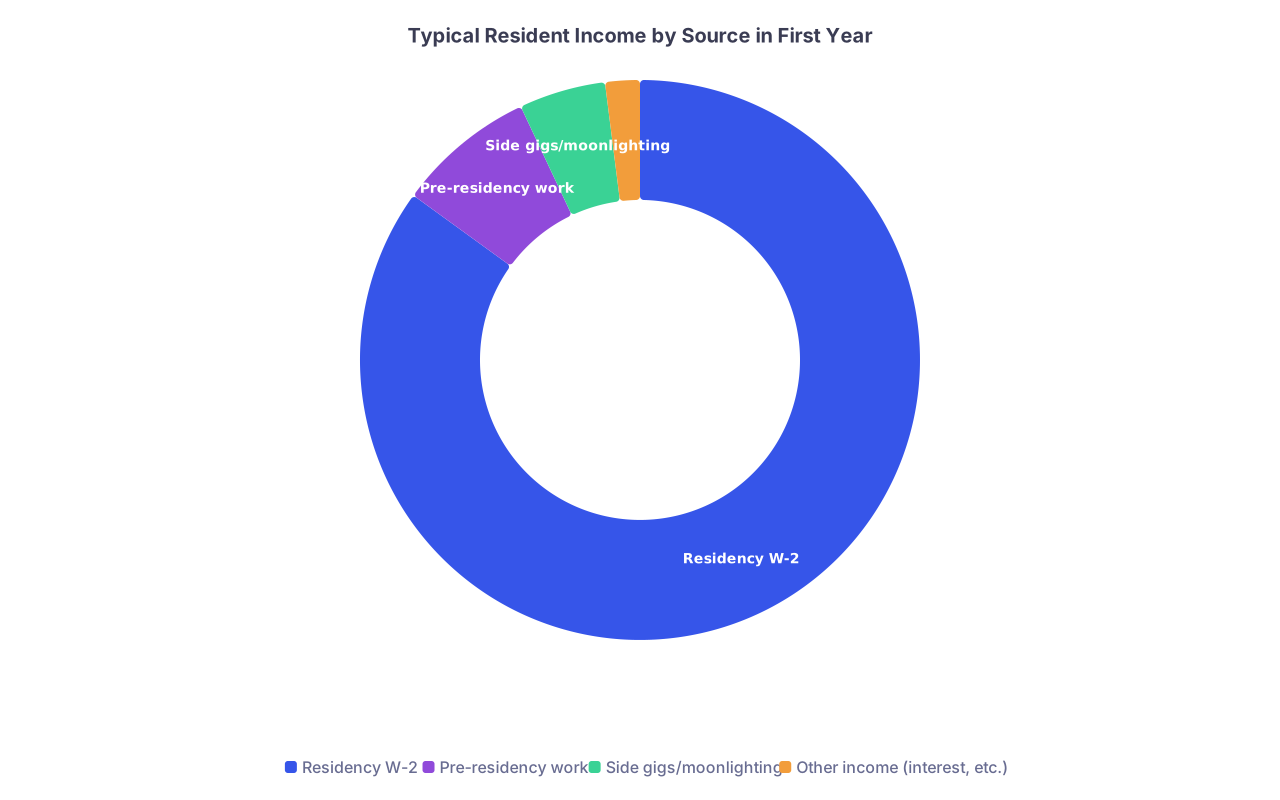
| Category | Value |
|---|---|
| Residency W-2 | 85 |
| Pre-residency work | 8 |
| Side gigs/moonlighting | 5 |
| Other income (interest, etc.) | 2 |
Step 6: How the Actual Tax Returns Will Look
Let’s walk through a simple but realistic scenario.
You:
- Lived and studied in Illinois (IL) Jan–June
- Matched in California (CA), moved July 1
- Little bit of IL W-2 income in the spring, then CA residency pay July–Dec
- You fully intend to stay in California after training
Your year one returns will likely be:
- Federal 1040 – one return, everything goes here
- Illinois part-year resident return – taxes IL-source income and any income while IL resident
- California part-year resident return – taxes CA-source income and your income while CA resident
No credits between IL and CA are needed if each state only taxes “its” portion of the year. If one state claims more, then you look at credits for taxes paid to other states.
Now, swap it:
You move from CA (high tax) to TX (no income tax), and you fully cut ties with CA. If done cleanly:
- Federal 1040 – same
- CA part-year – only until move date; after you’re out, CA should not claim TX salary as CA income
- TX – no return
The timing of when you severed ties (license, lease, voter reg) can matter if CA audits.
Step 7: Watch Out for These Traps Residents Fall Into
I’ve watched residents mess this up and write unnecessarily big checks later. Avoid these.
Trap 1: Letting Old State Keep You as a “Resident” by Default
If your parents’ address is still on everything, your driver’s license is old, and you vote absentee from home—your old state can credibly say: you never left.
Then:
- Old State: “You are a full-year resident. Pay us on all your income.”
- New State: “You work here, so pay us on that income too.”
Yes, there are credits. No, they’re not always clean or perfect. And audits are a time suck.
Trap 2: HR Withholds to the Wrong State
I’ve seen:
- A resident in Pennsylvania with withholding going to New Jersey because their permanent address said NJ.
- A New Yorker being withheld for New York even after moving to Connecticut for residency (and working exclusively in CT).
Fix the state on your HR/payroll profile. Don’t assume they got it right.
Trap 3: Multi-State Moonlighting Chaos
By PGY-2 or PGY-3, some of you will moonlight:
- Telemed in multiple states
- Weekend urgent care in a nearby state
- Locums-style shifts somewhere else
Each state may require:
- A nonresident return for that moonlighting income
- Coordination of credits with your domicile state
If you’re going to get cute with multi-state income, get a CPA who actually understands physicians, not your cousin who “does TurboTax for fun.”
Trap 4: Letting Your Parents Claim You When You’re Clearly Independent
This isn’t residency per se, but it ties into tax residency and dependency status.
If:
- You’re making $65K as a PGY-1
- You’re not living at home
- You’re paying most of your own support
Your parents probably can’t legitimately claim you as a dependent anymore. Some try anyway. That can mess with:
- Your standard deduction
- Your education credits or loan interest deduction
- Their state returns (if your domicile stories don’t match)
Have an adult conversation with them. Show them the IRS support rules if necessary.

| Step | Description |
|---|---|
| Step 1 | Moved for Residency |
| Step 2 | Update records to new state |
| Step 3 | File part year in old state only |
| Step 4 | Switch license vote mailing |
| Step 5 | Part year old state and part year new state |
| Step 6 | Keep old domicile |
| Step 7 | Full year old state return plus nonresident new state return |
| Step 8 | New state has income tax |
| Step 9 | Change domicile? |
Step 8: When You Should Absolutely Get a CPA
You can DIY a simple two-state year with software, but there are situations where you’re playing with fire if you wing it.
You should strongly consider a CPA (preferably one who regularly works with physicians) if:
- You moved from or to a very aggressive tax state like CA, NY, NJ, MA, MN.
- You’re in a no-income-tax state but still have ties to a high-tax state.
- You moonlight in more than one state.
- You’re married and your spouse’s income is in a different state than your residency program.
- You own rental property or a small business entity (LLC, S-corp) in another state.
Cost for a competent CPA handling a multi-state resident: maybe $400–$1,000. On a $60–$75K income, that feels steep. But if they prevent a multi-thousand-dollar mistake or years of fighting with a state, it’s a bargain.
Practical way to select:
- Ask upper-year residents at your program: “Who do you use for taxes?”
- Prefer someone who can say: “Oh yeah, I have 40 residents from your hospital as clients.”
Step 9: Quick State-Specific Gotchas (High-Level)
I’ll keep this short, but if you’re crossing these borders, pay extra attention.
- California: Very aggressive on domicile. If you appear to keep ties, they treat you as full-year. Document your exit if you want out.
- New York: Has a statutory residency test (183 days + permanent place of abode). If you spend enough time and have an apartment, they may call you a resident even if you “claim” another domicile.
- New Jersey / Connecticut / Pennsylvania: Lots of cross-border commuters. If you’re in this triangle, don’t DIY blindly.
- No-income-tax states (TX, FL, WA, TN, etc.): Great, but they don’t override others. Your old state can still claim you if you don’t sever ties.
Step 10: A Simple Playbook You Can Follow
If you’re too tired to remember anything else, do this:
Right after you move
- Update HR with your actual living address in the new state.
- Check your first paystub: is state withholding going where you now work?
Within 1–2 months
- Decide: do I intend to make this new state my home (for now)?
- If yes: change your driver’s license, voter registration, car registration, mailing address, and major accounts to the new state.
- If no: understand your old state will tax you as a resident; be consistent.
All year
- Keep a simple note of where you earned what income.
- Avoid random extra-state jobs without understanding tax consequences.
Next tax season (spring)
- Expect to file: 1 federal + 2 states (most likely both part-year, or one part-year + one nonresident/full-year).
- If you’re crossing high-tax states or doing anything more complex than one W-2, strongly consider paying for a CPA the first year. Learn from them, then decide if you DIY later.
Do this and you’re already ahead of most of your co-interns.
FAQs
1. I moved from a no-tax state (Texas) to a high-tax state (New York) for residency. Can I just keep my Texas residency for taxes?
You can’t “just decide” you’re still a Texas resident and ignore New York. NY will tax the income you earn while physically working there, period. That’s non-negotiable.
What you are playing with is domicile. If you keep strong ties to Texas and minimal ties to New York, you might argue TX remains your domicile. But if you:
- Rent an apartment in NY
- Live there most of the year
- Get a NY license and register to vote there
New York has a strong case you’re now a NY resident. They love that. Because then they tax your full income, not just NY-source.
Short version: NY will tax your residency paycheck either way. The question is whether any other state (like TX—no tax anyway) has a competing claim. For you, the big risk is NY calling you a full-year statutory resident with no way out. So get a CPA if you’re trying to be cute.
2. I only had loan refunds and no real income in my old state before moving. Do I still have to file a return there?
Maybe not. Most states have minimum income thresholds below which you don’t have to file. Many MS4s don’t meet that threshold in their last semester if they had no job.
But:
- If you had any W-2 or 1099 income in that state, check the state’s filing requirements.
- If state tax was withheld, you might want to file just to get a refund, even if you’re not required to.
If your “income” was purely federal loan disbursements and you didn’t work and no state tax was withheld, usually you won’t need a state return for that pre-move period. Always verify with that state’s rules, but in practice, many residents have a “clean cutoff” like this.
3. Can I change my tax residency mid-year, or do I have to wait until January 1?
You can change domicile any day of the year. There’s no magic January 1 rule. States care about facts:
- When did you move?
- When did you get a new driver’s license?
- When did you sign a lease or buy a home?
- When did you update your voter registration?
Your tax returns just split the year accordingly. That’s literally what “part-year resident” returns are for. So if you moved on July 1 and did all the domicile steps in July, most states will accept July 1 as your change date, and you’ll file:
- Old state: resident until June 30, maybe nonresident for any later in-state income.
- New state: nonresident until June 30, resident from July 1 onward.
The key is consistency and documentation.
Key takeaways:
- First year of residency in a new state = expect multi-state tax filings and make a clear decision about your domicile, then back it up with actions.
- Fix your payroll withholding and legal ties (license, voter reg, address) within the first couple months; this prevents 90% of headaches.
- If your move involves high-tax states, multi-state income, or a spouse with income elsewhere, do not be a hero—pay a CPA once, learn the system, and avoid expensive mistakes.


